


Refine your search for walks in Châtas
Châtas walks
 The Fontenelle National Necropolis and the hamlets that fell for France
 Visorando Member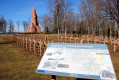
 3.85 mi
 +341 ft
 -367 ft
 2h 05
2h 05
 Easy
Easy
 Departure from Ban-de-Sapt (Vosges)
The Fontenelle National War Memorial is a major site commemorating the Vosges Front during the First World War. This route passes through hamlets that no longer exist, of which only a sign remains today to indicate their former existence.
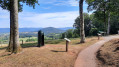
The Fontenelle site - The National Necropolis and Cote 627
 4.66 mi
+830 ft
-827 ft
2h 50
Easy
Departure from Ban-de-Sapt (Vosges)
4.66 mi
+830 ft
-827 ft
2h 50
Easy
Departure from Ban-de-Sapt (Vosges)
The walk takes you through the Fontenelle site and its surroundings, which were the scene of fighting during the First World War.
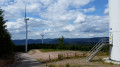
The Bois de Belfays Wind Farm (long version)
 8.68 mi
+1,417 ft
-1,398 ft
5h 15
8.68 mi
+1,417 ft
-1,398 ft
5h 15
 Moderate
Departure from Ban-de-Sapt (Vosges)
Moderate
Departure from Ban-de-Sapt (Vosges)
A walk offering a close-up view of the wind turbines at Bois de Belfays. In this longer version, you reach the wind farm via Pré Leroy (La Grande Fosse) and return via Pré Lannequin (Châtas).
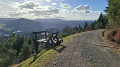
The Col du Dialtrepoix from Senones Abbey
 6.59 mi
+1,207 ft
-1,207 ft
4h 05
Moderate
Departure from Senones (Vosges)
6.59 mi
+1,207 ft
-1,207 ft
4h 05
Moderate
Departure from Senones (Vosges)
This varied and fairly easy hike starts in front of Senones Abbey and climbs to the Quatre-Bancs crossroads and then the Col du Dialtrepoix in a fairly wild environment. On the way back, you descend gently along a forest road that offers wide views of the valley at times.
From Senones towards La Roche Mère Henry and the Malfosse Chapel
 9.62 mi
+1,827 ft
-1,818 ft
8h 05
Moderate
Departure from Senones (Vosges)
9.62 mi
+1,827 ft
-1,818 ft
8h 05
Moderate
Departure from Senones (Vosges)
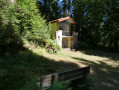
A circular walk starting from Senones, climbing up Rue de Lauviot, passing the ruins from the First World War. Passing the Fontaine de la Loge des Gardes, then arriving at the Quatre Bancs crossroads to climb towards the Roche Mère Henry, with a beautiful viewpoint and ruins from the First World War.
The route continues along the “Chemin de la Roche Mère Henry” memorial trail, passing German and French remains from the First World War, then the Croix du Pelé and the Sartorio Monument, before reaching the Croix de Malfosse crossroads. We then head towards the Chêne de la Vierge and the Malfosse Chapel. We return to the Quatre Bancs crossroads and descend along a small path, passing a blockhouse and the Source des Oiseaux.
The Climont and the Voyemont from Saales
11.83 mi
+2,139 ft
-2,133 ft
7h 20
Moderate
Departure from Saales (Bas-Rhin)
Climont rises to an altitude of 965 metres. The Julius Tower stands atop its summit, offering a 360-degree view of Alsace and the Black Forest. This walk takes you to the summit starting from Saales. Half of the walk is on flat ground. A further quarter is uphill, and another quarter is downhill. The climbs aren’t very long, but they are quite steep, technical and stony. Most of the walk takes place in the forest. The return route takes you past the Voyemont and the Roche des Fées, offering views of the Bruche Valley and the Bas-Rhin on one side, and the Vosges department on the other.
The Saâles ridges
 Tourist office6.67 mi
+1,063 ft
-1,063 ft
4h 00
Moderate
Departure from Saales (Bas-Rhin)
Tourist office6.67 mi
+1,063 ft
-1,063 ft
4h 00
Moderate
Departure from Saales (Bas-Rhin)
Set in the centre of a two-kilometre-long plateau, surrounded by mountains, the village of Saâles was built on the Via Salinaria at a convenient crossing point over the Vosges. The village has maintained its role as a market town throughout history. As early as 1743, it was granted the privilege of holding a fair and a market. In 1924, the rebuilt town hall housed the market halls on its ground floor.
Ascent of the Côte du Mont from La Petite Raon
 7.01 mi
+1,250 ft
-1,253 ft
4h 20
Moderate
Departure from La Petite-Raon (Vosges)
7.01 mi
+1,250 ft
-1,253 ft
4h 20
Moderate
Departure from La Petite-Raon (Vosges)
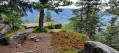
An opportunity to reach the summit of this beautiful hill, all the way to the Roche de la Motelotte and its television relay station.
The Celtic Camp at La Bure
 8.37 mi
+1,181 ft
-1,171 ft
4h 55
Moderate
Departure from Saint-Jean-d'Ormont (Vosges)
8.37 mi
+1,181 ft
-1,171 ft
4h 55
Moderate
Departure from Saint-Jean-d'Ormont (Vosges)
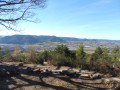
A circular hike near Saint-Dié to discover the Celtic camp of La Bure, a Gallic and Gallo-Roman fortified site listed as a historic monument.
It is located on a vast rocky promontory, offering a magnificent view of the Meurthe valley. A discovery trail has been created, punctuated by around fifteen information panels.
La Roche Mère Henry via the Malfosse Chapel
 5.46 mi
+1,365 ft
-1,368 ft
3h 40
Moderate
Departure from Senones (Vosges)
5.46 mi
+1,365 ft
-1,368 ft
3h 40
Moderate
Departure from Senones (Vosges)
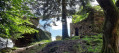
This is a hike with two different atmospheres: first a little mysterious and timeless with the Adrienne Fountain and the Malfosse Chapel, then historical and educational with the Roche Mère Henry memorial trail and its belvedere offering a breathtaking view of Senones and the Rabodeau valley.
La Roche de Haute Pierre and La Roche Mère-Henry via La Croix de Malfosse
 7.28 mi
+906 ft
-899 ft
4h 10
Moderate
Departure from Senones (Vosges)
7.28 mi
+906 ft
-899 ft
4h 10
Moderate
Departure from Senones (Vosges)
Here is a walking route between Senones and Moyenmoutier, offering beautiful views of both towns and the Rabodeau Valley. Remains from the First World War can be seen towards the end of the route.
L'Alhan - Le Climont - The source of the Bruche
 9.68 mi
+2,037 ft
-2,031 ft
6h 15
9.68 mi
+2,037 ft
-2,031 ft
6h 15
 Difficult
Departure from Bourg-Bruche (Bas-Rhin)
Difficult
Departure from Bourg-Bruche (Bas-Rhin)
A beautiful hike with stunning views of all the surrounding valleys: the Bruche Valley, Donon, Saint-Dié-des-Vosges, Val de Villé, Sainte-Croix-aux-Mines, Haut-Koenigsbourg, etc.
It is quite difficult due to its length, elevation gain and rough terrain (narrow paths on the edge of the void or muddy forest paths).
The Hang clearing at the foot of Climont
6.95 mi
+860 ft
-876 ft
3h 55
Moderate
Departure from Bourg-Bruche (Bas-Rhin)
This walk winds through a haven of peace and tranquillity at the foot of one of the valley's legendary peaks: Climont (966 m). The Bruche river rises at an altitude of 660 m and then crosses a vast basin: the Hang clearing. This is where families of glassmakers settled in 1723. Le Hang continued to prosper thanks to the arrival of Mennonite farmers of Swiss origin. They found here a place conducive to their pastoral and community life.
Le Climont and the source of the Bruche
6.74 mi
+1,250 ft
-1,247 ft
4h 10
Moderate
Departure from Bourg-Bruche (Bas-Rhin)
This walk winds through a haven of peace and tranquillity towards one of the legendary peaks of the Bruche Valley. Surrounded by green, wooded landscapes, Le Climont is the region's water tower. Three rivers originate in its vicinity: the Bruche, Giessen and Fave. This spot is marked by a stele created by sculptor Raymond Keller from a block of sandstone donated by the Champenay quarry.
Circular route around Saulxures
 6.71 mi
+755 ft
-764 ft
3h 45
Moderate
Departure from Saulxures (Bas-Rhin)
6.71 mi
+755 ft
-764 ft
3h 45
Moderate
Departure from Saulxures (Bas-Rhin)
A pleasant walk around Saulxures, much of it in the shade. Beautiful views along the route.
Exploring Climont
 7.66 mi
+1,440 ft
-1,407 ft
4h 45
Moderate
Departure from Bourg-Bruche (Bas-Rhin)
7.66 mi
+1,440 ft
-1,407 ft
4h 45
Moderate
Departure from Bourg-Bruche (Bas-Rhin)
A lovely walk in the Bruche Valley, with the climb up to Climont offering magnificent scenery. The ascent between (2) and (3) follows a footpath and is a bit of a challenge but well worth the effort. The descent is more gradual and follows a forest track.
Haute Loge route on the Passeurs trail
 4.57 mi
+1,125 ft
-1,125 ft
3h 05
Easy
Departure from Le Saulcy (Vosges)
4.57 mi
+1,125 ft
-1,125 ft
3h 05
Easy
Departure from Le Saulcy (Vosges)
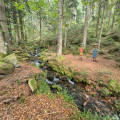
A fun hiking trail where around forty very diverse works produced during previous biennials remain in place. From the start, the ascent runs alongside the Grand Goutte stream and leads to stubble fields halfway along the route, offering a 360° view of breathtaking horizons. We reach the highest point at an altitude of 933 metres. The descent is just as interesting, with many surprises along the way.
Les Roches d'Ormont - Les Molières waterfall
 7.36 mi
+1,768 ft
-1,772 ft
4h 55
Moderate
Departure from Saint-Dié-des-Vosges (Vosges)
7.36 mi
+1,768 ft
-1,772 ft
4h 55
Moderate
Departure from Saint-Dié-des-Vosges (Vosges)
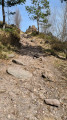
A beautiful circular route near Saint-Dié, featuring the many remarkable rocks of the Ormont massif, with viewing points offering beautiful views of Saint-Dié.
You will also discover part of the "Sentier du Capitaine Bonnefoy" trail with some remains from the First World War. Return via the bucolic site of the Molières waterfall.
Ormont Massif
 3.92 mi
+1,161 ft
-1,158 ft
2h 50
Moderate
Departure from Saint-Dié-des-Vosges (Vosges)
3.92 mi
+1,161 ft
-1,158 ft
2h 50
Moderate
Departure from Saint-Dié-des-Vosges (Vosges)
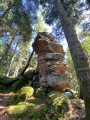
Hike through the pine forests on the heights of Saint-Dié-des-Vosges, in the Ormont area, to discover Saint-Dié from several viewpoints.
The Haute Loge Smugglers' Trail in Moussey
 9.88 mi
+2,031 ft
-2,031 ft
6h 20
Moderate
Departure from Moussey (Vosges) (Vosges)
9.88 mi
+2,031 ft
-2,031 ft
6h 20
Moderate
Departure from Moussey (Vosges) (Vosges)
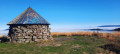
From Moussey (Vosges), a circular hike that passes through the Rouges Terres to climb the Hautes Chaumes and then the Haute Loge: 360° view. Return to the starting point via the Sentier des Passeurs. This section of the historic trail is the Vosges part, with the French part starting at the Maison Forestière de Salm in Alsace. From 1940 onwards, this trail was used by smugglers to guide escapees, those refusing to participate in the STO (compulsory labour service) and all kinds of people who wanted to flee Nazi barbarism to free France. Most of the elevation gain is concentrated in the first part of the hike, up to Haute Loge.
Champenay sandstone
10.34 mi
+1,916 ft
-1,909 ft
6h 25
Moderate
Departure from Plaine (Bas-Rhin)
Champenay is known for its quartzite sandstone quarry. This is a red sandstone veined with white, known as ‘grès des Princes’ in reference to the former status of this territory, which was the Principality of Salm. At the highest point of the route, there are old France–Germany boundary markers dating from 1870–1918. Finally, the route passes through the refreshing Falle Valley and past the lake of the same name.
Circular route straddling Alsace and Lorraine, starting from Champenay
13.01 mi
+2,549 ft
-2,539 ft
8h 10
Difficult
Departure from Plaine (Bas-Rhin)
At the Col du Hantz, we cross into Lorraine; then, after a fairly long stretch along a quiet road, we follow a stream along an impressive medieval cobbled path, adorned with installations by ‘art student’ from the University of Nancy; a little further up, the tranquillity of a secluded peat bog is disturbed only by birdsong. The Chemin des Passeurs then takes us to La Haute-Loge and La Chatte Pendue. A journey for lovers of nature and history.
Rouges Terres and Hautes Chaumes route
 9.66 mi
+1,601 ft
-1,565 ft
5h 50
Moderate
Departure from Moussey (Vosges) (Vosges)
9.66 mi
+1,601 ft
-1,565 ft
5h 50
Moderate
Departure from Moussey (Vosges) (Vosges)
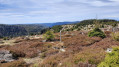
This hike starts on a forest trail in a wild environment and then continues in open country on the Hautes Chaumes. Next, head south towards the Abri de la Haute Loge shelter, then north to walk along the ridge. Return via the Basse des Loges and the Chemin des Italiens.
Les Chavons and Les Hautes Chaumes from Moussey
 6.90 mi
+1,401 ft
-1,401 ft
4h 25
Moderate
Departure from Moussey (Vosges) (Vosges)
6.90 mi
+1,401 ft
-1,401 ft
4h 25
Moderate
Departure from Moussey (Vosges) (Vosges)
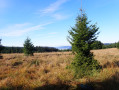
A beautiful hike in the heart of nature to the Hautes Chaumes from Moussey. The length and elevation gain are perfect for an average hiker.
The Schlitteurs climb to Roche du Sapin Sec
 7.25 mi
+1,818 ft
-1,827 ft
4h 55
Moderate
Departure from Saint-Dié-des-Vosges (Vosges)
7.25 mi
+1,818 ft
-1,827 ft
4h 55
Moderate
Departure from Saint-Dié-des-Vosges (Vosges)
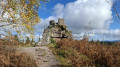
This route invites you to discover the Montée des Schlitteurs, as it is offered to sports enthusiasts every Christmas Eve. It will take you to Roche du Sapin Sec, then to other beautiful rocks with magnificent views, before beginning the descent to Saint-Dié-des-Vosges, its cathedral and the banks of the Meurthe.
The Four Fountains
 7.01 mi
+1,801 ft
-1,795 ft
4h 50
Moderate
Departure from Celles-sur-Plaine (Vosges)
7.01 mi
+1,801 ft
-1,795 ft
4h 50
Moderate
Departure from Celles-sur-Plaine (Vosges)
A hike in the forest of Celles-sur-Plaine, from Pain de Sucre to Roche du Coquin. Discover an observatory built and used by the Germans from 1915 onwards to alert the anti-aircraft defences along the route, knowing that the French air force was entering Alsace via the Col du Donon.
The five rocks of Kemberg
 8.08 mi
+1,617 ft
-1,611 ft
5h 05
Moderate
Departure from Saint-Dié-des-Vosges (Vosges)
8.08 mi
+1,617 ft
-1,611 ft
5h 05
Moderate
Departure from Saint-Dié-des-Vosges (Vosges)
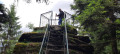
A day hike to discover the Kemberg massif. Several viewpoints from the rocks, secured by railings.
The rocks of the Kemberg sandstone massif in Saint-Dié
 10.47 mi
+1,929 ft
-1,916 ft
6h 30
Moderate
Departure from Saint-Dié-des-Vosges (Vosges)
10.47 mi
+1,929 ft
-1,916 ft
6h 30
Moderate
Departure from Saint-Dié-des-Vosges (Vosges)
Discover the Kemberg sandstone massif starting from the Saint-Dié SNCF railway station. This hike passes by numerous rocks offering beautiful views of Saint-Dié, the Bure, Ormont and Madeleine massifs and the Meurthe valley.
Saprée Vadrouille in the footsteps of Saint Déodat in Saint-Dié
 Association / Club / Walk leader
 2.50 mi
+72 ft
-72 ft
1h 15
Easy
Departure from Saint-Dié-des-Vosges (Vosges)
2.50 mi
+72 ft
-72 ft
1h 15
Easy
Departure from Saint-Dié-des-Vosges (Vosges)
With the Jubilee Year of Hope, since November 2024, our Catholic Church in the Vosges has developed a proposal: "Saprée Vadrouille, travel journal for paths of hope", with three issues per year focusing on liturgical times and the saints of the Vosges.Several itineraries are proposed in the Vosges as local pilgrimages and paths of hope. This is an opportunity to rediscover our region and our local saints throughout the Vosges department. Each itinerary can be done independently of the others, at any time of year. "In the footsteps of Saint Déodat" is the route proposed in the very first "Saprée Vadrouille", which you can discover here.
Kemberg Massif in Saint-Dié-des-Vosges
 3.59 mi
+1,142 ft
-1,106 ft
2h 40
Moderate
Departure from Saint-Dié-des-Vosges (Vosges)
3.59 mi
+1,142 ft
-1,106 ft
2h 40
Moderate
Departure from Saint-Dié-des-Vosges (Vosges)
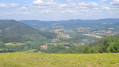
Hiking in the Kemberg massif in Saint-Dié-des-Vosges, covered with fir trees and offering two superb viewpoints: La Roche du Kiosque and La Roche de Saint-Martin.
La Chatte Pendue from Étang du Coucou
 4.12 mi
+1,145 ft
-1,135 ft
2h 55
Moderate
Departure from La Broque (Bas-Rhin)
4.12 mi
+1,145 ft
-1,135 ft
2h 55
Moderate
Departure from La Broque (Bas-Rhin)
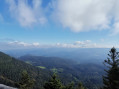
Mainly on shaded paths through the woods, this hike offers various points of interest, including the pretty Étang du Coucou lake surrounded by fir trees, the Chatte Pendue with its magnificent view of the Bruche valley and the Champs du Feu massif, and the Romanesque ruins of Salm Castle.
La Chatte Pendue and La Haute Loge, starting from Étang du Coucou
 6.43 mi
+1,490 ft
-1,476 ft
4h 15
Moderate
Departure from La Broque (Bas-Rhin)
6.43 mi
+1,490 ft
-1,476 ft
4h 15
Moderate
Departure from La Broque (Bas-Rhin)
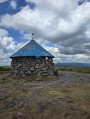
This walk will allow you to admire some stunning views whilst enjoying the tranquillity of the frequently used forest paths. A walk mainly through the forest, offering a chance to enjoy the cool, refreshing air.
Salm Castle, La Chatte Pendue and the Maxe peat bog
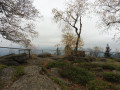 8.12 mi
+1,339 ft
-1,329 ft
4h 55
Moderate
Departure from La Broque (Bas-Rhin)
8.12 mi
+1,339 ft
-1,329 ft
4h 55
Moderate
Departure from La Broque (Bas-Rhin)
A circular walk mainly through forest. Starting from the enchanting setting of the Étang du Coucou, you will discover the ruins of the Château de Salm, currently undergoing restoration. You will then climb up to the promontory of the Chatte Pendue with its orientation table, make a short stop at the Monument des Passeurs, and then follow a slightly wilder path to the Tourbière de la Maxe.
July 2022 modification of the route between (8) and (9) due to poor trail maintenance: temporarily leave the blue cross markings in place.
Circular starting from the Étang du Coucou
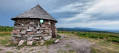 9.25 mi
+2,093 ft
-2,077 ft
6h 05
Moderate
Departure from La Broque (Bas-Rhin)
9.25 mi
+2,093 ft
-2,077 ft
6h 05
Moderate
Departure from La Broque (Bas-Rhin)
This walk leads to the Chatte Pendue viewpoint and the summit of the Hautes Loges, which offer a breathtaking 360° view of the neighbouring peaks: Donon, Rocher de Mutzig, the Champ du Feu massif and the Col du Hantz.The only challenging part is the climb up to La Chatte Pendue. So, take it easy to start with.
The three observatories above Celles-sur-Plaine
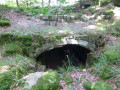 12.80 mi
+2,585 ft
-2,556 ft
8h 10
Difficult
Departure from Celles-sur-Plaine (Vosges)
12.80 mi
+2,585 ft
-2,556 ft
8h 10
Difficult
Departure from Celles-sur-Plaine (Vosges)
A circular hike starting from Celles-sur-Plaine, climbing up into the forest towards the three German observatories from the First World War. La Pierre Piquée, then the Pain de Sucre, passing by the Vierge de Dialtrepoix, and ending at the highest point, the Tête du Coquin, passing by the Coquin and Riangoutte fountains. The walk is partly signposted by Tourisme de Mémoire signs.La Pierre Piquée, with its parapets and blockhouses, just outside the site, Le Pain de Sucre with its ramparts and a beautiful view from the top of Le Coquin.
The Chatte Pendue circular path from the Ferme-auberge du Bambois
 Tourism professional
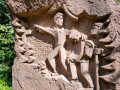 11.50 mi
+2,480 ft
-2,457 ft
7h 25
Difficult
Departure from La Broque (Bas-Rhin)
11.50 mi
+2,480 ft
-2,457 ft
7h 25
Difficult
Departure from La Broque (Bas-Rhin)
In the Bruche Valley, this circular route on the heights of Rothau, starting from the Étang du Coucou, takes us towards the peaks of La Chatte Pendue and La Haute Loge. The Auberge du Bambois is the perfect stop for a gourmet meal.
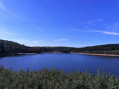
From Lac de la Plaine to Lac du Vieux Pré
 3.80 mi
+663 ft
-636 ft
2h 20
Easy
Departure from Pierre-Percée (Meurthe-et-Moselle)
3.80 mi
+663 ft
-636 ft
2h 20
Easy
Departure from Pierre-Percée (Meurthe-et-Moselle)
The Vallée de la Plaine or "Belle Vallée" (Beautiful Valley) boasts two lakes, a paradise for hikers and sports enthusiasts, where water, nature and forest are intimately linked.
 The Tour du Kemberg
 8.64 mi
+367 ft
-371 ft
1 hr
Easy
Departure from Saulcy-sur-Meurthe (Vosges)
8.64 mi
+367 ft
-371 ft
1 hr
Easy
Departure from Saulcy-sur-Meurthe (Vosges)
The Kemberg massif is well known to the people who live nearby. The Tour du Kemberg is well shaded with fairly wide paths.
Simply follow the blue circles and signs. Ideal for getting back into shape or for families, with no major difficulties.
Rocks and viewpoints in the Kemberg massif
 6.99 mi
+1,227 ft
-1,220 ft
4h 15
Moderate
Departure from Saulcy-sur-Meurthe (Vosges)
6.99 mi
+1,227 ft
-1,220 ft
4h 15
Moderate
Departure from Saulcy-sur-Meurthe (Vosges)
The Kemberg massif offers numerous vantage points: Roche Saint-Martin, Kiosque, Anozel and Enclume; add to these the paragliding launch sites at Col du Kiosque and Kemberg. You will enjoy the panoramic views over Saint-Dié, the Meurthe valley, and the Ormont and Bure massifs.
From Salm to Lac de la Maix via Haute Loge
 11.94 mi
+2,461 ft
-2,461 ft
7h 40
Moderate
Departure from La Broque (Bas-Rhin)
11.94 mi
+2,461 ft
-2,461 ft
7h 40
Moderate
Departure from La Broque (Bas-Rhin)
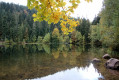
This hike follows part of the Sentier des Passeurs trail. It offers beautiful views of Haute Loge and the Hautes Chaumes, as well as picturesque surroundings around Lake Maix.
This route is not difficult, except for its length.
Circular walk from Salm via the Sentier des Passeurs and La Chatte Pendue
 6.13 mi
+1,224 ft
-1,198 ft
3h 55
Moderate
Departure from La Broque (Bas-Rhin)
6.13 mi
+1,224 ft
-1,198 ft
3h 55
Moderate
Departure from La Broque (Bas-Rhin)
A walk that follows the first section of the ‘smugglers’ trail’, which was used during the Second World War to smuggle escapees, draft dodgers and patriots from annexed Alsace into occupied France, emerging at Moussey 88. A memorial marking this historical event can be found along the route. At the former Franco-German border, you’ll discover sculptures created by contemporary artists. You’ll also pass through a nature reserve and a quiet zone.
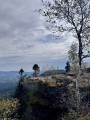
On the return leg, you’ll climb the Chatte Pendue; its summit offers breathtaking views of the Donon, the Alsace plain, the Champ du Feu and Climont mountain ranges, and the Hautes Vosges. TheGR®532also takes you to the ruins of Salm Castle, which is currently being restored.
From Salm to the Tête du Coquin
 10.34 mi
+2,963 ft
-2,349 ft
7h 20
Difficult
Departure from La Broque (Bas-Rhin)
10.34 mi
+2,963 ft
-2,349 ft
7h 20
Difficult
Departure from La Broque (Bas-Rhin)
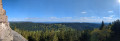
This first stage is probably the hardest day of the route. Beautiful views, pleasant trails and few forest roads. A steep climb at the end of the day explains the "Difficult" rating.
Three days around the Val de Senones with bivouacs
33.33 mi
+5,928 ft
-5,945 ft
3 days
Difficult
Departure from La Broque (Bas-Rhin)
Three days of hiking and camping around the Val de Senones, passing by beautiful viewpoints. Campsites at the Tête du Coquin and the Haute Loge.
Lake Pierre Percée – Discovering the battles of the Great War
 9.72 mi
+1,499 ft
-1,490 ft
5h 45
Moderate
Departure from Pierre-Percée (Meurthe-et-Moselle)
9.72 mi
+1,499 ft
-1,490 ft
5h 45
Moderate
Departure from Pierre-Percée (Meurthe-et-Moselle)
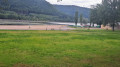
Discover an artificial lake that supplies water to the cooling system of the Cattenom nuclear power station. The battles of the Great War near Celles-sur-Plaine.
From the Vieux Pré dam to Pierre-Percée Castle
 4.04 mi
+482 ft
-466 ft
2h 15
Easy
Departure from Pierre-Percée (Meurthe-et-Moselle)
4.04 mi
+482 ft
-466 ft
2h 15
Easy
Departure from Pierre-Percée (Meurthe-et-Moselle)
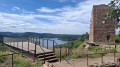
A short circular loop that runs alongside Lake Pierre-Percée before climbing up to the village of the same name and circling the nearby castle. Also known as Château de Salm, it has been open to visitors since May 2026 following a spectacular renovation. This offers walkers and other nature lovers the chance to finally rediscover this iconic site perched above the lake.
The Virgin of Vohné as seen from the Vieux Pré Dam on Lake Pierre Percée
 1.70 mi
+472 ft
-476 ft
1h 10
Easy
Departure from Pierre-Percée (Meurthe-et-Moselle)
1.70 mi
+472 ft
-476 ft
1h 10
Easy
Departure from Pierre-Percée (Meurthe-et-Moselle)
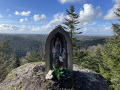
An easy, family-friendly walk through the forest on the shores of Lac de Pierre Percée. Ascent to Vohné, at an altitude of 526 m.
Le Petit Canada
 7.53 mi
+607 ft
-584 ft
4h 00
Moderate
Departure from Pierre-Percée (Meurthe-et-Moselle)
7.53 mi
+607 ft
-584 ft
4h 00
Moderate
Departure from Pierre-Percée (Meurthe-et-Moselle)
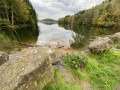
With its dam, the Roches de la Xaveure – some of which are shaped like animals – Salm Castle (or Château de Pierre-Percée) and the little village that bears its name, Lake Pierre-Percée offers landscapes with a distinctly Canadian feel.
More walks in Châtas
Select a point of interest below: