


Refine your search for walks in Sant Julià de Lòria
Sant Julià de Lòria walks


 From Sant Julia de Loria to the Perafita Refuge
 Visorando Member
 11.95 mi
 +6,309 ft
 -2,064 ft
 10 hrs
 Very difficult
 Departure from Sant Julià de Lòria (Andorra)
Set amongst forests and mountain pastures, this stage will take you to the Perafita Refuge, the perfect spot to rest.
Prat Primer path and the Caülla forest
 4.99 mi
+3,084 ft
-3,084 ft
5h 00
4.99 mi
+3,084 ft
-3,084 ft
5h 00
 Moderate
Departure from Escaldes-Engordany (Andorra)
Moderate
Departure from Escaldes-Engordany (Andorra)
This route offers the chance to discover Andorra’s high-mountain landscape and vegetation and to visit one of the Principality’s many self-catering mountain huts.
Monturull ridge to Coma Extremera peak via the Madriu Valley
17.10 mi
+7,231 ft
-7,224 ft
14h 10
Moderate
Departure from Escaldes-Engordany (Andorra)
You have to be curious enough to venture far south of the Principality of Andorra to have heard of the Monturull peak, the Tossal Bovinar or the Colilla peak; names that are not as famous as the great peaks of the West. However, these peaks are well over 2,700 metres, even reaching 2,800 metres, and are located in eastern Catalonia.
The ridge on today's itinerary is located just south of the Principality of Andorra. It marks the southern border with Spain. The southern slope of this ridge is gentle and accessible, while the northern slope is made up of ravines and steep cliffs. Naturally, the southern route is the most popular, but I decided to tackle this journey by looping around the north. I will therefore start this loop from the Madriu Valley in Andorra.
The Pic de Casamanya from the Col d'Ordino
4.55 mi
+2,415 ft
-2,415 ft
4h 10
Moderate
Departure from Ordino (Andorra)
A different side of Andorra if you want to get away from the shopping centres!
A demanding hike (it’s a tough climb) without being difficult, but offering sublime 360° views of the surrounding Pyrenean peaks and valleys.
At the start and finish, in the shade of mountain pines, and if you’re hiking in late August, there are raspberries to enjoy all along the way.
Circuit of Pic de la Coma Pedrosa
 Association / Club / Walk leader
 8.61 mi
+4,902 ft
-4,902 ft
8h 15
8.61 mi
+4,902 ft
-4,902 ft
8h 15
 Difficult
Departure from La Massana (Andorra)
Difficult
Departure from La Massana (Andorra)
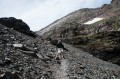
Pic de la Coma Pedrosa is the highest peak in Andorra. This route takes you around it, allowing you to explore the valleys to the north on the Spanish side as well as the Estanys Forcats, far from the hordes of hikers heading for the summit.
Please note: the descent from Portella de Baiau is not recommended for those who are not used to mountain terrain and are afraid of steep slopes.
Part of the route is off-trail but presents no significant difficulty.
Cami del Toll Bullidor
1.10 mi
+387 ft
-361 ft
0h 50
 Easy
Departure from Canillo (Andorra)
Easy
Departure from Canillo (Andorra)
A very short, easy hike to see a beautiful waterfall. There is only one path and it is very easy to follow.
Ensagents Refuge and Lakes
 6.08 mi
+2,192 ft
-2,192 ft
4h 40
Moderate
Departure from Encamp (Andorra)
6.08 mi
+2,192 ft
-2,192 ft
4h 40
Moderate
Departure from Encamp (Andorra)
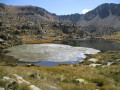
A fairly demanding hike through mountain pines and rhododendrons to reach the refuge and then the Étangs d'Ensagents, set in a predominantly mineral environment. The calm, the omnipresent water and the beauty of the landscapes more than compensate for the considerable effort required to negotiate a few very steep passages. A breath of fresh air just a few kilometres from the consumer frenzy of Pas de la Case.
Comapedrosa Refuge - El Serrat
8.64 mi
+2,329 ft
-4,610 ft
6h 00
Moderate
Departure from La Massana (Andorra)
The fourth stage is in the high mountains, easier than the previous two, allowing you to reduce your effort. Many trails through forests and woodlands make for a more bucolic and enjoyable hike. This stage presents no technical difficulties, but orientation and following the route are complicated due to numerous crossings and intersections of hiking trails. It is essential to have a hiking app and the GPX track to avoid getting lost.
From the Les Fonts refuge to the Étang de Soulcem
 8.87 mi
+3,310 ft
-5,180 ft
7h 00
Difficult
Departure from La Massana (Andorra)
8.87 mi
+3,310 ft
-5,180 ft
7h 00
Difficult
Departure from La Massana (Andorra)
Third and final stage of the circular route around the Étang de Soulcem. A beautiful high-mountain stage that takes us along the long grassy ridge running alongside the Pic del Clot del Cavall before descending into the valley to the Estanys de l’Angonella. We then cross a first pass and then the Port de Rat, which allows us to leave Andorra and reach France and the Étang de Soulcem.
Pic de L'Estanyo from Canillo (Andorra)
 11.32 mi
+4,754 ft
-4,760 ft
9h 20
Difficult
Departure from Canillo (Andorra)
11.32 mi
+4,754 ft
-4,760 ft
9h 20
Difficult
Departure from Canillo (Andorra)
Pic de l'Estanyo is the second highest peak in Andorra (2,915 m). The view of the other peaks in Andorra is magnificent. It is accessible from Sorteny or Ransol for the most well-known routes. It can also be accessed from Canillo, which is the subject of this guide.
This is a long hike with a significant elevation gain. The trail is generally well marked up to Estany Gran, then you have to follow the cairns and the trail where it exists.
From the Josep Maria Monfort Baiau refuge to the Les Fonts refuge
 6.49 mi
+2,684 ft
-3,717 ft
5h 20
Difficult
Departure from Alins (Lleida)
6.49 mi
+2,684 ft
-3,717 ft
5h 20
Difficult
Departure from Alins (Lleida)
Second stage of the route around Étang de Soulcem. A beautiful high-mountain stage with no major difficulties, despite the Port de Baiau pass, which is impressive and very steep towards the end but poses no real danger if you remain cautious. This is followed by a descent into the valley before climbing back up to spend the night at the unmanned Les Fonts refuge, a typical Andorran refuge with iron beds, a fireplace and an outdoor water point. The view over the Andorran valley is splendid and restful after the exertions of the day.
El Serrat - Pic de Tristagne - Refuge de l'Étang Fourcat
6.14 mi
+4,327 ft
-1,476 ft
6h 35
Very difficult
Departure from Ordino (Andorra)
The fifth and final stage of the high-mountain route passes by the iconic Pic de Tristagne, which towers over the many lakes in the surrounding area, and its short, fairly exposed ridge route, before returning to France via the magnificent Étangs Fourcat site.
Lakes of Cirque dels Pessons
6.37 mi
+1,726 ft
-1,696 ft
4h 25
Difficult
Departure from Encamp (Andorra)
Difficult hike, best done in good weather as many areas are unmarked.
Tour of the Cirque dels Pessons lakes
 6.44 mi
+1,699 ft
-1,703 ft
4h 25
Difficult
Departure from Encamp (Andorra)
6.44 mi
+1,699 ft
-1,703 ft
4h 25
Difficult
Departure from Encamp (Andorra)
This hike allows you to discover most of the lakes in the Cirque des Pessons while avoiding the crowds of hikers thanks to two off-trail sections that are therefore very little or not at all frequented. No fewer than sixteen lakes are on the itinerary, some identified and others unnamed. A wild landscape with rounded rocks shaped by ancient glaciers, streams and crystal-clear lakes, mountain pines... all this makes for an unforgettable experience, despite the difficulty of some sections.
Montmalús Peak
 5.61 mi
+2,349 ft
-2,343 ft
4h 40
Difficult
Departure from Encamp (Andorra)
5.61 mi
+2,349 ft
-2,343 ft
4h 40
Difficult
Departure from Encamp (Andorra)
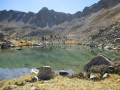
The first part of this hike consists of a long, steady climb up to the Collada de Montmalús and then on to the peak itself, offering exceptional views of the high Andorran peaks and the Cirque dels Pessons. On the descent, an off-trail section allows you to discover three beautiful, unnamed lakes, which are rarely or never visited, save perhaps by a few trout anglers. You will, however, need to take care when tackling the rather rugged and difficult terrain.
Estany de la Cabana Sorda and return via Val d'Inclès
 8.61 mi
+2,503 ft
-2,503 ft
6h 10
Difficult
Departure from Canillo (Andorra)
8.61 mi
+2,503 ft
-2,503 ft
6h 10
Difficult
Departure from Canillo (Andorra)
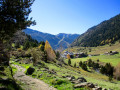
This beautiful and demanding hike allows you to discover several high-altitude lakes in an exceptional environment, including Estany del Querol, Estany de la Cabana Sorda and Estany d'Anrodat, to name but the most important. Other small lakes, some of which are unfortunately drying up, dot the route. After a particularly challenging descent, the return journey takes you along the Chemin de l'Ubac d'Inclès, which allows you to discover this beautiful valley as you walk alongside the Riu d'Inclès, close to pastures where cows, donkeys and horses graze in the summer. However, you will need to save your strength for the climb back up to the car park, which can be very tiring at the end of the walk.
Port de Caraussans - Étang de Soulcem
 4.79 mi
+49 ft
-3,596 ft
2h 15
Difficult
Departure from Auzat (Ariège)
4.79 mi
+49 ft
-3,596 ft
2h 15
Difficult
Departure from Auzat (Ariège)
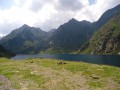
After our chairlift ride, we descend towards the Soulcem lake on the Ariège side. We enjoy the beauty of this glacial valley, the Soulcem lake, the Mérens horses grazing freely, not to mention the numerous orris that line the route. It is a wonderful but particularly challenging end to the hike between the Caraussans lake and the Soulcem trail.
Vallferrera Refuge - Pic de Comapedrosa - Comapedrosa Refuge
6.88 mi
+3,727 ft
-2,549 ft
6h 25
Very difficult
Departure from Alins (Lleida)
Third stage passing through the highest point in Andorra: Pic de Comapedrosa. A high-mountain stage with no particular difficulties apart from the climb to Portella de Baiau over scree and the descent along the somewhat exposed ridge of Pic de Comapedrosa.
The Red Pond of Riou Blanc
 6.38 mi
+2,680 ft
-2,680 ft
5h 15
Moderate
Departure from Auzat (Ariège)
6.38 mi
+2,680 ft
-2,680 ft
5h 15
Moderate
Departure from Auzat (Ariège)
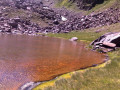
Accessible via a route that takes climbers to the Pointe de Roumazet, this little-known pond is well worth a visit due to the uniqueness of its setting. Overhung by two sloping peaks shaped like gigantic horns, it is surrounded by scree slopes laden with iron ore, which explains the red colour of its waters. The aquatic plants lining its banks are a vivid fluorescent green, and the white deposit left on the stones by the stream flowing out of it (thus justifying its name, Riou Blanc) completes the palette of bright colours in this landscape that is both wild and intimate.
The route, starting from Soulcem, first takes you to the Étang de Roumazet. Just before reaching it, turn right onto the path leading to the Port de Roumazet; you must then leave this path to follow the Riou Blanc upstream to the pass that overlooks the small plateau where the Étang Rouge de Riou Blanc is nestled.
The Étang de Médécourbe loop
 7.50 mi
+1,909 ft
-1,900 ft
5h 05
Moderate
Departure from Auzat (Ariège)
7.50 mi
+1,909 ft
-1,900 ft
5h 05
Moderate
Departure from Auzat (Ariège)
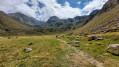
A beautiful walk in the heart of the Soulcem valley to discover the crystal-clear waters of the Étang de Médécourbe.
Loop trail around the Gardelle, Roumazet and Soucarrane lakes
 8.42 mi
+3,691 ft
-3,691 ft
7h 05
Difficult
Departure from Auzat (Ariège)
8.42 mi
+3,691 ft
-3,691 ft
7h 05
Difficult
Departure from Auzat (Ariège)
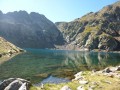
In the large glacial cirque of Soulcem, this hike allows you to discover several high-altitude lakes with crystal-clear waters and sumptuous mineral landscapes that make you forget the considerable effort required, both on the way up and down. On the way back, a few horses of the Mérens breed and the magnificent Orris du Carla provide a pleasant end to the day.
Étang Fourcat - Port de Caraussans
 3.04 mi
+889 ft
-1,411 ft
2h 10
Moderate
Departure from Auzat (Ariège)
3.04 mi
+889 ft
-1,411 ft
2h 10
Moderate
Departure from Auzat (Ariège)
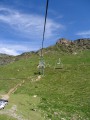
More magnificent lakes are on the agenda, with the added bonus of a short chairlift ride on the Andorran side to rest your legs before the descent to L'Étang de Soulcem, which is very challenging in the last section.
Circular Pic de la Soucarrane route via the Gardelle and Soucarrane lakes
 9.40 mi
+5,367 ft
-5,344 ft
10 hrs
Very difficult
Departure from Auzat (Ariège)
9.40 mi
+5,367 ft
-5,344 ft
10 hrs
Very difficult
Departure from Auzat (Ariège)
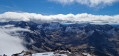
Set in the vast glacial cirque of Soulcem, this walk takes you past several high-altitude lakes with crystal-clear waters and sumptuous rocky landscapes that make you forget the considerable effort required, both on the ascent and the descent. On the way back, a few Mérens horses and the magnificent Orris du Carla sheep provide a pleasant end to the walk.
A minimum level of physical fitness is required for this mountain hike.
Cross-border hiking in the Pyrenees
24.36 mi
+10,646 ft
-10,650 ft
3 days
Difficult
Departure from Auzat (Ariège)
This beautiful Pyrenean route follows trails through Ariège, Catalonia and Andorra; it forms a lovely circular route around the Étang de Soulcem, the starting point of the hike. Accommodation is available, but these are unstaffed mountain huts. It is therefore advisable to bring a tent in case the huts are full or if bad weather forces you to stop.
From Étang de Soulcem to the Josep M. Monfort Baiau Refuge
 9.00 mi
+4,629 ft
-1,752 ft
8h 10
Difficult
Departure from Auzat (Ariège)
9.00 mi
+4,629 ft
-1,752 ft
8h 10
Difficult
Departure from Auzat (Ariège)
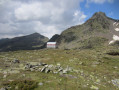
First stage of the 3-day hike that is circular and loops around the Étang de Soulcem. This beautiful, long stage will take us into Catalonia, first passing by small lakes and then through the Port de Bouet, through gentle high-mountain landscapes, over the grassy, undulating slopes of the Ariège and then Catalonia; we finally reach the unmanned Josep M. Monfort Baiau refuge, which is in perfect condition and offers safe shelter (sleeps 9).
Pic du Montcalm via Riufret
 8.11 mi
+5,600 ft
-5,604 ft
10 hrs
Very difficult
Departure from Auzat (Ariège)
8.11 mi
+5,600 ft
-5,604 ft
10 hrs
Very difficult
Departure from Auzat (Ariège)
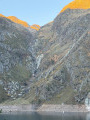
The Riufret is the mountain route to the 3,000-metre peaks of the Ariège. Wild, impressive, rugged but supremely authentic. With a bit of luck, you may have some wonderful encounters and come across a few ibex.
Pic de la Soucarrane
 9.71 mi
+4,183 ft
-4,183 ft
8h 05
Difficult
Departure from Auzat (Ariège)
9.71 mi
+4,183 ft
-4,183 ft
8h 05
Difficult
Departure from Auzat (Ariège)
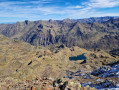
A day-long hike taking you to an altitude of almost 3,000 metres and offering splendid views of the French and Spanish Pyrenees.
The hike starts in the valley at 1,926 m and gradually climbs to the peak at 2,902 m.
Plan to spend the day with a picnic on the banks of the Soucarrane lake, which is very pleasant in good weather.
Please note that some sections along the ridges are not recommended for people who are prone to vertigo.
The Orris Trail
 Tourist office
 6.93 mi
+2,313 ft
-2,316 ft
5h 10
Moderate
Departure from Auzat (Ariège)
6.93 mi
+2,313 ft
-2,316 ft
5h 10
Moderate
Departure from Auzat (Ariège)
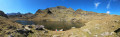
This high-altitude walk through a high-mountain landscape can also be turned into a short educational outing. The short journey back in time takes you to the orris at the bottom of the Soulcem valley on the border with Andorra and Spain. The numerous small dry-stone summer dwellings bear witness to the intense pastoral activity in the valley.
Tosa de Siscaro and Pic de la Cabaneta via the Vall d'Incles
 7.69 mi
+3,360 ft
-3,330 ft
6h 30
Difficult
Departure from Canillo (Andorra)
7.69 mi
+3,360 ft
-3,330 ft
6h 30
Difficult
Departure from Canillo (Andorra)
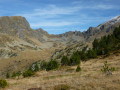
With its torrent, Spanish stone pines and rhododendrons, the Vall d’Incles is a small, protected gem, far from the crowds thronging at Pas de la Casa or Andorra la Vella. The ascent of Pic de la Cabaneta follows the Siscaro ponds before tackling the very steep climb leading to the ridge and then to Tosa de Siscaro, which lies at the same altitude as its better-known neighbour. Sustained effort is rewarded with an exceptional panorama.
Fourcat Mountain Hut – Picot Lakes – Mounicou
 5.90 mi
+1,109 ft
-5,564 ft
3h 40
Difficult
Departure from Auzat (Ariège)
5.90 mi
+1,109 ft
-5,564 ft
3h 40
Difficult
Departure from Auzat (Ariège)
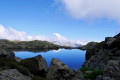
Second stage of the journey through Haute-Ariège.A difficult and long mountain stage (around 7 hours), to be undertaken seriously and by those in good physical condition.Shortly after leaving the mountain hut, there is a very steep climb.After crossing the first pass (2) (altitude 2,574 m), you’ll encounter rocks, snowfields, another climb and then another pass (3) at 2,640 m.From this point: tricky sections with cables and steel rungs fixed to the rock.Then the rest of the very gruelling descent through magnificent scenery.Please note that the Mounicou lodge will be closed in 2026 => accommodation in Marc: see the ‘Places to Visit’ section.
Refuge Fourcat - Marc's lodge
9.76 mi
+1,247 ft
-5,958 ft
5h 35
Difficult
Departure from Auzat (Ariège)
This is the sixth and final stage of the Tour des Géants des Trois Nations, which has a steep descent (1,800 m of elevation loss, which will hurt your joints) to return to the starting point of this journey. This stage passes by the Fourcat Waterfall, the beautiful Izourt Pond and the forests of Goulier-Auzat and Montcalm.
From the Juclar Refuge to Pas de la Case
 9.19 mi
+1,762 ft
-2,421 ft
5h 45
Moderate
Departure from Canillo (Andorra)
9.19 mi
+1,762 ft
-2,421 ft
5h 45
Moderate
Departure from Canillo (Andorra)
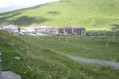
This third stage of the route linking Ax-les-Thermes to Latour de Carol takes you to Pas de la Case… and its hotels and refreshment stops; it is an easy, somewhat long stage that takes place at altitude, mainly along the gentle, grassy ridges of Andorra, but without any difficulty. It is best to tackle this stage in good weather, as landmarks can be misleading, especially if fog sets in.
Pic de Cabaillère
 7.23 mi
+2,890 ft
-2,871 ft
5h 50
Difficult
Departure from Ariège
7.23 mi
+2,890 ft
-2,871 ft
5h 50
Difficult
Departure from Ariège
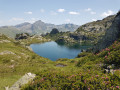
The hike is not particularly difficult, but it is quite steep overall.
Please note: good mountain navigation skills are necessary; using a map or GPS is not a luxury and will help you find your way more easily.
The view from the summit is superb, as is the view along the climb, with views of the beautiful Jasse de Pinet, the Pic du Ruhle and its refuge, the Pic de la Coume d'Enfer, etc.
From the Fontargente lakes to the Joclar lakes via Andorra
 12.00 mi
+4,245 ft
-4,236 ft
9h 15
Difficult
Departure from Ariège
12.00 mi
+4,245 ft
-4,236 ft
9h 15
Difficult
Departure from Ariège
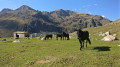
This circular route takes you to several mountain lakes as you cross the Andorran border.
The landscapes are varied and the overhangs allow you to admire the valley from several viewpoints.
Refuge du Ruhle via the Étangs de Fortargente
 5.58 mi
+1,955 ft
-1,962 ft
4h 15
Moderate
Departure from Ariège
5.58 mi
+1,955 ft
-1,962 ft
4h 15
Moderate
Departure from Ariège
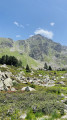
Another way to reach the Refuge du Ruhle is via the magnificent Fontargente lake and then the Estagnol lake, which is well worth a short detour to see. Once you reach the refuge, which is a crossroads for several hikes, the view from the terrace is splendid. The return to the starting point is now just a formality.
The Fontargente Lakes loop
 4.87 mi
+1,549 ft
-1,562 ft
3h 35
Moderate
Departure from Ariège
4.87 mi
+1,549 ft
-1,562 ft
3h 35
Moderate
Departure from Ariège
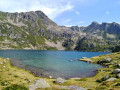
A half-day tour to admire the magnificent Étangs de Fontargente and their emerald green reflections.
The Fontargente and Joclar ponds in a loop through the Incles Valley
10.55 mi
+3,806 ft
-3,793 ft
8h 10
Difficult
Departure from Ariège
A superb hike between the austere Aston Valley and the equally austere upper part of the Inclès Valley in Andorra. There is a succession of ponds. Don't underestimate the difficulty of this long and technical hike, especially on the Andorran side. But as a group of American hikers we met twice during the hike said, "It is gorgeous."The loop is optimised compared to other routes as it does not descend to the bottom of the Inclès Valley and does not pass by the Refuge du Ruhle. But overall, it is very well marked!
Port de Fontargente loop via the ponds
 6.45 mi
+1,896 ft
-1,873 ft
4h 35
Moderate
Departure from Ariège
6.45 mi
+1,896 ft
-1,873 ft
4h 35
Moderate
Departure from Ariège
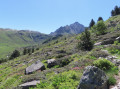
This is an easy hike. It is ideal in June when flowers and rhododendrons are everywhere. The ponds are magnificent. If you feel like swimming, choose the second one, as it will be less crowded. In summer, the site can be very busy. We preferred to do the loop in an anti-clockwise direction: fewer people and a more even climb.
Pic de la Coume d'Enfer circular from Pla de las Peyres
 8.04 mi
+3,642 ft
-3,612 ft
6h 50
Difficult
Departure from Ariège
8.04 mi
+3,642 ft
-3,612 ft
6h 50
Difficult
Departure from Ariège
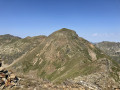
A very beautiful hike, wild and rocky, with splendid views of the surrounding peaks, Andorra and the Fontargente lakes.
This isa demanding hike due to the elevation gain, with some passages that may be tricky for inexperienced hikers, and very steep slopes both uphill and downhill. GPS recommended.
Circular via the Étangs de Fontargente and the Refuge de Rulhe
 6.54 mi
+1,936 ft
-1,919 ft
4h 40
Moderate
Departure from Ariège
6.54 mi
+1,936 ft
-1,919 ft
4h 40
Moderate
Departure from Ariège
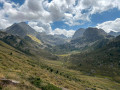
Spectacular views on this circular hike to the Étangs de Fontargente lakes, returning via the Refuge de Rulhe.
The Étangs de Joclar circular, via the Refuge du Rhule
 7.88 mi
+2,894 ft
-2,894 ft
6h 10
Difficult
Departure from Ariège
7.88 mi
+2,894 ft
-2,894 ft
6h 10
Difficult
Departure from Ariège
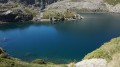
A hike in the heart of the Aston valley with four lakes to discover, passing through the Col de Jouclar, which forms the border between France and Andorra.
There are several options for this hike. I have chosen to present the most comprehensive version here, so that you can discover these circular lakes and enjoy a day's hiking. Of course, it can be done in two days, but I will discuss this option later.
Circular via the Estagnol and Fontargente lakes
 7.55 mi
+1,719 ft
-1,696 ft
5h 00
Moderate
Departure from Ariège
7.55 mi
+1,719 ft
-1,696 ft
5h 00
Moderate
Departure from Ariège
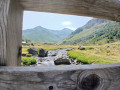
This hike takes you past several clear-water lakes and visits various cirques and mountain pastures.
Refuge du Ruhle - Col de Belh - de la Didorte - Cabane Rieutort - Laparan
 5.31 mi
+1,198 ft
-3,297 ft
3h 30
Moderate
Departure from Ariège
5.31 mi
+1,198 ft
-3,297 ft
3h 30
Moderate
Departure from Ariège
From the start of the hike, pay attention to the common white and red GR® T66 and GR®10 markings, as there are several crossroads and forks in the trail. Please note: the hike is in open terrain until the descent into the forest, well after the Rieutort hut.From the refuge, via the Crête des Isards and up to the Col de la Didorte, what a view! Of course, you need to be very careful on this ridge, which is often steep and jagged. But as soon as you stop, you can enjoy a 360° panorama.The steep descent to the Rieutort hut is on a narrow but safe path, offering beautiful views. The return to the road is not easy, but the path (GR®T66), although steep in places, is well marked throughout the descent.
Refuge du Rulhe - Castelet
11.00 mi
+958 ft
-5,958 ft
5h 55
Difficult
Departure from Ariège
This second day is exceptional. Most of it takes place on ridges from which you can see the Ax 3 Domaines resort on one side and the Plateau de Beille on the other. And everywhere, there are lakes and breathtaking landscapes. This stage is long (nearly 18 km), but you'll never want it to end before you descend into the valley through the forest. It's best to have someone waiting for you in the valley, or else you can reach Ax-les-Thermes on foot or by bus. Be aware that as you will be taking photos and spending time admiring the landscape, you should allow 6½ to 7 hours for the whole trip.