

 Country:

 City:






__A few ideas to help you prepare well for this long trek.
Clothing
3 short-sleeved T-shirts made from breathable, quick-drying microfibre
Underwear, preferably made of wool, which offers superior comfort in damp and cold weather; it also dries faster and absorbs less moisture than cotton.
5 pairs of quick-drying, mid-length socks made from a blend of wool and elastane, which provide compression for the foot and thus prevent direct friction with the boot.
4 pairs of thin wool-blend briefs; boxer shorts are often too warm and can cause overheating.
1 Pair of trousers, loose-fitting at the thighs and knees to allow freedom of movement, made from breathable, non-waterproof, quick-drying microfibre, featuring numerous belt loops and large side pockets. Wide fabric waistband.
1 Pair of shorts, loose-fitting at the thighs, made from breathable, non-waterproof, quick-drying microfibre. Drawstring waist, large pockets.
1 Fleece jacket, long and loose-fitting, not too warm.
1 Lightweight, sleeveless fleece gilet.
1 Windbreaker, hip-length and one size larger than usual, unlined, waterproof and breathable with a hood, long sleeves reaching halfway down the hand.
1 Sun hat or cap.
1 Pair of mid-cut mountain boots, one size larger, comfortable in width but with no extra room, lightweight, breathable and waterproof, with a thick and fairly stiff rubber sole (e.g. Vibram) offering good grip, deep lugs, a raised edge running round the side of the sole and covering the toe, a bellows-style tongue that won’t twist, and hooks instead of loops to make it easier to adjust the fit. Prevent blisters by lacing the boot so that the foot fits snugly against the boot, but not too tightly so as not to restrict blood circulation; then, at the instep, tie the lace and continue with a looser lacing when ascending than when descending. With polyester laces, secure the lacing by tying a circular loop. Keep your toenails trimmed short enough so they do not catch on the bottom of the shoe. Prevent blisters by keeping your feet dry; change damp socks.
1 pair of sandals or flip-flops for the evening and for crossing deep fords.
1 pair of gloves.
Sleeping / Carrying
1 Lightweight sleeping bag with hood, comfort temperature 0°/5°C, long enough that, if necessary, you can dry your shoes inside a plastic bag at the bottom.
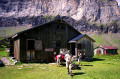
1 Lightweight tent, approx. 1.5 kg, with a flysheet to minimise condensation, and a groundsheet with a good raised edge. Inside, sufficient headroom to sit with your torso and head upright. A tent offers greater freedom and peace of mind when planning your stages, as the itinerary is rarely adhered to – whether due to bad weather, physical difficulties or, conversely, a surge in fitness that allows you to extend the route. Last-minute bookings are possible but never guaranteed, especially for groups. Most mountain huts allow camping nearby without a booking, including dinner and breakfast, though this is less common at stopover lodges. Avoid pitching your tent in a hollow, on a slope or on stony ground; ideally, choose a flat, grassy hillock. Remember to clear away any stones and tread down the grass before pitching your tent.
1 Pair of walking poles.
1 Lightweight rucksack of around 80 litres with side pockets, one on the flap and a pocket on the hip belt. Keep the weight, including water and food, to no more than 1/5 of your own body weight. (15 kg for a 75 kg person).
1 Rain cover for your rucksack, or one integrated into the rucksack.
1 Pair of gaiters for snowy, muddy or waterlogged sections.
Hiking maps, topographical maps and a map holder worn over the shoulder.
Accessories
1 watch with altimeter and compass. Remember to calibrate the altimeter frequently against a signpost or elevation marker. To follow a route without difficulty, memorise the distinctive landmarks ahead: junctions, roads, descents, ascents, hairpin bends, buildings, watercourses, gullies, scree slopes, woods, meadows, clearings, high-voltage power lines, masts, streams, etc., then check them as you go to keep track of your position at all times. If in doubt, check that the direction of the path and the elevation of the location match those of the supposed location on the map; if not, turn back to a reliable landmark. If you get lost but have a clear view, choose a landmark in the distance that is identifiable on the map and head towards it by estimation; in the forest or in fog, follow a path leading down towards the valley floor. Off the path, remain alert to slopes that gradually steepen, as this is often a sign of a precipice ahead.
1 Mobile phone, camera and charger.
1 Pair of sunglasses, prescription glasses and a spare pair.
1 Pair of shoelaces.
1 Multi-purpose knife, scissors, tweezers, can opener, nail file, awl.
1 Head torch.
1 Lighter.
First aid
1 Thin, microporous paper plaster. In the event of a blister, apply a plaster immediately.
1 A few aspirin tablets.
1 A few tablets for stomach ache.
1 Velpeau plaster in case of a sprain.
1 Small bottle of antiseptic and plasters.
1 Sun cream.
1 Emergency blanket.
1 Whistle.
Toiletries
1 Roll of toilet paper in a plastic bag.
1 Lightweight towel.
1 Small bar of Marseille soap.
1 Small bottle of shampoo.
1 Washcloth for washing outdoors.
1 Toothpaste and toothbrush.
6 clothes pegs, string and a clothesline clip for drying your washing on your rucksack.
Possible food and drink
1 2-litre water pouch.
1 Baguette.
1 pack of cold meats.
1 tin of sardines.
1 piece of hard cheese or a packet of cheese triangles.
1 piece of fruit.
1 bar of chocolate.
1 packet of cereal bars.
Documents
1 bank card, cheque book, cash.
1 ID card.
1 National Health Card and private health insurance card, blood group.
1 Pencil and notebook.
Not included as these are optional: foam trekking mattress, camping stove, saucepan.
Packing order, from bottom to top.
Each set in a bin bag with a drawstring. Tent – Sleeping bag – Fleece jacket and gilet, trousers, shorts.
Each set in a plastic bag: underwear: T-shirt, socks, briefs – Food (excluding bread)
In the side pockets. Water pouch, gaiters. Toiletries in a plastic bag. Baguette.
Flap pockets: Each set in a plastic bag: First aid kit – Documents – Accessories: sunglasses, laces, knife, head torch, lighter, charger, compass – Gloves.
Belt pouch: mobile phone, a cereal bar.
Card holder worn over the shoulder
 Visorando Member
 Difficult
 Easy
 Association / Club / Walk leader
 Moderate