


Refine your search for walks in Fégréac
Fégréac walks


 The Canal and Étang Aumée in Fégréac
 Visorando Member
 8.27 mi
 +299 ft
 -299 ft
 4h 05
4h 05
 Moderate
 Departure from Fégréac (Loire-Atlantique)
The landscape around Fégréac is characterised by three small valleys overlooked by the village. The first is home to the River Isac and the canal linking Nantes to Brest; the second is home to the Dréneuc stream and the marshes bordering it; and the third has been transformed into a large pond which once supplied the Aumée Mill. All converge on the River Vilaine, which can be seen at the Bellion lock. After passing through all these water-dominated spots, you return to the starting point by following the canal.
Saint-Jean-la-Poterie circular loop
 3.53 mi
+341 ft
-361 ft
1h 55
3.53 mi
+341 ft
-361 ft
1h 55
 Easy
Departure from Saint-Jean-la-Poterie (Morbihan)
Easy
Departure from Saint-Jean-la-Poterie (Morbihan)
A walk around Saint-Jean-la-Poterie along the banks of the Oust.
Around the Roho Mill and the Saint-Dolay marshes
4.58 mi
+335 ft
-308 ft
2h 25
Easy
Departure from Saint-Dolay (Morbihan)
Saint-Dolay features the typical landscapes of the region, though with a notable abundance of water and mills.This runoff and surface water has created marshes and ponds around the Moulin de Roho.This circular route is part ofthe PR®® known as the Boucle du Marais de Roho.
Roho moors and marshes
 6.71 mi
+453 ft
-459 ft
3h 30
Moderate
Departure from Saint-Dolay (Morbihan)
6.71 mi
+453 ft
-459 ft
3h 30
Moderate
Departure from Saint-Dolay (Morbihan)
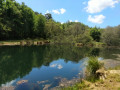
The village of Saint-Dolay overlooks the plateau that borders the south bank of the Vilaine. This flat landscape is cut by a valley with sometimes steep slopes, where the Moulin Neuf stream flows. While moors cover the slopes and heights of the valley, marshes and peat bogs cover the bottom. Add to this variety of vegetation a remarkable geological diversity, and you will have many reasons to explore this route.
Île aux Pies and Vallée de l'Oust
 19.02 mi
+719 ft
-719 ft
9h 20
19.02 mi
+719 ft
-719 ft
9h 20
 Difficult
Departure from Redon (Ille-et-Vilaine)
Difficult
Departure from Redon (Ille-et-Vilaine)
Discover the Oust Valley and the Nantes-Brest Canal, near Redon, and Bains-sur-Oust with this circular route that combines towpaths, forest paths and communal roads.
A few high points will give you a magnificent view of Île aux Pies and the Oust Valley.
 Cycling loop between Guenrouët and the Bellion lock
23.65 mi
+436 ft
-433 ft
3 hrs
Moderate
Departure from Plessé (Loire-Atlantique)
The Isac Valley connects Guenrouët to the Vilaine. Small country roads and wide carriageways, then the towpath of the Nantes-Brest Canal, lead to the Bellion Lock, a nautical stop at the confluence of the canal and the Vilaine. The return journey is the same, via other equally pleasant routes. A bucolic atmosphere is guaranteed on this ride on the edge of the Pays de Redon.
Bailey Bridge seen from Saint-Perreux
 5.64 mi
+20 ft
-16 ft
2h 35
Easy
Departure from Saint-Perreux (Morbihan)
5.64 mi
+20 ft
-16 ft
2h 35
Easy
Departure from Saint-Perreux (Morbihan)
A pleasant route along the Oust and the Arz, ideal for anglers.
The Gannedel and Massérac Marshes
21.40 mi
+443 ft
-443 ft
2.5 hrs
Easy
Departure from Sainte-Marie (Ille-et-Vilaine) (Ille-et-Vilaine)
Upstream from Redon, the Vilaine valley stretches out between the hillsides that flank it to the north and south. Vast expanses of wild or cultivated marshland follow one another, through the midst of which the river flows.
Cycling along the small roads that wind around these marshes is a refreshing way to explore the area and its villages, away from the main roads.
The tour of Île aux Pies, starting from La Potinais
 13.25 mi
+492 ft
-492 ft
6h 30
Difficult
Departure from Saint-Vincent-sur-Oust (Morbihan)
13.25 mi
+492 ft
-492 ft
6h 30
Difficult
Departure from Saint-Vincent-sur-Oust (Morbihan)
To cross the geological fold that extends the Landes de Lanvaux, the Oust has carved its way through the rocky plateau to wind its way through the Île aux Pies gorge. Upstream, at the confluence of the Oust and the Aff, the alluvial plain is sometimes dry, sometimes covered in water. You need to choose the right time to set off. Early spring seems to be the best season to fully enjoy the landscapes you pass through... without getting your feet wet.
The Vilaine hills via Saint-Cry and Sainte-Anne
8.46 mi
+623 ft
-627 ft
4h 25
Moderate
Departure from Nivillac (Morbihan)
The Bovenant hill is one of the hills overlooking the Vilaine marshes, between Saint-Dolay and Béganne. A stone’s throw away, the villages of Saint-Cry and Sainte-Anne are two small settlements where life revolves around their respective chapels. Further north, Ruelmin is practically right on the water’s edge. The suggested route connects these different places through a rolling landscape that alternates between farmland and woodland, with water running as a common thread throughout.
Circular Melneuf from Notre-Dame de Grâce
 5.68 mi
+148 ft
-167 ft
2h 45
Easy
Departure from Guenrouet (Loire-Atlantique)
5.68 mi
+148 ft
-167 ft
2h 45
Easy
Departure from Guenrouet (Loire-Atlantique)
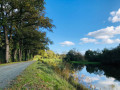
Passing through villages, tree-lined paths and the towpath of the Nantes-Brest Canal, this walk is an opportunity to observe ducks, foxes, swans, coots and deer, if you keep a low profile.
Short circular around Moulin de Quip
 3.04 mi
+177 ft
-187 ft
1h 35
Easy
Departure from Allaire (Morbihan)
3.04 mi
+177 ft
-187 ft
1h 35
Easy
Departure from Allaire (Morbihan)
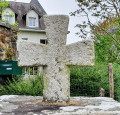
This is a gentle, enchanting walk that allows you to enjoy the woodland paths and the coolness of the long pond at the 18th-century Moulin de Quip mill.
The Coinanton Marshes in Saint-Vincent-sur-Oust
 6.97 mi
+289 ft
-272 ft
3h 25
Moderate
Departure from Saint-Vincent-sur-Oust (Morbihan)
6.97 mi
+289 ft
-272 ft
3h 25
Moderate
Departure from Saint-Vincent-sur-Oust (Morbihan)
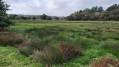
A very lovely walk in the area around Saint-Vincent-sur-Oust through the marshes and woods.
Boro Castle as seen from Saint-Vincent-sur-Oust
 6.29 mi
+282 ft
-272 ft
3h 10
Moderate
Departure from Saint-Vincent-sur-Oust (Morbihan)
6.29 mi
+282 ft
-272 ft
3h 10
Moderate
Departure from Saint-Vincent-sur-Oust (Morbihan)
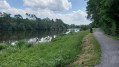
A route starting from Saint-Vincent-sur-Oust, through woodland and along the River Oust.
The Brivet between Branduca and Coisnongle
7.34 mi
+49 ft
-49 ft
3h 25
Moderate
Departure from Drefféac (Loire-Atlantique)
At Pontchâteau, the Brivet flows into a gorge in the Sillon de Bretagne before heading off towards the Brière marshes. But upstream of this gorge, it meanders through the marshes that fill the basin between Dréfféac and Sainte-Anne-sur-Brivet. The suggested route takes you along this very tranquil river, through beautiful wooded countryside, before following its course as closely as possible. And you might even be lucky enough to spot the storks that nest here.
Saint-Vincent-sur-Oust Day 1/2
 11.26 mi
+387 ft
-361 ft
5h 30
Moderate
Departure from Saint-Vincent-sur-Oust (Morbihan)
11.26 mi
+387 ft
-361 ft
5h 30
Moderate
Departure from Saint-Vincent-sur-Oust (Morbihan)
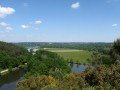
This first day of a two-day route will take us up the River Oust via the upper reaches. We’ll be walking above the river, offering lovely views of Île aux Pies.
The final stretch will be mainly through woodland and meadows.
Along the Oust to discover the Chapel of Saint-Méen
 3.68 mi
+243 ft
-217 ft
1h 55
Easy
Departure from Bains-sur-Oust (Ille-et-Vilaine)
3.68 mi
+243 ft
-217 ft
1h 55
Easy
Departure from Bains-sur-Oust (Ille-et-Vilaine)
This short circular walk allows you to enjoy the panoramic views over Île-aux-Pies, before setting off in search of the Chapel of Saint-Méen, the last remaining vestige of the former Abbey of Busal.It is a place to connect with nature, silence and serenity.
The Pontchâteau viaduct, from above and below
 2.76 mi
+194 ft
-164 ft
1h 25
Easy
Departure from Pontchâteau (Loire-Atlantique)
2.76 mi
+194 ft
-164 ft
1h 25
Easy
Departure from Pontchâteau (Loire-Atlantique)
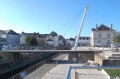
A short walk to explore Pontchâteau from above and below the viaduct, taking you through the marshes and the town centre.
The Brière Marshes: a chance to spot storks
 8.50 mi
+125 ft
-121 ft
4h 00
Moderate
Departure from Pontchâteau (Loire-Atlantique)
8.50 mi
+125 ft
-121 ft
4h 00
Moderate
Departure from Pontchâteau (Loire-Atlantique)
On your way to and from Pontchâteau town centre, discover the Brière marshes. With a bit of luck (in season), you may spot a nest of storks.
Around the Brivet from Pontchâteau
 16.20 mi
+328 ft
-328 ft
7h 45
Difficult
Departure from Pontchâteau (Loire-Atlantique)
16.20 mi
+328 ft
-328 ft
7h 45
Difficult
Departure from Pontchâteau (Loire-Atlantique)
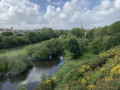
This walk will take you on a journey of discovery around the Pontchâteau area, winding your way along the River Brivet. The route mainly follows easily accessible paths, with a few sections on roads with very little traffic. You’ll encounter plenty of wildlife and a wide variety of vegetation. Please note that after heavy rain, the banks of the Brivet may be flooded.