Country:
 City:
City:


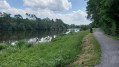
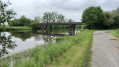
(S/E) Starting from the Potinais lock (a movable lock ensuring navigability on the Nantes–Brest Canal as far as Redon), cross the Oust and follow the canal to the bridge that spans it.
(1) Return to the other bank until you reach the river again and follow it upstream to the first bend, leaving the village of La Potinais on your right, on the hillside.
As the river turns left, follow the path running along the foot of the slope, skirting a patch of marshy meadows. When this path climbs to the right, follow it to reach the village of Saint-Méen.
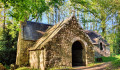
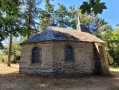
(2) Walk through the hamlet from one end to the other, ignoring the road branching off to the right. After the last house on the left, the street becomes a sunken lane that winds its way up the slope between large, wooded embankments. Turn right at the first crossroads to catch a glimpse of the chapel nestled in its green surroundings.
At the bottom of the valley, take the track to the left that skirts the hillside, returning to run alongside the river. When it begins to climb the slope, leave it for the path that branches off to the left to stay as close as possible to the riverbank.
After passing an island, you’ll come to a small valley which you must go round to the right. To do this, turn right twice, then left twice at the following crossroads and head back down towards the riverbank until you reach the gate leading to a horse pasture.
(3) Just before you get there, take the path that winds its way up to the right through the pine trees (GR® markings). It soon reaches the top of the plateau overlooking the river.
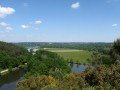
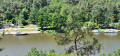
(4) Heading towards the edge of the cliff, you’ll reach the viewpoint offering a sweeping view over the gorge and a panoramic vista of the nearby Ile aux Pies. On this flat plateau, 50 metres above the ground, the view stretches far and wide! Head down towards the campsite via a wide, winding path through the woods. Don’t be surprised to come across plenty of climbers along the way; the cliffs of Île aux Pies are a renowned climbing spot.
(5) Cross the Île aux Pies leisure area, following the banks of the Rio de la Borde, which separates Île aux Pies from the rest of the commune of Bains-sur-Oust. A series of footbridges allow you to cross the many streams that drain this rather damp area. On either side of the bridge leading to the island, recent forestry work has damaged the path. So please watch your step.
When you reach the northern tip of the island, the stream curves westwards to rejoin the Oust. At this point, the path veers slightly to the right to run along the edge of a marshy meadow. For about a hundred metres, and depending on the water level in the streams, the path may be more or less damp. But once past this section, the path becomes passable again until you reach La Grognée.
(6) If it is impossible to cross this section, return to the island bridge and take the paths further inland.
(7) La Grognée provides access to the Mortier de Glénac, a vast expanse of open water and marshland at the confluence of the Aff and the Oust. Turning your back on the expanse of water, head up the path leading towards Port Corbin. It runs alongside the marsh bordering the lower reaches of the Aff, passes beneath the hamlet and joins the road leading to Glénac. Turn left when you reach the road to reach the Pont du Passage.
(8) As you leave the bridge, take the bend to the left and, as soon as you’ve passed the copse, turn left to walk along the edge of the meadow until you reach the bank of the Aff. Once there, turn right and follow the river to the first woods. At the unmistakable “Glénac” sign, turn right to find the footbridge crossing the wooded wetland, then left to rejoin the path marked as theGR® 347. This section is likely impassable once the water level rises in the marsh. You must then follow the road for a few hundred metres after the bridge.
(9) As you come out onto this path, turn left and head towards Glénac harbour, passing beneath some beautiful properties
(10) Walk along the harbour and continue on the road leading off to the west. If you have become accustomed to the red and white markings ofthe GR® 347, ignore them as soon as you pass the sports ground, as the path branches off to the right to go higher up the hillside. Continue along the small road that runs between the course of the Oust and the foot of the hillside. After 2 km, you come out onto the road that crosses the Oust and the canal. Turn left, follow this road for 300 m and turn onto the farm track that branches off to the left, after the Branféré Bridge.
(11) This track runs through the farmland between the meandering course of the Oust and the straight canal. After skirting the Oust and Île des Cobannes, it turns southwards to reach the bridge crossing the canal.
(12) Continue straight on for two hundred metres to reach the foot of the wooded slope. When you reach the road there, ignore theGR® markings heading up the slope and take the path on the left that runs along the base of this hillside. It leads into a stand of chestnut trees of quite impressive height. Here you’ll find the red and white markings ofthe GR® 38, which you’ll see from time to time (and rather randomly) until you reach your destination. This path begins to climb the wooded slope, passing beneath the villages situated on the plateau. We simply skirt past them as we make our way along above the canal. If the foliage doesn’t block your view, you’ll be able to enjoy some lovely views of the Mortier de Glénac.
(13) At the Painfaut campsite, begin the descent towards the river. Just before reaching it, cross the road and continue straight ahead along the path that runs halfway up the slope between the towpath and the service road. Head up to the right, pass the car park and take the first street on the left. Follow it until it turns right and continue straight on along the path that leads into the valley. Ignore the yellow markings which veer off to the right. After about 200 m, you’ll reach the Île aux Pies water sports centre, which you can access by taking the path to the right above the buildings. Continue along the towpath until you reach an old quarry where a tree-top adventure course has been set up.
(14) Continue along the towpath for about 800 m, then take the path on the right which begins to climb the wooded slope. After a climb of about 500 m, you’ll emerge at the site of the former Ti Kendalc’h cultural centre, now completely quiet.
(15) Walk past the star-shaped building, then the long one, leaving the former multi-purpose hall on your right. Continue straight on along the path that once provided access to the site until you reach the service road, which you then follow to the first crossroads.
Turn left towards Boro, which you cross until you reach the first road on the left, leading to the river and its towpath.
(16) When you reach the river, turn right and continue along the towpath. Pass two large bends before you see the dam and the canal diversion. This is where you’ll find the starting point (S/E).


 Visorando Member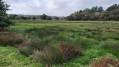
 Moderate
 Easy
Easy