Refine your search for walks in Vauvert
Vauvert walks


 Les Costières de Nîmes
 Visorando Member
 8.90 mi
 +568 ft
 -538 ft
 4h 35
4h 35
 Moderate
 Departure from Vauvert (Gard)
A walk winding through the hilly surroundings of the town of Vauvert and the Costières de Nîmes plateau, renowned for its wines.
The meadows of Le Cailar
 5.70 mi
+10 ft
-13 ft
2h 40
5.70 mi
+10 ft
-13 ft
2h 40
 Easy
Departure from Le Cailar (Gard)
Easy
Departure from Le Cailar (Gard)
A short half-day hike to breathe in and enjoy the Camargue and its treasures: horses, bulls, herons, storks, etc.
As "denisdenim" points out, there is an alternative route to avoid the road at point 1: cross it and take the small road that passes by the Mas du Bourry farmhouse, keeping to the right to rejoin the main road and descend towards point 2.
Meadows (les) du Cailar
5.88 mi
+7 ft
-7 ft
2h 40
Easy
Departure from Le Cailar (Gard)
Discover an authentic Camargue village with its customs and the statue of a bull ("Le Sanglier") at the entrance to the village of Le Cailar! A great, very short but very green hike through the meadows, with just a little bit of tarmac. Redone in January 2025, still as enjoyable as ever.
Le Cailar, the banks of the Philippe Lamour Canal and the Gallician fruit trees.
 4.36 mi
+213 ft
-135 ft
2h 10
Easy
Departure from Le Cailar (Gard)
4.36 mi
+213 ft
-135 ft
2h 10
Easy
Departure from Le Cailar (Gard)
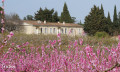
A beautiful walk to discover the banks of the Philippe Lamour Canal and the orchards (peach trees, almond trees, vines). Always in the sun, it is the ideal walk for sunny winter days.
 On the Costière de Nîmes, around Beauvoisin, Vauvert and Générac
11.59 mi
+584 ft
-591 ft
1 hr
Easy
Departure from Beauvoisin (Gard) (Gard)
A fun, quick little hike in the Costière de Nîmes with little elevation gain.
Œnorando® Between the Costières and the Camargue from Gallician
 Tourist office
 6.51 mi
+112 ft
-98 ft
3h 05
Moderate
Departure from Vauvert (Gard)
6.51 mi
+112 ft
-98 ft
3h 05
Moderate
Departure from Vauvert (Gard)
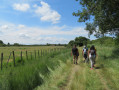
This walk, marked in yellow, invites you to explore the southernmost part of the Costières de Nîmes AOP. On this land of rounded pebbles, the sun, the mistral and the sea breezes combine to create a unique terroir, evident even in the pebble walls of the cellars and estates you’ll come across along the way. Set between the two canals of southern Gard, the vineyard plots of the Costières de Nîmes AOP and a viewpoint overlooking the ponds, this easy walk will transport you through the varied landscapes of the Camargue in the Gard. It’s the perfect opportunity to observe the typical Costières terroir, with its pebbles smoothed over millennia by the Rhône, the wine-growing farmhouses and their imposing gates, whilst keeping an eye out for the Camargue birds that inhabit the banks of the canals.
Between Port de Gallician and the Carbonière Tower
 13.87 mi
+82 ft
-82 ft
2 hrs
Easy
Departure from Vauvert (Gard)
13.87 mi
+82 ft
-82 ft
2 hrs
Easy
Departure from Vauvert (Gard)
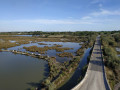
A short, easy route, by hybrid or mountain bike, along the greenway or paths in the Petite Camargue between Gallician and the Tour Carbonière.
You’ll discover the beautiful landscapes of this wetland and come across numerous birds, horses, Camargue bulls and possibly a few flamingos near the Tour Carbonière.
Gallician - Prés du Cailar - Banks of the Vistre
 9.26 mi
+167 ft
-164 ft
4h 25
Easy
Departure from Vauvert (Gard)
9.26 mi
+167 ft
-164 ft
4h 25
Easy
Departure from Vauvert (Gard)
A beautiful outing between the Rhône Canal in Sète, Les Fruitiers and Les Costières, as well as the meadows where Camargue horses and bulls live peacefully.
Gallician and the meadows of Le Cailar
 9.63 mi
+223 ft
-220 ft
4h 35
Moderate
Departure from Vauvert (Gard)
9.63 mi
+223 ft
-220 ft
4h 35
Moderate
Departure from Vauvert (Gard)
A pleasant walk among the peach trees. A calm and relaxing setting, especially in the meadows of Le Cailar.
Vestric Pond
6.68 mi
+46 ft
-46 ft
1 hr
Easy
Departure from Vergèze (Gard)
A family walk starting from the entrance to Vergèze and heading to the Étang de Vestric. Mixed terrain (paths and roads).
The Camargue between ponds, marshes and canals
 8.33 mi
+62 ft
-62 ft
3h 55
Moderate
Departure from Beauvoisin (Gard) (Gard)
8.33 mi
+62 ft
-62 ft
3h 55
Moderate
Departure from Beauvoisin (Gard) (Gard)
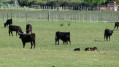
A beautiful hike between "two waters" in the heart of the Camargue.
Ponds, marshes, the Rhône Canal in Sète, the Philippe Lamour Canal, horses, bulls... everything that makes up the Camargue is brought together on a magnificent circuit with no difficulty other than its length.
Two castles in Marsillargues
4.57 mi
+13 ft
-13 ft
2h 05
Easy
Departure from Marsillargues (Hérault)
Hike to discover two castles: the Château de Marsillargues, former castle of Guillaume de Nogaret, in the centre of the town, which houses a museum, and the Château de Teillan, a former fortified castle nestled between the Vidourle river, the Camargue horse pastures and the vineyards of the Marsillargues region.
Cougourlier trail
 3.93 mi
+10 ft
-10 ft
1h 50
Easy
Departure from Saint-Gilles (Gard)
3.93 mi
+10 ft
-10 ft
1h 50
Easy
Departure from Saint-Gilles (Gard)
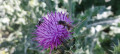
Discover the Camargue in less than two hours, without any difficulty, ideally in April-May when it is not too hot and the water irises and poppies are in bloom.
Wild scorpion beetle: a Camargue symphony
 3.10 mi
+3 ft
-3 ft
1h 25
Easy
Departure from Vauvert (Gard)
3.10 mi
+3 ft
-3 ft
1h 25
Easy
Departure from Vauvert (Gard)
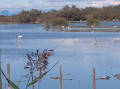
In the heart of the Petite Camargue, this easy circular invites you to immerse yourself in the vibrant world of the Scamandre Nature Reserve. Between rustling reed beds, sparkling ponds and footbridges on stilts, the trail unfolds like a musical score where each step reveals a new note of wildlife.This trail winds through a preserved landscape, a refuge for many species of birds, including the elegant little egret, the mischievous cattle egret and the flamingo. Discreet observatories punctuate the walk, offering moments of tranquillity to contemplate without disturbing.
The Path of 17 Drystone Shelters
 4.11 mi
+240 ft
-233 ft
2h 05
Easy
Departure from Milhaud (Gard)
4.11 mi
+240 ft
-233 ft
2h 05
Easy
Departure from Milhaud (Gard)
In the heart of the Milhaud heath, on this superb signposted trail, you will find typical drystone shelters with information panels. A short hike with some lovely surprises in store.
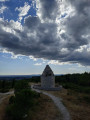
Calvisson and its mills
 2.16 mi
+397 ft
-377 ft
1h 20
Easy
Departure from Calvisson (Gard)
2.16 mi
+397 ft
-377 ft
1h 20
Easy
Departure from Calvisson (Gard)
A short walk to discover the capital of the Vaunage region and its mills at the top of Roc de Gachone, which offers a beautiful view from Pic-Saint-Loup to Mont Ventoux.
La Vaunage starting from Calvisson
11.55 mi
+997 ft
-991 ft
1.5 hrs
Moderate
Departure from Calvisson (Gard)
A lovely mountain bike ride starting from “Calvisson la Vaunage” with a few alternative routes.
Interesting but very stony.