


Refine your search for walks in Quéménéven
Quéménéven walks


 The Kergoat route via Locronan
 Visorando Member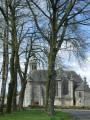
 6.90 mi
 +430 ft
 -417 ft
 3h 35
3h 35
 Moderate
 Departure from Quéménéven (Finistère)
Countryside route along sunken paths connecting Kergoat Chapel to the town of Locronan and back along the Forêt du Duc.
In the countryside between Saint-Albin and Quéménéven
 6.98 mi
+571 ft
-561 ft
3h 40
Moderate
Departure from Plogonnec (Finistère)
6.98 mi
+571 ft
-561 ft
3h 40
Moderate
Departure from Plogonnec (Finistère)
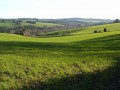
A route through the countryside with rolling hills offering wide open views. The route mainly follows quiet country lanes. Discover picturesque views, including Ménez Hom (330m), which marks the western end of the Montagnes Noires range.
Route de Saint-Albin en Plogonnec
 6.93 mi
+463 ft
-446 ft
3h 35
Moderate
Departure from Plogonnec (Finistère)
6.93 mi
+463 ft
-446 ft
3h 35
Moderate
Departure from Plogonnec (Finistère)
A route through undulating countryside, offering vast expanses of farmland surrounding a few hamlets.
The route mainly follows quiet country lanes.
Discover picturesque views from the hilltops, with the Montagne du Prieuré de Locronan towering above it all.
Chapels of Briec and the Ménez-Roc'h-Meur site
 6.55 mi
+561 ft
-558 ft
3h 30
Moderate
Departure from Landrévarzec (Finistère)
6.55 mi
+561 ft
-558 ft
3h 30
Moderate
Departure from Landrévarzec (Finistère)
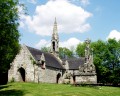
A countryside route exploring three chapels, all situated in remarkable locations.The chapel at Saint-Venec is particularly well known for its calvary and its majestic fountain.The route also takes you to Ménez-Roc’h-Meur, from where the view stretches across the whole of Douarnenez Bay.
The Kergoat Route
 5.95 mi
+282 ft
-282 ft
3h 00
5.95 mi
+282 ft
-282 ft
3h 00
 Easy
Departure from Quéménéven (Finistère)
Easy
Departure from Quéménéven (Finistère)
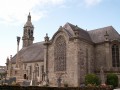
Countryside route offering views of the Notre Dame de Kergoat Chapel (16th century, famous for Jules Breton's painting "Le Pardon de Kergoat" 1891, on display at the Quimper Museum of Fine Arts.
Pass by the fountain and the edge of the Forêt du Duc.
Countryside and heritage in Landrévarzec
 4.99 mi
+259 ft
-246 ft
2h 30
Easy
Departure from Landrévarzec (Finistère)
4.99 mi
+259 ft
-246 ft
2h 30
Easy
Departure from Landrévarzec (Finistère)
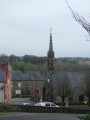
A discovery route through authentic countryside, enhanced by the village of Quilinen with its chapel, calvary and fountain, listed as historic monuments since 1990.
The interior of the chapel and the calvary have recently been restored.
Two other fountains are also of interest.
In the Stéïr valley, starting from Pont Quéau
 7.42 mi
+732 ft
-728 ft
4h 05
Moderate
Departure from Quimper (Finistère)
7.42 mi
+732 ft
-728 ft
4h 05
Moderate
Departure from Quimper (Finistère)
A hilly route through the countryside where the Stéïr, a tributary of the Odet, flows.
In the woods of Saint-Gildas between the chapel and the wind turbines.
 6.57 mi
+725 ft
-728 ft
3h 40
Moderate
Departure from Cast (Finistère)
6.57 mi
+725 ft
-728 ft
3h 40
Moderate
Departure from Cast (Finistère)
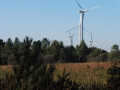
From the clearing surrounded by beech, chestnut and cypress trees, discover the long Saint-Gildas Chapel and, a little further down, its associated fountain, then venture into the Saint-Gildas woods overlooking the Châteaulin valley. Continue through this area where there are numerous wind turbines.The long climb up the old Châteaulin-Quimper Roman road may leave you panting before you reach the bare heights of Ménez Quelc'h.
Currently being revised
Ménez Roc’h Meur walk starting from the Notre-Dame d’Illijour Chapel
 4.96 mi
+518 ft
-518 ft
2h 50
Easy
Departure from Briec (Finistère)
4.96 mi
+518 ft
-518 ft
2h 50
Easy
Departure from Briec (Finistère)
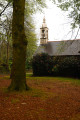
From the Chapel of Notre-Dame d’Illijour, come and discover some wonderful panoramic views as you walk around Ménez Roc’h Meur, Briec’s highest point at an altitude of 230 m. Weather permitting, you’ll be able to see the sea and the cliffs of the Crozon Peninsula. And if you feel like it, two extension routes will take you to the foot of the Chapel of Garnilis (a further 1 km) and the listed Chapel of Saint-Venec (a further 2 km).
On the heights of Locronan
 4.95 mi
+653 ft
-636 ft
2h 50
Moderate
Departure from Locronan (Finistère)
4.95 mi
+653 ft
-636 ft
2h 50
Moderate
Departure from Locronan (Finistère)
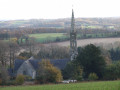
Along beautiful paths through the woods and small roads, this route takes you up the Montagne de Locronan, where the little Chapelle ar Sonj chapel is located, an essential stop on the various troménies: viewpoint over Locronan and the entire Porzay region from Ménez Hom to the Bay of Douarnenez. The route continues down into the woods to the imposing Chapelle Saint-Thélau chapel, before returning via the historic centre of Locronan.
Around and in Locronan
 3.36 mi
+367 ft
-361 ft
1h 50
Easy
Departure from Locronan (Finistère)
3.36 mi
+367 ft
-361 ft
1h 50
Easy
Departure from Locronan (Finistère)
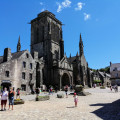
This short route takes you through the north-western part of the Locronan countryside with its beautiful sunken paths and passes by some of the iconic sites of this village, which is classified as a "Petite Cité de caractère de France" (Small Town of Character in France): the Manoir de Kerguénolé, the Chapelle Notre-Dame de Bonne Nouvelle and, of course, the central square with the Église Saint-Ronan.
Let yourself be guided through the many narrow streets.
The banks of the Steïr and woodland from Menfouest Chapel
 3.66 mi
+397 ft
-384 ft
2h 00
Easy
Departure from Quimper (Finistère)
3.66 mi
+397 ft
-384 ft
2h 00
Easy
Departure from Quimper (Finistère)
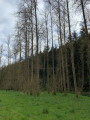
A return walk through unspoilt countryside along the Steïr, a tributary of the Odet, and then through the woods of this valley.The route may take you across two bridges used by the TER train linking Quimper to Landerneau.Along the route, you’ll pass the Menfouest Chapel and Kergadou Manor.
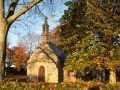
Menfouest Chapel Route
 4.29 mi
+341 ft
-381 ft
2h 15
Easy
Departure from Quimper (Finistère)
4.29 mi
+341 ft
-381 ft
2h 15
Easy
Departure from Quimper (Finistère)
Starting from the Menfouest Chapel and its bucolic setting, this route will first take you along small country lanes through countryside dominated by cattle farming.
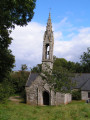
Sainte-Barbe Chapel and the Ploéven countryside
 6.62 mi
+456 ft
-443 ft
3h 25
Moderate
Departure from Ploéven (Finistère)
6.62 mi
+456 ft
-443 ft
3h 25
Moderate
Departure from Ploéven (Finistère)
Starting at the 16th-century Sainte-Barbe Chapel, built on a site said to have been founded by monks from across the Channel, the route continues through the Porzay countryside, a mosaic of colours depending on the crops and the season.Along the way, discover the ‘Quenouille de Sainte-Barbe’, an Iron Age stele, no doubt used for Celtic cultural ceremonies.It is also thought to have served as a pillory for tying up those condemned to death who were hanged there.
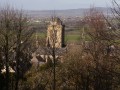
Locronan Mountain Route
 6.67 mi
+725 ft
-709 ft
3h 40
Moderate
Departure from Plogonnec (Finistère)
6.67 mi
+725 ft
-709 ft
3h 40
Moderate
Departure from Plogonnec (Finistère)
Let's climb Locronan Mountain, where we will have a view of the Porzay basin and Douarnenez Bay. Along the way, we can admire the Saint-Théleau Chapel and the Kerguénolé Manor and its grounds overlooking the village of Locronan.
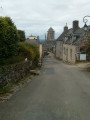
Via the Locronan mountain
 5.95 mi
+666 ft
-676 ft
3h 20
Moderate
Departure from Locronan (Finistère)
5.95 mi
+666 ft
-676 ft
3h 20
Moderate
Departure from Locronan (Finistère)
From the lively village of Locronan, climb the mountain that overlooks it, offering a beautiful panorama from the Bay of Douarnenez to the last peak of the Black Mountains, Ménez Hom (330 m).A beautiful descent takes you back to the countryside and its sunken paths to return to the heart of the former weavers' town.
Tro Sant Per from Plogonnec
 6.41 mi
+679 ft
-663 ft
3h 30
Moderate
Departure from Plogonnec (Finistère)
6.41 mi
+679 ft
-663 ft
3h 30
Moderate
Departure from Plogonnec (Finistère)
A countryside walk taking in the Saint-Pierre Chapel, the edge of the Bois du Névet and the hills overlooking Locronan.
Route in the country via the Bonnescat mill
 6.42 mi
+502 ft
-509 ft
3h 25
Easy
Departure from Plogonnec (Finistère)
6.42 mi
+502 ft
-509 ft
3h 25
Easy
Departure from Plogonnec (Finistère)
Countryside route overlooking the Kerganapé stream and its mills.
In the Steïr valley
 5.74 mi
+545 ft
-538 ft
3h 05
Easy
Departure from Plogonnec (Finistère)
5.74 mi
+545 ft
-538 ft
3h 05
Easy
Departure from Plogonnec (Finistère)
This route, very close to Quimper, alternates between small country lanes and sections through woodland. It also takes you along the right bank of the River Steïr, allowing you to explore the valley floor and the infrastructure for the Quimper-Brest railway line. At the start, the small Seznec chapel, dating from 1673, with its calvary in the enclosure.
Passing by the Saint-Alouarn Mill
 7.10 mi
+636 ft
-653 ft
3h 50
Moderate
Departure from Plogonnec (Finistère)
7.10 mi
+636 ft
-653 ft
3h 50
Moderate
Departure from Plogonnec (Finistère)
Following small country lanes, wooded paths and the old railway line converted into a greenway, let’s go and see the old feudal mill at Saint-Alouarn.
Through the Bois du Névet forest from Locronan
 7.48 mi
+479 ft
-505 ft
3h 50
Moderate
Departure from Locronan (Finistère)
7.48 mi
+479 ft
-505 ft
3h 50
Moderate
Departure from Locronan (Finistère)
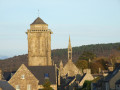
The route combines views of the historic centre of Locronan with a walk through part of the Bois du Névet forest.Return via sunken paths and a visit to the Chapelle de la Bonne Nouvelle chapel.
Along the sunken paths around Locronan
 6.21 mi
+627 ft
-630 ft
3h 25
Moderate
Departure from Locronan (Finistère)
6.21 mi
+627 ft
-630 ft
3h 25
Moderate
Departure from Locronan (Finistère)
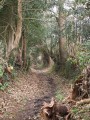
Like the troménie ("troménie" is a French adaptation of the Breton tro-minihi, literally tour - tro - du minihi, derived from the Latin monachia - monastic space in the early Middle Ages), this route will take you around Locronan. You will mainly follow old sunken paths and discover beautiful granite farmhouses. Near the end of your route, a high point will offer you a view of the Bay of Douarnenez.
Locronan and its bocage
 6.04 mi
+564 ft
-564 ft
3h 15
Easy
Departure from Locronan (Finistère)
6.04 mi
+564 ft
-564 ft
3h 15
Easy
Departure from Locronan (Finistère)
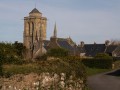
After wandering through the streets and alleys of Locronan, follow the paths through the bocage to return via the Bois du Névet.
In the heart of Locronan
 1.86 mi
+135 ft
-135 ft
1h 00
Easy
Departure from Locronan (Finistère)
1.86 mi
+135 ft
-135 ft
1h 00
Easy
Departure from Locronan (Finistère)
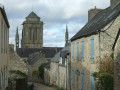
Through streets, alleys and paths, this route takes you on a journey of discovery through the heart of Locronan, a former weaving village and small town of character.From the 15th century onwards, the hemp and flax trade brought wealth to the town through the sailcloth market, which supplied the largest ships of the time.The impressive granite buildings are a testament to this today.
Locronan countryside and edge of Bois du Névet
 6.72 mi
+472 ft
-463 ft
3h 30
Moderate
Departure from Locronan (Finistère)
6.72 mi
+472 ft
-463 ft
3h 30
Moderate
Departure from Locronan (Finistère)
After passing through the countryside north-west of Locronan, this route turns south-west and ends at the edge of the Bois du Névet. It continues mainly along the edge of the forest before returning to Locronan.
The small troménie route of Locronan
 3.87 mi
+453 ft
-453 ft
2h 10
Easy
Departure from Locronan (Finistère)
3.87 mi
+453 ft
-453 ft
2h 10
Easy
Departure from Locronan (Finistère)
Every six years, Locronan hosts "la Grande Troménie", an unchanging pilgrimage of around 12 km around the sacred boundaries of the former monastery of Locronan. The last one took place in July 2025.
The "Petite Troménie" takes place annually, during the five years between two Grande Troménies. It only follows small roads. This route follows this route.
Bois du Névet via the bridle path
 5.60 mi
+591 ft
-584 ft
3h 05
Moderate
Departure from Locronan (Finistère)
5.60 mi
+591 ft
-584 ft
3h 05
Moderate
Departure from Locronan (Finistère)
In the Bois du Névet, following the bridle path allows you to venture along small, wild and deserted tracks that criss-cross the woodland. You’ll avoid the wide, often very busy paths.
Why not give this route a go?
Around the Chapelle Saint-Pierre in Plogonnec
 2.14 mi
+272 ft
-282 ft
1h 15
Easy
Departure from Plogonnec (Finistère)
2.14 mi
+272 ft
-282 ft
1h 15
Easy
Departure from Plogonnec (Finistère)
From the majestic Saint-Pierre Chapel, this short circular route continues along the edge of the Bois du Névet, then returns through the countryside via farm tracks and a quiet road serving only farms.
In the Bois du Névet via the Chapelle Saint-Pierre
 6.87 mi
+581 ft
-584 ft
3h 40
Moderate
Departure from Plogonnec (Finistère)
6.87 mi
+581 ft
-584 ft
3h 40
Moderate
Departure from Plogonnec (Finistère)
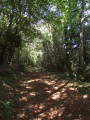
Starting from the beautiful Saint-Pierre Chapel, this route ventures into the Bois du Névet, a deciduous forest.
The route follows paths along the edge of the forest, a few sections of wide forest lanes and, towards the end, a wilder path above the Manoir du Névet estate.
In summer, you will appreciate the shaded route and in autumn, the colours of the foliage.
Passing by La Roche du Feu
 6.03 mi
+673 ft
-659 ft
3h 20
Moderate
Departure from Gouézec (Finistère)
6.03 mi
+673 ft
-659 ft
3h 20
Moderate
Departure from Gouézec (Finistère)
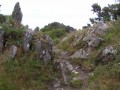
The route passes by the Roche du Feu (Karreg an Tan), the highest point of the Montagnes Noires (281m).
Hent Glaz (the Briec tower)
 6.24 mi
+325 ft
-315 ft
3h 10
Moderate
Departure from Briec (Finistère)
6.24 mi
+325 ft
-315 ft
3h 10
Moderate
Departure from Briec (Finistère)
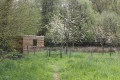
The Hent Glaz route (the Briec tour) showcases the surrounding countryside and the wetlands and wooded areas of Briec through streams and warrens. You will discover panoramic views towards Landudal and Edern, a passage close to the Manoir de la Boissière, Anita Conti Park, the heights of Briec de l'Odet, then the future urban forest of 7,000 newly planted trees and beautiful meadows and wetlands that will remind you of a bayou. Don't be surprised if you come across a deer or see a buzzard hovering above you in the unspoilt, natural vegetation, which is rich in biodiversity.
 Le Juch - Douarnenez circular via the Greenway
 24.29 mi
+640 ft
-636 ft
3 hrs
Moderate
Departure from Guengat (Finistère)
24.29 mi
+640 ft
-636 ft
3 hrs
Moderate
Departure from Guengat (Finistère)
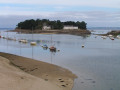
This route follows the route of the old Quimper - Douarnenez railway line.Along the way, take a short detour to pass through the village of Le Juch and cross Douarnenez along the seafront.
Hike around the St. Alouarn mill
 5.91 mi
+482 ft
-453 ft
3h 10
Easy
Departure from Guengat (Finistère)
5.91 mi
+482 ft
-453 ft
3h 10
Easy
Departure from Guengat (Finistère)
Discover the remains of the Manor of Saint-Alouarn and the mill, via the Quimper-Douarnenez bike route and country roads.
Saint-Laurent Chapel and Aulne Canal from Saint-Coulitz
 5.83 mi
+449 ft
-479 ft
3h 05
Easy
Departure from Saint-Coulitz (Finistère)
5.83 mi
+449 ft
-479 ft
3h 05
Easy
Departure from Saint-Coulitz (Finistère)
Hike along small roads, paths and towpaths to discover Saint-Coulitz, its religious heritage and the beauty of the surrounding nature.
Châteaulin right-bank route
 3.60 mi
+223 ft
-223 ft
1h 50
Easy
Departure from Châteaulin (Finistère)
3.60 mi
+223 ft
-223 ft
1h 50
Easy
Departure from Châteaulin (Finistère)
Starting from the old Châteaulin station, this walk combines town streets and dirt tracks, ending on the old railway line with views of the town’s bridges.
Canal route departing from the former station
 6.09 mi
+272 ft
-253 ft
3h 00
Easy
Departure from Châteaulin (Finistère)
6.09 mi
+272 ft
-253 ft
3h 00
Easy
Departure from Châteaulin (Finistère)
Set off on foot along the former Châteaulin-Carhaix railway line, overlooking the still-canalised Aulne river, continue along an old Roman road, then follow the towpath of the Nantes-Brest Canal to discover the heart of Châteaulin at the end of the route.
Along the Aulne in Châteaulin
 6.72 mi
+318 ft
-299 ft
3h 20
Moderate
Departure from Châteaulin (Finistère)
6.72 mi
+318 ft
-299 ft
3h 20
Moderate
Departure from Châteaulin (Finistère)
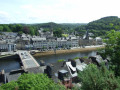
With the River Aulne, in its final stretch before the sea, as our guide, let’s set off to explore Port-Launay, a former river port. Let’s follow the towpath and then climb up to the Notre-Dame Chapel, which offers a view of Châteaulin, before returning to the river.
In the Guengat countryside
 5.14 mi
+190 ft
-190 ft
2h 30
Easy
Departure from Guengat (Finistère)
5.14 mi
+190 ft
-190 ft
2h 30
Easy
Departure from Guengat (Finistère)
Following the former Quimper-Douarnenez railway line at times, take a detour to discover the Saint-Thégonnec Chapel and its fountain inside. Return to the village of Guengat via small country roads.
Route of chapels starting from Quimper and passing through Plogonnec
 20.61 mi
+1,467 ft
-1,467 ft
3 hrs
Moderate
Departure from Quimper (Finistère)
20.61 mi
+1,467 ft
-1,467 ft
3 hrs
Moderate
Departure from Quimper (Finistère)
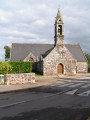
Discover part of the religious heritage of the area around Quimper via a hilly route mainly following small country lanes.
Around the logging trails of Aulne by the Vieux-Bourg
 7.09 mi
+312 ft
-331 ft
3h 30
Moderate
Departure from Lothey (Finistère)
7.09 mi
+312 ft
-331 ft
3h 30
Moderate
Departure from Lothey (Finistère)
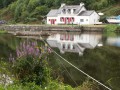
Make your way gently along the the Aulne following the logging trail. Views over the lock keepers’ houses located on the other side. Passage through the Vieux-Bourg and its St-They church, the birthplace of the parish of Lothey until 1846.
Via the towpath and the highest point at Lothey
 5.37 mi
+495 ft
-518 ft
2h 55
Moderate
Departure from Lothey (Finistère)
5.37 mi
+495 ft
-518 ft
2h 55
Moderate
Departure from Lothey (Finistère)
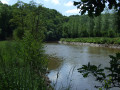
This little-used route descends towards the towpath of the channelled Aulne and follows the river, lined with beautiful ash trees.After the somewhat noisy stretch under the N165 bridge, the route continues along quiet country lanes and several grassy paths to reach the highest point in the commune of Lothey (166 m), offering a sweeping panorama of the Châteaulin basin which separates the Monts d’Arrée from the Montagnes Noires.Finish with a return trip to the wash house and the Saint-Fiacre fountain.
Around the Odet at Stangala
 3.93 mi
+430 ft
-430 ft
2h 10
Easy
Departure from Ergué-Gabéric (Finistère)
3.93 mi
+430 ft
-430 ft
2h 10
Easy
Departure from Ergué-Gabéric (Finistère)
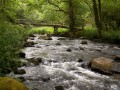
This short walk allows you to explore a part of the Stangala site that is relatively steep and to follow the River Odet.
Returning via a small road allows you to complete a circular route, avoiding the more difficult sections.
Along the Odet at Stangala
 3.42 mi
+279 ft
-279 ft
1h 50
Easy
Departure from Ergué-Gabéric (Finistère)
3.42 mi
+279 ft
-279 ft
1h 50
Easy
Departure from Ergué-Gabéric (Finistère)
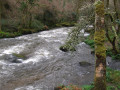
Between Quimper and the commune of Ergué-Gabéric, the 80-hectare Stangala communal property features deep gorges carved out over time by the Odet, which sometimes resembles a mountain torrent, leaping over rocky outcrops. This route allows you to follow part of the river's course, from calm areas to more turbulent ones. The end of the route crosses a wild wooded area.
The Odet at the Stangala Gorges
 7.21 mi
+728 ft
-705 ft
3h 55
Moderate
Departure from Quimper (Finistère)
7.21 mi
+728 ft
-705 ft
3h 55
Moderate
Departure from Quimper (Finistère)
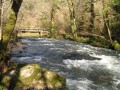
The Odet River first rolls its cool waves through gently rolling hills, wooded countryside and long meadows.Then, suddenly, upstream from Quimper, it carves out a narrow, deep gorge and describes a surprising "hairpin bend" around the Griffonès cliff, creating a wild, winding ravine framed by woods, rocks and moors.It is this discovery that I invite you to explore.
From Kerlic to the old Kerrous quarry
 2.44 mi
+102 ft
-105 ft
1h 15
Easy
Departure from Quimper (Finistère)
2.44 mi
+102 ft
-105 ft
1h 15
Easy
Departure from Quimper (Finistère)
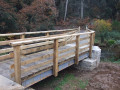
From the Kerlic health centre, theGR®38 takes us through part of the Stangala woods to the banks of the Odet, where a new footbridge has been installed.
This provides access to the site of the former Kerrous aggregate quarry, which has been redeveloped as a walking area with deciduous trees. A small viewing point overlooks the extraction pit, which has been converted into a drinking water reservoir.
A short walk on the outskirts of Quimper.
Route pédagogique along the Odet Canal
 1.93 mi
+26 ft
-26 ft
0h 55
Easy
Departure from Briec (Finistère)
1.93 mi
+26 ft
-26 ft
0h 55
Easy
Departure from Briec (Finistère)
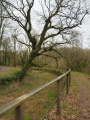
This canal was built between 1852 and 1858. It carried water from the Odet to the mill, where its power was used to drive the machinery and was essential for the production of paper pulp.
The paper mill closed in 1983, rendering the canal obsolete.
A educational route, marked by 9 information panels, has been created by the departmental council, which owns a large part of the site, the municipality of Ergué-Gabéric and the O.N.F.
Come and explore it.
Canal and Stang Luzigou route
 6.39 mi
+397 ft
-400 ft
3h 15
Easy
Departure from Ergué-Gabéric (Finistère)
6.39 mi
+397 ft
-400 ft
3h 15
Easy
Departure from Ergué-Gabéric (Finistère)
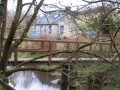
After following the Odet and the leat of the old paper mills, a beautiful circular route takes us through the wooded area of Stang Luzigou. On the way back, we pass through the Kerho Arboretum.Discover the Saint-Corentin Chapel in the hamlet of Kreïker.
The Stangala trail starting from Saint-Guénolé Chapel
 4.74 mi
+633 ft
-620 ft
2h 45
Moderate
Departure from Ergué-Gabéric (Finistère)
4.74 mi
+633 ft
-620 ft
2h 45
Moderate
Departure from Ergué-Gabéric (Finistère)
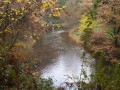
After exploring Saint-Guénolé Chapel, let’s approach the Stangala site from the side opposite Quimper.
Let’s head down to the Odet as it winds its way through here and climb a little higher to get a panoramic view.
At the source of the Goyen
 7.05 mi
+522 ft
-525 ft
3h 40
Moderate
Departure from Plonéis (Finistère)
7.05 mi
+522 ft
-525 ft
3h 40
Moderate
Departure from Plonéis (Finistère)
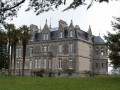
Route in rolling countryside mainly devoted to livestock farming, where the River Goyen has its source. Through wooded areas and along small country roads, this route takes you to two manor houses and a chapel in a rural setting. Its fountain, located at the bottom of a wild valley, is accessed by a staircase of 80 steps.
NB: some sections are tricky since Storm Ciaran.
Tour of Ménez Hom from the Sainte-Marie Chapel
 7.17 mi
+850 ft
-869 ft
4h 00
Moderate
Departure from Plomodiern (Finistère)
7.17 mi
+850 ft
-869 ft
4h 00
Moderate
Departure from Plomodiern (Finistère)
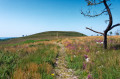
Ménez Hom is the highest hill in the western Montagnes Noires. Its two main peaks, Yelc'h (or Hielc'h according to the IGN map) and Yed, overlook Douarnenez Bay and Brest Harbour.
This route goes around them, along paths that are sometimes very discreet on its slopes and summits, and offers a vast panorama between the Aulne Valley and the Iroise Marine Natural Park.
Around and on the peaks of Ménez-Hom
 7.73 mi
+942 ft
-942 ft
4h 25
Moderate
Departure from Plomodiern (Finistère)
7.73 mi
+942 ft
-942 ft
4h 25
Moderate
Departure from Plomodiern (Finistère)
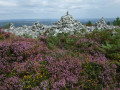
Circular route around Ménez-Hom, the final peak of the Montagnes Noires, via a route through the countryside on the eastern side before beginning the ascent to pass over the two peaks: Le Yed (329m) and then Le Hielc’h (298m).Wide panoramic views over the Aulne Valley and its suspension bridge, the head of Brest harbour and the whole of Douarnenez Bay.Beautiful vegetation comprising open heathland and heather in bloom from June onwards.You can visit the imposing chapel (if open) and its churchyard, which features a calvary dating from 1544.