Country:
 City:
City:


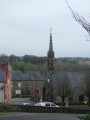
Departure: Place de la Fontaine behind the church: large free car park.
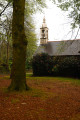
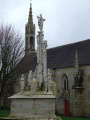
(S/E) From the car park, climb a small staircase and walk along the right-hand side of the church: note the large, naïve-style statue of Saint Guénolé, patron saint of the parish, near the church. With your back to the church and the town hall on your right, go down and follow the first street on the right. Immediately on your left, you will see the fountain and the Saint-Guénolé wash house. Turn left into Impasse du Kreisker and you will come to a metal footbridge over a small stream.
(1) Cross the footbridge and turn left to walk up alongside the small stream on your left. At the end, cross the street and continue straight ahead along Rue du Stade. Go through the gate and turn left to walk along one side of the football pitch to the corner.
(2) Climb the embankment via the rough steps in the grass and continue to the right along the path overlooking the stadium. At the end, turn left to join a larger street (signposted Le Stankou). Follow this street to the right and, after a bus stop, turn right onto the footpath that runs alongside a large grassy area with children's playground equipment.
(3) At the roundabout, turn right then left into Clos des Chênes and return to the
small road indicated by the Kervalennou sign. You will arrive at a football pitch.
(4) Turn right onto a farm track that leads to the hamlet of Kervoueled.
(5) At the exit, turn left at the hairpin bend, continue along the edge of the woods and you will reach the D770.
(6) Turn left onto a path at the edge of the field and head towards a house. Opposite the entrance, pass to the right on the embankment to return to the D770 and follow it to the left for about a hundred metres.
(7) Cross the main road with caution and continue left on the small road towards Ty Pin (Ti Pin on the IGN map), cross the hamlet and arrive at Ty Dokig (Ti Dokig on the IGN map), which you also cross.
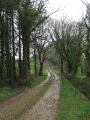
(8) At the end of the hamlet, leave the road and turn right onto a wide path, an old Roman road. Go straight down to the bottom of the valley where a stream flows, then climb up the side of the rock. At the road, turn left, pass in front of the Kervez farm (Kervaez on the IGN map) and take the road on the left to the D770. Cross it carefully and continue straight ahead to Quilinen.
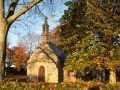
(9) Opposite the renowned inn of the same name, turn left to discover the15th-century chapel and its16th-centurycalvary. A visit to the chapel allows you to admire the recently restored frescoes (open on the third Sunday of the month with guided tours).
Walk around the building to see the porch and appreciate the size of the building.
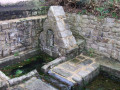
Turn left onto the small road and continue for 50 metres to the fountain and wash house associated with the chapel. Continue straight ahead, uphill, passing an abandoned poultry slaughterhouse, until you reach the fork at a place called Brungwen (old well on the left).
(10) Turn right and follow the small road between the fields to the next place called Toul ar Rognon (Toull ar Runiou on the IGN map), where you turn left. Continue straight ahead until you reach the junction with a larger road.
Turn left, pass the sign marking the entrance to the village of Landrévarzec via the C7. At the Kerdalaé industrial estate, look for a cross (1841) on the right with a damaged pietà at its base. Pass the Salle l'Hermine and leave the Clos de l'École housing estate on your left and the road to Saloù on your right.
(11) Opposite the oak trees, turn right into Rue Angéla Duval, which descends steeply towards the church. Pass the school marked Skol ar Gumun (communal school). At the bottom, walk along the right-hand side of the church and note the tomb of Alexandre-Marie-Sébastien, Marquis de Plœuc, a French politician and Deputy Governor of the Bank of France in 1868. Then veer right to reach the Fontaine Saint-Jean fountain next to a house. Retrace your steps to return to the car park (S/E).


 Visorando Member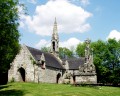
 Moderate