


Refine your search for walks in Chapelle de l'Oelberg
Chapelle de l'Oelberg walks


 The vineyard on the Rouffach side and the hills of Zinnkoepfle and Bollenberg
 Visorando Member
 10.05 mi
 +1,414 ft
 -1,398 ft
 5h 50
5h 50
 Moderate
 Departure from Orschwihr (Haut-Rhin)
The route takes us to the Bollenberg hill, then winds its way through the vineyards on the Rouffach side. Beautiful views of the Alsace plain, the Black Forest and the Jura mountains. We then cross over to the other side, into the Vallée Noble vineyards, interspersed with the limestone hill of Zinnkoepfle. On the way back, we pass through the village of Westhalten.
Notre-Dame de Schauenberg from Rouffach
 8.29 mi
+1,214 ft
-1,211 ft
4h 50
Moderate
Departure from Rouffach (Haut-Rhin)
8.29 mi
+1,214 ft
-1,211 ft
4h 50
Moderate
Departure from Rouffach (Haut-Rhin)
Circular hike from Rouffach to the Notre-Dame de Schauenberg sanctuary, with a beautiful view of the Alsace plain.The route follows part of "La grande promenade mystique" (The Great Mystical Walk ), linking places marked by the region's spiritual and religious heritage.The first part takes place in the Rouffach vineyards, then enters the forest. After the sanctuary, the return journey is along a corniche.
From Guebwiller to Rouffach through the vineyards
 15.15 mi
+1,480 ft
-1,483 ft
8h 15
15.15 mi
+1,480 ft
-1,483 ft
8h 15
 Difficult
Departure from Guebwiller (Haut-Rhin)
Difficult
Departure from Guebwiller (Haut-Rhin)
A long circular walk connecting two towns in the Haut-Rhin: Guebwiller and Rouffach. What makes this circular walk unique is that it mainly passes through vineyards. Other crops can be seen in the first part of the walk, but the bulk of the route is through vineyards. The return leg is particularly interesting, featuring chapels, a nature reserve and some remarkable views. The route passes through several charming villages
From Westhalten to the Oelberg Chapel
3.31 mi
+627 ft
-636 ft
2h 05
 Easy
Departure from Westhalten (Haut-Rhin)
Easy
Departure from Westhalten (Haut-Rhin)
A short walk allowing you to explore Strangenberg Hill, starting from the car park at Westhalten Cemetery. The route suggested here is a return walk, but you’ll easily find alternative routes for the return leg, particularly at the top of the hill.
Walks near Chapelle de l'Oelberg
Rouffach – Turckheim
14.19 mi
+1,375 ft
-1,250 ft
7h 45
Difficult
Departure from Rouffach (Haut-Rhin)
Wine-growing is an integral part of the Alsatian landscape. There is also a route named after it. This route is the third stage of the ‘Traversée des Vignes’ and links Rouffach to Turckheim. There are numerous vantage points, indeed they are almost everywhere outside the villages. The villages themselves are very traditional, with pretty half-timbered houses, and possess an undeniable charm. The region’s heritage is equally well represented.
Le Col du Grand Ballon depuis Soultz
8.15 mi
+3,596 ft
-89 ft
6h 55
Difficult
Departure from Soultz-Haut-Rhin (Haut-Rhin)
Randonnée presque quasiment en montée qui permet de relier Soultz, sympathique village culturel, au Col du Grand Ballon où vous pourrez passer la nuit avant d'aller le lendemain matin au sommet. Bien que cette étape soit courte en kilomètres, elle comporte un important dénivelé à ne pas négliger. Mais que de beautés en revanche entre les forêts et points de vues remarquables dans la dernière partie du parcours.
Linthal – Grand Ballon – Markstein
 Tourist office12.20 mi
+3,553 ft
-1,319 ft
8h 40
Difficult
Departure from Linthal (Haut-Rhin)
Tourist office12.20 mi
+3,553 ft
-1,319 ft
8h 40
Difficult
Departure from Linthal (Haut-Rhin)
A very physically demanding first day with a wide variety of landscapes.
Starting from Linthal, the most mountainous village in the Guebwiller region, the first day of this multi-day hike will take you to the Auberge du Steinlebach, via the Grand Ballon – the highest peak in the Vosges mountains, rising to an altitude of 1,424 metres – and the Markstein resort. The ascent is quite challenging and requires a good level of fitness. Along the way, you’ll pass the Gustiberg farmhouse inn, Lake Ballon and the Haag farmhouse inn…
Petit Ballon - Sengern
 5.91 mi
+604 ft
-2,608 ft
3h 15
Moderate
Departure from Luttenbach-près-Munster (Haut-Rhin)
5.91 mi
+604 ft
-2,608 ft
3h 15
Moderate
Departure from Luttenbach-près-Munster (Haut-Rhin)
The route begins in alpine pastureland, then passes through very shady forests.
Ascent to the Grand Ballon from Sengern (Guebwiller) via the lake
 5.78 mi
+2,910 ft
-39 ft
5h 10
Difficult
Departure from Lautenbachzell (Haut-Rhin)
5.78 mi
+2,910 ft
-39 ft
5h 10
Difficult
Departure from Lautenbachzell (Haut-Rhin)
A challenging climb to the Grand Ballon from Sengern (past Guebwiller). The route passes by the beautiful Lac du Ballon and the Gustiberg farmhouse inn, both of which offer very pleasant places to stop for a break.
On the ridges: Grand Ballon – Markstein – Petit Ballon
 13.44 mi
+2,110 ft
-3,022 ft
8h 00
Difficult
Departure from Murbach (Haut-Rhin)
13.44 mi
+2,110 ft
-3,022 ft
8h 00
Difficult
Departure from Murbach (Haut-Rhin)
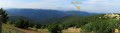
An easy route, gently undulating across the highest peaks of the Vosges, through stubble fields and forests. Magnificent views over the surrounding valleys.
Markstein – Petit Ballon – Linthal
12.88 mi
+1,407 ft
-3,619 ft
7h 10
Difficult
Departure from Oderen (Haut-Rhin)
Take the time to admire the landscapes and views that make this second day’s walk so special. The route follows the ridges for the most part, leading to the Petit Ballon via the Klintzkopf. Once again, you’ll be able to fully enjoy the panoramic views over the plains and valleys on either side of the mountain. This route, which passes through forests and stubble fields, will allow you to discover the richness of the local flora.
Le Markstein – Thann
 Tourism professional
 17.72 mi
+2,359 ft
-5,187 ft
10h 10
17.72 mi
+2,359 ft
-5,187 ft
10h 10
 Very difficult
Departure from Oderen (Haut-Rhin)
Very difficult
Departure from Oderen (Haut-Rhin)
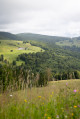
From the Markstein, the sixteenth stage of the journey across the Vosges proposed by Passion Vosges magazine continues along the Great Vosges Ridge towards the massif’s highest point, the Grand Ballon. After a visit to the Hartmannswillerkopf battlefield (1914–1918) and a climb to the summit of the Molkenrain, a long descent through the forest begins, heading towards Thann and its famous Gothic collegiate church. Franck Buchy’s account of this sixteenth stage can be found in *Passion Vosges*.
Hahnenbrunnen Pass and Uff Rain from Langenwasen
 9.32 mi
+2,182 ft
-2,146 ft
6h 10
Difficult
Departure from Metzeral (Haut-Rhin)
9.32 mi
+2,182 ft
-2,146 ft
6h 10
Difficult
Departure from Metzeral (Haut-Rhin)
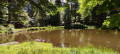
A lovely climb towards the Vosges ridge along the River Pfahlrunz, with a stop at a charming little lake (unnamed). Lots of remarkable trees. Then an easy walk along theGR®5along the ridge before heading towards the farm inns at Salzbach and Uff Rain, with panoramic views of the Vosges peaks.
Hahnenbrunnen – Willer-sur-Thur
 13.02 mi
+886 ft
-3,524 ft
6h 45
Moderate
Departure from Metzeral (Haut-Rhin)
13.02 mi
+886 ft
-3,524 ft
6h 45
Moderate
Departure from Metzeral (Haut-Rhin)
The final stage passes via the Markstein and beneath the Grand Ballon, with more downhill sections and shade provided by the trees, ending in the Thur Valley where you can catch a train to Mulhouse.