Refine your search for walks in Sixt-sur-Aff
Sixt-sur-Aff walks
 From La Gacilly to the Chapel of Saint-Jugon via the Black Forest
 Visorando Member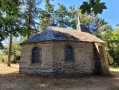
 7.95 mi
 +436 ft
 -410 ft
 4h 00
4h 00
 Moderate
 Departure from La Gacilly (Morbihan)
Starting from the marina, we begin by following the banks of the Aff, a charming little Breton river. Then, crossing the Forêt Neuve, we cross the Ruisseau des Brelles to enter the Forêt Noire. At the end of the path, we can stop for refreshments in the shade of the Chapelle Saint-Jugon.
The return journey is just as peaceful, taking the sunken lanes and ending up in the streets where the craftspeople's stalls are well worth stopping at.
The Saint-Jugon Chapel via the Black Forest
8.08 mi
+469 ft
-440 ft
4h 10
Moderate
Departure from La Gacilly (Morbihan)
La Gacilly is, first and foremost, a bridge spanning the River Aff, where the river winds its way between two wooded hills. By climbing the hill overlooking the town to the west, you can enjoy a lovely circular walk through a densely wooded landscape. The Saint-Jugon Chapel, nestled in its green surroundings, is a lovely spot to stop for a break halfway along the route.
Tour of the Étang du Val
4.49 mi
+233 ft
-240 ft
2h 15
 Easy
Departure from Saint-Just (Ille-et-Vilaine) (Ille-et-Vilaine)
Easy
Departure from Saint-Just (Ille-et-Vilaine) (Ille-et-Vilaine)
Walk around the Étang du Val, crossing the Lande de Cojoux and then skirting the Château du Val.
Étang du Val and megaliths in Saint-Just
 3.43 mi
+167 ft
-194 ft
1h 45
Easy
Departure from Saint-Just (Ille-et-Vilaine) (Ille-et-Vilaine)
3.43 mi
+167 ft
-194 ft
1h 45
Easy
Departure from Saint-Just (Ille-et-Vilaine) (Ille-et-Vilaine)
Walk along the Étang du Val, then along the river, under the cover of the forest, then climb up to the plateau in the moorland to explore the varied megaliths of this exceptional site. There are many paths on the site, offering numerous possible variations.
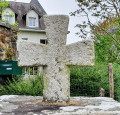
The Saint-Pierre Cross at the Saint-Just megalithic alignments
 1.18 mi
+75 ft
-75 ft
0h 35
Easy
Departure from Saint-Just (Ille-et-Vilaine) (Ille-et-Vilaine)
1.18 mi
+75 ft
-75 ft
0h 35
Easy
Departure from Saint-Just (Ille-et-Vilaine) (Ille-et-Vilaine)
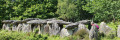
It’s a short walk suitable for children and ideal for families, whatever the season.This short circular loop runs along the western side of the Allée des Demoiselles de Cojoux, offering a view of the Étang du Val.Adults can extend the walk by heading east to see the famous Demoiselles de Cojoux and the Alignements du Moulin.
Finally, it’s well worth rounding off the walk by exploring the magnificent Allée Couverte de Tréal, which is just a 3-minute drive away.
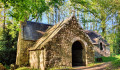
Along the Oust to discover the Chapel of Saint-Méen
 3.68 mi
+243 ft
-217 ft
1h 55
Easy
Departure from Bains-sur-Oust (Ille-et-Vilaine)
3.68 mi
+243 ft
-217 ft
1h 55
Easy
Departure from Bains-sur-Oust (Ille-et-Vilaine)
This short circular walk allows you to enjoy the panoramic views over Île-aux-Pies, before setting off in search of the Chapel of Saint-Méen, the last remaining vestige of the former Abbey of Busal.It is a place to connect with nature, silence and serenity.
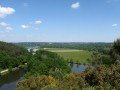
Saint-Vincent-sur-Oust Day 1/2
 11.26 mi
+387 ft
-361 ft
5h 30
Moderate
Departure from Saint-Vincent-sur-Oust (Morbihan)
11.26 mi
+387 ft
-361 ft
5h 30
Moderate
Departure from Saint-Vincent-sur-Oust (Morbihan)
This first day of a two-day route will take us up the River Oust via the upper reaches. We’ll be walking above the river, offering lovely views of Île aux Pies.
The final stretch will be mainly through woodland and meadows.
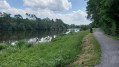
Boro Castle as seen from Saint-Vincent-sur-Oust
 6.29 mi
+282 ft
-272 ft
3h 10
Moderate
Departure from Saint-Vincent-sur-Oust (Morbihan)
6.29 mi
+282 ft
-272 ft
3h 10
Moderate
Departure from Saint-Vincent-sur-Oust (Morbihan)
A route starting from Saint-Vincent-sur-Oust, through woodland and along the River Oust.
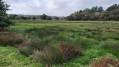
The Coinanton Marshes in Saint-Vincent-sur-Oust
 6.97 mi
+289 ft
-272 ft
3h 25
Moderate
Departure from Saint-Vincent-sur-Oust (Morbihan)
6.97 mi
+289 ft
-272 ft
3h 25
Moderate
Departure from Saint-Vincent-sur-Oust (Morbihan)
A very lovely walk in the area around Saint-Vincent-sur-Oust through the marshes and woods.
The tour of Île aux Pies, starting from La Potinais
 13.25 mi
+492 ft
-492 ft
6h 30
13.25 mi
+492 ft
-492 ft
6h 30
 Difficult
Departure from Saint-Vincent-sur-Oust (Morbihan)
Difficult
Departure from Saint-Vincent-sur-Oust (Morbihan)
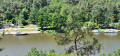
To cross the geological fold that extends the Landes de Lanvaux, the Oust has carved its way through the rocky plateau to wind its way through the Île aux Pies gorge. Upstream, at the confluence of the Oust and the Aff, the alluvial plain is sometimes dry, sometimes covered in water. You need to choose the right time to set off. Early spring seems to be the best season to fully enjoy the landscapes you pass through... without getting your feet wet.
 The Gannedel and Massérac Marshes
21.40 mi
+443 ft
-443 ft
2.5 hrs
Easy
Departure from Sainte-Marie (Ille-et-Vilaine) (Ille-et-Vilaine)
Upstream from Redon, the Vilaine valley stretches out between the hillsides that flank it to the north and south. Vast expanses of wild or cultivated marshland follow one another, through the midst of which the river flows.
Cycling along the small roads that wind around these marshes is a refreshing way to explore the area and its villages, away from the main roads.
Bailey Bridge seen from Saint-Perreux
 5.64 mi
+20 ft
-16 ft
2h 35
Easy
Departure from Saint-Perreux (Morbihan)
5.64 mi
+20 ft
-16 ft
2h 35
Easy
Departure from Saint-Perreux (Morbihan)
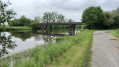
A pleasant route along the Oust and the Arz, ideal for anglers.
Île aux Pies and Vallée de l'Oust
 19.02 mi
+719 ft
-719 ft
9h 20
Difficult
Departure from Redon (Ille-et-Vilaine)
19.02 mi
+719 ft
-719 ft
9h 20
Difficult
Departure from Redon (Ille-et-Vilaine)
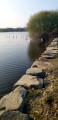
Discover the Oust Valley and the Nantes-Brest Canal, near Redon, and Bains-sur-Oust with this circular route that combines towpaths, forest paths and communal roads.
A few high points will give you a magnificent view of Île aux Pies and the Oust Valley.
Monteneuf megalithic circular loop
 Tourist office
 7.18 mi
+331 ft
-322 ft
3h 35
Moderate
Departure from Monteneuf (Morbihan)
7.18 mi
+331 ft
-322 ft
3h 35
Moderate
Departure from Monteneuf (Morbihan)
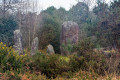
Set off to explore the dry and wet moors, home to a wide variety of flora and fauna. You will then come across several Neolithic burial monuments (La Loge Morinais, the Bordouès Covered Walkway). A little further on is the Pierres Droites megalithic site, one of the most important archaeological sites in central Brittany. It has 420 menhirs, around forty of which have been re-erected in their original location.
Route of Little Red Riding Hood in Monteneuf
9.66 mi
+390 ft
-381 ft
4h 45
Moderate
Departure from Monteneuf (Morbihan)
Set off to explore the Étang du Chaperon Rouge. On the side of the dyke is the ‘Bonnet Rouge’ shelter, a seat carved out of the stone by a revolutionary. To the north of the Étang de Quéhéon, you may be lucky enough to see gentians, sundews (a protected flower) and at least three varieties of heather. Finally, at La Loge Morinais, you’ll discover the most charming of the covered walkways and a wide variety of flora and fauna.
Heathland, ponds and megaliths in Monteneuf
 6.99 mi
+180 ft
-180 ft
3h 20
Moderate
Departure from Monteneuf (Morbihan)
6.99 mi
+180 ft
-180 ft
3h 20
Moderate
Departure from Monteneuf (Morbihan)
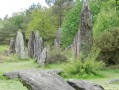
As you walk through the Landes de Monteneuf, come and discover a remarkable megalithic site: a collection of standing stones, covered passages and isolated menhirs. Although less spectacular than the site at Carnac, it is nonetheless very interesting due to the presence of a site currently undergoing restoration, where regional archaeologists have recreated both the dwellings of the period and the methods used to erect the stones.