


Refine your search for walks in Saint-Lubin-de-Cravant
Saint-Lubin-de-Cravant walks


 Circular Saint-Lubin-de-Cravant in the footsteps of a "Fauve"
 Visorando Member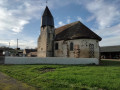
 5.26 mi
 +243 ft
 -240 ft
 2h 40
2h 40
 Easy
Easy
 Departure from Saint-Lubin-de-Cravant (Eure-et-Loir)
These circulars will not take you into the bush in search of large predators, but along good paths through woods and fields on the outskirts of the Perche, in this transitional region known as the Thimerais. You will pass through the landscapes that inspired the painter Maurice de Vlaminck, who founded Fauvism at the beginning of the 20th century with his friends Derain and Matisse.Having settled in La Tourillère, near Rueil-la-Gadelière, 100 years ago, the artist fell in love with this region, which he tirelessly explored until his death in 1958 in search of places of inspiration.These circular loops take you through the landscapes "where the wind bends the trees and chases the clouds across a dark sky" that captivated the painter.This route starts in Saint-Lubin de Cravant, where the church inspired the painter. It follows the Meuvette valley, which was once canalised. The Avre Aqueduct crosses the valley on imposing arches. It supplies Paris with drinking water.
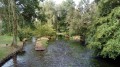
Along the Avre and in the Bois des Brouillets
 5.68 mi
+210 ft
-226 ft
2h 50
5.68 mi
+210 ft
-226 ft
2h 50
 Moderate
Departure from Acon (Eure)
Moderate
Departure from Acon (Eure)
Starting from the charming church of Acon, on the border between Normandy and Île-de-France, the route first takes you through the Avre valley and follows the river for a good distance. Then, higher up, it passes through a forest of oak and birch trees with fern undergrowth. This is a relatively short hike, but it can be extended by following another route that starts and ends at the same point.
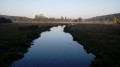
Along the Avre between Dampierre and Acon
 5.58 mi
+125 ft
-118 ft
2h 40
Easy
Departure from Acon (Eure)
5.58 mi
+125 ft
-118 ft
2h 40
Easy
Departure from Acon (Eure)
Starting from a charming church, this is a short hike focused on water in the Avre Valley, on the border between Normandy and Île-de-France.
In the footsteps of Vlaminck in Rueil-la-Gadelière
 Tourism professional5.07 mi
+69 ft
-98 ft
2h 25
Easy
Departure from Rueil-la-Gadelière (Eure-et-Loir)
Tourism professional5.07 mi
+69 ft
-98 ft
2h 25
Easy
Departure from Rueil-la-Gadelière (Eure-et-Loir)
Vlaminck, the famous Fauvist painter, greets walkers as soon as they arrive, as his bust, sculpted by Paul Belmondo, stands in the Town Hall Square. He is then commemorated at La Tourillière, where he lived before being buried in the local cemetery.
In the footsteps of Vlaminck
8.62 mi
+197 ft
-197 ft
4h 10
Moderate
Departure from Rueil-la-Gadelière (Eure-et-Loir)
This walking route follows paths that pass close to sites associated with Vlaminck, a painter from the early 20th century. Slightly undulating, the route crosses back and forth over the Avre aqueduct, which carries drinking water to Paris. Passing through the valleys of the Buternay, Lamblore and Nouvet, this walk is characterised by water that is either visible or sometimes just hinted at.
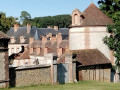
From Rueil-la-Gadelière to Montigny-sur-Avre in the footsteps of a "Fauve"
 8.92 mi
+174 ft
-203 ft
4h 15
Moderate
Departure from Rueil-la-Gadelière (Eure-et-Loir)
8.92 mi
+174 ft
-203 ft
4h 15
Moderate
Departure from Rueil-la-Gadelière (Eure-et-Loir)
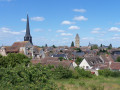
The painter Maurice de Vlaminck lived near Rueil-la-Gadelière from 1925 until his death in 1958. This year marks the centenary of his arrival in the area. Six circular loops named "Sur les traces d'un Fauve" (In the footsteps of a Fauve) allow you to discover the places that inspired the painter."I liked the countryside: slightly hilly, with endless fields and meadows planted with twisted apple trees. Here and there were copses, woods and farms surrounded by thorny hedges. It was on the edge of the Perche, a region where the plains of Beauce come to an end in a series of undulations, a region that has retained the appearance that the ages have shaped. Nothing modern alters its structure or disturbs the harmony of the landscape." Maurice de Vlaminck.This circular, between Beauce and Thimerais, crosses the agricultural plain near Verneuil, following the Avre valley to Montigny and returning to Rueil-la-Gadelière through fields and copses. You can visit the Château de Montigny (open to visitors by appointment).
Between Rueil-la-Gadelière and Saint-Martin in the footsteps of a "Fauve"
 6.28 mi
+105 ft
-102 ft
3h 00
Moderate
Departure from Rueil-la-Gadelière (Eure-et-Loir)
6.28 mi
+105 ft
-102 ft
3h 00
Moderate
Departure from Rueil-la-Gadelière (Eure-et-Loir)
These circular loops will not take you into the bush in search of large predators, but along good paths through woods and fields on the outskirts of the Perche, in this transitional region known as the Thimerais. You will pass through the landscapes that inspired the painter Maurice de Vlaminck, who founded Fauvism in the early 20th century with his friends Derain and Matisse.Having settled in La Tourillère, near Rueil-la-Gadelière, 100 years ago, the artist fell in love with this region, which he tirelessly explored until his death in 1958 in search of places of inspiration.These circular loops starting from neighbouring villages aim to give you a feel for the landscapes "where the wind bends the trees and chases the clouds across a dark sky" that captivated the painter, reminding him of his paternal family's homeland of Flanders.This hike takes you from Rueil to Saint-Martin aux Portes de Verneuil, where the "Fauve" often visited.
The hare and the tortoise at Escorpain
 8.97 mi
+138 ft
-151 ft
4h 15
Moderate
Departure from Escorpain (Eure-et-Loir)
8.97 mi
+138 ft
-151 ft
4h 15
Moderate
Departure from Escorpain (Eure-et-Loir)
This circular route offers an opportunity to discover some of the structures that line the Avre Aqueduct, particularly the Tue-Cheval structure, but also to admire the castle of Escorpain. Two pretty ponds are also on the itinerary. It is an easy route with a few sections in the forest, which are welcome when it is very hot!
Circular Beauche via Boulay Saint-Clair in the footsteps of a "Fauve"
 6.33 mi
+233 ft
-256 ft
3h 05
Moderate
Departure from Beauche (Eure-et-Loir)
6.33 mi
+233 ft
-256 ft
3h 05
Moderate
Departure from Beauche (Eure-et-Loir)
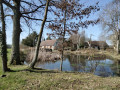
The painter Maurice de Vlaminck lived near Rueil-la-Gadelière from 1925 until his death in 1958. This year marks the centenary of his arrival in the area. A three-day itinerary already allows you to explore his homeland from Verneuil-sur-Avre to La Loupe. Walkers who are unable to undertake this crossing can take one or more of the short circulars "In the footsteps of a Fauve". These allow you to discover in detail the places that inspired the painter."Beauche is the village next to the hamlet of La Tourillière. Its origins are lost in the mists of time. One cannot imagine that its pleasant, wholesome appearance has ever changed. The spire of its bell tower pierces the clouds. It can be seen from far away because Beauche is built on flat ground in the plain..." Vlaminck.Starting from Beauche, this short route through fields and woods skirts the Château du Boulay Saint-Clair. On the way back, it passes by the Benne pond, which has recently been restored by the municipality of Rueil-la-Gadelière.
The Blaise flows through Louvilliers, if you don't mind!
 6.20 mi
+98 ft
-125 ft
2h 55
Easy
Departure from Louvilliers-lès-Perche (Eure-et-Loir)
6.20 mi
+98 ft
-125 ft
2h 55
Easy
Departure from Louvilliers-lès-Perche (Eure-et-Loir)
Let's go in search of the Blaise, a mischievous little river that hides so well from its source that geographers are perplexed. According to the elders, it originates near the Rond des Louvetiers, between Tardais and the Étang de la Bénette. Recent maps show it near the Grand Rond. In fact, these are "gouttiers", episodic streams that flow towards and cross the Tardais pond. It emerges under the dyke where a mill once operated, but suddenly disappears, sinking into a "chasm". It sometimes reappears.
At the edge of the forest, the Ruisseau de Saint-Cyr joins it. Together, the two waterways pass at the foot of Louvilliers-lès-Perche, flowing sometimes on the surface, sometimes underground. The Blaise reappears definitively in the Étang de Dampierre. In the past, it enabled the establishment of a very important steel complex. It then flows towards Dreux, which it crosses, before joining the Eure at Fermaincourt.
Circular des Templiers à la Saucelle
 5.32 mi
+66 ft
-66 ft
2h 30
Easy
Departure from La Saucelle (Eure-et-Loir)
5.32 mi
+66 ft
-66 ft
2h 30
Easy
Departure from La Saucelle (Eure-et-Loir)
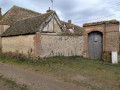
On the edge of the Senonches Forest, north of Perche, La Saucelle is a real crossroads between different historical and natural sites. On this short route, come and discover what the Knights Templar brought to the village. It was here, in La Saucelle, that they first settled in the Drouais region, and even in Eure-et-Loir. This settlement, in 1165, was made possible thanks to donations from local lords. These were largely plots of land in the Carnutes Forest. The Knights Templar cleared these plots and all those that followed, creating the vast plain that surrounds the village.
Tour of the Bois de la Noë
 4.43 mi
+98 ft
-105 ft
2h 05
Easy
Departure from Rueil-la-Gadelière (Eure-et-Loir)
4.43 mi
+98 ft
-105 ft
2h 05
Easy
Departure from Rueil-la-Gadelière (Eure-et-Loir)
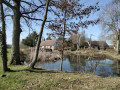
Beneath the seemingly peaceful surface of the Baine (or Benne) pond, there is a whole world of plants and animals. The route, which starts in this hamlet in the commune of Rueil-la-Gadelière, takes you around the Bois de la Noë, passing by the farms of Bois Normand and Rueil. It is located south of Verneuil d'Avre et d'Iton, at the gateway to Normandy. Return via the hamlets of Les Bruyères and Le Canada.
In the land of Vlaminck
 36.06 mi
+633 ft
-522 ft
3 days
36.06 mi
+633 ft
-522 ft
3 days
 Difficult
Departure from Verneuil-sur-Avre (Eure)
Difficult
Departure from Verneuil-sur-Avre (Eure)
In the centenary year of Maurice de Vlaminck's move to La Tourillière near Verneuil-sur-Avre, here is a journey through his heartland between Verneuil-sur-Avre and La Loupe. These towns are both served by railway stations that can be reached from Paris Montparnasse. Woods, fields and forests were the inspiration for many of the painter's works. With cloudy skies guaranteed, take a stroll through the landscapes that so strongly inspired this colourful, versatile artist, where he welcomed the greatest celebrities of his time.
Verneuil-sur-Avre - La Ferté-Vidame
15.72 mi
+423 ft
-194 ft
7h 35
Difficult
Departure from Verneuil-sur-Avre (Eure)
To mark the centenary of Maurice de Vlaminck's move to La Tourillière near Rueil-la-Gadelière, a few kilometres from Verneuil-sur-Avre, recently renamed Verneuil d'Avre et d'Iton, this tour offers a three-stage discovery of the region that inspired the painter.A hunter, fisherman, walker, cyclist, motorist and motorcyclist, he came to settle here to find peace and inspiration. From 1925 until his death in 1958, under an often changeable sky dotted with clouds, the painter tirelessly explored these landscapes of fields, copses and the vast forest of Senonches, in search of subjects for his many paintings.We will first go from Verneuil to La Ferté-Vidame, passing by his grave in the cemetery of Rueil, his bust sculpted by his friend Paul Belmondo in front of the town hall, and above all his home in La Tourillière, preserved in the state in which he lived.
Mesnil-Thomas circular: the lovers' path
 6.92 mi
+69 ft
-69 ft
3h 15
Moderate
Departure from Le Mesnil-Thomas (Eure-et-Loir)
6.92 mi
+69 ft
-69 ft
3h 15
Moderate
Departure from Le Mesnil-Thomas (Eure-et-Loir)
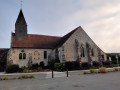
A circular loop between the village and the Senonches National Forest, passing through fields and copses. It goes through small hamlets with pretty farmhouses decorated with flowers in summer. After La Motte and La Petite Motte, places reminiscent of the ancient line of defence established between France and Normandy, the route becomes more romantic, crossing the Bois du Rouvray via a path which, it is said, was a meeting place for young lovers from the village. There weren't many other places nearby where they could meet discreetly!
Circular loop from the Church of Saint-Ange
 3.83 mi
+92 ft
-92 ft
1h 50
Easy
Departure from Saint-Ange-et-Torçay (Eure-et-Loir)
3.83 mi
+92 ft
-92 ft
1h 50
Easy
Departure from Saint-Ange-et-Torçay (Eure-et-Loir)
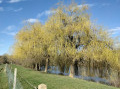
Starting from the public garden created by the local council around the Torçay pond on Rue de la Blaise, this short circular route takes you through the beautiful Blaise Valley, passing the recently restored Church of Saint-Ange. It then follows the pond created from a former gravel pit dug in the 1960s, near the Torçay mill. Although highly controversial at the time due to the risk of groundwater pollution, these bodies of water now add to the charm of the valleys in the Drouais region. The numerous mills that line the valley, bearing witness to a very early industrialisation, have now become beautiful private residences, such as the Torçay Mill. The scenic value of the area justified retaining the detour required by the new GRP® route, which has replaced the former GR®351, before heading towards the Châteauneuf forest.
The Louvilliers arm
 3.30 mi
+105 ft
-105 ft
1h 35
Easy
Departure from Senonches (Eure-et-Loir)
3.30 mi
+105 ft
-105 ft
1h 35
Easy
Departure from Senonches (Eure-et-Loir)
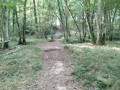
A circular path at the far end of the Bras de Louvilliers in the Senonches State Forest, taking in the valley of the Ruisseau de Saint-Cyr and the site of the Poste de Louvilliers forest lodge with its pond and magnificent oak tree. The path then winds its way above the Blaise valley before skirting the Bois du Paradis. Quite a journey!
The Champs Élysées of the Perche
 3.65 mi
+26 ft
-26 ft
1h 40
Easy
Departure from La Puisaye (Eure-et-Loir)
3.65 mi
+26 ft
-26 ft
1h 40
Easy
Departure from La Puisaye (Eure-et-Loir)
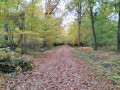
This short loop in the Bois de la Saucelle, near Puisaye, is mainly woodland. It confirms the toponymic meaning of the name Puisaye, which refers to a wetland area. Through private woods, the circuit follows wide avenues, including the Ligne Jacob, whose length, width and majesty could justify the mischievously pretentious name of "Champs Élysées du Perche". However, don't expect to find shops and noisy café terraces here. All you will hear is birdsong. Enjoy the peace and quiet of this unspoilt, authentic natural environment, exploring it on tiptoe so as not to disturb the many animals that you are sure to glimpse if you are discreet.Avoid this route on hunting days. Danger!
Memorial loop for those shot in Morvilliers
 5.20 mi
+72 ft
-66 ft
2h 25
Easy
Departure from Morvilliers (Eure-et-Loir) (Eure-et-Loir)
5.20 mi
+72 ft
-66 ft
2h 25
Easy
Departure from Morvilliers (Eure-et-Loir) (Eure-et-Loir)
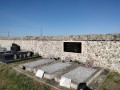
Starting from Morvilliers, this loop takes you to the sites where a tragic episode unfolded during the final days of the Maquis de La Ferté-Vidame in August 1944.It first leads to the farm of Mary Thibault, the instigator of the Maquis. It then crosses the Bois de Malassis, where the Maquisards hid after machine-gunning a German car, killing the driver and the secretary of the Kommandantur of La Ferté-Vidame This action triggered the fury of the SS, who, after searching the neighbouring farms in vain, arrested three young members of the Maquis in the hamlet of Les Rayers. They were taken to the nearby Château du Gland, where they were tortured. The first man was shot on 11 August in front of his comrades. The next day, the other two were also executed. They had to dig their own graves.
A commemoration takes place every year in the clearing and at the cemetery in Morvilliers, where the bodies were returned after the Liberation.
Les Framboisiers de la Framboisière
 2.22 mi
+26 ft
-26 ft
1h 05
Easy
Departure from La Framboisière (Eure-et-Loir)
2.22 mi
+26 ft
-26 ft
1h 05
Easy
Departure from La Framboisière (Eure-et-Loir)
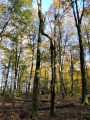
No raspberries in sight: for now, but where on earth have the raspberry bushes of La Framboisière gone?The village’s name is more likely to be linked to the Bois Francs – the free-hold woods.The Raspberry Festival takes place every two years. It brings together local artisans who showcase their products related to the preparation of dishes made with red berries.A short walk to explore the fields and woodland edge between the Senonches State Forest and the village. A stroll past the majestic oaks of La Framboisière and Le Grand Village. Reminders of an old railway line.
Walk around the Bois de la Saucelle in La Puisaye
 7.00 mi
+69 ft
-79 ft
3h 15
Moderate
Departure from La Puisaye (Eure-et-Loir)
7.00 mi
+69 ft
-79 ft
3h 15
Moderate
Departure from La Puisaye (Eure-et-Loir)
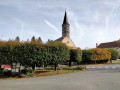
Starting from the village of La Puisaye – whose village centre has recently been beautifully refurbished, complete with its wash house and a leisure area near the town hall and the church – this circular walk takes you through woods and fields around the Bois de la Saucelle, which should not be confused with the neighbouring village of the same name. With its long forest lanes, the return route along the Meuvette takes you past the Étang de Rouge, a prime spot for recreational fishing home to carp and enormous catfish.
Jaudrais circular via the Grande Vallée
 7.32 mi
+203 ft
-220 ft
3h 35
Moderate
Departure from Jaudrais (Eure-et-Loir)
7.32 mi
+203 ft
-220 ft
3h 35
Moderate
Departure from Jaudrais (Eure-et-Loir)
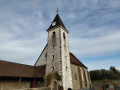
A walk half in the fields and half in the Châteauneuf-en-Thymerais State Forest, starting from the village of Jaudrais and passing through its hamlets. The circular route follows the Grande Vallée stream from a distance on both sides.
Short circular loop around Lamblore via the Chemin du Mortripié
 5.20 mi
+180 ft
-197 ft
2h 35
Easy
Departure from Lamblore (Eure-et-Loir)
5.20 mi
+180 ft
-197 ft
2h 35
Easy
Departure from Lamblore (Eure-et-Loir)
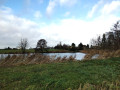
Starting from Lamblore Town Hall, this circular leads to La Ferté-Vidame, where you will find reminders of historical figures: The Dukes of Saint-Simon, the father, who after acquiring the estate had the parish church built, and the son, the famous memoirist, the Marquis de Laborde, who had a sumptuous palace built, the romantic ruins of which still remain, and laid out a huge park. King Louis-Philippe wanted to restore this building, which had been dismantled after the Revolution, to its former glory, but he was only able to build the "Petit Château" (small castle)...A detailed tour of the village and park is a must. The return journey takes you past the former Citroën test centre, a mecca for the automotive industry. This is where the most famous models of the chevron brand were developed: the Traction Avant, the 2CV, the DS, the Ami 6, the SM... After passing the Champ-Brulé equestrian centre, the route returns to the village via the beautiful Chemin du Mortripié, which has been reopened by the local council.
Circular route from Saint-Jean-de-Rebervilliers to Châteauneuf-en-Thymerais
 6.98 mi
+125 ft
-125 ft
3h 20
Moderate
Departure from Saint-Jean-de-Rebervilliers (Eure-et-Loir)
6.98 mi
+125 ft
-125 ft
3h 20
Moderate
Departure from Saint-Jean-de-Rebervilliers (Eure-et-Loir)
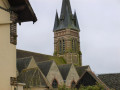
A circular route starting from Saint-Jean-de-Rebervilliers. Largely through woodland, it leads to Châteauneuf-en-Thymerais. After setting off through the forest, the route crosses the Rond de France, where a beautiful stone column stands, locally known as the ‘pyramid’. After passing through the town centre, the return route takes you back through the forest, past the Château du Jaglu and then the Église Saint-Jean, ending near the pretty pond with its pleasantly landscaped surroundings.
Tour du Gué au Chéron in the Senonches forest
 6.18 mi
+52 ft
-52 ft
2h 55
Easy
Departure from Senonches (Eure-et-Loir)
6.18 mi
+52 ft
-52 ft
2h 55
Easy
Departure from Senonches (Eure-et-Loir)
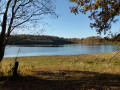
Le Gué au Chéron is a district of the Senonches National Forest. This tour starts in Tardais and leads through fields into the forest. It follows the edge of the forest, passing in front of the majestic Chêne de la Framboisière oak tree. After crossing the old La Loupe-Verneuil railway line, the trail follows the Gervaine, a stream that was canalised in the 18th century to float timber down the Avre and Seine rivers to Rouen.The trail then runs alongside the Étang de la Bénette, managed by the Conservatoire des Espaces Naturels, which preserves its exceptional flora and fauna. A long forest line crosses the Rond de Sauveloup, then joins the small road from Tardais to Laudigerie. It takes you past the lake and the Château de Tardais before reaching this picturesque village with its wash house, small church and tiny town hall. Vlaminck stayed here frequently and immortalised this view of "the road" in winter under the snow from the town hall to the church in one of his paintings.
Around Tardais
 7.23 mi
+66 ft
-82 ft
3h 25
Moderate
Departure from Senonches (Eure-et-Loir)
7.23 mi
+66 ft
-82 ft
3h 25
Moderate
Departure from Senonches (Eure-et-Loir)
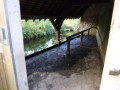
Allow a day to complete this route and visit Senonches. As it is easier to find shelter in town for lunch in winter or in case of bad weather, this route suggests setting off from Tardais in the morning, heading towards Senonches where you can picnic or eat in a restaurant, and, after visiting the town and the castle, returning to Tardais at the end of the afternoon. The route takes you around Tardais and connects it to Senonches. It is varied, passing between the castle and the lake, crossing the forest, taking you through the recently developed town centre and leading to Lake Arthur Rémy. After passing by the castle and the church, it returns across fields and through the forest again. It follows the edge of the village. Here you will find the magnificent Tardais Beech, a remarkable listed tree. At 185 years old, it is suffering, like all the beech trees in the forest, from global warming, which will cause them to disappear in the short term. So don't delay in going to see it.
A getaway to Chappe
 4.71 mi
+62 ft
-62 ft
2h 15
Easy
Departure from Saint-Maixme-Hauterive (Eure-et-Loir)
4.71 mi
+62 ft
-62 ft
2h 15
Easy
Departure from Saint-Maixme-Hauterive (Eure-et-Loir)
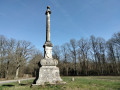
This circular walk starting from Chappe takes you on a journey of discovery through the Châteauneuf Forest. This hamlet has a pond that has just been restored and a magnificent oak tree. The route follows a section of the GRP® Vallées de la Blaise et de l'Avre from the Châteauneuf water tower to the Rond du Roi, then part of the bridle path that circles this vast national forest.
In the footsteps of Pablo Neruda
 7.69 mi
+98 ft
-105 ft
3h 35
Moderate
Departure from Gouville (Eure)
7.69 mi
+98 ft
-105 ft
3h 35
Moderate
Departure from Gouville (Eure)
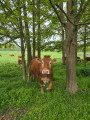
A very pleasant unmarked route where you cross the Iton several times. It is also an opportunity to discover the former home of the Chilean poet Pablo Neruda and the beautiful Chambray Castle along the way.
The Diane and Actaeon Route in the Senonches State Forest
 6.29 mi
+66 ft
-62 ft
2h 55
Easy
Departure from Senonches (Eure-et-Loir)
6.29 mi
+66 ft
-62 ft
2h 55
Easy
Departure from Senonches (Eure-et-Loir)
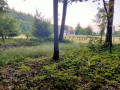
Three circular walks in the Senonches State Forest follow one another along the Ligne des Trois Pierres: the Rond des Gardes, the Rond d’Actéon and the Rond de Diane. If mythology is to be believed, the hunter Actéon would have had good reason to be on his guard when he caught Diana bathing. The chaste goddess, enraged, is said to have instantly transformed him into a stag and had him devoured by his own hounds! You’re unlikely to suffer such a misfortune whilst walking this short circular route. Diane and Actéon are now nothing more than forest crossroads. Even so, this cruel tale reminds us that voyeurism is always punished and that we must be wary when walking our beloved dogs. Come on, let’s set off on this short, entirely woodland walk. It is particularly recommended for the growing number of residents in the Moinerie and HLM neighbourhoods.
Tour des canards in Senonches
 3.41 mi
+52 ft
-52 ft
1h 35
Easy
Departure from Senonches (Eure-et-Loir)
3.41 mi
+52 ft
-52 ft
1h 35
Easy
Departure from Senonches (Eure-et-Loir)
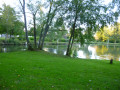
In Senonches, starting from the Jacques-Yves Cousteau School, there is a short circuit designed for families, leading from the Moinerie housing estate or the HLM social housing complex to the Arthur Rémy pond. Here you will find a whole happy flock of waterfowl, games for the little ones and picnic tables for the grown-ups. You can fish or follow a fitness trail. Crossing the town centre, you will pass by the main points of interest: the listed cinema, Town Hall, media library, castle museum and church.
Circular loop around the ponds from Les Ressuintes
 12.81 mi
+279 ft
-262 ft
6h 10
Difficult
Departure from Les Ressuintes (Eure-et-Loir)
12.81 mi
+279 ft
-262 ft
6h 10
Difficult
Departure from Les Ressuintes (Eure-et-Loir)
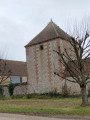
Starting from Les Ressuintes, between Senonches and La Ferté-Vidame, you will pass through La Puisaye and hamlets dotted with numerous tastefully renovated farmhouses. Set amongst woods and fields, this circular route takes you past several ponds, including the Bénette, a site protected by the Regional Conservatory of Sensitive Natural Areas due to its valuable biodiversity. Beautiful, straight paths wind through the Senonches State Forest, where you might just spot some large wildlife.
Water seeps at Les Ressuintes
 8.09 mi
+164 ft
-164 ft
3h 50
Moderate
Departure from Les Ressuintes (Eure-et-Loir)
8.09 mi
+164 ft
-164 ft
3h 50
Moderate
Departure from Les Ressuintes (Eure-et-Loir)
This very wet area drains water from the Senonches Forest. There are numerous streams and ponds. The route starts by following the Meuvette valley. The stream originates in the nearby private woods and flows through the Haron and Rouge ponds.After passing through a cultivated area, the return journey is along small roads. This walk is best done in winter, when the nearby forest paths are difficult to navigate.The commune is backed by private woods and bordered to the west by the walls of the park of the former château of the Marquis de La Borde, which became the Citroën Test Centre in the 20th century.Between the park and the forest, old farmhouses have been converted into attractive second homes, well maintained and decorated with flowers in summer. The village has a church which, since the 12th century, has undergone many vicissitudes.At the rear, the communal wash house has been restored, and a public space welcomes walkers who wish to take a moment's rest.
Route de Châteauneuf-en-Thymerais
5.00 mi
+49 ft
-49 ft
2h 20
Easy
Departure from Châteauneuf-en-Thymerais (Eure-et-Loir)
Route in the Châteauneuf-en-Thymerais National Forest
The Chemin du Maupas
 4.25 mi
+36 ft
-36 ft
2h 00
Easy
Departure from Senonches (Eure-et-Loir)
4.25 mi
+36 ft
-36 ft
2h 00
Easy
Departure from Senonches (Eure-et-Loir)
This circular loop in the Senonches State Forest, starting from the Grand Rond – a magnificent star-shaped junction of forest tracks – first follows long forest tracks leading to the Rond des Quatre Barrières and then to the Rond des Hussards. A path then winds its way between the state-owned forest and private woodland. After passing through the Rond de la Rachée, the route passes at the foot of the Chêne d’Hérissé, the sole survivor of the 1999 storm in this area. Shortly before the finish, the Hêtre du Haut Cornet stands a few metres from the path.