From Rueil-la-Gadelière to Montigny-sur-Avre in the footsteps of a "Fauve"

The painter Maurice de Vlaminck lived near Rueil-la-Gadelière from 1925 until his death in 1958. This year marks the centenary of his arrival in the area. Six circular loops named "Sur les traces d'un Fauve" (In the footsteps of a Fauve) allow you to discover the places that inspired the painter.
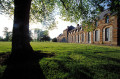
"I liked the countryside: slightly hilly, with endless fields and meadows planted with twisted apple trees. Here and there were copses, woods and farms surrounded by thorny hedges. It was on the edge of the Perche, a region where the plains of Beauce come to an end in a series of undulations, a region that has retained the appearance that the ages have shaped. Nothing modern alters its structure or disturbs the harmony of the landscape." Maurice de Vlaminck.
This circular, between Beauce and Thimerais, crosses the agricultural plain near Verneuil, following the Avre valley to Montigny and returning to Rueil-la-Gadelière through fields and copses. You can visit the Château de Montigny (open to visitors by appointment).

Details

85683135
Creation:
Last update:
Last review:
  • Walking
    Activity: Walking
  • ↔
    Distance: 14.35 km
  • ◔
    Average duration: 4h 15 
  • ▲
    Difficulty: Moderate

  • ⚐
    Back to start: Yes
  • ↗
    Ascent: + 53 m
  • ↘
    Descent: - 62 m

  • ▲
    Highest point: 178 m
  • ▼
    Lowest point: 141 m

Photos

Description of the walk

Rueil-la-Gedelière via the D939 - Departure from the town hall - Parking in front of the town hall, Rue Maurice de Vlaminck.

Yellow markings

(S/E) With your back to the town hall, turn right. Pass by the war memorial. Cross the D339 carefully at the pedestrian crossing. A few metres further on, turn left onto Rue du Chemin Fossard, which descends to the bottom of the valley and climbs back up towards the church. After 300 metres, you will see Vlaminck's grave in the cemetery on your left.

No signposts

(1) Turn right to walk past the church. Take the first path on the left at the corner of the farm. Follow this path straight ahead through the fields to the entrance to Le Baudry.

(2) Continue straight ahead on the main street. Ignore the side streets. You will come to a fork around a pond opposite the gate of a property.

(3) Turn right onto Chemin de la Prairie, which runs alongside a small wood and leads to a crossroads. Junction with the GR®22.

White and red markings

(4) Follow it to the right, crossing Le Breuil. After leaving the village, turn right, then left to walk along the fences of the Avre aqueduct springs. At the T-junction, go down the path to the right and cross the river on a footbridge. Go up into the woods and continue straight along the road. After about 50 metres, turn right, pass Le Gland and arrive at a place called Le Fétu. Cross the village and, at the crossroads, turn left to reach the D54.

(5) Follow it to the right. At the cross, take the road on the right towards Courteilles and arrive at La Guigneterie. Continue for about 200 metres and, a few dozen metres after No. 17 (on the right-hand side of the street), you will see a path on the left protected from motorbikes by a chicane of posts.

(6) Take this path, which follows a branch of the Avre, then widens and becomes a track that joins the D24 just before the church in Courteilles. You will arrive at the crossroads in front of the church.

(7) Take thefirst road on the right. After crossing several branches of the Avre, enter on the left through an old gate into Allée du Lary, which crosses (with permission) a private estate. Stay on the path and respect the surroundings. Go to the end and you will come out onto Impasse du Moulin à papier. However, you can take a detour of a few dozen metres to the left to enjoy the beautiful site around the footbridge.

No markings

(8) Leave the GR® which goes to the left. Turn right and reach the D102, then left towards the church of Montigny-sur-Avre. Picnic table. Continue for about 200 m to see the exterior of the castle.

(9) Retrace your steps to take Rue du Cabriolet, then Chemin du Clos Polyte. Turn left onto Rue André Lambert in front of the entrance to the town hall courtyard. Continue straight ahead, pass the cemetery, and cross the grassy path under which the aqueduct that carries water from Rueil to Paris passes. Pass close to the equestrian centre and cross the D102.3. Continue straight ahead to the Marette water tower.

Yellow markings

(10) Just before the water tower, turn right onto Chemin du Pavillon. Follow this path, then turn right to cross Sault. In the bend, continue straight ahead and arrive at the entrance to Flouville.

(11) Take the road on the left, passing at the foot of another water tower (picnic table). Turn right, then left and arrive at the entrance to a path at the corner of the last building in the hamlet.

(12) Take the path on the right. Continue straight ahead, passing in front of the entrance to the grounds of Château de Montuel. Cross the woods, then follow the edge of a field until you reach a fork in front of a wooden gate.

(13) Continue to the left. Follow the path and descend to the road. Go to the bridge and the sign for the town of Rueil-la-Gadelière.

(14) Cross the bridge. At the next fork, turn right. Walk up to the D939. Cross it carefully at the pedestrian crossing, walk behind the war memorial and continue along the school to the town hall car park (S/E).

Waypoints

  1. S/E : km 0 - alt. 164 m - Rueil-la-Gadelière Town Hall
  2. 1 : km 0.58 - alt. 164 m - Église Saint-Denis (Rueil-la-Gadelière)
  3. 2 : km 1.99 - alt. 172 m - Le Baudry
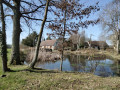
  4. 3 : km 2.51 - alt. 167 m - Mare du Baudry
  5. 4 : km 2.84 - alt. 165 m - Crossroads at the corner of a small wood
  6. 5 : km 5.73 - alt. 158 m - D 54
  7. 6 : km 6.29 - alt. 146 m - La Guigneterie
  8. 7 : km 7.22 - alt. 149 m - Courteilles - Avre (rivière)
  9. 8 : km 8.52 - alt. 142 m - Impasse du Moulin à Papier
  10. 9 : km 8.86 - alt. 149 m - Château de Montigny-sur-Avre
  11. 10 : km 10.5 - alt. 177 m - La Marette water tower
  12. 11 : km 12.04 - alt. 169 m - Entrance to Flouville
  13. 12 : km 12.56 - alt. 170 m - Path at the corner of a building
  14. 13 : km 13.27 - alt. 163 m - Crossroads in front of a wooden gate
  15. 14 : km 13.91 - alt. 153 m - Bridge at the entrance to Rueil-la-Gadelière
  16. S/E : km 14.35 - alt. 164 m - Rueil-la-Gadelière Town Hall

Notes

The stretch across the plain between the church at Rueil (1) and Le Fétu (5) should not be attempted in strong winds or high temperatures. It is preferable to shorten the route by following the D 316 from the church at Rueil to Launay, then turning right onto the pretty road that follows the Avre. Turning left at Moulin Foulon, you will rejoin the route at La Guigneterie. (6)

During hunting season, please follow the instructions given by hunters.

Worth a visit

On the route:

Bust of Vlaminck (S/E)
In front of the Town Hall is the bust, created in 1962 by his friend, the sculptor Paul Belmondo. At the crossroads, a public garden welcomes walkers who want to take a break: picnic tables and games for children.

Church of Rueil-la-Gadelière (1)
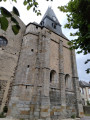
The flat buttresses on the west façade and narrow windows surrounded by grey stone blocks indicate that the nave dates back at least to the Romanesque period (11th-12th century), but it was modified in the 16th century, extending the building by a few metres. The bell tower with its pyramidal spire on an octagonal base is covered with slate, like most bell towers in the Thimerais and Avre Valley.

Vlaminck's tomb (1)
In the nearby cemetery, the painter rests alongside his wife. On a simple granite stone, an epitaph recalls his attachment to nature : "I never asked for anything, life gave me everything.
I did what I could, I painted what I saw."

Les Maisons Rouges (5)

A beautiful cross stands at the crossroads of Rue du Fossé Royal and Rue de l'Avre. To its right, embedded in the wall of the house, is an old letterbox, surprising in the height at which it has been placed.

Courteilles: (7)

Nearby, to the left of the church on the edge of the woods, via the D 54 and then the D 676, you can see the remains of the Château de Courteilles. Built in the 18th century by the Marquis de Courteilles and Governor of Verneuil, this immense building required the destruction of the ramparts of the medieval city of Verneuil so that its stones could be reused. Later, Alexandrine-Rosalie, wife of the Duke of Richelieu, lived there separately from her husband. The duchess's tomb can still be seen in the church of Courteilles.

Courteilles Cemetery and Church

The cemetery preserves the memory of the Courteilles family through the graves of its various members, including Alexandrine-Rosalie. A moving tomb can be found along the wall running alongside the Route de Rochechouart. A child is buried there. A beautiful sculpture is placed on the upper slab and plaques commemorate this painful memory.

Montigny sur Avre ( 9) Saint-Martin Church

In the17th century, François de Laval de Montmorency, the first bishop of Quebec, who gave his name to the city of Laval and its university, was baptised in this church. A commemorative plaque set into the wall of the nave recalls the village's links with this great man, who was beatified by John Paul II in 1980 and canonised in 2014.

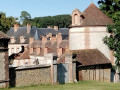
Château de Montigny, (9) where the man mentioned above was born. The building, listed as a historic monument, has a magnificent English-style park with plantations, rivers and waterfalls.

The Avre Aqueduct Leaving the village, after the cemetery, the road crosses a grassy avenue under which the Avre Aqueduct passes. This structure, inaugurated in 1893, supplies Paris with drinking water from its source in Rueil la Gadelière, barely 3 kilometres upstream. Every day, it carries up to 100,000 m³ of water from the catchment areas to the capital, some 100 kilometres away!

Nearby:

Avre water catchment area
approximately 1 kilometre west of the village.
Here, the city of Paris captures 99% of the Avre's water to supply the capital with drinking water. An aqueduct carries the water over 102 km and draws it mainly from the water-finding perimeter of La Vigne in Rueil-la-Gadelière. Six pavilions and a collection gallery cover 128 hectares and deliver 100,000m3 of water every day. The aqueduct, which generally runs at ground level, is marked by a long grassy path, regularly interrupted by small buildings made of rough stone rubble, providing access to the underground aqueduct.

La Tourillière, 2 km south of the village
Vlaminck's house in La Tourillère, a hamlet located about 2 km south of Rueil, is open to visitors. A painter of the Fauvism and Cubism movements, he was a man of many talents, also working as a ceramist, musician and writer. The artist chose to settle in Rueil-la-Gadelière in 1925 and lived there until his death 33 years later.

Nearby, the Château de la Gadelière is also open to the public in summer. Artistic events are organised there.

Verneuil-sur-Avre, 3 km away One of the 100 Petite Cité de Caractère - Plus Beaux Détours de France (Small Towns of Character - Most Beautiful Detours in France).
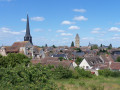
There were once six religious buildings. Today, three are listed as historic monuments. Among the most remarkable are the Madeleine Church with its famous 56-metre-high Gothic tower, the Notre-Dame Church with its brown colour derived from Grison stone, and St-Nicolas Abbey, founded in 1627, which the last Benedictine nuns left in 2001. In the 18th century, the town's population included many civil servants, solicitors, bailiffs, etc. This local elite, along with the nobility who owned manor houses in the surrounding countryside, had luxurious mansions built for themselves.

(Based on the historical route booklet available at the tourist office.)
https://www.normandie-sud-tourisme.fr/

 Always be cautious and plan ahead when you're outdoors. Visorando and the author of this route cannot be held responsible for any accidents occurring on this route.

The GR® and PR® markings are the intellectual property of the Fédération Française de Randonnée Pédestre.

Other walks in the area

For more walks, use our search engine .

The GPS track and description are the property of this route's author. Please do not copy them without permission.