Mesnil-Thomas circular: the lovers' path

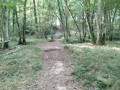
A circular loop between the village and the Senonches National Forest, passing through fields and copses. It goes through small hamlets with pretty farmhouses decorated with flowers in summer. After La Motte and La Petite Motte, places reminiscent of the ancient line of defence established between France and Normandy, the route becomes more romantic, crossing the Bois du Rouvray via a path which, it is said, was a meeting place for young lovers from the village. There weren't many other places nearby where they could meet discreetly!

Details

52056091
Creation:
Last update:
Last review:
  • Walking
    Activity: Walking
  • ↔
    Distance: 11.13 km
  • ◔
    Average duration: 3h 15 
  • ▲
    Difficulty: Moderate

  • ⚐
    Back to start: Yes
  • ↗
    Ascent: + 21 m
  • ↘
    Descent: - 21 m

  • ▲
    Highest point: 212 m
  • ▼
    Lowest point: 190 m

Photos

Description of the walk

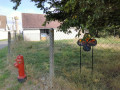
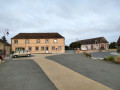
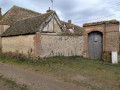
Departure from Mesnil-Thomas, 5 km from Senonches, via the D20. Car park at Place de l'Église.

No signposts

(S/E) Pass in front of the church porch. Follow the D20 on the left towards Senonches. Pass in front of the school, then turn right onto a gravel path. It reaches the Cloutières houses and ends at a crossroads.

(1) Leave the return route on your left and take the road on your right. At the water tower, continue straight ahead towards Les Quéronnières until you reach a T-junction.

(2) Take the path on the left. After the left-hand bend, at the fork, take the path on the right which follows the edge of a wood, then reaches the D320 near the Senonches National Forest. Follow the road to the left. At the next crossroads, leave it and turn left towards Le Tartre.

(3) In the hamlet of Le Tartre, turn right. At the left-hand bend in the road, leave it and follow the path opposite heading due south. Continue straight ahead, ignoring the crossroads, until you reach a T-junction (IGN 205).

(4) Turn left and join the D20. Cross it carefully and take the path opposite. At the D320.3, turn left. Ignore the first road on the right and continue to the next crossroads. Then turn right to reach the Motte water tower.

(5) Continue along the road to La Petite Motte. Go to the left-hand bend in the road, opposite the sign for Les Épineraises.

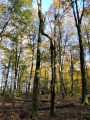
(6) Leave the road and take the path on the right, which follows the edge of the Bois du Rouvray. At the crossroads, enter the woods on the left and cross through them (Chemin dit des Amoureux). At the edge of the woods, follow the track on the left, which soon leads to a crossroads opposite some horse paddocks.

(7) Turn left and follow the D320.3. At the Y-junction that follows, turn right along the D320.5 and continue to the entrance to the hamlet of Le Pommier Benoist. Keep right on the D320.5 and cross the hamlet straight ahead until you reach the start of a path at No. 10 on the street.

(8) Leave the road and take the path on the left between the fields until you reach the cross at the edge of the D20. Cross it carefully by turning left and then right. Then take the small road towards Les Cloutières. After about 300 m, you will return to the initial crossroads.

(1) Retrace your steps along the route you took on the way there, which will bring you back to the car park at Place de l'Église (S/E).

Waypoints

  1. S/E : km 0 - alt. 191 m - Parking: Church square
  2. 1 : km 0.96 - alt. 198 m - Les Cloutières - Junction of the circular
  3. 2 : km 1.92 - alt. 195 m - Les Quéronnières - T-junction
  4. 3 : km 3.63 - alt. 204 m - Le Tartre
  5. 4 : km 4.64 - alt. 205 m - T-junction - IGN 205
  6. 5 : km 5.62 - alt. 208 m - La Motte Water Tower
  7. 6 : km 6.35 - alt. 207 m - Crossroads - Les Épineraises sign
  8. 7 : km 7.68 - alt. 199 m - Les Épineraises
  9. 8 : km 9.01 - alt. 193 m - Path between the fields
  10. S/E : km 11.13 - alt. 191 m - Car park

Notes

This route should not be attempted in strong winds. Wear sturdy shoes as the paths can be wet during rainy periods. During hunting season, follow the instructions of hunters.

Worth a visit

(1) Le Mesnil-Thomas was originally simply "Thomas's house" (his farm). The parish (today's commune) had a notable castle, La Salle, which has been reduced to ruins.
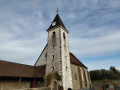
The Church of St Barthélémy, in a composite style, has a few statues from the Church of La Burgondière (a parish attached at the end of the 17th century). Its entrance is protected by a porch, also from this church.
The town hall occupies the buildings of a former café. Next door, in the building recently converted into a rural lodge, was the residence of musicologist Philippe Beaussand (1930-2016), academician, radio presenter and leading specialist in Baroque music at the court of Louis XIV.
Leaving the village, you cross the old Senonches-Dreux tramway via Brezolles, whose isolated station can be seen in the middle of the fields on the right.

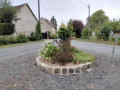
The hamlet of Les Cloutières (1) may owe its name to a nail-making workshop, unless it is simply the residence of the Cloutier family, just as Les Quéronnières may be the place of residence of a certain Queron. A glassmaker recently moved there, reviving the traditional local craft of glassmaking, which was developed in the Middle Ages by the master glassmakers of Tardais in the glassworks of the Senonches forest.

Le Tartre(3), a deformation of "tertre" (mound), would indicate its position on a relatively high ground. The route approaches the Oakland Stud Farm, which belonged to Isabelle Brel, Jacques' daughter.

La Motte and La Petite Motte (5) are named after a feudal motte, the remains of which are clearly visible before reaching the water tower (about a hundred metres from the road on the left, topped by a cluster of trees, on private property).
The ruins of the old Soulaires castle are also said to be located here.
Finally, at La Motte (on private property), you can see the remains of old lime kilns, which closed in 1900.

The name of the Bois du Rouvray, which you cross, recalls that Louis de Rouvray, Duke of Saint-Simon (memorialist of the court of Louis XIV and the Regency), was lord here at the end of the 17th century and the beginning of the 18th century, but the word may also come from "rouvre", a variety of oak.
Leaving the woods, on the right: the Champtier des Clotraines – a word that refers to heavy soil (terres clotes) – ends at the Vaupillon valley. The name recalls former metallurgical activities, probably downstream (involving work with a pestle).

Les Épineraises: ( 7) a name that clearly recalls the presence of thorny shrubs.

Le Pommier Benoist: ( 8) thename "Benoist" may simply come from a surname, but it could also refer to a variety of apples or designate a "blessed" place. This location is in the Charme valley, a small intermittent stream marked on the 1812 cadastral map.

According to "Balades en Toponymie senonchoise" (Walks in Senonchaux Toponymy) by local historian Paul Alexandre.

Nearby:

Senonches: 5 km Château-Musée "Histoires de Forêt"

La Ferté-Vidame: 18 km Château Park - Espace Saint Simon.

Other walks in the area

For more walks, use our search engine .

The GPS track and description are the property of this route's author. Please do not copy them without permission.