Refine your search for walks in Orquevaux
Orquevaux walks


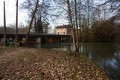
 Le Cul du Cerf, starting from Orquevaux
 Visorando Member
 5.40 mi
 +364 ft
 -364 ft
 2h 50
2h 50
 Moderate
 Departure from Orquevaux (Haute-Marne)
A route that takes you to the Cul du Cerf, a limestone cirque 200 metres wide and 65 metres high, at the bottom of which flows the underground spring known as La Manoise. A Natura 2000-listed site notable for its flora, where you can admire the spring gushing from the ground, protected by a metal grille. A fairly technical route with some difficulties due to the nature of the terrain.
The Vivier hillside at Andelot
 2.28 mi
+144 ft
-128 ft
1h 10
2.28 mi
+144 ft
-128 ft
1h 10
 Easy
Departure from Andelot-Blancheville (Haute-Marne)
Easy
Departure from Andelot-Blancheville (Haute-Marne)
A short, easy walk with views of Andelot, Montéclair and the Fouillot hill that hides Rimaucourt. You can also see the Moulin district and its very old Tréfilerie factory.
La Bove and La Cona
 6.84 mi
+594 ft
-597 ft
3h 40
Moderate
Departure from Bourmont (Haute-Marne)
6.84 mi
+594 ft
-597 ft
3h 40
Moderate
Departure from Bourmont (Haute-Marne)
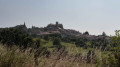
Starting from Bourmont, a charming little village in the Haut-Marne region, you’ll go on a short walk through the surrounding forest.
Between Millières and Esnouveaux via Le Raillemont
 7.01 mi
+528 ft
-518 ft
3h 40
Moderate
Departure from Millières (Haute-Marne) (Haute-Marne)
7.01 mi
+528 ft
-518 ft
3h 40
Moderate
Departure from Millières (Haute-Marne) (Haute-Marne)
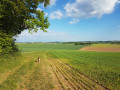
Discover part of the Langres plateau and the Rognon valley. A route through woods and meadows.
Vignory Castle
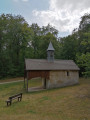 6.59 mi
+735 ft
-709 ft
3h 40
Moderate
Departure from Vignory (Haute-Marne)
6.59 mi
+735 ft
-709 ft
3h 40
Moderate
Departure from Vignory (Haute-Marne)
A walk that allows you to explore Vignory, one of the “small towns of character”, with its Romanesque church and the remains of its feudal castle, as well as the forests and woods surrounding the village.
 From Neufchâteau station to the Citadel of Langres (Navarre campsite)
53.87 mi
+1,732 ft
-1,145 ft
8 hrs
 Difficult
Departure from Neufchâteau (Vosges)
Difficult
Departure from Neufchâteau (Vosges)
This stage follows the southern part of the Eurovélo 19 "La Meuse à vélo" route (1,050 km from Langres to Rotterdam). From Neufchâteau, we follow the meandering Mouzon, a tributary of the Meuse. We then leave it behind, taking less travelled but more direct roads that avoid the meanders of the Meuse. We rejoin the EV19 just before the "Source de la Meuse" site, on the Langres plateau crossed by three watersheds. With the plateau reaching a height of 450 m, the gradients are not significant, but on arrival, you will need to make a little effort to climb the promontory on which the Citadel of Langres is perched. Your reward: a splendid view at dusk!
From the Joan of Arc Basilica to Les Faux
 13.41 mi
+997 ft
-1,014 ft
7h 00
Difficult
Departure from Domrémy-la-Pucelle (Vosges)
13.41 mi
+997 ft
-1,014 ft
7h 00
Difficult
Departure from Domrémy-la-Pucelle (Vosges)
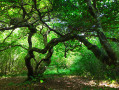
A rich and varied route, starting from the Joan of Arc Basilica, taking you to see the strange, twisted beech trees of Sionne (much less famous, and therefore less popular than the Faux de Verzy), through beautiful, unspoilt forests and a few pastures, to discover a well-hidden dolmen. The tour concludes with a visit to Domrémy-la-Pucelle.
Saprée Vadrouille in the land of Joan of Arc in Domrémy-la-Pucelle
 Association / Club / Walk leader
 6.53 mi
+636 ft
-614 ft
3h 35
Moderate
Departure from Domrémy-la-Pucelle (Vosges)
6.53 mi
+636 ft
-614 ft
3h 35
Moderate
Departure from Domrémy-la-Pucelle (Vosges)
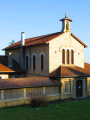
With the Jubilee Year of Hope, since November 2024, our Catholic Church in the Vosges has developed a proposal: "Saprée Vadrouille, travel journal for paths of hope", with three issues per year focusing on liturgical times and the saints of the Vosges.Several itineraries are proposed in the Vosges as local pilgrimages and paths of hope. This is an opportunity to rediscover our region and our local saints throughout the Vosges department. Each itinerary can be done independently of the others, at any time of year. "Dans le pays de Jeanne" (In the Land of Joan) is the itinerary proposed in the second issue of "Saprée Vadrouille", which you can discover here.
The path of springs and streams starting from Abainville
 12.71 mi
+679 ft
-679 ft
6h 25
Moderate
Departure from Abainville (Meuse)
12.71 mi
+679 ft
-679 ft
6h 25
Moderate
Departure from Abainville (Meuse)
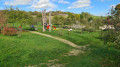
A circular route in a region dotted with springs and streams, offering the chance to discover Bonnet, a village with a rich history.
Bermont Chapel
3.97 mi
+627 ft
-620 ft
2h 20
Easy
Departure from Greux (Vosges)
A short walk in the heart of the forest near Domrémy-la-Pucelle.
Greux is a small village near Neufchâteau.
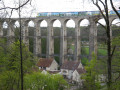
Ferme du Fays and Chaumont Viaduct
 4.56 mi
+299 ft
-312 ft
2h 20
Easy
Departure from Chaumont (Haute-Marne) (Haute-Marne)
4.56 mi
+299 ft
-312 ft
2h 20
Easy
Departure from Chaumont (Haute-Marne) (Haute-Marne)
An almost entirely shaded route between the Ferme du Fays and the Chaumont Viaduct.
Le Haut de Crémont from Chevillon
5.76 mi
+272 ft
-302 ft
2h 55
Easy
Departure from Chevillon (Haute-Marne)
A very pretty walk through the forest and then along the canal, with a slightly steep climb at the beginning but which quickly becomes easier with the descent towards Sommeville. Picturesque spot: the passage under the railway line, then over the river on a metal footbridge.
Curel via Haut de Fosse from Chevillon
7.74 mi
+463 ft
-463 ft
4h 00
Moderate
Departure from Chevillon (Haute-Marne)
A beautiful summer walk along the canal, then discover the pretty village of Curel and climb through the forest to reach Chevillon. Beautiful views of the Marne Valley and the Châtonrupt Viaduct (in good weather).
The Route des Moines through the Morimond Forest
6.00 mi
+279 ft
-279 ft
3h 00
Easy
Departure from Parnoy-en-Bassigny (Haute-Marne)
A pleasant walk around the site of the former Morimond Abbey and through the woods of the same name. Morimond Abbey, a Cistercian abbey founded in 1115, is the mother house of more than seven hundred monasteries for men and women in France and Europe. The route also takes you past the Morimond Lakes, a series of artificial lakes created by the Cistercian monks to supply water to the abbey’s various outbuildings: gardens, mills, sawmill, nail-making workshop, and so on.