Refine your search for walks in Briouze
Briouze walks


 Grand Hazé Marshes
 Visorando Member
 4.47 mi
 +10 ft
 -10 ft
 2h 05
2h 05
 Easy
Easy
 Departure from Briouze (Orne)
A family walk in the largest wetland area in the Orne department. Located in the Houlme region, at the heart of the Normandy bocage, the Grand Hazé is a landscape of 200 hectares of ponds, peat bogs, reed beds and peaty woods.
Nature trail in Craménil
 Association / Club / Walk leader4.42 mi
+354 ft
-364 ft
2h 20
Easy
Departure from Craménil (Orne)
Association / Club / Walk leader4.42 mi
+354 ft
-364 ft
2h 20
Easy
Departure from Craménil (Orne)
The organisations Familles Rurales Briouze, Environnement et Vie en Pays de Briouze and the municipality of Craménil have put together a family trail for you to discover the flora, fauna and typical landscapes of our bocage. Some sections are damp, so make sure you wear sturdy shoes! The route described includes a 3.2 km alternative route; you can also complete the 4 km circular route.
Route Orange in Sainte-Honorine-la-Guillaume
5.54 mi
+417 ft
-410 ft
2h 55
Easy
Departure from Sainte-Honorine-la-Guillaume (Orne)
A refreshing walk in the heart of Suisse Normande, through dense woods, sunken paths, alongside small streams and across farmland. Some lovely climbs to give your calves a good workout. The paths are very easy to walk on, well-maintained and marked in orange.
The Iron Route - Discovering the mining region of Orne
8.01 mi
+568 ft
-564 ft
4h 10
 Moderate
Departure from La Ferrière-aux-Étangs (Orne)
Moderate
Departure from La Ferrière-aux-Étangs (Orne)
During this hike, you will discover surprising mining remains: iron mine shafts, calcination furnaces from before and after 1938, and a mining town.
The hike begins along a Way of the Cross that will take you to the Calvary of Mont Brûlé.
The hike winds through the undergrowth and follows a few sections of road.
During your journey, you will discover a castle and an old watermill nestled in a green setting.
The meandering trail in Saint-Philbert-sur-Orne
 3.94 mi
+407 ft
-423 ft
2h 10
Easy
Departure from Saint-Philbert-sur-Orne (Orne)
3.94 mi
+407 ft
-423 ft
2h 10
Easy
Departure from Saint-Philbert-sur-Orne (Orne)
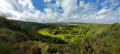
Hike through woods, countryside, villages and rivers, from Roches d'Oëtre to Méandre de Rouvrou. From Roches d'Oëtre, follow a well-marked path that will take you through the meanders of La Rouvre.
The granite trail at La Roche d'Oëtre
 5.49 mi
+617 ft
-591 ft
3h 05
Moderate
Departure from Saint-Philbert-sur-Orne (Orne)
5.49 mi
+617 ft
-591 ft
3h 05
Moderate
Departure from Saint-Philbert-sur-Orne (Orne)
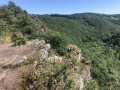
If there were a paradise for hiking, the Roche d'Oëtre Sensitive Natural Area and the Rouvre Gorges would certainly be well placed! A listed site and Sensitive Natural Area in the Orne department, La Roche d'Oëtre, located in the heart of the Normandy Mountains, is a must-see site and a meeting place for lovers of wild nature and hiking.
Between town and country in Bagnoles-de-l'Orne
 3.91 mi
+131 ft
-144 ft
1h 55
Easy
Departure from Bagnoles-de-l'Orne (Orne)
3.91 mi
+131 ft
-144 ft
1h 55
Easy
Departure from Bagnoles-de-l'Orne (Orne)
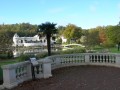
A beautiful walk that runs alongside the Village du Cheval and then enters the forest via a path offering beautiful views of the surrounding countryside. It then crosses the Saint-Ortaire priory and returns to the centre of Bagnoles-de-l'Orne, passing by the lake and the casino on the way back to the car park.
Les Roches d'Oëtre and La Forêt-Auvray
 13.10 mi
+1,227 ft
-1,247 ft
7h 05
Moderate
Departure from Le Mesnil-Villement (Calvados)
13.10 mi
+1,227 ft
-1,247 ft
7h 05
Moderate
Departure from Le Mesnil-Villement (Calvados)
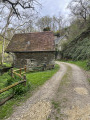
A beautiful hike offering views of the Roches d'Oëtre, the village of La Forêt-Auvray, the banks of the Orne and the Normandy countryside.
This hike is a slightly longer variation of the "Around La Forêt-Auvray" hike.
You can start the hike at La Fouillerie (the option chosen for the description) or at La Forêt-Auvray.
Forges de Varennes and La Nocherie via the Voie Verte and footpaths
 5.05 mi
+184 ft
-197 ft
2h 30
Easy
Departure from Saint-Bômer-les-Forges (Orne)
5.05 mi
+184 ft
-197 ft
2h 30
Easy
Departure from Saint-Bômer-les-Forges (Orne)
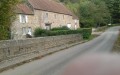
A picturesque circular route with no navigation difficulties, ideal for families. The route mainly follows the Flers-Domfront Greenway, passes by the Château de Varenne and its old forges, then climbs up a path towards the Manoir de la Nocherie. It rejoins the Greenway after crossing the Varenne at the Moulin de la Nocherie ford to return to the start.
The Baize Valley
 4.54 mi
+489 ft
-492 ft
2h 30
Easy
Departure from Rapilly (Calvados)
4.54 mi
+489 ft
-492 ft
2h 30
Easy
Departure from Rapilly (Calvados)
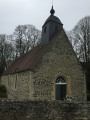
The starting point of this route will charm you with its beautiful landscapes. You will set off to explore a valley where clear, fast-flowing streams run through often wooded slopes. As you hike, you will discover unique landscapes where emotion guides your steps.
Around Les Loges-Saulces
7.70 mi
+492 ft
-492 ft
4h 00
Moderate
Departure from Les Loges-Saulces (Calvados)
A day out in the Swiss Normandy region. Beautiful scenery along well-signposted paths.
The Chemin du Roy in Pont-d'Ouilly
6.39 mi
+948 ft
-948 ft
3h 45
Moderate
Departure from Pont-d'Ouilly (Calvados)
From the banks of the cool Val la Hère stream, you will climb to the heights of Plainville and Bourg d'Ouilly, where the view is remarkable.
The Mont de Cerisy nature trail
 1.30 mi
+144 ft
-151 ft
0h 45
Easy
Departure from Cerisy-Belle-Étoile (Orne)
1.30 mi
+144 ft
-151 ft
0h 45
Easy
Departure from Cerisy-Belle-Étoile (Orne)
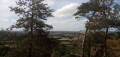
A short, mainly woodland walk that can be undertaken with very young children. The route is mainly through woodland, with several fine trees that catch the eye. The top of the castle tower (accessible) and a viewing point offer fine panoramic views of the Normandy countryside.
The Chapelle du Cerisier in Domfront-en-Poiraie
 7.71 mi
+561 ft
-531 ft
4h 00
Moderate
Departure from Domfront (Orne) (Orne)
7.71 mi
+561 ft
-531 ft
4h 00
Moderate
Departure from Domfront (Orne) (Orne)
The landscapes and views to the east serve as a reminder that the Alpes Mancelles are not far away. Consequently, some sections involve elevation changes which may present a few difficulties for those who are not used to them.
At the (5), do pop into the Chapelle du Cerisier for a short break.
Around Mont Secret
 4.37 mi
+640 ft
-650 ft
2h 35
Easy
Departure from Montsecret (Orne)
4.37 mi
+640 ft
-650 ft
2h 35
Easy
Departure from Montsecret (Orne)
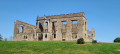
Circling Mont Secret with an off-centre start at the car park near L’Aufrairie, this more challenging route climbs towards Mont de Cerisy along the section belonging to the commune of Montsecret. Between two hills, will Mont Secret perhaps reveal itself?
Circular des Rochers des Parcs
 4.23 mi
+676 ft
-676 ft
2h 30
Easy
Departure from Le Bô (Calvados)
4.23 mi
+676 ft
-676 ft
2h 30
Easy
Departure from Le Bô (Calvados)
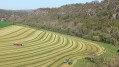
This is a fairly easy hike, with beautiful panoramic views of the Orne and the surrounding countryside throughout. An iconic site in Suisse Normande, the Rochers des Parcs are also a mecca for rock climbing.
The Rocks of Brisevieille
 5.96 mi
+879 ft
-899 ft
3h 30
Moderate
Departure from La Pommeraye (Calvados)
5.96 mi
+879 ft
-899 ft
3h 30
Moderate
Departure from La Pommeraye (Calvados)
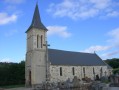
Circuit starting from La Pommeraie, a small authentic village in Suisse Normande, whose name comes from the word pomme (apple). In autumn, there are many chestnut trees.
A gentle, short walk around Domfront-en-Poiraie
3.90 mi
+322 ft
-295 ft
2h 05
Moderate
Departure from Domfront (Orne) (Orne)
A gentle, short walk around Domfront-en-Poiraie with a slight climb. Passes through the small village of Saint-Front. The route follows small roads and paths, some of which are wooded. Lovely views.
Meeting the Fairies of the Baligot Rocks
 6.52 mi
+758 ft
-748 ft
3h 40
Moderate
Departure from Proussy (Calvados)
6.52 mi
+758 ft
-748 ft
3h 40
Moderate
Departure from Proussy (Calvados)
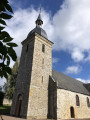
The Fairies of the Baligot Rocks still have their legend, which has never ceased to be popular in Proussy. They lived in the Fairy’s Hole, on the side of a high rocky escarpment that rises at the edge of the Druance, on the road from Condé to Pontécoulant.
Walk in Falaise
 2.84 mi
+167 ft
-167 ft
1h 25
Easy
Departure from Falaise (Calvados) (Calvados)
2.84 mi
+167 ft
-167 ft
1h 25
Easy
Departure from Falaise (Calvados) (Calvados)
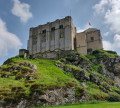
This family walk allows you to discover the town of Falaise, its castle and its ramparts. It is accessible to most people.
You will discover all of the ramparts surrounding the town as well as the main gates and monuments.
The Val stream and its mills between Bonnoeil and Saint-Germain-Langot
 9.16 mi
+554 ft
-554 ft
4h 40
Moderate
Departure from Bonnœil (Calvados)
9.16 mi
+554 ft
-554 ft
4h 40
Moderate
Departure from Bonnœil (Calvados)
Good footing and good eyesight are required for this hike...
The name Bonnoeil probably comes from "bonus" or "bonos" and "ialo", meaning "good field" or "good clearing". The rich soil is an asset in this region, where nursery growers cultivate the fertile land watered by numerous streams and rivers, along the banks of which stand old mills (only the mill in the village of Saint-Germain-Langot is still in operation).
Orne valley around Clécy
 6.16 mi
+906 ft
-922 ft
3h 35
Moderate
Departure from Clécy (Calvados)
6.16 mi
+906 ft
-922 ft
3h 35
Moderate
Departure from Clécy (Calvados)
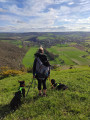
A superb walk to discover the Normandy bocage and the Orne valley.
This hike takes in "le pain de sucre", "les rochers de la Houle" and "les rochers des parcs".
In the Normandy countryside around Clécy
 5.68 mi
+850 ft
-837 ft
3h 20
Easy
Departure from Clécy (Calvados)
5.68 mi
+850 ft
-837 ft
3h 20
Easy
Departure from Clécy (Calvados)
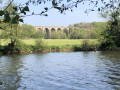
A fairly easy walk, mostly along country lanes with virtually no traffic.Return via the Clécy viaduct and along the River Orne.This walk can be done in the morning, with a stop for lunch at one of the riverside bistros along the Orne.
In Suisse Normande, the Pain de Sucre and the Rochers des Parcs
7.92 mi
+896 ft
-915 ft
4h 25
Moderate
Departure from Clécy (Calvados)
Starting from Le Vey, this easily accessible circular route leads to the Pain de Sucre and the Rochers des Parcs, two lovely sites in Suisse Normande, via quiet roads, the Greenway and footpaths. Starting along the River Orne, the route then climbs up onto the plateau before descending back to the river. The walk follows tree-lined paths for part of the way, but some sections are exposed to the sun.
Circular Route of the Streams from Saint-Aignan-de-Couptrain
 Tourist office
 6.85 mi
+285 ft
-292 ft
3h 25
Moderate
Departure from Saint-Aignan-de-Couptrain (Mayenne)
6.85 mi
+285 ft
-292 ft
3h 25
Moderate
Departure from Saint-Aignan-de-Couptrain (Mayenne)
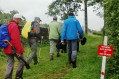
The village of Saint-Aignan-de-Couptrain is the starting point for two circular walks that will take you through unspoilt hedgerow countryside. Both routes follow dirt tracks for 90 per cent of the way. Here is one of these circular walks. The second: The ‘Boucle des herbages’ circular walk from Saint-Aignan-de-Couptrain
The “Circular Tour of Herbages” from Saint-Aignan-de-Couptrain
7.39 mi
+243 ft
-243 ft
3h 35
Moderate
Departure from Saint-Aignan-de-Couptrain (Mayenne)
The village of Saint-Aignan-de-Couptrain is the starting point for two circular walks that will take you through unspoilt hedgerow countryside. Both routes follow dirt tracks for 90 per cent of the way. Here is one of these circular walks.
The Moulin du Fay
 6.83 mi
+820 ft
-830 ft
3h 50
Moderate
Departure from Cauville (Calvados)
6.83 mi
+820 ft
-830 ft
3h 50
Moderate
Departure from Cauville (Calvados)
Swiss Normandy: valleys, springs, streams, fir trees, small villages – everything you need to have a great day out and come home tired.
Circular route starting from the Mont des Avaloirs viewpoint
 4.54 mi
+479 ft
-479 ft
2h 30
Easy
Departure from Pré-en-Pail (Mayenne)
4.54 mi
+479 ft
-479 ft
2h 30
Easy
Departure from Pré-en-Pail (Mayenne)
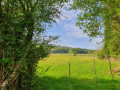
A hike starting from the iconic Mont des Avaloirs viewpoint, offering a beautiful route through the Multonne forest. Before or after the hike, be sure to climb the 108 steps of the building for an exceptional 360° view and, as you ascend, discover the brightly coloured street art by Seb Toussaint, a Franco-British graffiti artist.
Route of the Mont des Avaloirs Community of Communes.
Discovery trail around the Mont des Avaloirs Reserve in Pré-en-Pail
 5.18 mi
+604 ft
-614 ft
2h 55
Moderate
Departure from Pré-en-Pail (Mayenne)
5.18 mi
+604 ft
-614 ft
2h 55
Moderate
Departure from Pré-en-Pail (Mayenne)
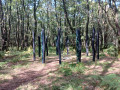
Immerse yourself in nature at the heart of the Mont des Avaloirs Regional Nature Reserve!
At 416 metres high, Mont des Avaloirs, the highest point in western France, takes you to the summit of the Armorican Massif. You are in the heart of the Normandy-Maine Regional Nature Park and Geopark. On the poor soil of Armorican sandstone, the dominant habitats are heathland and deciduous woodland. In this gentle, low-lying landscape, you’ll also find meadows, peat bogs and scree slopes. Current inventories list over 2,000 species, several of which are heritage species such as the European Nightjar and the Montagu’s Harrier.
Numerous routes set off from this particularly well-preserved natural environment, dotted with magnificent sites.
This trail offers a total immersion in nature, with themed stops to trace the thread of history, discover the wildlife and flora, and understand how the landscapes have evolved. Along the way, new views unfold!