


Refine your search for walks in Bellême
Bellême walks


 Étang de la Herse lake at the start of Bellême
 Association / Club / Walk leader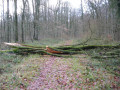
 6.18 mi
 +525 ft
 -522 ft
 3h 20
3h 20
 Easy
Easy
 Departure from Bellême (Orne)
A lovely walk in the beautiful Bellême national forest, where you can admire the Étang de la Herse lake and its fountain.
The spur at Bellême
 Visorando Member
 4.50 mi
+344 ft
-338 ft
2h 20
Easy
Departure from Bellême (Orne)
4.50 mi
+344 ft
-338 ft
2h 20
Easy
Departure from Bellême (Orne)
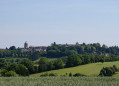
Discover Bellême, a Petite Cité de Caractère® (Small Town of Character), on this tour that highlights its rich heritage. Bellême charms visitors with its unique architecture, where the harmony between limestone and ochre and pink sand plaster, typical of Perche-style buildings, gives this town its incomparable charm.
La Grande Brumardière
 3.64 mi
+56 ft
-56 ft
1h 45
Easy
Departure from Le Pin-la-Garenne (Orne)
3.64 mi
+56 ft
-56 ft
1h 45
Easy
Departure from Le Pin-la-Garenne (Orne)
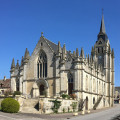
Route starting from Saint-Barthélémy Church. You can explore the avenue of plane trees and the Manoir de la Pellonnière, part of the old railway line, the Jeandotterie Bridge, the countryside and the Château de la Courtinière. The route can be covered on foot or by mountain bike.
Perche heritage in Saint-Cyr-le-Rosière
 7.40 mi
+413 ft
-417 ft
3h 45
7.40 mi
+413 ft
-417 ft
3h 45
 Moderate
Departure from Saint-Cyr-la-Rosière (Orne)
Moderate
Departure from Saint-Cyr-la-Rosière (Orne)
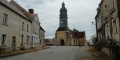
A countryside trail exploring the built heritage of the Perche region and its gems, notably the hamlet of Saint-Gauburge and its priory, the Manoir de l'Angenardière, the Manoir des Chaponnières, and the hamlet of Clémencé. Discover exceptional buildings constructed from cut stone and finished with lime plaster coloured with local sand.
La Perrière – Saint-Germain-de-la-Coudre via Bellême
 18.14 mi
+1,211 ft
-1,453 ft
8 hrs
18.14 mi
+1,211 ft
-1,453 ft
8 hrs
 Very difficult
Departure from La Perrière (Orne)
Very difficult
Departure from La Perrière (Orne)
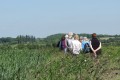
This walk is one of two variants of the seventh stage of an eight-day, 220 km route, the Tour des Collines du Perche. It will take you along the edge of the Bellême Forest until you reach one of the jewels of the Perche region in the Orne, Bellême, which you’ll certainly want to visit. The route then heads south, passing through La-Chapelle-Souëf and then Saint-Germain-de-la-Coudre.
From La Perrière to Saint-Germain-de-la-Coudre via Igé
 17.09 mi
+951 ft
-1,214 ft
8h 40
17.09 mi
+951 ft
-1,214 ft
8h 40
 Difficult
Departure from La Perrière (Orne)
Difficult
Departure from La Perrière (Orne)
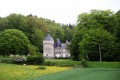
This walk is one of two variants of the seventh stage of an eight-day, 220-km route, the Tour des Collines du Perche.
After leaving La Perrière, the walk enters the Bellême national forest, emerges to the south into very hilly countryside and arrives in the village of Vaunoise with its Cenomanian cuesta terrain. After Igé, the route continues along quiet country lanes, then some very beautiful sunken paths.
Manor houses and dolmens from the priory of Sainte-Gauburge
 8.78 mi
+571 ft
-574 ft
4h 30
Moderate
Departure from Saint-Cyr-la-Rosière (Orne)
8.78 mi
+571 ft
-574 ft
4h 30
Moderate
Departure from Saint-Cyr-la-Rosière (Orne)
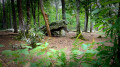
Starting from the 13th-century priory of Sainte-Gauburge, this route leads along sunken paths to the Dolmen de la Pierre Procureuse, the site of several legends, then passes in front of a feudal motte at the Tour du Sablon and several fortified farms, before reaching the Angenardière manor house.
The Coudre Valley, starting from Saint-Germain-de-la-Coudre
 10.24 mi
+673 ft
-650 ft
5h 20
Moderate
Departure from Saint-Germain-de-la-Coudre (Orne)
10.24 mi
+673 ft
-650 ft
5h 20
Moderate
Departure from Saint-Germain-de-la-Coudre (Orne)
A lovely walk through the Percheron countryside and the Perche Regional Park. Numerous watercourses flow through this area: the Coudre, the Même, the Coutillonnière and the Jaunet, all of which flow into the Huisnes. The undulating route follows beautiful sunken lanes lined with pollarded trees.
From Saint-Germain-de-la-Coudre to Nogent-le-Rotrou
 17.44 mi
+1,299 ft
-1,280 ft
10 hrs
Very difficult
Departure from Saint-Germain-de-la-Coudre (Orne)
17.44 mi
+1,299 ft
-1,280 ft
10 hrs
Very difficult
Departure from Saint-Germain-de-la-Coudre (Orne)
This walk is the eighth and final stage of an eight-day, 220km route, the Tour des Collines du Perche.
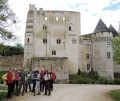
Setting off from Saint-Germain-de-la-Coudre, you will first pass through the Bois de la Bretèche, situated on a plateau on the left bank of the Huisne, which you will cross at Le Theil. The route, offering plenty of panoramic views, will take you to Nogent-le-Rotrou at the foot of Château Saint-Jean. All that remains then is to walk through the historic districts of Le Pâty.
The Priory of Sainte-Gauburge, starting from L’Hermitière
 14.55 mi
+935 ft
-935 ft
7h 30
Moderate
Departure from L'Hermitière (Orne)
14.55 mi
+935 ft
-935 ft
7h 30
Moderate
Departure from L'Hermitière (Orne)
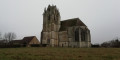
Following the sunken lanes of the Perche and the rolling hills, the route passes through the village of Gemages, the Angenardière Manor and the Priory of Sainte-Gauburge with its Ecomuseum. The return journey to L’Hermitière takes you through the Bois des Baronnières, which overlooks Le Theil.
Village of Gemages at the start of the Chêne Vert
 4.87 mi
+453 ft
-440 ft
2h 40
Easy
Departure from Le Theil (Orne) (Orne)
4.87 mi
+453 ft
-440 ft
2h 40
Easy
Departure from Le Theil (Orne) (Orne)
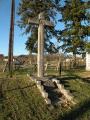
A hike through woods, sunken paths and hills that will introduce you to the Même valley, a panoramic view of Saint-Germain-de-la-Coudre and the church of Gemages. Along the way, you will admire the charming village of L'Hermitière, its castle and its church perched proudly on a hill.
Circular in the Réno Valdieu forest
 14.34 mi
+883 ft
-896 ft
7h 20
Difficult
Departure from La Chapelle-Montligeon (Orne)
14.34 mi
+883 ft
-896 ft
7h 20
Difficult
Departure from La Chapelle-Montligeon (Orne)
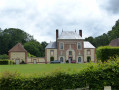
A lovely walk, mostly on good paths, which allows you to visit a magnificent forest, admire a few ponds and pass by some religious buildings. The only difficulty is the length.
Huisne Valley and the hills of Val-au-Perche
 11.52 mi
+787 ft
-778 ft
6h 00
Moderate
Departure from Le Theil (Orne) (Orne)
11.52 mi
+787 ft
-778 ft
6h 00
Moderate
Departure from Le Theil (Orne) (Orne)
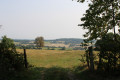
Lush green valleys, steep hillsides, majestic panoramas, sunken lanes and their gnarled pollarded trees are all part of this beautiful countryside walk, which crosses the wide Huisne valley and takes you through the villages of Mâle and La Rouge.
The sunken lanes of Préval
 3.08 mi
+105 ft
-105 ft
1h 30
Easy
Departure from Préval (Sarthe)
3.08 mi
+105 ft
-105 ft
1h 30
Easy
Departure from Préval (Sarthe)
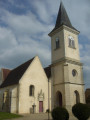
Discover this peaceful village, its countryside and its hedgerows by following its sunken lanes, which offer beautiful panoramic views of the Même valley and the hills of the Perche.
Mortagne-au-Perche – Bellême, alternative route via Mauves-sur-Huisne
14.60 mi
+627 ft
-709 ft
7h 15
Difficult
Departure from Mortagne-au-Perche (Orne)
This section is a variant of the Tour des Collines du Perche. It links Mortagne-au-Perche to Bellême, both of which are former historic capitals of the Perche region. The first part of the route follows the old Alençon–Condé-sur-Huisne railway line, which has been converted into a greenway and now forms part of the Paris–Le Mont Saint-Michel cycle route.
You will then reach Bellême mainly via some very beautiful natural paths and very short stretches of tarmac.
From Mortagne-au-Perche to La Perrière
 18.02 mi
+663 ft
-856 ft
8 hrs
Very difficult
Departure from Mortagne-au-Perche (Orne)
18.02 mi
+663 ft
-856 ft
8 hrs
Very difficult
Departure from Mortagne-au-Perche (Orne)
This walk is the sixth stage of the Tour des Collines du Perche. It starts in an iconic town and ends in an iconic village of the Perche region, both of which are very popular with Parisians seeking historic architecture and beautiful scenery. As both are situated on high ground, the panoramic views are remarkable.
The Avezé and Souvigné plateau, starting from L’Orgerie
3.62 mi
+30 ft
-30 ft
1h 40
Easy
Departure from Souvigné-sur-Même (Sarthe)
A pleasant walk through the woods and countryside of Avezé along sunken paths.
From Mâle to the outskirts of Ceton
 8.80 mi
+764 ft
-758 ft
4h 45
Moderate
Departure from Orne
8.80 mi
+764 ft
-758 ft
4h 45
Moderate
Departure from Orne
Through sunken lanes, hedgerows and woods, discover the landscapes of the Perche region as far as Ceton, the Jambette Valley and the Huisne Valley.
In the heart of the Perche countryside from Avezé
 Tourism professional
 8.17 mi
+367 ft
-367 ft
4h 05
Moderate
Departure from Avezé (Sarthe) (Sarthe)
8.17 mi
+367 ft
-367 ft
4h 05
Moderate
Departure from Avezé (Sarthe) (Sarthe)
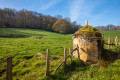
The village of Avezé developed in the Middle Ages to the north-east of the church, which was rebuilt inthe 16th century, at the same time as the priory that adjoined it, of which only extensive farm buildings remain. The main street is dominated by a large two-storey house known as the “Maison du prieur” (Prior’s House), dating from the 15th or 16th century, notable for its rear stair tower and its elegant façade that juts out over the current street.
The woods of Beauvais
 7.14 mi
+548 ft
-538 ft
3h 45
Moderate
Departure from Avezé (Sarthe) (Sarthe)
7.14 mi
+548 ft
-538 ft
3h 45
Moderate
Departure from Avezé (Sarthe) (Sarthe)
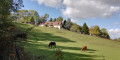
A lovely walk along sunken paths, through woodland and across the gentle hills of the Perche. Panoramic views of the Huisne and Maroisse valleys.
Panoramic views over the Prairies d'Avezé
 6.80 mi
+377 ft
-384 ft
3h 25
Moderate
Departure from Avezé (Sarthe) (Sarthe)
6.80 mi
+377 ft
-384 ft
3h 25
Moderate
Departure from Avezé (Sarthe) (Sarthe)
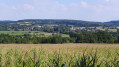
This route, which alternates between sunken lanes, forest paths and flat sections, will take you to the hill overlooking the Huisne Valley to the west. Along the way, several panoramic views allow you to admire the meadows of Avezé, a veritable hay barn that has provided for generations of farmers.
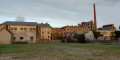
The Abadie factory, the Saules tile works and the Jambette Valley
 17.33 mi
+1,158 ft
-1,161 ft
9h 00
Difficult
Departure from Avezé (Sarthe) (Sarthe)
17.33 mi
+1,158 ft
-1,161 ft
9h 00
Difficult
Departure from Avezé (Sarthe) (Sarthe)
This walk takes you through the Avezé forest to the outskirts of Saint-Germain-de-la-Coudre, passing by the Saules tile works. Winding through the hills, the route passes through Le Theil, a once-thriving industrial town and home to the former Abadie factories, now listed as heritage sites. Then, following the sunken paths, you’ll explore the Jambette Valley before returning to Avezé via the Beauvais woods and the panoramic views over the Huisne Valley.