


Refine your search for walks in Saint-Eloy
Saint-Eloy walks


 Roc'h an Daol route
 Visorando Member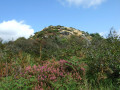
 3.67 mi
 +384 ft
 -400 ft
 2h 00
2h 00
 Moderate
 Departure from Saint-Eloy (Finistère)
A short walk with beautiful panoramic views of the peaks in the municipality of Saint-Eloy.
Roc’h Gad to Tréhou route
9.09 mi
+636 ft
-659 ft
4h 45
Moderate
Departure from Le Tréhou (Finistère)
A walk through the heart of the Tréhou countryside.An easy walk in dry weather.
Walk around the Cranou Forest
8.60 mi
+912 ft
-899 ft
4h 45
Moderate
Departure from Le Faou (Finistère)
Situated in the Armorique Regional Park, this is the largest state-owned forest in Finistère. Hilly, with its beech trees and ancient oaks, and crossed by theGR®37and the Way of St James, it is a favourite spot for walkers.
Discover forestry in the Cranou Forest
 10.57 mi
+1,165 ft
-1,161 ft
5h 50
Moderate
Departure from Le Faou (Finistère)
10.57 mi
+1,165 ft
-1,161 ft
5h 50
Moderate
Departure from Le Faou (Finistère)
This walk has been organised by three Forestry Management students
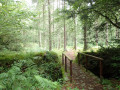
We invite you to discover the profession of a forester by following a slide show along a route whose stops will help you understand forest management.
Circular Rumengol towards Le Cranou
6.38 mi
+568 ft
-574 ft
3h 25
Moderate
Departure from Le Faou (Finistère)
Discover sunken paths, recharge your batteries in the forest, and visit the village of Rumengol and its place of pilgrimage.
The Leopards’ Route in Le Faou
2.36 mi
+30 ft
-30 ft
1h 05
 Easy
Departure from Le Faou (Finistère)
Easy
Departure from Le Faou (Finistère)
Set off to explore this ‘Petite Cité de Caractère’ with this urban walking route known as the ‘Léopards’!On foot, by bike, on a scooter, or with a pushchair!The route is marked with bronze nails bearing the town’s coat of arms (the leopard) and additional blue signposts.
Circuit du nouveau bourg de Quimerc'h vers Kostalan
 4.52 mi
+554 ft
-571 ft
2h 35
Moderate
Departure from Pont-de-Buis-lès-Quimerch (Finistère)
4.52 mi
+554 ft
-571 ft
2h 35
Moderate
Departure from Pont-de-Buis-lès-Quimerch (Finistère)
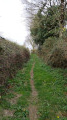
Découvrez la campagne de Quimerc'h à partir du nouveau bourg jusqu'au village typique de Kostalan. Cette promenade offre de beaux points de vues sur le Menez Hom, Rumengol et la rade de Brest. Itinéraire équilibré entre chemins creux, chemins d'exploitation et petites routes tranquilles.
Tour of Lake Drennec
4.07 mi
+56 ft
-56 ft
1h 55
Easy
Departure from Sizun (Finistère)
At the gateway to the Monts d'Arrée, this is a short, easy and bucolic walk that never strays far from the lake and is shaded by trees. Crossing the floating footbridge adds a nice touch to this walk.
Tro Sant Riwal circuit
 Local authority
 9.75 mi
+781 ft
-794 ft
5h 10
Moderate
Departure from Saint-Rivoal (Finistère)
9.75 mi
+781 ft
-794 ft
5h 10
Moderate
Departure from Saint-Rivoal (Finistère)
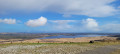
Nestled beautifully in a lush green valley, this village has all the charm of a mountainous countryside, with its sunken lanes, hedgerows, streams and rugged terrain.The village’s name derives from the parish’s patron saint, Saint Rivoal (formerly Riwall), the name of a prominent family among the Bretons who emigrated to Great Britain in the 5th and 6th centuries.
Saint-Rivoal has been awarded the ‘Communes du Patrimoine Rural de Bretagne’ designation.
Saint-Rivoal countryside and Monts d'Arrée ridges
10.74 mi
+1,175 ft
-1,175 ft
6h 00
Moderate
Departure from Saint-Rivoal (Finistère)
Hiking in wild areas, mostly unmarked. Woods, rivers, moors, views of several peaks of the Monts d'Arrée, Lake Brennilis, Saint-Michel Chapel.
In the countryside and around Lake Drennec
 12.25 mi
+922 ft
-942 ft
6h 25
Moderate
Departure from Commana (Finistère)
12.25 mi
+922 ft
-942 ft
6h 25
Moderate
Departure from Commana (Finistère)
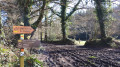
A varied route where you can discover aspects of the Breton countryside that have changed little over time. Cross moors and woods, pass through isolated hamlets to return to the lake and its landscaped surroundings.
Banks of the Mignonne and Daoulas Viaduct
 2.25 mi
+49 ft
-49 ft
1h 05
Easy
Departure from Daoulas (Finistère)
2.25 mi
+49 ft
-49 ft
1h 05
Easy
Departure from Daoulas (Finistère)
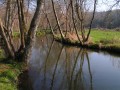
A short, bucolic walk along the Mignonne, the river in Daoulas, to reach the imposing viaduct that allows the railway to span the valley with a series of fifteen arches.
The return journey takes you along a short section of the Daoulas estuary.
Route of the old paths in Lopérec
 7.26 mi
+896 ft
-869 ft
4h 05
Moderate
Departure from Lopérec (Finistère)
7.26 mi
+896 ft
-869 ft
4h 05
Moderate
Departure from Lopérec (Finistère)
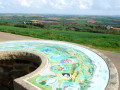
The municipality of Lopérec is set amidst a varied, undulating landscape of hedgerows, featuring woods, moorland and farmland criss-crossed by numerous watercourses.
In 1830, a traveller described Lopérec as follows: “Everywhere, water, foliage, majestic trees, numerous villages, surrounded by lush orchards where apple and cherry trees display their dazzling blossoms in shades of purple and white...”°°
Monts et Vallées circuit in Pencran
 Tourist office
 6.03 mi
+469 ft
-459 ft
3h 10
Moderate
Departure from Pencran (Finistère)
6.03 mi
+469 ft
-459 ft
3h 10
Moderate
Departure from Pencran (Finistère)
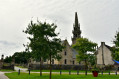
With its rich church and parish enclosure, Pencran stretches across the hill south of Landerneau and then plunges down into green rural valleys. The first part of this trail leaves the village and passes through residential neighbourhoods facing Landerneau. It then joins the countryside, following paths through the woods and farm tracks. In addition to the parish enclosure, you will discover the bucolic atmosphere of a tree-lined canalised stream and the surprising Fontaine de la Vierge (Virgin's Fountain), set in a small, well-preserved sanctuary.
Ridge, Lake Drennec and countryside from the Mougau Bihan passage grave.
 6.43 mi
+640 ft
-653 ft
3h 30
Moderate
Departure from Commana (Finistère)
6.43 mi
+640 ft
-653 ft
3h 30
Moderate
Departure from Commana (Finistère)
Starting from the beautiful Mougau Bihan covered walkway in Commana, this route crosses the nearby peat bog and then climbs up to a ridge on Mont-d'Arrée. Following this ridge, you reach the shores of Lake Drennec before returning along small country roads.
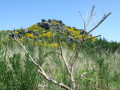
Mougau peat bog and the Commana ridges
 4.38 mi
+453 ft
-456 ft
2h 25
Moderate
Departure from Commana (Finistère)
4.38 mi
+453 ft
-456 ft
2h 25
Moderate
Departure from Commana (Finistère)
After a visit to the beautiful Mougau Vihan covered walkway, there is a long stretch through the neighbouring bog (with well-maintained boardwalks) before beginning the climb up to the ridge: discover the cross (Croaz Mélar) and its history, followed by a gentle descent.
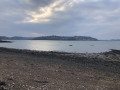
Seillou beach - Kergadalen - Térénez bridge - Aulne river
 7.05 mi
+889 ft
-860 ft
4h 00
Moderate
Departure from Rosnoën (Finistère)
7.05 mi
+889 ft
-860 ft
4h 00
Moderate
Departure from Rosnoën (Finistère)
Walk along the banks of the Aulne with views of the Térénez bridge, Térénez Island, the Landévennec boat graveyard, Saint-Guénolé Abbey and Landévennec.
Sainte-Marguerite Chapel and Rosmorduc Castle in Logonna-Daoulas
 2.74 mi
+154 ft
-144 ft
1h 25
Easy
Departure from Logonna-Daoulas (Finistère)
2.74 mi
+154 ft
-144 ft
1h 25
Easy
Departure from Logonna-Daoulas (Finistère)
An easy, short walk along the River Camfrout, offering views of the exterior of a pretty castle and the chance to visit a small, beautifully renovated chapel. Discover an Iron Age menhir that was Christianised in the Middle Ages.
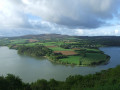
Circular between the Aulne and the Faou river
 10.11 mi
+1,335 ft
-1,342 ft
5h 50
Moderate
Departure from Rosnoën (Finistère)
10.11 mi
+1,335 ft
-1,342 ft
5h 50
Moderate
Departure from Rosnoën (Finistère)
A circular loop between the Aulne in its final meanders before its estuary in the Brest harbour and its last tributary, the Faou river.
Several viewpoints on the left bank of the Aulne with Ménez-Hom, the new Térénez bridge, Landévennec and its abbey.
Shellfish farming on the Faou river is currently limited to the cultivation of Pacific oysters.
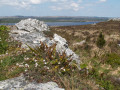
Around Lake Brennilis and via Saint-Michel de Braspart.
 14.18 mi
+804 ft
-827 ft
7h 15
14.18 mi
+804 ft
-827 ft
7h 15
 Difficult
Departure from Saint-Rivoal (Finistère)
Difficult
Departure from Saint-Rivoal (Finistère)
The Yeun Ellez, altered since the construction of the nuclear power station in 1962, is now flanked by the reservoir of the Nestavel dam. In the past, only the barren moors gave this valley its wild character; according to Breton legend, it is said to be the ‘Gates of Hell’.Let yourself be enchanted by the place and its legends.The rest of the route takes you up to the two neighbouring peaks: Tuchenn Kador (384 m) and Menez Mikel (381 m).
On the trails of the Monts d'Arrée via An Eured Veign
 6.88 mi
+443 ft
-430 ft
3h 35
Moderate
Departure from Saint-Rivoal (Finistère)
6.88 mi
+443 ft
-430 ft
3h 35
Moderate
Departure from Saint-Rivoal (Finistère)
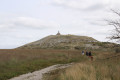
Delve into the heart of the Monts d'Arrée on this beautiful hike that passes by two of its iconic peaks: Ménez-Mikel and Roc'h Cléger. Last stop: a strange megalithic alignment lost in the moorland of "An Eured Veign" (The Wedding of Stones).
On the trails of the Monts d’Arrée via the Yeun-Elez bog
 11.41 mi
+801 ft
-801 ft
5h 55
Moderate
Departure from Saint-Rivoal (Finistère)
11.41 mi
+801 ft
-801 ft
5h 55
Moderate
Departure from Saint-Rivoal (Finistère)
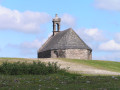
Immerse yourself in the heart of the Monts d’Arrée on this beautiful walk, which takes in three of its iconic peaks: Ménez-Mikel, Tuchenn Kador and Roc’h Cléger.
The route also takes you through two picturesque villages and across an area of peat bogs: the “Yeun Elez”. This is where, according to Breton tradition, the gates of hell were said to be located.
The final sight: a strange megalithic alignment lost in the moorland known as ‘An Eured Veign’ (The Wedding of Stones).Please note: see practical information
State Forest and Maritime Alder in Landévennec
 9.41 mi
+768 ft
-755 ft
5h 00
Moderate
Departure from Landévennec (Finistère)
9.41 mi
+768 ft
-755 ft
5h 00
Moderate
Departure from Landévennec (Finistère)
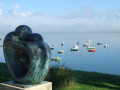
Landévennec, at the end of the peninsula, offers several views of the last meanders of the Aulne before it flows into the sea at Brest harbour.This route, starting from the church and its marine cemetery, first climbs into the national forest and allows you to discover the Sillon des Anglais, a coastal strip of small rocky blocks.The end of the circuit runs along the foreshore where the Aulne meets the Rivière du Faou before reaching the sea.Also worth seeing are the ruins of the old abbey and its museum.
Walk in Landévennec
 2.87 mi
+115 ft
-108 ft
1h 25
Easy
Departure from Landévennec (Finistère)
2.87 mi
+115 ft
-108 ft
1h 25
Easy
Departure from Landévennec (Finistère)
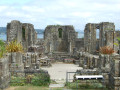
Landévennec is well known for its new Saint-Guénolé Abbey, inaugurated in 1958, which attracts many worshippers, as well as for the ruins of the 10th-century Romanesque abbey church and its museum. The village is located at the confluence of the Aulne and Rivière du Faou rivers and offers a beautiful walk, best enjoyed at high tide.
Logonna-Daoulas Peninsula around Moulin-Mer
1.57 mi
+98 ft
-98 ft
0h 50
Easy
Departure from Logonna-Daoulas (Finistère)
This short circular walk allows you to explore the innermost part of Brest Harbour. On a calm day, the Anse du Bourg – with Landévennec on the Crozon Peninsula opposite – may remind you of a mid-mountain lake.
Circular Kerzafloc'h
4.35 mi
+236 ft
-210 ft
2h 10
Easy
Departure from Loperhet (Finistère)
A lovely, easy circular loop with varied views of the Brest harbour.
Around the Pointe du Château in Logonna Daoulas
 2.39 mi
+194 ft
-223 ft
1h 15
Easy
Departure from Logonna-Daoulas (Finistère)
2.39 mi
+194 ft
-223 ft
1h 15
Easy
Departure from Logonna-Daoulas (Finistère)
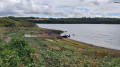
Short walk along the coastal path from Pointe du Château to Logonna-Daoulas, starting from the car park in the village of Gorrequer.
Mougau Vihan covered walkway and the Monts d'Arrée ridges from Commana
 11.26 mi
+906 ft
-932 ft
6h 00
Moderate
Departure from Commana (Finistère)
11.26 mi
+906 ft
-932 ft
6h 00
Moderate
Departure from Commana (Finistère)
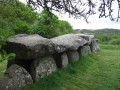
Between the 16th and 18th centuries, thanks to the linen weaving industry, Commana enjoyed a period of prosperity, which explains the opulence of its parish churchyard.From the village, dominated by the 57-metre-high bell tower, the view stretches northwards over the Léon plateau and southwards to the ridges of the Monts d’Arrée.This route along the ridges and through the countryside takes you past the 14-metre-long Mougau Bihan Covered Walkway, a beautiful peat bog with an interpretive route, and former slate quarries.
Logonna-Daoulas peninsula circuit
 9.97 mi
+745 ft
-728 ft
5h 15
Moderate
Departure from Logonna-Daoulas (Finistère)
9.97 mi
+745 ft
-728 ft
5h 15
Moderate
Departure from Logonna-Daoulas (Finistère)
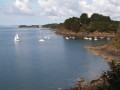
Discover the bottom of Brest harbour via the Logonna-Daoulas coastal path.
Please note: the coastal path between points (6) and (7) has collapsed (May 2025), so you will need to walk along the beach at low tide.
The 'Au fil de l'eau' route from Brasparts
 9.03 mi
+860 ft
-830 ft
4h 55
Moderate
Departure from Brasparts (Finistère)
9.03 mi
+860 ft
-830 ft
4h 55
Moderate
Departure from Brasparts (Finistère)
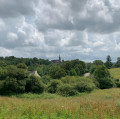
A hike in the Monts d'Arrée that takes you through the west and north-east of the commune. Along the way, discover the rich religious heritage of Brasparts.
In the Monts d'Arrée around Brasparts
 8.89 mi
+1,086 ft
-1,106 ft
5h 00
Moderate
Departure from Brasparts (Finistère)
8.89 mi
+1,086 ft
-1,106 ft
5h 00
Moderate
Departure from Brasparts (Finistère)
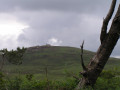
Situated in the heart of the Monts d’Arrée, Brasparts offers a wide variety of landscapes: hills covered in woodland, moorland or lush farmland, steep-sided valleys with numerous pastures, and fairly dense hedgerows.
This route provides a fine overview of this rural commune.
Its religious heritage is well known, such as the Church of Notre-Dame and Saint-Tugen and its 16th-century ossuary, famous for its statue of the Ankou holding a javelin with the inscription ‘I will kill you all’.
Along the water’s edge to the west of Brasparts
3.80 mi
+453 ft
-469 ft
2h 10
Easy
Departure from Brasparts (Finistère)
A short, easy walk, featuring a few stream crossings.
Trinité Chapel and the Douffine Valley in Pleyben
 5.81 mi
+574 ft
-577 ft
3h 10
Moderate
Departure from Pleyben (Finistère)
5.81 mi
+574 ft
-577 ft
3h 10
Moderate
Departure from Pleyben (Finistère)
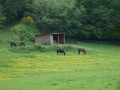
Hills and valleys, with a river running beneath, are what give this route along the banks of the Douffine its charm: a wild route, largely through woodland, ideal for summer days but not recommended in winter.This route is recommended for those who appreciate peace and quiet in a less-frequented area.There is a beautiful chapel at the start, set within its own enclosure, featuring a calvary with a fine Pietà.
Walk along the Landerneau towpath.
 3.83 mi
+20 ft
-20 ft
1h 45
Easy
Departure from Landerneau (Finistère)
3.83 mi
+20 ft
-20 ft
1h 45
Easy
Departure from Landerneau (Finistère)
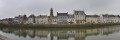
Walk along the Élon as it crosses Landerneau, once a port whose reputation extended beyond the borders of France. Flax, leather and wine were exported throughout Europe. The quays, built in the 17th and 18th centuries, still bear witness to this prosperous period.
Easy route along the towpath and the two quays, Cornouaille and Léon.
Along the route, you will find the Pont de Rohan, one of the last inhabited bridges in Europe, which celebrated its 500th anniversary in 2010.
Rosconnec marsh route via the Sant-Dispar Chapel
 5.92 mi
+830 ft
-830 ft
3h 25
Moderate
Departure from Dinéault (Finistère)
5.92 mi
+830 ft
-830 ft
3h 25
Moderate
Departure from Dinéault (Finistère)
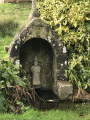
From the beautiful green setting where the Sant-Dispar Chapel nestles, flanked by its calvary and fountain, make your way through the woodland to the protected Rosconnec marshes at the confluence of the Aulne and its tributary, the Douffine.These meadows, which flood at spring tides, are protected areas for the aquatic reed warbler, a small passerine measuring 12 to 13 cm in length and weighing 10 to 14 g. This species is one of the birds protected by the European Commission.
Saint-Sébastien route
 6.21 mi
+295 ft
-285 ft
3h 05
Easy
Departure from Port-Launay (Finistère)
6.21 mi
+295 ft
-285 ft
3h 05
Easy
Departure from Port-Launay (Finistère)
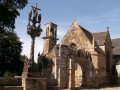
A route through the countryside and along the banks of the Aulne, the final section of the Nantes–Brest Canal which runs through a channel.Discover Saint-Sébastien Chapel.
From the Chapel of Guénily along the banks of the Aulne and through the countryside
 6.71 mi
+499 ft
-472 ft
3h 30
Moderate
Departure from Pleyben (Finistère)
6.71 mi
+499 ft
-472 ft
3h 30
Moderate
Departure from Pleyben (Finistère)
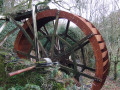
Starting from the little chapel at Guénily, a peaceful route between the banks of the channelled Aulne (Nantes-Brest Canal) and the countryside.Sweeping views over the Montagnes Noires.
Aulne towpath and Notre-Dame de Kerluan Chapel
 7.05 mi
+243 ft
-243 ft
3h 25
Moderate
Departure from Châteaulin (Finistère)
7.05 mi
+243 ft
-243 ft
3h 25
Moderate
Departure from Châteaulin (Finistère)
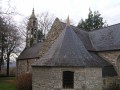
Let's take a leisurely stroll along the canalised Aulne for about 6 km, passing three locks. Then let's head back up small roads towards the Notre-Dame de Kerluan Chapel. Let's climb a little further to finally descend back down to the banks of the Aulne.
Following the canalised River Aulne
 6.79 mi
+154 ft
-154 ft
3h 15
Easy
Departure from Châteaulin (Finistère)
6.79 mi
+154 ft
-154 ft
3h 15
Easy
Departure from Châteaulin (Finistère)
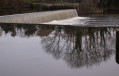
The route is largely a return walk, following a section of the channelled River Aulne. Peace and quiet, with the murmur of the water as you approach the two locks. You’ll regularly spot pairs of mallards and, occasionally, herons and great cormorants.
Along the route, you’ll pass a memorial stone commemorating a terrible shipwreck on this river in 1693 (in which 77 people, including many children, drowned).
From the summit of Ménez Hom to the banks of the Aulne via Trégarvan
 11.49 mi
+1,375 ft
-1,365 ft
6h 30
Moderate
Departure from Dinéault (Finistère)
11.49 mi
+1,375 ft
-1,365 ft
6h 30
Moderate
Departure from Dinéault (Finistère)
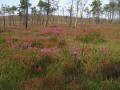
Start at the summit of Ménez-hom (330 m) and descend on the west side with views of Douarnenez Bay.Stroll through pine forests to the banks of the River Aulne in Trégarvan, then return to the summit via the eastern side.
The Ménez Hom tour through the Trégarvan Communal Forest
 6.31 mi
+801 ft
-801 ft
3h 35
Moderate
Departure from Dinéault (Finistère)
6.31 mi
+801 ft
-801 ft
3h 35
Moderate
Departure from Dinéault (Finistère)
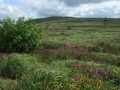
Ménez Hom, the last peak in the Montagnes Noires range, part of the Armorican Massif, rises to 330 m above Douarnenez Bay.
Starting from the summit, this route descends on the west side, then goes around the north side through the Trégarvan Communal Forest and finally climbs back up on the east side.
Beautiful views over Douarnenez Bay and the entire Châteaulin basin where the Aulne river flows.
Countryside and religious heritage in Pleyben
 4.51 mi
+312 ft
-335 ft
2h 20
Easy
Departure from Pleyben (Finistère)
4.51 mi
+312 ft
-335 ft
2h 20
Easy
Departure from Pleyben (Finistère)
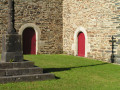
Bringing together within the same parish enclosure a church, a calvary, an ossuary and a monumental gate, Pleyben offers its visitors one of the finest religious architectural ensembles in Brittany, listed as a Historic Monument.This walk also takes you along the old railway line that once linked Carhaix to Châteaulin, allowing you to discover one of the six chapels scattered across the countryside: the Chapel of Saint-Laurent, with its lovely calvary and fountain.
The Langazel moors in Trémaouézan
 4.94 mi
+46 ft
-46 ft
2h 20
Easy
Departure from Trémaouézan (Finistère)
4.94 mi
+46 ft
-46 ft
2h 20
Easy
Departure from Trémaouézan (Finistère)
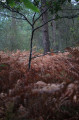
A family walk through the Langazel wetland, considered to be the oldest peat bog in western Brittany. It is classified as a protected natural area and forms part of the Natura 2000 network.It consists of a mosaic of remarkable habitats (wet meadows, heathland, peat bogs) which give it its unique character. It is also one of the main sources of the Aber Wrac’h stream, which supplies 36 local authorities with drinking water.