Country:

 City:
City:



Park in the car park near Landévennec Church.
(S/E) From the car park, retrace your steps to enter the cemetery through the stone archway and walk around this seaside cemetery on the banks of the River Aulne. The church, open daily from 9 am to 6 pm, is well worth a visit.
Leave the cemetery and continue along the esplanade, which features benches and a bronze statue entitled ‘L’Entrée dans le troisième millénaire’ (Entry into the Third Millennium).
Signposting:GR®® 34 (white and red) +PR®® (yellow).
Pass the road leading to the small harbour on your right and turn left onto Rue du Fiezen, a narrow, single-lane road that climbs steadily. You will come to a television mast.
(1) At the signpost, turn right to enter the Landévennec State Forest. Follow the wide, stony path which descends gradually to overlook the estuary of the Aulne. At the first fork, turn right (marked VTT18) then, after a short circular loop, follow the wide path heading west. The route is easy through this deciduous forest.
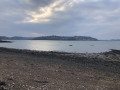
After a while, you’ll begin to make out, on your right-hand side amongst the trees, the end of the Sillon des Anglais, a coastal strip of small rocky outcrops. Carry on, keeping an eye out for a gap in the trees to access it once you’ve passed a small stream, which was dry in September 2019.
(2) A discreet sign, set slightly back and partly worn away, marking the geological site, indicates the way. Head down to the right and onto the beach, then continue to the right until you reach the start of the coastal ridge.
Retrace your steps and rejoin the wideGR®® path until you reach the next junction, marked by a ‘You are here’ information sign which helps you find your bearings.
(3) The route enters the area known as Bois du Loc’h. Continue straight on along theGR®® heading south-west.
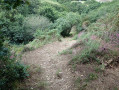
The path narrows considerably and requires greater caution due to the presence of stones. It alternates between ascents and descents whilst gradually moving away from the river. You’ll reach a rocky viewpoint, which is not secured.
(4) Shortly afterwards, the path cuts across the contour lines as it descends and crosses a rocky area where the passage is somewhat tricky despite the improvements made. It ends with a flight of steps.
At Le Loc’h, another coastal ridge comes into view. Follow the road down to reach this geological site.
(5) Retrace your steps, leaving theGR®® behind, and head back up the small road to the gate at the entrance to the state-owned forest, where there is a new information board.
YellowPR®® markings: few and far between as the route does not require them.
(6) Follow this wide forest track, which climbs steadily and runs alongside, on your right, a strictly protected nature reserve to which access is, of course, prohibited. Continue along this forest track, lined here with conifers, until you reach another gate marking the exit from the woods.
(7) Carry on straight ahead along the small road, leaving the long “Tour de Landévennec” route to your right. Follow this small road towards the hamlet of La Forêt. Here, the yellow markings are very sporadic. Walk through the hamlet.
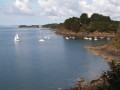
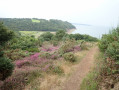
(8) At the exit, at a junction, carry on straight ahead along an unpaved track open to vehicles but restricted to agricultural use only. This wide track winds its way through the meadows and offers views, on the right, of the Logonna-Daoulas peninsula. Continue towards the hamlet of Kerbéron.
(9) At the entrance to the hamlet, turn right onto the first road – the entrance isn’t very clearly marked. If you drive right through the hamlet, turn round as you’ve missed the turn-off. Follow this small road, which curves first to the left then to the right, until you reach the D60 at a ‘Stop’ sign and a postbox.
(10) Cross with care (no pedestrian crossing) and take the grassy path opposite, which leads onto another road where you’ll rejoin theGR®® and thePR®® long route.
Signposting:GR®® 34 (white and red) +PR®® (yellow).
Follow this road to the left, keeping to the right where there is slightly more space to walk. Take care as the road is narrow. Pass the ‘Le Roz’ sign, continue on, keeping an eye out for the River Aulne below amongst the houses, and arrive at the viewpoint.
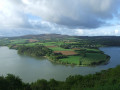
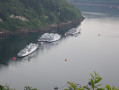
(11) This viewpoint offers a view of the meandering Aulne, the Île Ronde de Térenez and, below, the graveyard of military vessels, which is barely visible. Continue down the slope, keeping to the right-hand side at all times, as this is the safest route. Pass the entrance to Saint-Guénolé Abbey, then the former abbey and its museum. Carry on straight ahead along the narrow Rue du Pal, which leads out onto the foreshore. Look out for the confluence of the Aulne and the River Faou, as well as the coastal strip known as Le Pal, a birdwatching area.
No signposts.
(12) Turn right and follow the shaded Penforn path, which runs alongside the Aulne maritime and the abbey’s surrounding wall. Continue to the end of the path.
(13) Retrace your steps.
(12) Carry straight on, skirting the campsite. At the ‘dead end’ sign, turn left to walk up the street and, at the top, turn right to reach the church and its car park (S/E).


 Visorando Member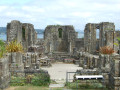
 Easy
Easy