


Refine your search for walks in Gîte des Gabelous
Gîte des Gabelous walks


 Ceillac - Saint Véran
 Visorando Member
 7.82 mi
 +4,321 ft
 -3,045 ft
 7h 20
 Moderate
 Departure from Ceillac (Hautes-Alpes)
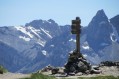
The third stage is entirely on theGR®58, heading towards the rising sun.
Tour du Queyras
 56.34 mi
+22,976 ft
-22,575 ft
7 days
Moderate
Departure from Château-Ville-Vieille (Hautes-Alpes)
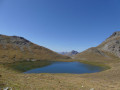
The Tour du Queyras, labelledGR®58, is adaptable. The route described, starting from Château Queyras and completed in a group in September 2008, will take you through this natural park, skirting and climbing some 3,000 metres. You will discover the beautiful villages of this park with their well-known names: Ceillac, Saint Véran, Abriés... What's more, in summer the weather is almost always fine. The bright blue sky the next day will quickly make you forget the storm of the previous evening.
Saint Véran - Col Agnel
 8.02 mi
+3,468 ft
-1,683 ft
6h 45
 Difficult
Departure from Saint-Véran (Hautes-Alpes)
The fourth stage takes you towards the Italian border, offering beautiful views of Mont Viso.
Saint-Véran – Agnel Mountain Hut
 9.64 mi
+3,963 ft
-2,103 ft
7h 55
Difficult
Departure from Saint-Véran (Hautes-Alpes)
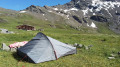
This is the second stage ofthe GR®®58, but it takes a variant route via the Col de Saint-Véran or the Col de la Cavale and includes an ascent to an altitude of 3,000 metres at the Pic de Caramantran. There’s a magnificent view of Mount Viso at the highest point of this route. At the start of the season, there were still plenty of snowfields. This is a very wild route, which I recommend as an alternative to the Col de Chamoussière path, which tends to be quite busy.
Ceillac – Saint-Véran
 8.54 mi
+4,252 ft
-2,986 ft
7h 40
Difficult
Departure from Ceillac (Hautes-Alpes)
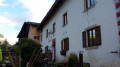
A good warm-up for thisfirst stage. Thefirst pass is the Col des Estronques, followed by a round trip to the nearby summit of the Tête de la Jacquette, where an exceptional panorama awaits you, taking in the Pics de la Font Sancte, the Aiguille de Chambeyron, the Bric de Rubren, the Peouvou and, to the north, the Grand Glaiza and the Rochebrune.
Walks near Gîte des Gabelous
From Saint-Véran to Larche: Ubaye Transfrontière
 49.21 mi
+20,728 ft
-21,916 ft
5 days
 Very difficult
Departure from Saint-Véran (Hautes-Alpes)
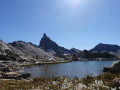
A fantastic Franco-Italian ride between Saint-Véran and Larche! It will take you through strange places, from the solitary, green rocky landscapes of Saint-Véran to the fantastical, almost Dolomite-like terrain of the massif between Chambeyron and Orrenaye.
Saint Véran – Refuge de la Blanche
10.15 mi
+4,537 ft
-3,035 ft
8h 35
Difficult
Departure from Saint-Véran (Hautes-Alpes)
This serves as an introduction to a cross-border trek between Saint-Véran and Larche. We set off from the mountain pastures for a gentle approach to the border, through a rocky and colourful landscape that can at times be quite disorientating. There are no real difficulties, but a good understanding of how to read the terrain is sometimes necessary to avoid losing your way.
The Refuge de la Blanche, starting from Saint-Véran
 8.69 mi
+1,814 ft
-945 ft
5h 35
Moderate
Departure from Saint-Véran (Hautes-Alpes)
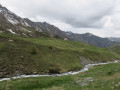
Via the Grand Canal, now completely disused, a long crossing opposite the Grande Tête des Toillies, ending at the Refuge de la Blanche and then at the observatory car park.
Le Cros - Refuge de la Blanche
6.63 mi
+2,943 ft
-906 ft
5h 35
Difficult
Departure from Saint-Véran (Hautes-Alpes)
This is the first stage of this journey, half in Queyras and half in Ubaye. Follow the right bank of the Aigue Blanche, then continue along the Col de Saint-Véran trail, before enjoying a beautiful descent that leads to the lake and the Refuge de la Blanche.
Le Raux – Refuge de la Blanche
8.39 mi
+3,878 ft
-1,768 ft
7h 15
Difficult
Departure from Saint-Véran (Hautes-Alpes)
A first day combining a stage of the Tour du Queyras with a detour to an easy 3,000-metre peak and a stop at the Refuge de la Blanche overlooking the lake of the same name.
Tête de Rissace
8.53 mi
+2,933 ft
-4,075 ft
6h 30
Difficult
Departure from Ceillac (Hautes-Alpes)
This summit can be tackled as a round trip or as a traverse. The route described below is the traverse option: leave a car at the Mélezet ski resort car park.
Refuge de la Blanche - Maljasset
10.03 mi
+1,532 ft
-3,494 ft
5h 55
Difficult
Departure from Saint-Véran (Hautes-Alpes)
Here, the names change from white to black with great dexterity. Indeed, the passage from Queyras, Refuge de la Blanche, to Ubaye is via the Col de la Noire. Original, isn't it?
Refuge de la Blanche – Le Raux
 11.04 mi
+2,641 ft
-4,770 ft
7h 25
Difficult
Departure from Saint-Véran (Hautes-Alpes)
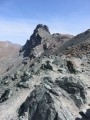
On the second day of this trip, the plan is to walk the Tour de la Tête des Toillies and finish the day with a long walk back to Le Raux.
Refuge de la Blanche – Franco Boerio Bivouac
 8.91 mi
+4,465 ft
-2,543 ft
8h 00
Difficult
Departure from Saint-Véran (Hautes-Alpes)
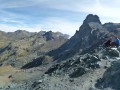
A foray into the Haute Ubaye to round off the route in style at its highest point. With the option of watching the sunset from the summit of the Bric de Rubren.
The route deliberately moves away from the border to take the easiest route up the hill.
Agnel Mountain Hut – La Monta Mountain Hut
 8.25 mi
+1,434 ft
-4,390 ft
5h 00
Difficult
Departure from Molines-en-Queyras (Hautes-Alpes)
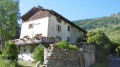
The third stage of this journey presents no major difficulties, with exceptional views around the lakes. Only the descent from the Col Vieux to the Refuge de la Monta quickly takes its toll on your legs.
The abundance of flora makes this stage even more beautiful.