Saint Véran – Refuge de la Blanche

This serves as an introduction to a cross-border trek between Saint-Véran and Larche. We set off from the mountain pastures for a gentle approach to the border, through a rocky and colourful landscape that can at times be quite disorientating. There are no real difficulties, but a good understanding of how to read the terrain is sometimes necessary to avoid losing your way.

This walk is part of a multi-day hike: De Saint-Véran à Larche : Ubaye Transfrontière

Details

156194
Creation:
Last update:
Last review:
  • Walking
    Activity: Walking
  • ↔
    Distance: 10.15 mi
  • ◔
    Average duration: 8h 35 
  • ▲
    Difficulty: Difficult

  • ⚐
    Back to start: No
  • ↗
    Ascent: + 4,537 ft
  • ↘
    Descent: - 3,035 ft

  • ▲
    Highest point: 9,882 ft
  • ▼
    Lowest point: 6,713 ft

Photos

Description of the walk

Park in one of the car parks in Saint-Véran.

(S) Head up above the village, following the signposted Grand Canal route. It starts near the ski lift furthest to the right (to the east) of the ski area and passes above the Alta Peyra hotel.
The path turns left and climbs fairly steeply to around 2,250 m, where it meets the Grand Canal.

(1) Take this path on the right, passing several shepherds’ huts; take the path on the left after the Labounnais hut, then pass above the old copper mine. Continue to the junction with the Col du Longt.

(2) Continue straight ahead, ignoring the path to the Col du Longe, and go round the Pinilière hut.
Then head slightly downhill to pass above a former green marble quarry.

(3) You can see a few specimens of this as you look south towards the Clausis Chapel.
Join theGR®58.

(4) Turn left onto it and follow it as it climbs gently, leaving the path at the Rocher des Marrous junction on your right. Continue on to reach the Col de Chamoussière.

(5) Once at the pass, look eastwards (to the right as you reach the pass). Take the track up to the Pic de Caramantran. From there, the hike becomes more ‘alpine’, though the only difficulties are the very stony terrain and the need to follow the track carefully. From the pass, you’ll quickly reach the ridge between the Aigue Agnel valley and the Aigue Blanche valley (Saint-Véran), then the border at the summit of the Pic de Caramantran. You’ll then reach this first 3,000-metre peak (3,025 m to be exact)

(6) Follow the ridge to the right (towards the south-southeast). Pass a southern secondary summit at 3,021 m, then descend to the Col de Saint-Véran at 2,844 m (border marker 49).

(7) Continue southwards towards Rocca Bianca, where the going gets tougher. You’ll come to an area marked with thick blue lines, featuring a climbing section that may not be particularly difficult.
Note on the route: To ensure this remains a hike, avoid this section by passing to the right beneath Rocca Bianca via a fairly faint track that bypasses any tricky sections and allows you to reach the southern ridge of Rocca Bianca just before the Col Blanchet, or right at the pass. At a glance, there are one or two couloirs that allow you to climb up to the ridge. Alternatively, simply head to the pass and climb up to the secondary summit of Rocca Bianca. The summit is only accessible via a short climb up a well-marked white-and-red-marked couloir.

(8) Head for the Col Blanche via the ridges.

(9) Descend (west-north-west) to the refuge along a well-marked path (Tour de la Tête des Toillies) to the Refuge de la Blanche (E).

Waypoints

  1. S : mi 0 - alt. 6,713 ft - Saint-Véran car park
  2. 1 : mi 0.74 - alt. 7,362 ft - Grand Canal
  3. 2 : mi 3.89 - alt. 8,173 ft - Mine de Cuivre de Saint-Véran
  4. 3 : mi 4.41 - alt. 7,730 ft - Ancienne carrière de marbre
  5. 4 : mi 4.61 - alt. 7,792 ft - GR58 junction
  6. 5 : mi 6.7 - alt. 9,472 ft - Col de Chamoussière
  7. 6 : mi 7.03 - alt. 9,875 ft - Pic de Caramantran
  8. 7 : mi 7.55 - alt. 9,327 ft - Col de Saint-Véran
  9. 8 : mi 8.73 - alt. 9,859 ft - Rocca Bianca
  10. 9 : mi 9.11 - alt. 9,501 ft - Col Blanchet ou Colle Blanchet (2897m)
  11. E : mi 10.15 - alt. 8,212 ft - Refuge de la Blanche

Notes

(1) Note: The signposted Grand Canal path follows, almost at the same level, this old irrigation canal which, amongst other things, used to carry water to the fields of Saint-Véran, particularly those planted with rye.
If you stick to the route described, there are no particular difficulties. However, the terrain is quite alpine and can become tricky in snowy conditions. That said, I don’t think crampons or an ice axe are necessary. You rarely encounter very steep slopes, and any you do come across can usually be bypassed.
In the event of bad weather, it is very easy to reach the refuge via theGR®58(at the bottom of the Aigue Blanche valley… not exactly thrilling, but it has the merit of being straightforward), or from the vicinity of the Clausis Chapel (4), the Col Chamoussière (5) or the Col Saint-Véran (7).

Be sure to take a look at the remains of the copper mine along the way, which was in operation for 4,000 years right up until the late 1950s.

Worth a visit

If you need accommodation in Saint-Véran:
The Gîte des Gabelous. It’s unique, tastefully decorated and the food is excellent!
The destination for this first day is the Refuge de la Blanche. Don’t forget to book in peak season, as it fills up quickly due to its easy access and great atmosphere.

Take a good look at the rocks and their colours.
When the rock is ochre or beige, you’re on limestone (marble) or calcareous schist. When it’s green, almost black, streaked with white – sometimes powdery – you’re on the oceanic crust of the Tethys. The ocean crushed between Europe and the ‘Apulian’ plate… a little piece of Africa. The Viso, which you really shouldn’t miss, is also a piece of this oceanic crust, pushed down into the subduction zone and then ‘brought back to the surface’ by a series of faults.
If you look carefully in the heavily fractured serpentinite zones, you may find asbestos, a mineral formed by the weathering of the components of the serpentinite.

Always be cautious and plan ahead when you're outdoors. Visorando and the author of this route cannot be held responsible for any accidents occurring on this route.

The GR® and PR® markings are the intellectual property of the Fédération Française de Randonnée Pédestre.

Reviews and comments

4.8 / 5
Based on 3 reviews

Reliability of the description
5 / 5
Ease of following the route
4.3 / 5
Route interest
5 / 5
Michjos01
Michjos01

Overall rating : 4.7 / 5

Date of your route : Sep 13, 2019
Reliability of the description : ★★★★★ Very good
Ease of following the route : ★★★★☆ Good
Route interest : ★★★★★ Very good

An easy and stunning walk. A map is useful, but you’ll have no trouble finding your way.
Stunning views over the Italian side, including Viso, Asti, Pain de Sucre, Taillante and so on.
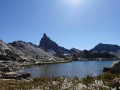
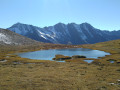
As suggested in the review dated 12/09/17, you absolutely must head to the Upper Lac de la Blanche by following the signposts: after the Col St Véran, continue climbing for a short while along the ridge to a modest secondary summit, then turn right onto the flat sections, keeping to the same level. A few cairns, a barely marked path, but you really can ‘go anywhere’ through the rocks with a bit of common sense. The lake at the foot of La Toilies, fringed with cotton grass, in the late afternoon sun: absolutely stunning. Not to be missed under any circumstances. And then a warm welcome on the terrace of the refuge before the rather less enjoyable few kilometres back to St V.
Thank you for this lovely hike

Machine-translated

daubram05
daubram05

Overall rating : 5 / 5

Date of your route : Mar 03, 2019
Reliability of the description : ★★★★★ Very good
Ease of following the route : ★★★★★ Very good
Route interest : ★★★★★ Very good

Here’s a trail that’s quite similar, but on snowshoes or with mini crampons
The beauty of the Aigue Blanche valley in summer, above Saint Véran – said to be the highest village in Europe – is rivalled only by that of winter, which is spectacular against the backdrop of the Tête des Toilies. A real feast for the eyes. Here’s another brilliant idea from Annie: a round trip between the village of Saint-Véran and the Refuge de la Blanche, 500 metres higher up (but 8 km further away!).
We’ll revisit the wayside shrines, the Clausis Chapel, the marble quarry (where the marble for Napoleon’s tomb came from) and the copper mine. And, as promised long ago, we’ll pop into Saint-Véran so you can appreciate this little village where the roosters peck at the stars.
And if you’d like to find out more, do feel free to go back a few months earlier to explore the Lacs de la Blanche and learn about the legend of the St Véran dragon (click on the link at the end of the video)
Enjoy your hike
https://youtu.be/sMAVPIMbMj8

Machine-translated

Moyenne Randonneuse
Moyenne Randonneuse

Overall rating : 4.7 / 5

Date of your route : Sep 12, 2017
Reliability of the description : ★★★★★ Very good
Ease of following the route : ★★★★☆ Good
Route interest : ★★★★★ Very good

Hello, after spending the night at the Refuge de la Blanche, we covered the following route: the ascent to the Col de Chamoussière – Pic de Caramantran – Col de St-Véran, then on to Rocca Bianca.
The warden had recommended we visit the Lacs Blanchet. It’s magnificent; after reaching a secondary summit and coming from the Col de St-Véran, you head for the ‘replats’. Soon the paths appear – the warden had told us, ‘you can go anywhere’!
When we reached the Col Blanchet path, we followed it uphill; yet another magnificent view!

Machine-translated

Other walks in the area

For more walks, use our search engine .

The GPS track and description are the property of this route's author. Please do not copy them without permission.