


Refine your search for walks in Breteuil
Breteuil walks


 The Breteuil circular, following in the footsteps of one of the martyrs of Vingré
 Visorando Member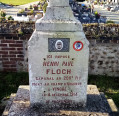
 6.24 mi
 +66 ft
 -66 ft
 2h 55
2h 55
 Moderate
 Departure from Breteuil (Eure)
A route that alternates between quiet country lanes, field paths and a few stretches through woodland. You’ll find yourself hopping over the River Iton. For those so inclined, the grave of a soldier who was shot as an example in 1914 – and whose reputation has since been cleared – adds a touch of remembrance.
In the footsteps of Pablo Neruda
 7.69 mi
+98 ft
-105 ft
3h 35
Moderate
Departure from Gouville (Eure)
7.69 mi
+98 ft
-105 ft
3h 35
Moderate
Departure from Gouville (Eure)
A very pleasant unmarked route where you cross the Iton several times. It is also an opportunity to discover the former home of the Chilean poet Pablo Neruda and the beautiful Chambray Castle along the way.
Route de la Comtesse in Beaubray
 8.69 mi
+167 ft
-161 ft
4h 10
Moderate
Departure from Beaubray (Eure)
8.69 mi
+167 ft
-161 ft
4h 10
Moderate
Departure from Beaubray (Eure)
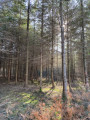
In the heart of Normandy’s largest forest, set off to discover the local flora and fauna. Along the way, you’ll encounter a variety of deciduous trees and pines, and you might even be lucky enough to spot a young deer as you round a bend in the path.
In the land of Vlaminck
 36.06 mi
+633 ft
-522 ft
3 days
36.06 mi
+633 ft
-522 ft
3 days
 Difficult
Departure from Verneuil-sur-Avre (Eure)
Difficult
Departure from Verneuil-sur-Avre (Eure)
In the centenary year of Maurice de Vlaminck's move to La Tourillière near Verneuil-sur-Avre, here is a journey through his heartland between Verneuil-sur-Avre and La Loupe. These towns are both served by railway stations that can be reached from Paris Montparnasse. Woods, fields and forests were the inspiration for many of the painter's works. With cloudy skies guaranteed, take a stroll through the landscapes that so strongly inspired this colourful, versatile artist, where he welcomed the greatest celebrities of his time.
Verneuil-sur-Avre - La Ferté-Vidame
15.72 mi
+423 ft
-194 ft
7h 35
Difficult
Departure from Verneuil-sur-Avre (Eure)
To mark the centenary of Maurice de Vlaminck's move to La Tourillière near Rueil-la-Gadelière, a few kilometres from Verneuil-sur-Avre, recently renamed Verneuil d'Avre et d'Iton, this tour offers a three-stage discovery of the region that inspired the painter.A hunter, fisherman, walker, cyclist, motorist and motorcyclist, he came to settle here to find peace and inspiration. From 1925 until his death in 1958, under an often changeable sky dotted with clouds, the painter tirelessly explored these landscapes of fields, copses and the vast forest of Senonches, in search of subjects for his many paintings.We will first go from Verneuil to La Ferté-Vidame, passing by his grave in the cemetery of Rueil, his bust sculpted by his friend Paul Belmondo in front of the town hall, and above all his home in La Tourillière, preserved in the state in which he lived.
Around Damville
1.86 mi
+46 ft
-46 ft
0h 55
 Easy
Departure from Damville (Eure)
Easy
Departure from Damville (Eure)
A lovely little walk around Damville (27).
Between Rueil-la-Gadelière and Saint-Martin in the footsteps of a "Fauve"
 6.28 mi
+105 ft
-102 ft
3h 00
Moderate
Departure from Rueil-la-Gadelière (Eure-et-Loir)
6.28 mi
+105 ft
-102 ft
3h 00
Moderate
Departure from Rueil-la-Gadelière (Eure-et-Loir)
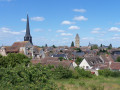
These circular loops will not take you into the bush in search of large predators, but along good paths through woods and fields on the outskirts of the Perche, in this transitional region known as the Thimerais. You will pass through the landscapes that inspired the painter Maurice de Vlaminck, who founded Fauvism in the early 20th century with his friends Derain and Matisse.Having settled in La Tourillère, near Rueil-la-Gadelière, 100 years ago, the artist fell in love with this region, which he tirelessly explored until his death in 1958 in search of places of inspiration.These circular loops starting from neighbouring villages aim to give you a feel for the landscapes "where the wind bends the trees and chases the clouds across a dark sky" that captivated the painter, reminding him of his paternal family's homeland of Flanders.This hike takes you from Rueil to Saint-Martin aux Portes de Verneuil, where the "Fauve" often visited.
On the Way of St James around Conches-en-Ouche
9.05 mi
+344 ft
-344 ft
4h 30
Moderate
Departure from Conches-en-Ouche (Eure)
Conches, capital of the Pays d’Ouche, reveals the hidden treasures of its historical past and takes you on a winding journey through the secret Rouloir Valley, allowing you to discover the coolness of its banks and the beautiful gems of Norman rural architecture. It is the memory of a Normandy with a distinctly feminine charm and a gentle landscape that this region—so aptly described by Jean de la Varende—leaves with the walker.
Entre forêts et manoirs à Conches-en-Ouche
 13.45 mi
+279 ft
-266 ft
6h 25
Difficult
Departure from Conches-en-Ouche (Eure)
13.45 mi
+279 ft
-266 ft
6h 25
Difficult
Departure from Conches-en-Ouche (Eure)
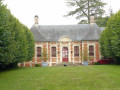
Cette randonnée vous fera arpenter des chemins boisés et champêtres, des zones naturelles protégées, permettra à toute la famille d'accéder à des parcours sportifs, et vous fera découvrir de magnifiques manoirs normands chargés d'histoire. Les petits comme les grands passeront un bon moment entre nature et architecture.
In the footsteps of Vlaminck
 Tourism professional8.62 mi
+197 ft
-197 ft
4h 10
Moderate
Departure from Rueil-la-Gadelière (Eure-et-Loir)
Tourism professional8.62 mi
+197 ft
-197 ft
4h 10
Moderate
Departure from Rueil-la-Gadelière (Eure-et-Loir)
This walking route follows paths that pass close to sites associated with Vlaminck, a painter from the early 20th century. Slightly undulating, the route crosses back and forth over the Avre aqueduct, which carries drinking water to Paris. Passing through the valleys of the Buternay, Lamblore and Nouvet, this walk is characterised by water that is either visible or sometimes just hinted at.
In the footsteps of Vlaminck in Rueil-la-Gadelière
5.07 mi
+69 ft
-98 ft
2h 25
Easy
Departure from Rueil-la-Gadelière (Eure-et-Loir)
Vlaminck, the famous Fauvist painter, greets walkers as soon as they arrive, as his bust, sculpted by Paul Belmondo, stands in the Town Hall Square. He is then commemorated at La Tourillière, where he lived before being buried in the local cemetery.
From Rueil-la-Gadelière to Montigny-sur-Avre in the footsteps of a "Fauve"
 8.92 mi
+174 ft
-203 ft
4h 15
Moderate
Departure from Rueil-la-Gadelière (Eure-et-Loir)
8.92 mi
+174 ft
-203 ft
4h 15
Moderate
Departure from Rueil-la-Gadelière (Eure-et-Loir)
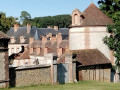
The painter Maurice de Vlaminck lived near Rueil-la-Gadelière from 1925 until his death in 1958. This year marks the centenary of his arrival in the area. Six circular loops named "Sur les traces d'un Fauve" (In the footsteps of a Fauve) allow you to discover the places that inspired the painter."I liked the countryside: slightly hilly, with endless fields and meadows planted with twisted apple trees. Here and there were copses, woods and farms surrounded by thorny hedges. It was on the edge of the Perche, a region where the plains of Beauce come to an end in a series of undulations, a region that has retained the appearance that the ages have shaped. Nothing modern alters its structure or disturbs the harmony of the landscape." Maurice de Vlaminck.This circular, between Beauce and Thimerais, crosses the agricultural plain near Verneuil, following the Avre valley to Montigny and returning to Rueil-la-Gadelière through fields and copses. You can visit the Château de Montigny (open to visitors by appointment).
The Sébécourt Forest
 2.66 mi
+33 ft
-33 ft
1h 15
Easy
Departure from Sébécourt (Eure)
2.66 mi
+33 ft
-33 ft
1h 15
Easy
Departure from Sébécourt (Eure)
A family route marked out in the Sébécourt Forest.
Around La Haisette in Sébécourt
 5.25 mi
+56 ft
-56 ft
2h 30
Easy
Departure from Sébécourt (Eure)
5.25 mi
+56 ft
-56 ft
2h 30
Easy
Departure from Sébécourt (Eure)
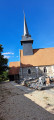
A lovely walk that will take you through the fields and woods of the centre of Sébécourt, with its 15th-century church, to the calvary at the Chapel of Saint Blaise in the heart of the forest.
Discovering the Sec Iton
 5.03 mi
+262 ft
-259 ft
2h 35
Easy
Departure from Gaudreville-la-Rivière (Eure)
5.03 mi
+262 ft
-259 ft
2h 35
Easy
Departure from Gaudreville-la-Rivière (Eure)
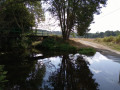
In this sea of greenery, nature remains intimate and secret: it reveals itself now in the forest, now in the valley. The Iton appears and disappears as the walk progresses.
Tour of the Bois de la Noë
 4.43 mi
+98 ft
-105 ft
2h 05
Easy
Departure from Rueil-la-Gadelière (Eure-et-Loir)
4.43 mi
+98 ft
-105 ft
2h 05
Easy
Departure from Rueil-la-Gadelière (Eure-et-Loir)
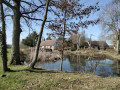
Beneath the seemingly peaceful surface of the Baine (or Benne) pond, there is a whole world of plants and animals. The route, which starts in this hamlet in the commune of Rueil-la-Gadelière, takes you around the Bois de la Noë, passing by the farms of Bois Normand and Rueil. It is located south of Verneuil d'Avre et d'Iton, at the gateway to Normandy. Return via the hamlets of Les Bruyères and Le Canada.
The Valley of the Crows
 5.40 mi
+308 ft
-318 ft
2h 45
Easy
Departure from La Croisille (Eure)
5.40 mi
+308 ft
-318 ft
2h 45
Easy
Departure from La Croisille (Eure)
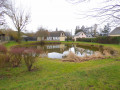
This is a short, varied route, where you will pass some beautiful Norman houses, an old church and a farmhouse inn dating from the 13th century. Half on tarmac, half on paths, this route is not very difficult, even if the hill leading to the D830 puts hikers' calves to the test!
Circular Beauche via Boulay Saint-Clair in the footsteps of a "Fauve"
 6.33 mi
+233 ft
-256 ft
3h 05
Moderate
Departure from Beauche (Eure-et-Loir)
6.33 mi
+233 ft
-256 ft
3h 05
Moderate
Departure from Beauche (Eure-et-Loir)
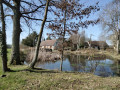
The painter Maurice de Vlaminck lived near Rueil-la-Gadelière from 1925 until his death in 1958. This year marks the centenary of his arrival in the area. A three-day itinerary already allows you to explore his homeland from Verneuil-sur-Avre to La Loupe. Walkers who are unable to undertake this crossing can take one or more of the short circulars "In the footsteps of a Fauve". These allow you to discover in detail the places that inspired the painter."Beauche is the village next to the hamlet of La Tourillière. Its origins are lost in the mists of time. One cannot imagine that its pleasant, wholesome appearance has ever changed. The spire of its bell tower pierces the clouds. It can be seen from far away because Beauche is built on flat ground in the plain..." Vlaminck.Starting from Beauche, this short route through fields and woods skirts the Château du Boulay Saint-Clair. On the way back, it passes by the Benne pond, which has recently been restored by the municipality of Rueil-la-Gadelière.
Route de Ferrière-sur-Risle
12.68 mi
+207 ft
-187 ft
6h 00
Difficult
Departure from La Ferrière-sur-Risle (Eure)
Spend a day crossing fields, forests and greenways and discover the cultural and heritage treasures (churches, market halls, etc.) of the Pays de Conches community of municipalities.
Ajou Circular Route via Champignolles
 5.57 mi
+236 ft
-217 ft
2h 45
Easy
Departure from Ajou (Eure)
5.57 mi
+236 ft
-217 ft
2h 45
Easy
Departure from Ajou (Eure)
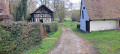
A lovely walk that starts at the Ajou tennis courts, follows the GR®224 to Champignolles, then returns via the Chemin du Gouffre, which runs alongside the River Risle. The first part takes you through fields, whilst the second part is through the woods.
Le Rouge Moulin
 7.94 mi
+354 ft
-377 ft
4h 00
Moderate
Departure from Ajou (Eure)
7.94 mi
+354 ft
-377 ft
4h 00
Moderate
Departure from Ajou (Eure)
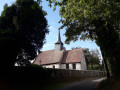
Shortened version of the marked route starting from Ajou, retaining the interesting views of this high valley of the Risle, its mills, including the very pretty Rouge Moulin, the charming village of Champignolles and forest passages that are enjoyable in summer. On the other hand, the 4 km to Ajou are of little interest, hence the suggestion to start from the church of Saint Aubin.
Yellow markings
Circular Saint-Lubin-de-Cravant in the footsteps of a "Fauve"
 5.26 mi
+243 ft
-240 ft
2h 40
Easy
Departure from Saint-Lubin-de-Cravant (Eure-et-Loir)
5.26 mi
+243 ft
-240 ft
2h 40
Easy
Departure from Saint-Lubin-de-Cravant (Eure-et-Loir)
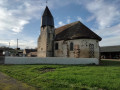
These circulars will not take you into the bush in search of large predators, but along good paths through woods and fields on the outskirts of the Perche, in this transitional region known as the Thimerais. You will pass through the landscapes that inspired the painter Maurice de Vlaminck, who founded Fauvism at the beginning of the 20th century with his friends Derain and Matisse.Having settled in La Tourillère, near Rueil-la-Gadelière, 100 years ago, the artist fell in love with this region, which he tirelessly explored until his death in 1958 in search of places of inspiration.These circular loops take you through the landscapes "where the wind bends the trees and chases the clouds across a dark sky" that captivated the painter.This route starts in Saint-Lubin de Cravant, where the church inspired the painter. It follows the Meuvette valley, which was once canalised. The Avre Aqueduct crosses the valley on imposing arches. It supplies Paris with drinking water.