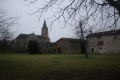
The Hermitain Forest
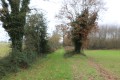
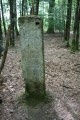
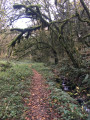
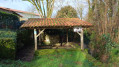
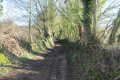
Covering 614 hectares, this forest is home to oak and chestnut trees in a well-preserved setting. There are numerous paths for walking through it. The last remnant of the Sylva Savra – the Sèvre Forest – the Hermitain Forest was much more extensive in the past, and the clearings scattered throughout it enabled the first human settlements to establish themselves there several thousand years ago.
‘Hand in Hand’
Tales of the Poitou region (from the year 250 to the year 1900) by Jean Rivierre
Excerpt from ‘Resurrection: The Life of a Farmer from Goux in the Year 1720’ – Chapter I
‘In the heart of Huguenot Poitou lies a mysterious land.
This region has no name. You will find no name for it on any map. When you pass through it, ask anyone you like what the region is called: they will reply with the name of a hamlet, or a farm lost amongst the tall trees. But that will not be the name of this region, which has none.
Nor does this region have any very precise boundaries. No prefect of the Deux-Sèvres will be able to point them out to you, nor will any rural constable. Yet these are well-informed gentlemen, but they cannot perceive such things. The country of which I speak stretches across several parishes, but it does not entirely cover any of them. What I am asserting is that it is a country distinct from all others. You would have to be a traveller in a great hurry along the new tarmacked road not to notice anything as you pass through it. For anyone travelling there on foot, for anyone who knows how to speak to the trees, the earth and the water, with a voice that is both present and close to the past, it is clear that there is something there that cannot be found elsewhere.
This country is a closed country. Not that one cannot come here from anywhere. But the very moment one enters, it feels as though something is closing in on you. You feel trapped, between these woods and these hedgerows. At the four corners of this land, no doubt four angels stand, gigantic, invisible and silent. It is they, then, who hold out over the fields this veil of very light, almost impalpable mist, which is not made of moisture but of silence, and which has been floating there for centuries. I strongly suspect that those born here, and who live here, have not even noticed it. But for the visitor from elsewhere, there can be no doubt: a mysterious presence hovers over this countryside, placing a finger to the lips and whispering: ‘Hush!’
The sounds in this land seem made to fade away. The paths seem made to vanish round the nearest bend. The houses seem made to hide, and they do not hesitate to do so, drawing curtains of trees before them. The leaves seem made to fall, so thick are the carpets of them on the ground, even in spring.
People, at last, seem made to flee: they need take but a single step to vanish.
You always think you’re alone in this country, but that doesn’t mean you actually are. Can you see steam rising from nostrils behind the hedge? That’s the plough going. Did twigs snap to the right? That’s someone making a bundle of brushwood. Just because you can’t see anyone, never say: ‘No one can see me!’ There may well be several pairs of eyes watching you, and from very close by.
Whether one comes from Saint-Maixent, or La Mothe, or Celles, or Melle—which are, in truth, large and
populous towns, numbering as many as a few thousand inhabitants, one always discovers this land of silence. And whether one comes from the vast, bare plain of Niort and Mougon, barely broken by a few scattered cypresses, or from the limestone lands of Exoudun, dotted with walnut trees, or even from the sun-drenched hills which, towards Melle, slope down towards the south, sooner or later one enters this strange land, where the light dims a little, where even the sun and its warmth, and even the wind and its biting chill, must squeeze through and be broken up by countless partitions.
This country is the summit, the heart, the secret stronghold of an entire region. It is the refuge one would seek if one had to flee. In the final days of the Huguenots, it was the citadel of resistance: the valleys and towns had opened themselves to the enemy, welcoming, as always, the wind that comes from afar. When people wished to find God, they would climb silently up there at night, along the paths. There they would always find some gathering and some preacher. They would realise with joy that there were still thousands of them. Then they would descend again, like streams of running water, in all directions.
For this is a land of springs. Do you know what the villages here are called? They are called Fomblanche,
Fombedoire, Fombelle, Fonmorte, Fonquerré, Fonchâtré, Fontagnou, Fonfréroux… and they are all fountains. Take a few steps, with hardly any ascent or descent: you’ll pass from one hillside to another. There is a hill, a few dozen metres high, from which the waters radiate, before your very eyes, towards the Sèvre and Niort, towards the Charente and Rochefort, towards Poitiers and Nantes, and finally, via the distant Loire.
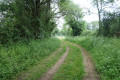
There are some very curious paths in this region. They are sometimes very narrow—disconcertingly so. They
are squeezed between hedges wider than themselves, which never cease to encroach upon them, whilst the carts that stubbornly persist in
crush and soil the drooping tips of the ferns at the bottom of the ruts. Elsewhere, these paths
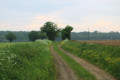
widen and are covered in splendid, reddish, thick vegetable mud, marked by a thousand holes—the thousand footsteps of oxen—but a mud in which one does not get lost, for the rock is not far away, and pokes out here and there in sharp, shoe-sole-piercing jagged edges. Elsewhere still, these paths become avenues, where several competing ruts run side by side, forming vast, bumpy clearings at the crossroads, watched over by a few chestnut trees which, in times gone by, witnessed the peculiar frolics of witches. And these main paths are far from being the only ones: they are by no means footpaths. Pedestrians prefer to take simple shortcuts, cutting the shortest route through gaps in the hedgerows, of which no outsider is aware.
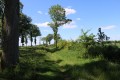
The true king of the countryside is the tree: the chestnut tree, above all, or, as they say, the ‘talle’. There are all manner of them and of
all ages. In the woods one sees whole armies of very young ones, shivering and pale, huddled close together
one another, knowing they will not be allowed to live, and that one day they will perish together in brotherhood: the stump
will remain, but it is always a case of starting over! There are others, however, who are venerable old-timers,
enormous, visible from a great distance, twisted, tormented, terrifying in the night, ranging from splendour to decrepitude, and which live in solitude, here and there, mingling with no other species of tree, mingling only with themselves, and thus forming, upon the stubble, majestic royal groves.
One could speak at length about this land. Let us bring this to a close! The best thing is to set off there at once, and to make our way through all this mystery to the place which, of all these places, is the most mysterious.
It is a wood.
A wood of a kind one does not often see in Poitou.
It stands on a fairly high hilltop and ought to dominate the horizon.
But we are in a land where the trees alone are enough to hide the mountains. It can only be glimpsed by chance, through some gap in the foliage, from afar—perhaps whilst, up close, beneath the canopy, one might reach it without ever having seen it.
I do, however, know of places from which it can be seen quite clearly. One then beholds a sight unusual for the region: a very dark, almost black wood, a wood of firs and pines. It turns its back on the northerly winds. It slopes steeply down towards the south. Once one has found the way in, one is further delayed by broom, scrub and ferns.
But if one persists, one finally reaches the sandy ground where the fine golden needles fall from above. The breeze takes on a tone that it possesses only there. One feels utterly far removed, it seems, from all living things. The branches start so low that one cannot see very far, but on summer evenings, the setting sun slips in from below right to the very depths of the wood, and everything becomes luminous and golden. The ground is strewn with small, very hard rocks, which is why this wood has always been called the Bois des Roches. Look no further: this is where it all comes together.
To the right lies the old hamlet of Goux—the Celtic ‘Goos’—barely four houses. To the left is the
wooded Fombedoire, which was long known as Thérouanne. Opposite, some two hundred paces away, lies the sombre, rounded mass – uncultivated, indecipherable, full of ruins beneath the tall trees – the remains of a medieval fortress known as the Motte d’Aiglemier. Nestled between these two immense, silent sentinels is a farmhouse, the roofs of which are barely visible. And this is La Foye, La Foye-de-Goux (1).
There, in the year 1720, lived the newly converted farmer, Jean Savariau, with his wife and children; we shall now turn our attention to his affairs.”
(1) Now the commune of La Couarde (Deux-Sèvres)



 Country:
 City:
City:




 Visorando Member

 Easy
Easy