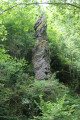
The Lady of Chambrille
The Legend of Chambrille
Source: Legend written by H. Caillon (published in 1885).
Long ago, on the banks of the source of the Chambrille stream, which flows into the Sèvre at La Mothe-St-Héray, stood the Château de Font Quérré. The lord of the manor, Amaury, had a daughter of great beauty whom he had named Berthe.
She fell in love with her young neighbour, Guy de Trémont, and Guy’s love for Berthe was equally tender and passionate. The young couple began to live out this great love intensely, making countless promises that rhymed with ‘forever’ in the blissful innocence of their youth.
The neighbouring lord, who held the estate of La Mothe-St-Héray, Baron Tutebert de Chambrille—a comrade-in-arms and friend of Amaury—asked Amaury for Berthe’s hand in marriage and was granted it. In those bygone days, daughters had to submit to their fathers’ commands. Berthe de Font Quérré and Guy de Trémont were devastated by the news. Berthe thus became Madame de Chambrille through her marriage to the Baron.
Some time later, the two young lovers could no longer resist the fervour of their passion and arranged to meet at night, halfway between their respective homes, in the valley, near the stream.
Their trysts became more frequent; the lovers would prolong their dangerous dalliances until dawn, parting only when they heard the crowing of the rooster at Le Payré, the earliest of them all.
Berthe’s nocturnal absences were unfortunately discovered by Tutebert, who proved to be highly suspicious. After conducting a swift investigation, he went to hide near the lovers’ meeting place just after sunset to lie in wait for them.
A moment later, by moonlight, he saw that his suspicions were well-founded, and, mad with rage, he threw himself upon them and stabbed them. Berthe de Chambrille was rooted to the spot and turned to stone. She became the rock that now bears her name: La Dame de Chambrille.
Guy de Trémont, mortally wounded, dragged himself as best he could up the valley running perpendicular to that of Chambrille to return to his home, leaving a trail of his blood in his wake. These drops of blood turned into small garnets, pebbles carried ever since by the stream that carved out the valley, and which gave it the name Vallée aux Grenats. Guy, having lost all his blood, died not far from his home in Trémont.
Ever since, despite everything, the Ruisseau des Grenats has continued to merge its waters with the Ruisseau de Chambrille, as if, beyond the stream, the two young lovers were still united, lavishing tender caresses upon one another.
La Mothe Saint-Héray
History
The Duke of Joyeuse ordered the massacre of 800 Huguenots on 21 June 1587 (known as the Saint-Éloi massacre).
May 1682: destruction of the Protestant church by Louis XIV. See Louis XIV’s anti-Protestant policy.
The commune, like certain others in the department, has the distinction of possessing, in accordance with the provisions of an imperial law, two cemeteries, one Catholic, the other Protestant (adjacent to a new ‘multi-faith’ cemetery), in addition, of course, to the numerous private family cemeteries established on their estates in the 15th and, above all, the 19th century by the descendants of Huguenots, who were initially excluded from Catholic cemeteries during the era of religious persecution and the ‘dragonnades’ under Louis XIV.
Heritage, tourism and culture
The Orangery
This long, two-storey building in stone and brick, in the Louis XIII style, a former outbuilding of the former Château des Baudéan-Parabère – a lady of Parabère was the mistress of Philippe d’Orléans, Regent of France – and later of the Carvoisin family, was built between 1632 and 1634 by Nicolas Tillon, master mason to Richelieu (37).
A French-style garden with a large canal to the south in front of the two pavilions was created there (see the historical study by Charlotte Pon-Willemsen published by the S.H.S.D.S.).
After having allocated this estate to Prince Murat, who held grand parties in the orangery until his departure with his wife Caroline Bonaparte to reign in Naples, Napoleon I gave it to General Georges Mouton, whom he made Count of Lobau – before being elevated by Louis-Philippe I successively to the ranks of Marshal (1831) and then Peer of France (1833)—thereby establishing a primogeniture on the La Mothe estate; upon his death without heirs in 1838, the estate reverted to the State, which sold it off in parts.
This was followed in 1842 by the almost total demolition of the medieval castle, which 19th-century views show surrounded by a moat, of which a few buildings remain, the most significant being the former orangery and its two symmetrical pavilions, which, having been sold to other parties, escaped this fate; but in 1925 the orangery was partially dismantled to be transported across the Atlantic, a process that was halted by the State.
Visible remnants of the house’s furnishings, Abel Grimou’s painting *Le Marquis d’Artaguiette en buveur* (early 18th century) and a set of 17th-century painted panelling are preserved at the Musée d’Agesci in Niort.
Restored from 1997 onwards and enhanced by a French formal garden created on what had become a courtyard, and a canal, the former orangery is the venue for numerous cultural events and can also be hired for family occasions. The exhibition ‘Nouvelles métamorphoses’ showcased works by the contemporary artist Bernard Bourgeois in 2017.
Hiking trails
"Dame de Chambrille", the Sèvre valley and the Hermitain forest are all worth exploring on foot or by mountain bike. Route maps are available from the tourist information office at the Moulin du Pont l'Abbé. Of particular note is the remarkable footpath that takes you through La Mothe-Saint-Héray, from the Moulin du Pont l'Abbé to the Orangery.
The Moulin du Pont l'Abbé
This mill, first mentioned as early as the 12th century, is one of the many watermills that were built along the upper Sèvre Niortaise. In 1809, during the mill census, there were 13 mills in the commune of La Mothe-Saint-Héray and 7 in the commune of Exoudun. In the 17th and 18th centuries, these mills produced a renowned flour (known as ‘minots’) from the high-quality wheat grown nearby. The flour, gathered at Bagnault and bagged, was transported by donkey to the port of Niort. From there, it was shipped by boat to Marans and La Rochelle. Until the 18th century, the Abbé mill ground oak or chestnut bark into powder. This tannin was used for tanning hides. It was converted into a wheat mill in the early 18th century. Enlarged in the 19th century, it kept pace with technical advances in milling and was renovated by the miller Ludovic Gelin between 1911 and 1936.
The Pont l’Abbé mill, acquired by the local council and now home to the tourist information centre and museum, is a remarkable sight. It is a visit well worth recommending for young and old alike. Its machinery – the large water wheel, the millstones, the sorters, the sifters, the rheostat and the ball regulator – is still in working order.
The Fouace Mothaise
Made famous by Rabelais in Gargantua, the fouace is found in various regions of France and even in Italy and Spain. Derived from the Latin “panis focacius”, meaning literally “bread baked on a hearth or under the ashes of a fire”, it is enjoyed in savoury (fougasse, fouée) or sweet (fouasse, or fouace) forms. Whilst the latter appears to originate from the Aveyron region, it is found under other names: the fouace de Caen, the fouasse nantaise… and the fouace du Poitou.
The fouace, from Bagnault to La Mothe-Saint-Héray Originally, fouaces were made in Bagnault (in the commune of Exoudun) before moving to La Mothe-Saint-Héray in 1902. From the Middle Ages onwards, Bagnault was a major hub for the trade in wheat, flour and salt, as well as for its fouaces. Wheat from Poitou was ground into flour in the mills along the Sèvre Niortaise (in 1716, there were 120 mills within a radius of a league around La Mothe-Saint-Héray). Sacks of flour, known as “les minots de Bagnault”, were transported by mule to La Rochelle, Rochefort and beyond to supply the Atlantic coast, as well as the West Indies and the Americas.
The return journey from the coast was made with salt, which passed through Bagnault before being delivered to the rest of the region. The Bagnault fouace has benefited from this economic dynamism. Renowned since the Middle Ages, the fouace is a type of brioche-style bread, but the secret of its production is jealously guarded, as the recipe is sold along with the business. The last bakery still making fouaces by hand is located in La Mothe-Saint-Héray.
Founded in 1982, the Confrérie de la Fouace Mothaise inducts new fouace bakers every year.
Fouace is enjoyed by the slice or in portions. Plain, with butter, jam, honey, fruit or cream. Toasted to accompany foie gras, smoked salmon or warm goat’s cheese. As an aperitif with Hypocras, Pineau des Charentes...
(Extract from the walking guide “La vallée de Chambrille” published by the Fédération Française de Randonnée des Deux-Sèvres.)



 Country:
 City:
City:










 Visorando Member



 Easy
Easy