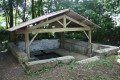
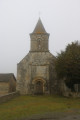
The six fountains of Savrelle

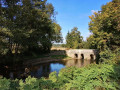
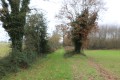
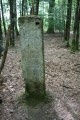
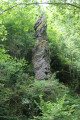
This hiking route in fairly hilly terrain allows you to discover the Cougnat fountain and wash house, family cemeteries, the Paradis fountain and wash house, remarkable "talles", the Perrière fountain and its pond, the Chagnasses woods, the Garennerie fountain and the Savrelle wash house fountain.

This hike highlights a geological fault that runs from Saint-Maixent to Lezay, separating the Mellois plateau from a collapse trench where the Sèvre Niortaise river flows.

Details

430387
Creation:
Last update:
Last review:
  • Walking
    Activity: Walking
  • ↔
    Distance: 8.99 km
  • ◔
    Average duration: 2h 50 
  • ▲
    Difficulty: Moderate

  • ⚐
    Back to start: Yes
  • ↗
    Ascent: + 105 m
  • ↘
    Descent: - 104 m

  • ▲
    Highest point: 174 m
  • ▼
    Lowest point: 84 m

Photos

Description of the walk

(S/E). At the bend in the road (car park), take the farm track heading north-west.
Leave the path on your right that leads to the Savrelle fountain and wash house: this will be the way back to the car park.
The path runs alongside the valley through which the Savrelle river flows, giving its name to the village near the starting point of this route. Leave a path on your left.

(1) About 1 km from the starting point, take the small path on the right that leads to the Cougnat fountain and wash house. Return by the same path to the main farm track. Turn right to continue the walk along the farm track.
At the next crossroads, take the road on the right.

(2) Turn left onto the farm track towards Fonfréroux. This junction is located right next to a reservoir on the banks of the Savrelle (private lake). At the next junction of farm tracks, take the one on the right overlooking the bottom of the valley.
Further on, ignore the road that branches off to the right at a bend. After three more right-angle bends, the road arrives at the village of Fonfréroux via Rue des Chagnasses.
At the crossroads at the entrance to the village, take the road on the right. There are several family cemeteries around the village.
At the next crossroads, turn left onto the road leading into the village. Pass a street on the left and shortly afterwards turn right onto the path leading to the Paradis wash house fountain (near the exit of Fonfréroux).

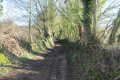
(3) When the path joins the road, turn right onto the path towards La Perrière. This wide path is lined with remarkable "talles" (grafted chestnut trees).
At the crossroads, before La Perrière (near some houses), turn right onto the path that leads to the hamlet. The path becomes a road. Nearby, just after a horse farm, go down to the La Perrière fountain and its pond.

(4) Return to the previous path and continue to the right. A wide panorama allows you to take in the Sèvre Niortaise valley to the north-north-east and the villages of Sainte-Eanne and Salles.
At the next crossroads, continue along the road opposite (slightly to the right). The road turns into a path. The route continues downhill towards the bottom of the valley (a drop of about 50 metres).
At the next crossroads, turn right towards the hamlet of La Vallée. Just before you reach it, the path comes to a road, which you take by turning right towards the hamlet.
Follow the road to the bridge over the Savrelle. This bridge marks the end of the stream's course in its valley. The Savrelle joins the Sèvre Niortaise about 1 km further on. This bridge highlights the existence of a geological fault that runs from Saint Maixent to Lezay, separating the Mellois plateau from the collapse trench where the Sèvre is located. Immediately after the bridge, take the narrow path on the right towards Virecourt.
At the next crossroads, turn right, pass Virecourt and head towards Château Tison, where a bridge allows you to cross the Savrelle again. The path begins a steep climb of about thirty metres in the Chagnasses woods (châgne in Poitevin refers to oak).

(5) At the crossroads, take the path on the left, which descends gently towards the Savrelle in the Combes valley, then climb up the other side towards La Garennerie.

NB: during periods of high water and/or heavy rain, it is advisable to take the path on the left just before Virécourt and reach La Garennerie by road, as the Savrelle stream crossing at the bottom of the Vallon des Combes is not equipped.

Crossing the Savrelle in the Vallon des Combes is easy most of the year, but can be tricky in bad weather. The same applies to the climb up to La Garennerie.
The path turns into a road as you approach the village. On the right-hand side is a family cemetery. At the crossroads, turn right.

(6) In the village, take the first road on the left uphill. The road becomes a farm track and leads above the village to a T-junction. Take the path on the right, which leads to a spring and further on to a fountain.
Further on, leave a path on your left that descends towards the Sèvre Niortaise plain. The path climbs again to the next crossroads.

(7) At the next crossroads, take the path on the left that leads to the hamlet of Boisguerin. There is a wash house near the crossroads. Turn right and immediately after, leave a path on the left.
The path climbs slightly and leads to the road from Boisguerin. Turn right onto the road, leaving Boisguerin behind you.

(8) At the T-junction of three roads and a path, turn left onto the path, which continues to climb slightly. At the top of this short climb, the path joins a farm track, which you should take by turning left.
When the farm track joins the road to Savrelle, turn right towards the village.
Enter the village of Savrelle and turn right at the first crossroads. Pass three streets (roads) on your left. The road gives way to a path.

(9) Immediately afterwards, there is a Y-shaped crossroads. Take the left fork. The route passes by the fountain and wash house in Savrelle.
Continue along the path, which initially runs alongside a pond on the right. At the next crossroads with a farm track, turn left. After two or three hundred metres, you will reach the car park (S/E).


Waypoints

  1. S/E : km 0 - alt. 165 m - Parking area, before Savrelle
  2. 1 : km 1.11 - alt. 157 m - Chemin de la Fontaine de Cougnat
  3. 2 : km 1.96 - alt. 145 m - crossroads near a water reservoir in Cougnat.
  4. 3 : km 3.25 - alt. 147 m - Road-path junction
  5. 4 : km 4.07 - alt. 132 m - crossroads near the Fontaine de la Perrière fountain.
  6. 5 : km 5.14 - alt. 126 m - Crossroads
  7. 6 : km 5.74 - alt. 142 m - Crossroads
  8. 7 : km 6.55 - alt. 154 m - Crossroads
  9. 8 : km 7.44 - alt. 166 m - Crossroads of three roads and a path
  10. 9 : km 8.52 - alt. 160 m - Crossroads
  11. S/E : km 8.99 - alt. 165 m - Parking area, before Savrelle

Notes

This hike over varied terrain requires sturdy footwear. A few fairly steep sections mean that this route is classified as moderately difficult, despite its relatively modest total distance.

Alternative
A variation to make the final stretch a little easier is to (7) turn onto the path on the right which joins the road leading to La Garennerie. At the road, turn right towards La Garennerie. At the first houses, take the farm track on the left. This path passes close to a fountain. From here, there is a beautiful view of the Vallon des Combes.
At the end of the farm track, turn right onto the road. Just before crossing the Savrelle, take the path on the left that runs alongside the Savrelle (at a distance) and joins the (9).

Worth a visit

Commune of Souvigné
Reigné Castle 15th and 16th centuries: coat of arms on the door, beautiful staircase, fireplaces, three wings of outbuildings, well and ironwork, dovecote. It has belonged to the Vasselot de Régné family since 1403.
Château des Essarts, rebuilt in the 19th century: old tower.
Château de Boisguérin 19th century.
Logis du Bois des Prés.
Bois Dureau, old 17th-century post house.
Temple and its interior décor.
Notre-Dame Priory: fireplace.
Museum of Headwear and the Pélebois Region.

Melle
In addition to its medieval fortifications, Melle has three interesting Romanesque churches. They were built between the end of the 11th century and the middle of the 12th century, offering a condensed overview of the architectural evolution of this period in a single location. This group of buildings is known as the Romanesque triad of Melle.

Saint-Hilaire Church
Named after the first bishop of Poitiers, who died in 367, this church, the largest of the three, is also the only one still used as a place of worship. According to a 10th-century charter, the church was dependent on the Benedictine priory of Saint-Jean-d'Angely and was probably donated to the abbey in 961 by Guillaume Tête d'Étoupe, Count of Poitou. The church was originally built of wood. It was replaced in the 12th century by the current building. The latter was constructed in two stages: around 1090 for the choir and transept, and around 1150 for the nave and façade.

Saint-Hilaire Church has been listed as a Historic Monument since 30 March 1887. It has also been listed as a UNESCO World Heritage Site since 1998, as a stop on the Way of St James in France.

Saint-Pierre Church
Saint-Pierre Church was built in ochre limestone in the early 12th century on the site of an oratory dating from 950 and belonging to Saint-Maixent Abbey. This first church was surrounded by a Carolingian cemetery.

The church was restored between 1965 and 1966 and was given new windows and a new roof.

It has been listed as a Historic Monument since 1862.

The church has a very simple layout: a wide nave leading to a transept with flat arms onto which two apsidioles open. These apsidioles flank the central apse of the chevet. The transept crossing is surmounted by a square tower with four narrow windows and covered by a pyramidal roof dating from 1466.

Saint-Savinien Church
Probably the least remarkable of the three but the oldest, it is the only one to have been built in the feudal city. Its façade is simple but harmonious. It prefigures those of the 12th century. It has a portal framed by two blind arcades. The tympanum of the portal is in the shape of a batten, a decoration that is very common in Auvergne but rare in Poitou. The low relief sculptures show Christ encircled in a medallion, standing between two lions. Above the door, between the corbels of the cornice, there are animals carved in relief: quadrupeds, a bird, a deer, a fish, as well as fighting figures, a knight and an erotic scene.

The south transept houses a Romanesque-style portal.

Inside, its single nave is covered by a roof structure in the shape of an upturned boat. Here you can admire the tombs of magistrates François Houliers (1555) and Pierre Saturne Houliers (1665), the author of the judgement known as "buchettes" which inspired La Fontaine's tale: Le Juge de Melle.

On a pillar in the choir, a capital depicts the martyrdom of Saint Savinien. The transept crossing is topped by a dome on squinches.

It was converted into a prison from 1801 to 1927, and now hosts a music festival and exhibitions.

It was listed as a Historic Monument on 18 April 1914.

The Hôtel de Ménoc or Bishop's Palace
A beautiful 15th-century mansion that takes its name from the Menoc family, who settled in Melle towards the end of the 13th century. In 1841, it was decided to establish the courthouse there. To this end, the buildings were modified in 1846, then the façade was redone in 1863 by Mr Murisson, the departmental architect, in a flamboyant neo-Gothic style.

It housed the courthouse until 31 December 2009. Since 1 January 2010, this service has been transferred to Niort and the building has been empty. The hall is regularly used for exhibitions.

The 15th-century towers were listed as historic monuments on 11 May 1911.

The origin of the name "Évêché" (bishopric) remains unclear, as no bishop has ever resided in Melle. This name is no longer used today.

Reviews and comments

4.6 / 5
Based on 9 reviews

Reliability of the description
4.6 / 5
Ease of following the route
4.3 / 5
Route interest
4.8 / 5
Gaston1258
Gaston1258

Overall rating : 5 / 5

Date of your route : Mar 10, 2025
Reliability of the description : ★★★★★ Very good
Ease of following the route : ★★★★★ Very good
Route interest : ★★★★★ Very good
Very busy route : No

A very challenging section.
Very hilly with a chaotic section of stones.

Machine-translated

mifo10
mifo10

Overall rating : 4.7 / 5

Date of your route : Feb 16, 2025
Reliability of the description : ★★★★★ Very good
Ease of following the route : ★★★★☆ Good
Route interest : ★★★★★ Very good
Very busy route : No

Hike to do. Very beautiful walk with varied landscapes. For your information, the official car park is signposted on the side of the D5.

Machine-translated

dandom79
dandom79

Overall rating : 5 / 5

Date of your route : Sep 23, 2024
Reliability of the description : ★★★★★ Very good
Ease of following the route : ★★★★★ Very good
Route interest : ★★★★★ Very good
Very busy route : No

Great hike

Machine-translated

MIZ DU YELLOW
MIZ DU YELLOW

Overall rating : 4.7 / 5

Date of your route : Jul 21, 2023
Reliability of the description : ★★★★★ Very good
Ease of following the route : ★★★★☆ Good
Route interest : ★★★★★ Very good
Very busy route : No

A pleasant and varied walk with beautiful scenery, paths, hamlets, fountains and wash houses. A few steeper sections, but not particularly difficult. Encountered a deer and two alpacas.

Machine-translated

GILMIC79
GILMIC79

Overall rating : 5 / 5

Date of your route : Apr 25, 2023
Reliability of the description : ★★★★★ Very good
Ease of following the route : ★★★★★ Very good
Route interest : ★★★★★ Very good
Very busy route : No

Magnificent hike. Note the tall grass, especially at the end of point 5 when you head north to reach point 6: very narrow path, grass up to shoulder height (1.60 m), so watch out for ticks!

Machine-translated

pgetrochon
pgetrochon

Hello,
This is the official starting point for the hike. Parking is permitted as long as it does not interfere with farmers' activities on the farm track and at the entrances to their plots. Check with the farmer.
There is another option along the D5 road, known as the hunting car park.
Enjoy your hike.

Machine-translated

Sneg
Sneg

Overall rating : 4 / 5

Date of your route : Aug 24, 2022
Reliability of the description : Not used / Not applicable
Ease of following the route : ★★★★☆ Good
Route interest : ★★★★☆ Good
Very busy route : No

Very nice walk! Thank you. Just one comment: parking is not allowed at the indicated location, so we left the car on the D5.

Machine-translated

anne-marie.r
anne-marie.r

Overall rating : 4 / 5

Date of your route : Jan 10, 2022
Reliability of the description : ★★★★☆ Good
Ease of following the route : ★★★★☆ Good
Route interest : ★★★★☆ Good
Very busy route : Yes

very pleasant paths lined with beautiful trees

Machine-translated

pgetrochon
pgetrochon

Hello,

I assume this is the end of the comment about the "Between Prailles and Lambon" hike: please see my response on this subject.

As for the Six Fountains hike in Savrelle, it is indeed one of the most beautiful in southern Deux-Sèvres. I highly recommend it. Take a close look at the map to find the parking spot and/or GPS coordinates.
Enjoy your hike!

Machine-translated

Nathalie Papot
Nathalie Papot

So we didn't do it, but based on the comments, we'll definitely do it!

Machine-translated

catzzz
catzzz

Overall rating : 4.3 / 5

Date of your route : Mar 07, 2018
Reliability of the description : ★★★★☆ Good
Ease of following the route : ★★★★☆ Good
Route interest : ★★★★★ Very good

One of the best hikes we have ever done!!!

Machine-translated

catzzz
catzzz

Overall rating : 4.3 / 5

Date of your route : Mar 09, 2018
Reliability of the description : ★★★★☆ Good
Ease of following the route : ★★★★☆ Good
Route interest : ★★★★★ Very good

We were completely won over by this hike!!!
It was such a pleasure to walk in the countryside and enjoy the birdsong and the sound of running water. The wash houses and other fountains blend beautifully into the landscape, even if they are not all maintained.
We can't wait to do this walk again in spring or summer.
Thank you!!! tar:

Machine-translated

Other walks in the area

For more walks, use our search engine .

The GPS track and description are the property of this route's author. Please do not copy them without permission.