From the Hermitain Forest to Trémont, La Villédé and Vivier

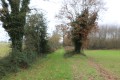
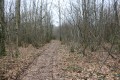
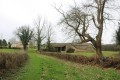
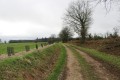
A pleasant walk that begins in the Forêt de l'Hermitain, continues through the open countryside near Trémont after following the Chambrille stream, then across the plain near La Villédé and Vivier before returning to the Forêt de l'Hermitain via the Bois de la Gandissière.

Details

954957
Creation:
Last update:
Last review:
  • Walking
    Activity: Walking
  • ↔
    Distance: 11.59 km
  • ◔
    Average duration: 3h 35 
  • ▲
    Difficulty: Moderate

  • ⚐
    Back to start: Yes
  • ↗
    Ascent: + 83 m
  • ↘
    Descent: - 87 m

  • ▲
    Highest point: 187 m
  • ▼
    Lowest point: 122 m
  • ⚐ Country: France
  • ⚐ City: La Couarde (79800)
  • ⚑
    Start/End: N 46.317257° / W 0.149304°
  • ❏
    IGN map(s): Ref. 1628SB
  • Hour-by-hour weather

Photos

Description of the walk

(S/E) Leave the car park by taking the forest track eastwards. Go through the gate.
Take the first forest track on the left and continue straight ahead.

(1) Just before the edge of the woods, turn left at a right angle onto the last forest track.
At the end of this track, turn left onto the Ligne de Fontmorte forest track.
Turn right onto a forest track and continue straight on through the Bois des Larsières to the Route Forestière de Font Querré.

(2). Turn right onto this forest road, which soon takes a sharp left-hand bend and then runs straight ahead along the Ligne de Savrelle. This road passes close to the Fontaine Querré (about 200 metres to the right).
At the end of the Ligne de Savrelle, the forest track turns left and becomes the Ligne du Rivaud. At this point, continue almost straight ahead along the forest track at the edge of the woodland heading north.

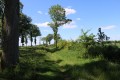
(3) Turn right onto a logging track that heads straight across the fields. It is marked by a few fine trees.
Further on, at a Y-junction, take the left-hand path which soon joins a logging track. Turn right onto this logging track.

(4) Cross a small road and continue straight on along the forest track, which descends gently towards a wooded area surrounding the Ruisseau de Chambrille.
At the next junction of forest tracks, turn right and cross the stream immediately. The forest track then climbs the side of the valley towards the hamlet of Trémont, where you’ll find a château called “La Côte de Grace”. A hamlet with typical Poitou-style houses.

(5) When you reach the road at a T-junction, turn left and walk past the château.
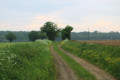
Shortly afterwards, turn right onto a farm track that crosses the Vallée des Grenats, which leads north to La Dame de Chambrille.
At the junction of farm tracks as you reach the plateau, turn right and follow the Vallée des Grenats along the plateau.

Further on, cross a small road and take, almost directly opposite but slightly to the right, a small road leading to La Villedé. Walk through the village until you reach the water tower on your right.

(6) Leave the farm track leading there on your right and take the second farm track on the right towards the fields, whilst the road continues through the rest of the village of La Villedé.
Continue straight on until you reach a crossroads of farm tracks (at a cross). Turn right towards the hamlet of Le Vivier and, after a small pond on your right, you’ll come to a junction with a small road called “La Rue de la Planche”.

(7) Turn left onto this street, which leads into the hamlet of Le Vivier a little further on. Continue straight on until you reach the junction with the Grand Rue Vivier.

(8) Cross over and continue straight on along a farm track which eventually leads to the edge of the Bois de la Bosse.

(9) Just as the farm track turns left and moves away from the Bois de la Bosse, take the path on the edge of the woods to the right.
Further on, leave the path leading to the beautiful Bosse farm (traditional building) on your left. Shortly afterwards, the path turns right and enters the Bois de la Gandissière.
Go straight across the first crossroads, then leave a path heading south-west on your left.

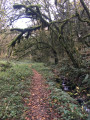
(10) At the next crossroads, turn left and follow the forest path until you leave the Bois de la Gandissière, where it becomes a farm track.

(11) Just before reaching a small road, turn right onto a tree-lined forest track which leads further on to the Route Forestière du Parterre. Turn left onto this forest road and follow it towards the D10 road.

The route soon returns to the car park, which marks the end of this walk (S/E).

Waypoints

  1. S/E : km 0 - alt. 187 m - Forest track
  2. 1 : km 0.99 - alt. 181 m - Crossroads of forest tracks
  3. 2 : km 1.82 - alt. 174 m - Junction of forest track and forest lane
  4. 3 : km 3.1 - alt. 171 m - Junction of forest track and farm track
  5. 4 : km 3.95 - alt. 160 m - Crossing a road
  6. 5 : km 4.64 - alt. 166 m - Hamlet of Trémont
  7. 6 : km 6.12 - alt. 168 m - Walk through the village of La Villedé
  8. 7 : km 7.1 - alt. 159 m - Junction of farm track and Rue de la Planche
  9. 8 : km 7.57 - alt. 167 m - Junction of Rue de la Planche and Grand Rue Vivier
  10. 9 : km 8.92 - alt. 182 m - Junction of farm track and forest track
  11. 10 : km 9.9 - alt. 181 m - T-junction of forest tracks
  12. 11 : km 10.76 - alt. 182 m - T-junction of farm tracks
  13. S/E : km 11.59 - alt. 187 m - Forest track

Notes

The car park is located at the start of the Parterre forest road, to the right of the D10 road after the Vilaine Croisée junction when coming from Beaussais towards Saint-Maixent l’École (park between the water tank on the right-hand side and the barrier closing off this forest track – wide verge). At this point, the D10 road takes a wide bend to the right (reduced visibility) and, opposite the forest road, a small road leads to La Couarde.

This hike across varied terrain requires suitable footwear.

This route, which is not particularly difficult, is only partially marked in yellow. Consequently, it is advisable to follow the directions in the description and on the map, whilst also reading the landscape. In particular, in the Hermitain forest, with its many parallel paths, it is advisable to take note of landmarks by observing the landscape (such as the clearings at the edge of the forest, for example).

Check hunting days online (e.g. 2017–2018: Every Wednesday
from 11 September 2017 to 28 February 2018, except 1 November 2017
and on Fridays 3 November 2017 and 23 February 2018)

Alternative route
At the point (5) in Trémont, turn right and continue along the small road towards Barbecane and then Le Pin. Pass through the hamlet of Le Pin. Further on, turn left onto the farm track which leads to the point (7). The length of the route is then 10.3 km.

Hike completed by the author on 31 January 2018.

Worth a visit

Hermitain Forest

The Hermitain State Forest is a former ecclesiastical forest that passed into state ownership during the French Revolution and is managed by the National Forestry Office.
The last remaining part of the Sylva Savra (Sèvre Forest), it now covers an area of just 614 hectares.
It is a forest of oak and chestnut trees used to make baskets and barrel hoops, with the wood also used to produce stakes or shingles for cladding sheds.
This practice gave its name to the area surrounding the Hermitain state forest: the Pelebois region.

In 1598, the revocation of the Edict of Nantes forced Protestants into hiding; Louis XIV ordered the destruction of churches and the expulsion of pastors, thereby forcing preachers to meet in secret, in the evenings, to read the Bible. These gatherings were known as ‘assemblies in the wilderness’. It was not until after the French Revolution that the churches were rebuilt.

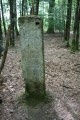
The Parterre Stele.

On this stele is an inscription: ‘In this place, the Parterre, Huguenot assemblies in the wilderness were held in the 17th and 18th centuries’.
This stele refers to the history of our region. From the 16th century onwards, the Reformation took firm hold in Poitou, which became the second most Protestant region in the kingdom after the Cévennes.
However, the various successive kings did not see it that way. With the exception of Henry IV, from Francis I to Louis XV, all attempted to bring these heretics back to Catholicism. Some resorted to force, such as Louis XIV with the dragonnades. In 1685, he banned the practice of the Protestant faith. The Huguenots went underground and gathered, despite all the dangers, in ‘Assemblées du Désert’. These clandestine meetings took place in barns, houses, forests… the Hermitain Forest!
This history still shapes the landscape of the Upper Val de Sèvre and the Mellois region: umbrella pines, cemeteries in gardens, places of worship. These reminders of the past are the vestiges of this history.

The Patriarch Oak (The walk does not pass at the foot of this tree)

The “Patriarch” oak, so named by the children of the neighbouring school in La Couarde. A tree typical of the forests of southern Deux-Sèvres, with a long, straight trunk and a crown reaching some thirty metres high. Its circumference is 5.26 metres.

The Lady of Chambrille: the legend of Chambrille

Source: Legend written by H. Caillon (published in 1885).

Long ago, on the banks of the source of the Chambrille stream, which flows into the Sèvre at La Mothe-Saint-Héray, stood the Château de Font Quérré. The lord of the manor, Amaury, had a daughter of great beauty whom he had named Berthe.

She fell in love with her young neighbour, Guy de Trémont, and Guy’s love for Berthe was equally tender and passionate. The young couple began to live out this great love intensely, making countless promises that rhymed with ‘forever’ in the blissful innocence of their youth.

The neighbouring lord, Baron Tutebert de Chambrille, who held the estate of La Mothe-Saint-Héray and was a comrade-in-arms and friend of Amaury, asked Amaury for Berthe’s hand in marriage and was granted it. In those bygone days, daughters had to submit to their fathers’ commands. Berthe de Font Quérré and Guy de Trémont were devastated by the news. Berthe thus became Madame de Chambrille, through her marriage to the Baron.

Some time later, the two young lovers could no longer resist the fervour of their passion and arranged to meet at night, halfway between their respective homes, in the valley, near the stream.

Their trysts became more frequent; the lovers dangerously prolonged their lovemaking until dawn, parting only when they heard the crowing of the rooster at Le Payré, the earliest of them all.

Berthe’s nocturnal absences were unfortunately discovered by Tutebert, who proved highly suspicious. After conducting a swift investigation, he went to hide near the lovers’ meeting place just after sunset to lie in wait for them.

A moment later, by moonlight, he saw that his suspicions were well-founded, and, mad with rage, he threw himself upon them and stabbed them. Berthe de Chambrille was rooted to the spot and turned to stone. She became the rock that now bears her name: the Lady of Chambrille.

Guy de Trémont, mortally wounded, dragged himself as best he could up the valley running perpendicular to that of Chambrille to return to his home, leaving a trail of his blood in his wake. These drops of blood turned into small garnets, pebbles carried ever since by the stream that carved out the valley, and which gave it the name Vallée aux Grenats. Guy, having lost all his blood, died not far from his home in Trémont.

Ever since, despite everything, the Ruisseau des Grenats has continued to merge its waters with the Ruisseau de Chambrille, as if, beyond, the two young lovers were still united, lavishing tender caresses upon one another.

Reviews and comments

4.7 / 5
Based on 4 reviews

Reliability of the description
4.8 / 5
Ease of following the route
4.5 / 5
Route interest
4.8 / 5
User 26279210

Overall rating : 4.7 / 5

Date of your route : Jun 22, 2025
Reliability of the description : ★★★★★ Very good
Ease of following the route : ★★★★☆ Good
Route interest : ★★★★★ Very good
Very busy route : No

A beautiful route with varied landscapes. Please note that a small section of the path is not maintained on the way back into the forest. This makes it difficult to find and the path is overgrown with brambles for about 50 metres. It adds a little adventure!

Machine-translated

Mary0411
Mary0411

Overall rating : 4.7 / 5

Date of your route : Dec 02, 2024
Reliability of the description : ★★★★★ Very good
Ease of following the route : ★★★★★ Very good
Route interest : ★★★★☆ Good
Very busy route : No

A lovely walk through fields and woods! Apart from a deer and plenty of birds, we didn’t come across a soul! Perfect for those who love peace and quiet. The only downside: some of the paths were muddy and slippery, having been rather badly worn down by tractors.

Machine-translated

GILMIC79
GILMIC79

Overall rating : 5 / 5

Date of your route : Apr 18, 2023
Reliability of the description : ★★★★★ Very good
Ease of following the route : ★★★★★ Very good
Route interest : ★★★★★ Very good
Very busy route : No

A wonderful hike, with varied scenery and lovely paths

Machine-translated

Jacques gomes
Jacques gomes

Overall rating : 4.3 / 5

Date of your route : Mar 22, 2021
Reliability of the description : ★★★★☆ Good
Ease of following the route : ★★★★☆ Good
Route interest : ★★★★★ Very good
Very busy route : No

A really lovely walk.

Machine-translated

Other walks in the area

For more walks, use our search engine .

The GPS track and description are the property of this route's author. Please do not copy them without permission.