Hills and plains between Souvigné and Sèvre Niortaise

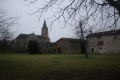
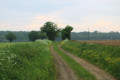
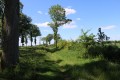
This walk between Souvigné and the Sèvre Niortaise valley offers a chance to discover varied landscapes of hillsides, woods and plains. The Bois des Challoteries is typical of the area’s lovely forests. Furthermore, the many villages and hamlets you pass through provide an opportunity to discover the traditional architecture of southern Deux-Sèvres

Details

803087
Creation:
Last update:
Last review:
  • Walking
    Activity: Walking
  • ↔
    Distance: 10.47 km
  • ◔
    Average duration: 3h 20 
  • ▲
    Difficulty: Moderate

  • ⚐
    Back to start: Yes
  • ↗
    Ascent: + 121 m
  • ↘
    Descent: - 117 m

  • ▲
    Highest point: 146 m
  • ▼
    Lowest point: 64 m

Photos

Description of the walk

(S/E) Leave the car park heading towards the stadium and take the inner road heading west towards the Salle des Fêtes (to avoid walking along the D10, known as Rue du Croissant de Lune).
When the track reaches the D10, turn right onto a farm track heading north-east.
At the first right-angled bend to the left, take the track on the right. At the next crossroads, turn left and continue along the track until you reach a farm track.
Turn left, then immediately right onto a track which, shortly afterwards, passes under a high-voltage power line. Continue to a farm track, which you take by turning left.

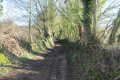
(1) Alternative route available at this point (see § Practical information). Continue straight on along the forest track until you reach the Soignon stream.
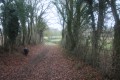
Just before entering the village of Soignon, the track reaches a junction: take the farm track on the right. Continue straight on towards the Bois des Chalotteries, which you cross. The track climbs here.

(2) Just before reaching a road, turn right onto the flat track heading south. Continue straight on until you reach a farm track in front of a building and turn left. Shortly afterwards, you’ll reach a junction where the farm track meets two other tracks: this is the end point of the track that forms the shorter alternative route.

(3) Continue along the second farm track on the right, which heads east. The farm track winds south of the hamlet of Chiloup. It joins a small road: take this by turning left and head straight down between a farm on the left and the houses of Le Petit Geay on the right.
At a T-junction, carefully turn left onto the road which bends at a right angle and heads north-east. Continue to the next right-angle bend in the road to the left.

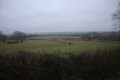
(4) Take the path on the right that descends towards the Sèvre Niortaise valley. Shortly afterwards, through gaps in the hedge, you’ll enjoy lovely views of Le Logis and the Bidolière farm on your left. At the first crossroads, turn left. Further on, the path takes a right-angle bend to the right and follows the Sèvre Niortaise at a distance.
Continue straight on at the next crossroads, then turn right at the second set of crossroads (the path on the left leads to the Sèvre Niortaise and is a dead end). When you reach the road, turn right onto it and, at the next junction, carefully follow the road to the left heading south-east.

(5) At the Y-junction, turn right. At the next right-angled bend, continue straight on along a farm track which turns left shortly afterwards. Cross the Glandune stream (seasonal), pass under a high-voltage power line and arrive at the hamlet of La Croisière, which you cross.

(6) Immediately afterwards, turn right onto a farm track which leads to the hamlet of Paille. Here you will see some beautiful farmhouses and some less so.
When you reach the road, turn right and follow it carefully to a T-junction where a farm track joins.

(7) Turn right onto the road heading north-west. In a wide right-hand bend, take the farm track opposite on the left-hand side of the road.
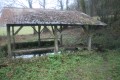
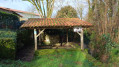
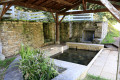
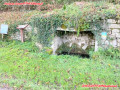
Further on, the farm track passes by the Glandune spring and its wash house (a small building).
At the top of a short steep slope, continue along the farm track to the right, then go straight on, leaving the woods of Le Couvent and Le Dac some distance to your left. Join a road.

(8) Take this road, turning left. At the right-hand bend in the road, take the path on the left. This leads to a road which you follow to the left, continuing straight on at the junction that comes up immediately. You will reach the D10.
Cross with care and take the road opposite, slightly to the left; this is Rue du Tail Robert.

(9) After the first few buildings, turn right onto a path that winds its way to Rue de la Châtaigneraie.
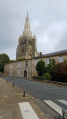
Turn left onto this street and continue straight on until you reach Rue de l’Église.
Turn right onto this street, then right again onto Rue de la Chapelle a little further on.
At the next junction, Rue de la Chapelle continues straight ahead. Take the passage immediately to its left (leaving Rue du Rompis further to the left). This passage is closed to motor vehicles.
Continue straight ahead along this street until you reach the D10 road.
Cross the D10 with care and proceed to the car park (S/E).


Waypoints

  1. S/E : km 0 - alt. 141 m - Car park at the Souvigné village hall
  2. 1 : km 1.42 - alt. 76 m - Junction with the alternative route
  3. 2 : km 2.91 - alt. 83 m - Junction of farm track and path, on the right
  4. 3 : km 3.57 - alt. 90 m - Crossroads, straight ahead
  5. 4 : km 4.26 - alt. 80 m - Junction of road and farm track. Near - Sèvre Niortaise (fleuve)
  6. 5 : km 5.4 - alt. 65 m - Y-junction, turn right
  7. 6 : km 6.37 - alt. 80 m - T-junction of farm tracks
  8. 7 : km 7.07 - alt. 86 m - Crossroads of three roads and a farm track
  9. 8 : km 8.67 - alt. 90 m - Crossroads: farm track/road, left
  10. 9 : km 9.67 - alt. 144 m - Junction of Rue du Tail Robert and Chemin d’Exploitat.
  11. S/E : km 10.47 - alt. 141 m - Car park at the Souvigné village hall

Notes

The car park is located next to the Souvigné Village Hall on the side of the D10 road.

This hike over varied terrain requires sturdy footwear. This unmarked route sometimes follows sections of various marked trails in the area. It is therefore advisable to follow the directions in the description and on the map.

Alternative route:
A shorter route of just 8.4 km is possible by turning right at (1) and continuing along the path that leads directly to (3).

Hike completed by the author of this guide on 23 December 2017 and 29 May 2019

Worth a visit

Souvigné
Régné Castle has belonged to the Vasselot de Régné family since 1403. Coat-of-arms-adorned gate, fine staircase, fireplaces, three wings of outbuildings, well and ironwork, roof.
Château des Essarts, rebuilt in the 19th century: old tower.
Boisguérin Castle, 19th century.
Logis du Bois des Prés.
Bois Dureau, old 17th-century post house.
Temple and its interior decoration.
Notre-Dame Priory: fireplace.
Museum of Headwear and the Pélébois Region
Note that there are 21 wash houses in this parish.

Saint-Maixent l'École
The town developed around the monastery founded in 459 by the Oratorian monk Agapit, who was joined in 480 by Adjutor, who then took the name Maixent. The town was initially named Saint-Saturnin and flourished in the 5th and 6th centuries.
In September 1346, the Earl of Derby failed in his attempt to capture the town1 (Hundred Years’ War).
In February 1469, by letters patent, King Louis XI authorised the establishment of fairs and markets in Saint-Maixent, following a request from the Count of Maine.
It was the district capital from 1790 to 1795.
From 1880 to 1940, the Military Infantry School (EMI, later EMICC, with combat tanks) trained thousands of officers drawn from the ranks of non-commissioned officers.
In June 1940, these officer cadets from Saint-Maixent joined the cadets of the Saumur Cavalry School in their sacrifice to defend the crossing of the Loire.
After the war, the Military School of Infantry and Battle Tanks merged with the Joint Services Military School at the Saint-Cyr Coëtquidan camp.
In 1948, the National School for Active Non-Commissioned Officers was established.

Places and monuments
Medieval residences.
From 1881 to 1940, Saint-Maixent was home to a military academy for training army officers (infantry, then infantry and tanks).
Since 1963, Saint-Maixent has been the headquarters of the National School for Active Non-Commissioned Officers, which trains all non-commissioned officers of the French Army.
The NCO Museum, in the Marchand district, is situated on the site of the Château de Saint-Maixent. The origins of this institution date back to 1926, when General Pierre Michelin founded the Museum of Remembrance to trace the military history of Saint-Maixent and that of other training schools.
The abbey church, built in 940, housed the relics of Saint Maixent and Saint Léger and was destroyed by an earthquake. Rebuilt in the 11th and 12th centuries (Romanesque church), it was destroyed again by the Calvinists in September 1568, and rebuilt (as an abbey church) on its Romanesque foundations in a very beautiful Gothic style.
The remains of Saint-Léger Church, next to the abbey church, beneath which lies the Saint-Léger crypt.
Sources: official municipal website and Wikipedia (excerpts)

Reviews and comments

4.1 / 5
Based on 6 reviews

Reliability of the description
3.8 / 5
Ease of following the route
4.5 / 5
Route interest
4 / 5
dandom79
dandom79

Overall rating : 5 / 5

Date of your route : Jul 24, 2023
Reliability of the description : ★★★★★ Very good
Ease of following the route : ★★★★★ Very good
Route interest : ★★★★★ Very good
Very busy route : No

a lovely walk

Machine-translated

GILMIC79
GILMIC79

Overall rating : 5 / 5

Date of your route : Mar 17, 2023
Reliability of the description : ★★★★★ Very good
Ease of following the route : ★★★★★ Very good
Route interest : ★★★★★ Very good
Very busy route : No

Great hike.
The ground is a bit damp between the start and the Soignon cheese dairy (between 1 and 2)
Up to around point 3, there is some traffic noise (due to the A10 motorway), but it is only a minor nuisance and does not detract from the appeal of this route.

Machine-translated

Eleonore79
Eleonore79

Overall rating : 4.3 / 5

Date of your route : Jan 05, 2022
Reliability of the description : ★★★★☆ Good
Ease of following the route : ★★★★★ Very good
Route interest : ★★★★☆ Good
Very busy route : No

Hello,
I just wanted to let you know about a problem on this route, which is otherwise very pleasant.
Towards the end of the route, after crossing the main road to head towards Souvigné, you have to turn right onto a path that goes through a farm. I met the owner this afternoon and he asked me to let you know that this is a private road. It shouldn’t be marked as a walking route. He’s very nice, but he wouldn’t want there to be a problem one day, with his dog for example.
Thank you very much.

Machine-translated

pgetrochon
pgetrochon

Thank you for your comment.
As for the shortcuts taken without realising it, this justifies my recommendation to follow the map and the route description closely, which I took the time to write and correct after completing the hike.
Enjoy your walks

Machine-translated

Henryjj79
Henryjj79

Overall rating : 4 / 5

Date of your route : Feb 24, 2019
Reliability of the description : ★★★★☆ Good
Ease of following the route : ★★★★☆ Good
Route interest : ★★★★☆ Good

A lovely unmarked walk. Be careful, as you can sometimes take shortcuts without realising it.

Machine-translated

philouis
philouis

Overall rating : 3.3 / 5

Date of your route : Aug 20, 2018
Reliability of the description : ★★★☆☆ Average
Ease of following the route : ★★★★☆ Good
Route interest : ★★★☆☆ Average

This pleasant walk has the drawback of bypassing almost all the hamlets along the route.
A return trip to the Sèvre Niortaise is a must (between points 4 and 5)
Two issues encountered on the route:
- between 3 and 4, it is better to go via Chiloup on the small road as the path downhill is impossible to find
- between points 7 and 8, at the left-hand bend, there is no crossroads. Take the second path on the right after the Vinaterie.

Machine-translated

pgetrochon
pgetrochon

Hello,

I am quite surprised by the somewhat peremptory tone of your comment.

Admittedly, part of this route does follow small roads that are nothing more than old, tarmac-surfaced farm tracks. There isn’t even a hundred metres on a main road! The rest, making up about a third of the route – as shown on the map and in the description – follows paths that link together areas of interesting scenery and trails leading to wash houses or fountains, or that cross or run alongside lovely woods, at least in the opinion of other walkers I know who have helped me discover this beautiful corner of southern Deux-Sèvres. These tarmac roads are very quiet and are often unavoidable in southern Poitou, as settlements are so scattered.

The distinction between a road, a path and a track is clear to me: a road is tarmac, even if grass sometimes grows on it; a path (rare in southern Poitou) is a narrow track where one walks single file; a track is usually a farm track as it allows a tractor to pass (one can walk two abreast without difficulty). There are then further distinctions depending on whether one is in a rural or forested area (the track then becomes a forest track, or even a forest lane when the edges are largely cleared, etc.).

Having re-read the route description, I struggle to see where the confusing terms lie. However, for me, a hike involves following the map first and foremost and reading the landscape to stick closely to the proposed route. If in doubt, it is useful to refer to the description, which is easy to consult thanks to the numbers placed along the route, thus preventing you from getting lost in the text.

Unfortunately, it’s also quite easy to get lost as there are multiple signposts in certain places. Whilst preparing this route, I fell ‘victim’ to this near Chiloup, for example. I wanted to take the path and ended up on the road. Hence the very precise description. This area is quite complex… more so than the terms used in the description.

One final point: when I suggest “taking” a path or a road, I do mean walking along it and following its course… but sometimes this is just after turning right or left onto it.

This route is simply designed to help you discover an area with remarkable and very varied landscapes. It is accessible all year round and offers walkers some lovely surprises (fountains, wash houses, old buildings, etc.) along quiet paths where everyone can stroll in the peace of nature, without worrying too much about traffic.

Happy hiking in the future

Machine-translated

Archelaos79
Archelaos79

Overall rating : 3 / 5

Date of your route : Mar 18, 2018
Reliability of the description : ★★☆☆☆ Disappointing
Ease of following the route : ★★★★☆ Good
Route interest : ★★★☆☆ Average

I was quite disappointed because, in the end, you end up walking quite a bit on roads.

On the other hand, the route description leaves a lot to be desired. I got lost three times because the terms were ambiguous.

On that note, more care should be taken with the terms ‘road’, ‘path’ and ‘track’. As far as I’m concerned, a road has been tarmac for a long time now, not a dirt track. Or it’s like using the term ‘take the road’ when ‘cross’ would be more appropriate. In short, it lacks clarity, and when you have to stop and take a few seconds to figure it out, it’s a bit of a nuisance;

Machine-translated

Other walks in the area

For more walks, use our search engine .

The GPS track and description are the property of this route's author. Please do not copy them without permission.