


Refine your search for walks in Bazouges-la-Pérouse
Bazouges-la-Pérouse walks


 The path from La Ballue to Bazouges-la-Pérouse
 Visorando Member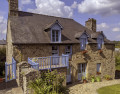
 7.40 mi
 +614 ft
 -630 ft
 3h 55
3h 55
 Moderate
 Departure from Bazouges-la-Pérouse (Ille-et-Vilaine)
Discover the charming little town of Bazouges-la-Pérouse, then walk through the woods to reach this former residence of the Counts of Fougères, now a guest house, and finally stroll along charming streams that offer peace and serenity.
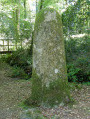
In the Villecartier State Forest
 7.05 mi
+207 ft
-203 ft
3h 25
Moderate
Departure from Bazouges-la-Pérouse (Ille-et-Vilaine)
7.05 mi
+207 ft
-203 ft
3h 25
Moderate
Departure from Bazouges-la-Pérouse (Ille-et-Vilaine)
The Villecartier State Forest is now known for its leisure centre and miniature harbour. A former royal forest covering 1,000 hectares, it has been home to craftsmen since ancient times: the Auge des Sabotiers archaeological site bears witness to this. During the Roman period and then in the Middle Ages, its activities continued to evolve against a backdrop of religious influence.
This walk, which takes place entirely in the forest, invites you to discover all these places steeped in history.
Circular route in the Villecartier Forest via the Colonne des Chouans
 Association / Club / Walk leader
 5.05 mi
+85 ft
-85 ft
2h 25
5.05 mi
+85 ft
-85 ft
2h 25
 Easy
Departure from Bazouges-la-Pérouse (Ille-et-Vilaine)
Easy
Departure from Bazouges-la-Pérouse (Ille-et-Vilaine)
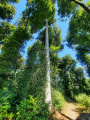
The Villecartier National Forest is known for its leisure centre, miniature harbour and hiking trails. The forest, formerly royal, covers an area of 1,000 hectares. It is dotted with monuments of varying ages that bear witness to human activity throughout its history. The proposed route allows you to discover some of them, and with a little luck, the four-legged animals that inhabit it; to do so, you must be relatively quiet.
A peaceful route taking in the monuments of the Villecartier National Forest.
 4.96 mi
+105 ft
-98 ft
2h 20
Easy
Departure from Bazouges-la-Pérouse (Ille-et-Vilaine)
4.96 mi
+105 ft
-98 ft
2h 20
Easy
Departure from Bazouges-la-Pérouse (Ille-et-Vilaine)
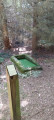
The Villecartier National Forest is known for its leisure centre, miniature harbour and hiking trails. The forest, formerly royal, covers an area of 1,000 hectares. It is dotted with monuments of varying ages that bear witness to human activity throughout its history. The proposed route allows you to discover some of them, and with a little luck, the four-legged animals that inhabit it. To do so, you must be relatively quiet.
Circular in the Villecartier National Forest
 7.65 mi
+102 ft
-102 ft
3h 35
Moderate
Departure from Bazouges-la-Pérouse (Ille-et-Vilaine)
7.65 mi
+102 ft
-102 ft
3h 35
Moderate
Departure from Bazouges-la-Pérouse (Ille-et-Vilaine)
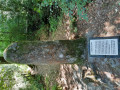
The Villecartier National Forest is known for its leisure centre, miniature harbour and hiking trails. The forest, formerly royal, covers an area of 1,000 hectares. It is dotted with monuments of varying ages that bear witness to human activity throughout its history. The proposed route allows you to discover some of these monuments and, with a little luck, the four-legged animals that inhabit the forest. To do so, you need to be relatively quiet and have a little luck.
Circular route between La Fontenelle and La Roche
 5.36 mi
+318 ft
-299 ft
2h 45
Easy
Departure from La Fontenelle (Ille-et-Vilaine)
5.36 mi
+318 ft
-299 ft
2h 45
Easy
Departure from La Fontenelle (Ille-et-Vilaine)
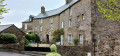
A walk along the country lanes of La Fontenelle, which presents no significant difficulty. There is a beautiful view over the Couesnon valley and the charming village of La Roche. The architecture of some of its houses is remarkable, with decorative arched windows and double-roll-top doors...
The menhir of La Butte in Cuguen
 6.78 mi
+200 ft
-223 ft
3h 15
Moderate
Departure from Cuguen (Ille-et-Vilaine)
6.78 mi
+200 ft
-223 ft
3h 15
Moderate
Departure from Cuguen (Ille-et-Vilaine)
A very pleasant route along sunken paths (sometimes wet) and hedgerow paths. You will walk alongside small streams with the incessant sound of lapping water as they cross a stony area. The highlight of this hike is the Butte menhir.
The Ruisseau des Saules in Romazy
5.43 mi
+249 ft
-259 ft
2h 45
Easy
Departure from Romazy (Ille-et-Vilaine)
A small village in the Pays de Rennes; from the heights of Romazy, you can see part of the Couesnon valley. Visitors are struck by the relaxed way of life here and appreciate its unspoilt surroundings.
Sougeal Marsh Route via La Selle and Les Landelles
 6.84 mi
+436 ft
-440 ft
3h 30
Moderate
Departure from Sougéal (Ille-et-Vilaine)
6.84 mi
+436 ft
-440 ft
3h 30
Moderate
Departure from Sougéal (Ille-et-Vilaine)
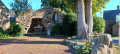
The route runs along the edge of the marsh and its vast 175-hectare wet meadows. These are classified as an “Espace Remarquable de Bretagne” (Regional Nature Reserve). The marsh is home to waterfowl all year round, but you may also come across cows and horses grazing freely there. In winter, access to the marsh is often cut off by floodwaters. The suggested route allows you to go round the marsh. However, two observation points overlooking the marsh remain accessible. The route also offers a more idyllic stretch through the woods and countryside around Sougeal. All in all, a peaceful walk to be enjoyed all year round.
The Sougeal Marsh
 8.81 mi
+459 ft
-466 ft
4h 25
Moderate
Departure from Sougéal (Ille-et-Vilaine)
8.81 mi
+459 ft
-466 ft
4h 25
Moderate
Departure from Sougéal (Ille-et-Vilaine)
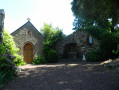
It comprises 175 hectares of extensive wet meadows and encompasses three main activities (see practical information). This route invites you to explore this environment, starting at the fish pass and then following the course of the Couesnon as closely as possible.In this regional nature reserve, only birdsong can be heard.
The Route des Rochers in Chauvigné
7.46 mi
+102 ft
-98 ft
3h 30
Moderate
Departure from Chauvigné (Ille-et-Vilaine)
In the 1920s, Chauvigné had granite quarries next to the village of Le Fretay on the "Rochers des Renaisières" site.
The quarrying operation, which remained small-scale, focused mainly on the creation of funerary monuments.
Walkers will enjoy a stroll right in the heart of granite country: amongst meadows where the rock outcrops and traditional buildings.
The route from Saint-Georges to Chauvigné
 5.27 mi
+131 ft
-148 ft
2h 30
Easy
Departure from Chauvigné (Ille-et-Vilaine)
5.27 mi
+131 ft
-148 ft
2h 30
Easy
Departure from Chauvigné (Ille-et-Vilaine)
Lulled by the calm waters of the Ritort and the Moulinet, Chauvigné invites you to discover its hidden treasures and offers you a glimpse into its history.
A circular discovery trail around the Sougeal Marsh Nature Reserve
 4.04 mi
+13 ft
-13 ft
1h 50
Easy
Departure from Sougéal (Ille-et-Vilaine)
4.04 mi
+13 ft
-13 ft
1h 50
Easy
Departure from Sougéal (Ille-et-Vilaine)
A short, easy walk around the Sougeal Marshes. Designated both a Regional Nature Reserve and a ‘Remarkable Site of Brittany’, with over 175 hectares restored, the area safeguards the bay’s ecosystem. You can spot over 360 plant species, amongst the reed beds and hedgerows. As for wildlife, there are numerous migratory birds. Depending on the season, you’ll find over 60 species of waterbirds, including grey herons and white storks.
The Parc de la Higourdais and the Croix de Pierre
 7.44 mi
+102 ft
-69 ft
3h 30
Moderate
Departure from Epiniac (Ille-et-Vilaine)
7.44 mi
+102 ft
-69 ft
3h 30
Moderate
Departure from Epiniac (Ille-et-Vilaine)
The Parc de la Higourdais is managed by the Ille-et-Vilaine Departmental Council. It was the Council that had the mill and the bakehouse restored. Furthermore, along the route you will come across no fewer than five crosses.
Circular loop through the Parc de la Higourdais via Le Brégain to Épiniac
 8.66 mi
+374 ft
-387 ft
4h 20
Moderate
Departure from Epiniac (Ille-et-Vilaine)
8.66 mi
+374 ft
-387 ft
4h 20
Moderate
Departure from Epiniac (Ille-et-Vilaine)
This route crosses the Parc de la Higourdais on the heights of Épiniac. It leads to the banks of the Ruisseau du Landal, which it follows through woodland that is particularly pleasant in summer. It then continues, half on road and half on footpaths. The walk passes over Brégain Hill, which offers a beautiful view of the Guyoult basin to the north. In good weather, you can see Mont-Saint-Michel to the north-east. The return journey takes you along small roads that are generally quite pleasant and quiet, allowing you to discover old hamlets and some beautiful stone houses.
The Couesnon and the Minette
13.27 mi
+807 ft
-810 ft
6h 50
 Difficult
Departure from Vieux-Vy-sur-Couesnon (Ille-et-Vilaine)
Difficult
Departure from Vieux-Vy-sur-Couesnon (Ille-et-Vilaine)
4-hour hike (hence its medium difficulty). A little road and quite a few paths. You will cross the Couesnon and Minette valleys.
Route of the quarries along the Couesnon
6.79 mi
+312 ft
-318 ft
3h 25
Moderate
Departure from Vieux-Vy-sur-Couesnon (Ille-et-Vilaine)
After walking along the Couesnon, which is calm and peaceful on this section, walkers are invited to discover a small stream that feeds it: the Vallées d'Hervé stream. Then, despite a few open sections, walkers will appreciate the peaceful shade of the undergrowth and sunken paths.
The Priory of Brégain
10.08 mi
+299 ft
-279 ft
4h 55
Moderate
Departure from La Boussac (Ille-et-Vilaine)
Set off to explore the local bocage landscape, with its meadows enclosed by embankments, fences or stone walls.
The Étang de Boulet and the Grotte Notre-Dame de Lourdes
 6.56 mi
+46 ft
-46 ft
3h 05
Moderate
Departure from Feins (Ille-et-Vilaine)
6.56 mi
+46 ft
-46 ft
3h 05
Moderate
Departure from Feins (Ille-et-Vilaine)
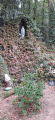
This walk, starting at the Boulet lock, goes round the Étang de Boulet. The terrain is flat and easy, making it ideal for young children. The Étang de Boulet is the largest navigable body of water in Ille-et-Vilaine. The lake is a Natura 2000 site. The route takes you past the Notre-Dame de Lourdes Grotto and along the Rigole du Boulet, which once supplied water to the Ille and Rance Canal. The route ends with a short detour through the countryside near the lake.
The walk through the three communes: Feins, Montreuil-sur-Ille and Aubigné
11.52 mi
+302 ft
-305 ft
5h 35
Moderate
Departure from Feins (Ille-et-Vilaine)
Explore the paths linking these three towns, whose development is owed to the Ille and Rance Canal, built between 1804 and 1832, and to the Rennes–Saint-Malo railway line, which runs close to Montreuil-sur-Ille.
The Pond and the Boulet Canal
 9.57 mi
+194 ft
-207 ft
4h 35
Moderate
Departure from Feins (Ille-et-Vilaine)
9.57 mi
+194 ft
-207 ft
4h 35
Moderate
Departure from Feins (Ille-et-Vilaine)
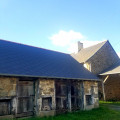
This walk will take you on a journey of discovery through a rich environment of flora and fauna linked to the presence of the Étang de Boulet. The Étang and the Boulet canal form part of the heritage of the water supply infrastructure for the Ille and Rance Canal and are inextricably linked to the rich history of navigation along this route.
Boulet Canal – From the Estate to Pas de l’Ille via Les Landelles
 4.87 mi
+23 ft
-23 ft
2h 15
Easy
Departure from Dingé (Ille-et-Vilaine)
4.87 mi
+23 ft
-23 ft
2h 15
Easy
Departure from Dingé (Ille-et-Vilaine)
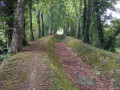
This walk follows the banks of the Rigole de Boulet to the east of Dingé. The well-maintained path runs alongside the meandering watercourse, passing wooden or iron sheet piling, and crosses several 19th-century engineering structures: siphons, aqueducts, drinking troughs…
You walk beneath a canopy of beech trees. The colours change from spring to autumn. It’s cool in summer.