


Refine your search for walks in Pluzunet
Pluzunet walks


 The Trégor countryside in Pluzunet
 Visorando Member
 7.40 mi
 +197 ft
 -200 ft
 3h 35
3h 35
 Moderate
 Departure from Pluzunet (Côtes-d'Armor)
The Trégor countryside, always rich in peaceful scenery, is at its best during this walk, which presents no difficulty.
The Léguer on the outskirts of Le Danot
 7.12 mi
+682 ft
-699 ft
3h 50
Moderate
Departure from Pluzunet (Côtes-d'Armor)
7.12 mi
+682 ft
-699 ft
3h 50
Moderate
Departure from Pluzunet (Côtes-d'Armor)
A walk through the Trégor forest, where you’ll follow the Léguer coastal river, as well as passing chapels and cave dwellings.
Option to take a shortcut, reducing the distance to 8 km; classified as ‘Easy’.
Pluzunet – Le Danot
6.36 mi
+482 ft
-479 ft
3h 20
Moderate
Departure from Pluzunet (Côtes-d'Armor)
In the green Trégor region, a walk through wooded countryside with a brief visit to the Léguer before discovering the rolling landscape of the foothills of the ancient Montagnes Noires.
From Tonquédec to the castle ruins via the Léguer
7.26 mi
+371 ft
-381 ft
3h 40
Moderate
Departure from Tonquédec (Côtes-d'Armor)
There is virtually no elevation gain on this walk in the Trégor forest. Just magnificent scenery, starting with paths through chestnut trees, then a walk along the banks of the Léguer, ending with a visit to the imposing ruins of Tonquédec Castle. At the end of the walk, don't forget to visit the village church.
To the east of Tonquédec
 7.15 mi
+236 ft
-236 ft
3h 30
Moderate
Departure from Tonquédec (Côtes-d'Armor)
7.15 mi
+236 ft
-236 ft
3h 30
Moderate
Departure from Tonquédec (Côtes-d'Armor)
We are not inviting you to hike towards Tonquédec Castle, which was dismantled around 1626 on the orders of Richelieu and is situated to the north-west of the village of the same name, but rather to the south-east of this village. There we will find the Guindy, a river dear to the people of Trégor, as well as green sunken paths in lush countryside.
Castles and chapels in the Trégor
7.14 mi
+587 ft
-617 ft
3h 50
Moderate
Departure from Tonquédec (Côtes-d'Armor)
The chapels of Kerrivoalan and Saint-Gildas on the one hand; but also Kergrist Castle (a private residence open to visitors only in summer) and, of course, the ruins of Tonquédec Castle and its oratory on the other; and finally the mills at Traoumorvan, Kergrist and Kergrot bear witness, throughout this route, to a Brittany that was once warlike, devout and agricultural, but has now become a tourist destination.
Exploring the Guindy Valley
 7.37 mi
+164 ft
-171 ft
3h 30
Moderate
Departure from Cavan (Côtes-d'Armor)
7.37 mi
+164 ft
-171 ft
3h 30
Moderate
Departure from Cavan (Côtes-d'Armor)
This walk between Cavan and Tonquédec is very easy. It begins and ends with a covered avenue lined with sculptures: this is the Vallée des Arts. Unfortunately, over time, some of the sculptures have disappeared. After exploring the Guindy Valley, you’ll finish with the ‘Apple Tree Avenue’: a wide avenue lined with around a hundred apple trees of various species, where anyone is free to pick apples.
Les Sept-Saints and the Léguer Valley
 7.62 mi
+643 ft
-656 ft
4h 05
Moderate
Departure from Le Vieux-Marché (Côtes-d'Armor)
7.62 mi
+643 ft
-656 ft
4h 05
Moderate
Departure from Le Vieux-Marché (Côtes-d'Armor)
Forest paths and sunken lanes lead walkers along the "Sentier des Améthystes" (Amethyst Trail) alongside the Léguer and then the Saint-Éturien stream, before arriving at a centuries-old beech tree.
The walk starts and ends at the Chapelle des Sept-Saints: a place of great significance for the friendship between Islam and Christianity.
Tonquédec Forest
3.10 mi
+213 ft
-180 ft
1h 35
Moderate
Departure from Tonquédec (Côtes-d'Armor)
A refreshing walk through the woods and along the Léguer.
From Saint-Éloi to the Pergat Menhir, returning along the banks of the Guindy
 7.15 mi
+200 ft
-200 ft
3h 30
Moderate
Departure from Louargat (Côtes-d'Armor)
7.15 mi
+200 ft
-200 ft
3h 30
Moderate
Departure from Louargat (Côtes-d'Armor)
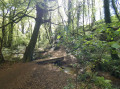
There is virtually no elevation gain on this route, which follows small forest paths alongside a river and stream, allowing you to enjoy the sound of the water and the birdsong.
There is no answer to the mystery of the menhirs when faced with this colossus weighing several tonnes, which has stood in this small clearing for over 5,000 years.
Tonquédec Castle and Kerfons Chapel
 4.90 mi
+643 ft
-633 ft
2h 50
4.90 mi
+643 ft
-633 ft
2h 50
 Easy
Departure from Tonquédec (Côtes-d'Armor)
Easy
Departure from Tonquédec (Côtes-d'Armor)
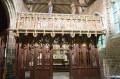
Two historic sites along this walk: Tonquédec Castle with its walls and restoration work, and the magnificent little Chapel of Kerfons. All this is complemented by a relaxing stroll along the Léguer.
Along the Donant
 7.67 mi
+361 ft
-361 ft
3h 50
Moderate
Departure from Bégard (Côtes-d'Armor)
7.67 mi
+361 ft
-361 ft
3h 50
Moderate
Departure from Bégard (Côtes-d'Armor)
The Donant and the Kerogan Stream flow into the Jaudy, one of the many coastal rivers of the Trégor.
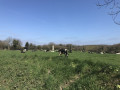
This route allows you to discover peaceful, leafy landscapes as you walk along both sunken paths and tarmac roads where, at times, you can forget about civilisation.
If you’d rather not go hiking, you can spend the day at the amusement park, which serves as the starting point.
From Poulloguer Pond to Coatascorn
 6.98 mi
+469 ft
-479 ft
3h 35
Moderate
Departure from Prat (Côtes-d'Armor)
6.98 mi
+469 ft
-479 ft
3h 35
Moderate
Departure from Prat (Côtes-d'Armor)
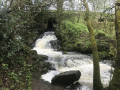
Although this walk uses a few tarmac roads, priority has been given here to forest paths and tracks open to farm machinery. In return, it offers magnificent scenery both around Poulloguer Pond and along the stream of the same name, with a very pleasant walk through the village of Coatascorn, a quintessential Trégor village with all its stone houses.
To the west of Vieux-Marché
 8.30 mi
+846 ft
-837 ft
4h 35
Moderate
Departure from Le Vieux-Marché (Côtes-d'Armor)
8.30 mi
+846 ft
-837 ft
4h 35
Moderate
Departure from Le Vieux-Marché (Côtes-d'Armor)
The Trégor region boasts a rich religious heritage. This walk allows you to discover several examples, which, whilst not exceptional, are classic in their beauty and aesthetic appeal.
This walk also allows you to enjoy the lush countryside and the Breton bocage.
Moments of tranquillity and exertion are always welcome in this mild climate.
From Vieux-Marché to Sept-Saints
 9.29 mi
+656 ft
-653 ft
4h 50
Moderate
Departure from Le Vieux-Marché (Côtes-d'Armor)
9.29 mi
+656 ft
-653 ft
4h 50
Moderate
Departure from Le Vieux-Marché (Côtes-d'Armor)
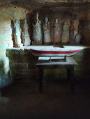
This walk, suitable for walkers of all ages, takes you through wooded, shaded areas along sunken paths as well as fields and meadows. It features three remarkable sites: the centuries-old beech tree, the Chapel of the Seven Saints and the Saint-Éturien stream, where the lucky ones may find amethyst crystals.
From Plouaret to Lannion along the Léguer
 16.39 mi
+994 ft
-1,375 ft
8h 25
16.39 mi
+994 ft
-1,375 ft
8h 25
 Difficult
Departure from Plouaret (Côtes-d'Armor)
Difficult
Departure from Plouaret (Côtes-d'Armor)
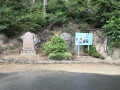
The aim is to follow the course of the Saint-Éturien stream and then the Léguer river from Plouaret-Trégor station to Lannion station. Plan to return by train.
The Pergat Menhirs and the Koad Bré Wood
4.89 mi
+240 ft
-233 ft
2h 25
Easy
Departure from Louargat (Côtes-d'Armor)
This short, easy walk takes you through the Louargat countryside to discover the two menhirs of Pergat, one of which is among the largest in Europe. You’ll follow the Ruisseau du Frout through its valley, which can be quite damp in places, before reaching the hamlet of Manaty. From there, you’ll head into the Koad Bré Forest at the foot of Ménez Bré before reaching Louargat via some lovely forest paths.
Tro Ménez Bré
 6.46 mi
+574 ft
-600 ft
3h 30
Moderate
Departure from Pédernec (Côtes-d'Armor)
6.46 mi
+574 ft
-600 ft
3h 30
Moderate
Departure from Pédernec (Côtes-d'Armor)
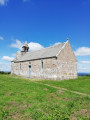
This walk offers nothing less than the chance to climb the highest point in the Côtes d’Armor and enjoy a completely unobstructed 360° view. On a clear day, it’s even said that you can see the sea!
From Buhulien, the banks of the Léguer between Lannion and Kerfons
7.98 mi
+801 ft
-814 ft
4h 20
Moderate
Departure from Lannion (Côtes-d'Armor)
Walking around the Coat Azur forest means discovering all these hamlets which, in the Middle Ages, lived off the coastal river – hence the many castles that line its banks: Coatfrec, Tonquédec, Kergrist
Today, the largest of these continue to grow, bringing together the homes of people who work in Lannion.
Quemperven and its surroundings
7.14 mi
+272 ft
-266 ft
3h 30
Moderate
Departure from Quemperven (Côtes-d'Armor)
Sunken paths and lush woodland all inspire a sense of calm and tranquillity during this walk, which features a few more challenging sections.
Tour of the paper mill valley in Plounévez-Moëdec
 4.33 mi
+466 ft
-456 ft
2h 25
Easy
Departure from Plounévez-Moëdec (Côtes-d'Armor)
4.33 mi
+466 ft
-456 ft
2h 25
Easy
Departure from Plounévez-Moëdec (Côtes-d'Armor)
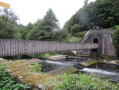
The tour of the paper mill valley is a short hike through the forest that runs alongside the Léguer river and passes by the ruins of an old factory and a dam.
A stroll through the heritage of Rospez
 5.54 mi
+102 ft
-102 ft
2h 40
Easy
Departure from Rospez (Côtes-d'Armor)
5.54 mi
+102 ft
-102 ft
2h 40
Easy
Departure from Rospez (Côtes-d'Armor)
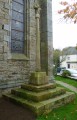
This walk through the heritage of Rospez is offered by the "heritage" group of the "Ro'Spered" association.
The remarkable sites linked together are very diverse: parish church, chapels, fountain, crosses or calvaries, flax scutching machine, Bronze Age tumulus, restored wash house... crossroads of three Roman roads...
A hike through the Rospez countryside, discovering the remains of a past dating back nearly three millennia...
The Léguer and its streams
7.98 mi
+719 ft
-712 ft
4h 20
Moderate
Departure from Lannion (Côtes-d'Armor)
Downstream from Lannion, the Léguer is fed by several streams: the Porz al Lan, the Kerlouzouen and the Pontol. After following the Léguer, we invite you to explore these streams, which are part of the charm of this region. All that remains is to let your imagination take you back in time to when the various mills along the banks were still in operation, washing flax and hemp and, in some cases, grinding wheat.
In the forest of Coat an Noz
 9.21 mi
+745 ft
-738 ft
4h 55
Moderate
Departure from Belle-Isle-en-Terre (Côtes-d'Armor)
9.21 mi
+745 ft
-738 ft
4h 55
Moderate
Departure from Belle-Isle-en-Terre (Côtes-d'Armor)
To the south of Belle-Île-en-Terre, a forest hides many secrets. It comprises two parts separated by the Léguer river: to the east, the Coat an Hay State Forest (Le Bois du Jour) and to the west, the Coat an Noz State Forest (Le Bois de la Nuit). In the latter, with a 19th-century castle undergoing restoration and a former ironworks site (lead mine), the route follows wide paths that are sometimes poorly lit by daylight.
Exploring the Léguer south of Lannion
7.27 mi
+420 ft
-440 ft
3h 45
Moderate
Departure from Lannion (Côtes-d'Armor)
Whilst the level of the Léguer, as it flows through Lannion, is influenced by the tides, further upstream, thanks to several retaining walls, the flow is much more steady. Moreover, the entire area is protected as it serves as a water catchment area for the region.
This route therefore offers an exploration of this coastal river, upstream of Lannion, with a return journey through the surrounding hills.
Along an old railway line north of Lannion
7.49 mi
+397 ft
-400 ft
3h 45
Moderate
Departure from Lannion (Côtes-d'Armor)
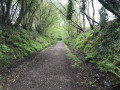
Apart from a short stretch through the north-eastern districts of Lannion, this route follows the route of an old railway line that linked Lannion to Perros-Guirec. It is therefore not particularly difficult but allows you to walk through areas where nature has reclaimed its territory.
The old railway line from Lannion to Perros-Guirec
 7.64 mi
+312 ft
-374 ft
3h 45
Moderate
Departure from Lannion (Côtes-d'Armor)
7.64 mi
+312 ft
-374 ft
3h 45
Moderate
Departure from Lannion (Côtes-d'Armor)
The walk follows part of the first railway network in the Côtes-du-Nord (as it was known at the time), linking Lannion to Perros-Guirec via Petit Camp.
Circular route in Tréglamus, from Kermadec to the Kermoda Cross
7.19 mi
+325 ft
-312 ft
3h 35
Moderate
Departure from Tréglamus (Côtes-d'Armor)
This is a lovely, easy little walk in the countryside around Tréglamus. You will pass from one hamlet to another, travelling along a wide variety of paths (sunken, white, forest, grassy and a little tarmac) and landscapes (forests, stream banks, fields, pastures, etc.).
Along the Léguer towpath
 7.84 mi
+449 ft
-449 ft
4h 00
Moderate
Departure from Lannion (Côtes-d'Armor)
7.84 mi
+449 ft
-449 ft
4h 00
Moderate
Departure from Lannion (Côtes-d'Armor)
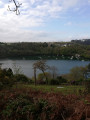
At high tide, the Léguer reaches its maximum level. The landscape is then truly beautiful, provided the sun is shining. The green of the trees is reflected among the boats on the blue water.
At low tide, the landscape is different and the bottom of the Léguer, which is sometimes muddy, gives this coastal river a different appearance.
From the Léguer to the heights of Servel in Lannion
 4.60 mi
+279 ft
-282 ft
2h 20
Easy
Departure from Lannion (Côtes-d'Armor)
4.60 mi
+279 ft
-282 ft
2h 20
Easy
Departure from Lannion (Côtes-d'Armor)
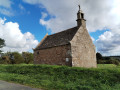
First, a long walk along the Léguer on the towpath, then you’ll reach the heights of Servel via a steep path. After walking along a quiet country lane, offering views of the valley and the town of Lannion, take a path down through the woodland to rejoin the towpath.
La Pointe du Yaudet via the Léguer
6.97 mi
+676 ft
-643 ft
3h 50
Moderate
Departure from Lannion (Côtes-d'Armor)
Walking through a pine forest, you will follow the Léguer river in its tidal section, so the landscape is more pleasant at high tide.You will walk to the Pointe du Yaudet to discover the mouth of the Léguer and then the Baie de la Vierge.On the way back, after following the small meanders of the river (the Yaudet), you will pass not far from the Château de Kerninon (private property, not open to visitors) and descend towards the Léguer.