


Refine your search for walks in Pic Cascavelier
Pic Cascavelier walks


 Crête de la Marcelette from Saint-Véran
 Visorando Member
 7.01 mi
 +3,711 ft
 -3,714 ft
 6h 25
6h 25
 Difficult
 Departure from Saint-Véran (Hautes-Alpes)
This is a superb hike, partly unmarked on the IGN map, where you will undoubtedly be the only ones to enjoy the 360° panorama throughout the central part of the hike.The ridge is safe for hikers who are not afraid of heights and are used to the mountains. Hiking boots are recommended.About halfway along the ridge, there is a lovely spot for a snack, with a hollow to shelter from the wind.
Pic de Cascavelier via the Curlet ridges
 5.42 mi
+2,746 ft
-2,756 ft
4h 55
Difficult
Departure from Saint-Véran (Hautes-Alpes)
5.42 mi
+2,746 ft
-2,756 ft
4h 55
Difficult
Departure from Saint-Véran (Hautes-Alpes)
This beautiful and varied hike follows ridges offering unobstructed views. The route to the summit of Pic de Cascavelier via the rocky ridge is more alpine in character but never dangerous. The exposed path, zigzagging between the rocks, sometimes requires you to use your hands. From the Croix du Curlet, you have a magnificent bird’s-eye view of the village of Saint-Véran and its valley.
Walks near Pic Cascavelier
Saint-Véran – Agnel Mountain Hut
 9.64 mi
+3,963 ft
-2,103 ft
7h 55
Difficult
Departure from Saint-Véran (Hautes-Alpes)
9.64 mi
+3,963 ft
-2,103 ft
7h 55
Difficult
Departure from Saint-Véran (Hautes-Alpes)
This is the second stage ofthe GR®®58, but it takes a variant route via the Col de Saint-Véran or the Col de la Cavale and includes an ascent to an altitude of 3,000 metres at the Pic de Caramantran. There’s a magnificent view of Mount Viso at the highest point of this route. At the start of the season, there were still plenty of snowfields. This is a very wild route, which I recommend as an alternative to the Col de Chamoussière path, which tends to be quite busy.
Saint Véran - Col Agnel
 8.02 mi
+3,468 ft
-1,683 ft
6h 45
Difficult
Departure from Saint-Véran (Hautes-Alpes)
8.02 mi
+3,468 ft
-1,683 ft
6h 45
Difficult
Departure from Saint-Véran (Hautes-Alpes)
The fourth stage takes you towards the Italian border, offering beautiful views of Mont Viso.
The Refuge de la Blanche, starting from Saint-Véran
 8.69 mi
+1,814 ft
-945 ft
5h 35
8.69 mi
+1,814 ft
-945 ft
5h 35
 Moderate
Departure from Saint-Véran (Hautes-Alpes)
Moderate
Departure from Saint-Véran (Hautes-Alpes)
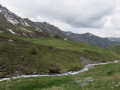
Via the Grand Canal, now completely disused, a long crossing opposite the Grande Tête des Toillies, ending at the Refuge de la Blanche and then at the observatory car park.
Saint Véran – Refuge de la Blanche
 10.15 mi
+4,537 ft
-3,035 ft
8h 35
Difficult
Departure from Saint-Véran (Hautes-Alpes)
10.15 mi
+4,537 ft
-3,035 ft
8h 35
Difficult
Departure from Saint-Véran (Hautes-Alpes)
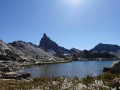
This serves as an introduction to a cross-border trek between Saint-Véran and Larche. We set off from the mountain pastures for a gentle approach to the border, through a rocky and colourful landscape that can at times be quite disorientating. There are no real difficulties, but a good understanding of how to read the terrain is sometimes necessary to avoid losing your way.
From Saint-Véran to Larche: Ubaye Transfrontière
49.21 mi
+20,728 ft
-21,916 ft
5 days
 Very difficult
Departure from Saint-Véran (Hautes-Alpes)
Very difficult
Departure from Saint-Véran (Hautes-Alpes)
A fantastic Franco-Italian ride between Saint-Véran and Larche! It will take you through strange places, from the solitary, green rocky landscapes of Saint-Véran to the fantastical, almost Dolomite-like terrain of the massif between Chambeyron and Orrenaye.
Le Cros - Refuge de la Blanche
6.63 mi
+2,943 ft
-906 ft
5h 35
Difficult
Departure from Saint-Véran (Hautes-Alpes)
This is the first stage of this journey, half in Queyras and half in Ubaye. Follow the right bank of the Aigue Blanche, then continue along the Col de Saint-Véran trail, before enjoying a beautiful descent that leads to the lake and the Refuge de la Blanche.
Refuge de la Blanche - Maljasset
10.03 mi
+1,532 ft
-3,494 ft
5h 55
Difficult
Departure from Saint-Véran (Hautes-Alpes)
Here, the names change from white to black with great dexterity. Indeed, the passage from Queyras, Refuge de la Blanche, to Ubaye is via the Col de la Noire. Original, isn't it?
Refuge de la Blanche – Le Raux
 11.04 mi
+2,641 ft
-4,770 ft
7h 25
Difficult
Departure from Saint-Véran (Hautes-Alpes)
11.04 mi
+2,641 ft
-4,770 ft
7h 25
Difficult
Departure from Saint-Véran (Hautes-Alpes)
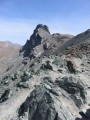
On the second day of this trip, the plan is to walk the Tour de la Tête des Toillies and finish the day with a long walk back to Le Raux.
Refuge de la Blanche – Franco Boerio Bivouac
 8.91 mi
+4,465 ft
-2,543 ft
8h 00
Difficult
Departure from Saint-Véran (Hautes-Alpes)
8.91 mi
+4,465 ft
-2,543 ft
8h 00
Difficult
Departure from Saint-Véran (Hautes-Alpes)
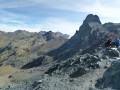
A foray into the Haute Ubaye to round off the route in style at its highest point. With the option of watching the sunset from the summit of the Bric de Rubren.
The route deliberately moves away from the border to take the easiest route up the hill.
From Ceillac to Fouillouse
 13.37 mi
+4,452 ft
-4,216 ft
10h 00
Difficult
Departure from Ceillac (Hautes-Alpes)
13.37 mi
+4,452 ft
-4,216 ft
10h 00
Difficult
Departure from Ceillac (Hautes-Alpes)
This fifteenth stage crosses the Escreins massif (not to be confused with the Écrins massif) and, via the Ubaye valley, enters the Chambeyron valley. From the Refuge de la Cime, the route—off the GR®5—crosses the Torrent du Mélezet valley and climbs up the Pré Girardin valley via the ski runs; then, on the plateau, it skirts the rocky ridge overlooking Lac Miroir, reaches the lake and rejoins the GR®5. The route climbs up the valley between the shoulder of the Pic des Heuvières and the Crête de Coste Belle, passing the small pass of Sainte-Anne and then the lake of the same name before reaching the Col Girardin. It descends towards a basin, where the Torrent des Séchoirs has its source, and follows it. Clinging to the side of a steep slope, it joins the D25 road in the upper Ubaye valley and continues downstream, alternating between the road and paths close to the river. It leaves the D25 for the Fouillouse road, passes the vertiginous Pont du Châtelet, a tunnel and, via a path, reaches the hamlet of Fouillouse.