


Refine your search for walks in Peyrelevade
Peyrelevade walks

 Sources de la Vienne
 Visorando Member
 2.40 mi
 +367 ft
 -371 ft
 1h 25
1h 25
 Easy
Easy
 Departure from Saint-Setiers (Corrèze)
A short discovery trail to discover the Sources de la Vienne, the natural peat bogs and those created by shepherds.Please note: this discovery trail appears to be poorly maintained in view of the reviews. The Visorando application is recommended to follow the itinerary.
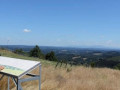
Mont Audouze, the highest point in Corrèze on the Millevaches Plateau
 6.50 mi
+469 ft
-472 ft
3h 25
6.50 mi
+469 ft
-472 ft
3h 25
 Moderate
Departure from Saint-Setiers (Corrèze)
Moderate
Departure from Saint-Setiers (Corrèze)
Hike to the highest point in the Corrèze department, on the Haut Plateau de Millevaches.
Millevaches trail to Les Oussines
8.70 mi
+692 ft
-689 ft
4h 35
Moderate
Departure from Millevaches (Corrèze)
This trail is part of the Millevaches trails, allowing you to enjoy the peace and quiet of nature in the Millevaches Regional Nature Park.
Pass through herds of cows and sensitive natural areas. Remain calm. Respect the areas you pass through.
Sources of the Vienne from Millevaches
10.41 mi
+732 ft
-738 ft
5h 25
Moderate
Departure from Millevaches (Corrèze)
For those who enjoy day hikes, there is a circular trail that allows you to explore the surroundings of Millevaches, as well as the Sources de la Vienne site and its discovery trail.Lots of small roads and wide paths.
Chavanac from Millevaches
 3.72 mi
+282 ft
-256 ft
1h 55
Easy
Departure from Millevaches (Corrèze)
3.72 mi
+282 ft
-256 ft
1h 55
Easy
Departure from Millevaches (Corrèze)
This hike, starting from the village of Millevaches, will take you to Chavanac, a restored village with a beautiful Romanesque church and stone houses.
Iconic trail of the Millevaches Plateau to Saint-Merd-les-Oussines
10.32 mi
+866 ft
-866 ft
5h 30
Moderate
Departure from Saint-Merd-les-Oussines (Corrèze)
Set off to explore one of the iconic trails of the Millevaches Plateau, passing by the Gallo-Roman ruins at Les Cars and the Longeyroux peat bogs.
The Cent Pierres peat bog, source of the Vézère river
12.41 mi
+584 ft
-554 ft
6h 15
Moderate
Departure from Saint-Merd-les-Oussines (Corrèze)
A long loop starting from Saint-Merd-les-Oussines, through forests and moorland, to discover the remarkable Tourbière de Longeyroux, nicknamed the Tourbière des Cent Pierres (Bog of a Hundred Stones), where a multitude of rivulets are born, providing sources for the Vézère.But be careful! There are long stretches of road on this route.
Tarnac, mills and rocks
 7.57 mi
+860 ft
-856 ft
4h 15
Moderate
Departure from Tarnac (Corrèze)
7.57 mi
+860 ft
-856 ft
4h 15
Moderate
Departure from Tarnac (Corrèze)
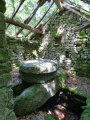
A very beautiful hike that takes you back to the source of the Vienne near the village of Servières and across the Chandouille on wooden bridges and granite stone bridges.
The Vienne and the Servières and Chammet lakes
12.24 mi
+1,050 ft
-1,047 ft
6h 30
Moderate
Departure from Tarnac (Corrèze)
A long walk to discover the hydroelectric schemes on the Vienne that led to the creation of the Servières and Chammet lakes. Tarnac, our starting point, is a beautiful village on the Plateau de Millevaches with a church, a fountain and a remarkable oak tree.
Escape to the Longeyroux bog on the Millevaches Plateau
8.36 mi
+381 ft
-404 ft
4h 10
Moderate
Departure from Chavanac (Corrèze)
Starting from the village of Chavanac, with its charming granite buildings, set off to explore a vast and peaceful natural site: the Longeyroux bog, where you can see and hear a multitude of things.
Between Corrèze and Haute-Vienne, starting from Tarnac
9.02 mi
+1,526 ft
-1,509 ft
5h 30
Moderate
Departure from Tarnac (Corrèze)
Hike on the Millevaches Plateau, through moors and forests. The route crosses streams and hamlets, allowing you to discover beautiful sites such as the cup-marked rocks of the Bois de Cholet, the Château de Mazeau and the castrum of Puy Murat. At the end of the hike, take the time to stroll around the pretty village of Tarnac, which has a remarkable church, fountain and Sully oak tree.
Pallier route
 Tourist office
 5.89 mi
+525 ft
-499 ft
3h 10
Moderate
Departure from Gentioux-Pigerolles (Creuse)
5.89 mi
+525 ft
-499 ft
3h 10
Moderate
Departure from Gentioux-Pigerolles (Creuse)
At the foot of the highest peaks of the Plateau de Millevaches, set off to discover the small village
of Pallier.
The Source of the Creuse
0.63 mi
+69 ft
-69 ft
0h 20
Easy
Departure from Le Mas-d'Artige (Creuse)
A pleasant walk along a well-maintained path through a wet meadow, then through the woods. The Source de la Creuse, which has not been specially developed, has retained its natural state. It is an interpretive trail with a few information boards.
Route du Lac de Faux
 3.97 mi
+102 ft
-102 ft
1h 55
Easy
Departure from Faux-la-Montagne (Creuse)
3.97 mi
+102 ft
-102 ft
1h 55
Easy
Departure from Faux-la-Montagne (Creuse)
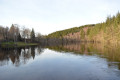
Faux-la-Montagne owes its name to its high altitude (over 700 metres above sea level) on the western edge of the Millevaches plateau. Around Lake Faux, beech and oak trees mingle with conifers, occupying what was still sheep pasture in the 19th century.
Montfranc Circular Loop
 4.41 mi
+285 ft
-305 ft
2h 15
Easy
Departure from La Nouaille (Creuse)
4.41 mi
+285 ft
-305 ft
2h 15
Easy
Departure from La Nouaille (Creuse)
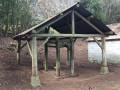
This lovely walk takes you to the southernmost village in the commune of La Nouaille (Creuse).Walkers will discover a ‘travail’ (a workshop used for shoeing cattle) that has been completely cleared. The walk alternates between passages through conifer plantations and beautiful open spaces. You can discover other walks in the commune of La Nouaille
Route de Toy Viam via Petit Paris
 7.31 mi
+623 ft
-646 ft
3h 55
Easy
Departure from Toy-Viam (Corrèze)
7.31 mi
+623 ft
-646 ft
3h 55
Easy
Departure from Toy-Viam (Corrèze)
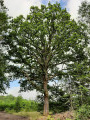
This easy route takes you along beautiful deciduous forest paths, which are magnificent in autumn, and past the lovely Étang de Condeau lake.
Longeyroux peat bog
 4.71 mi
+230 ft
-236 ft
2h 20
Easy
Departure from Meymac (Corrèze)
4.71 mi
+230 ft
-236 ft
2h 20
Easy
Departure from Meymac (Corrèze)
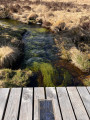
You will walk through the Longeyroux peat bog, where you will discover the sources of the Vézère river, in which you can take a dip. You can also follow a discovery trail through the peat bog with educational information boards.
Gallo-Roman site at Les Cars and the surrounding area
10.70 mi
+853 ft
-853 ft
5h 40
Moderate
Departure from Pérols-sur-Vézère (Corrèze)
As well as the beautiful Gallo-Roman site of Les Cars, this walk through a varied landscape of moorland and woodland takes in the small built heritage of the hamlets (crosses, wells, bridges) and the beautiful thatched cottage village of Variégas.
The mills of Razel
5.49 mi
+420 ft
-407 ft
2h 55
Easy
Departure from Pérols-sur-Vézère (Corrèze)
A varied landscape of moorland, forest and pasture, this walk takes in the beautiful site of the Razel mills on the Ruisseau de Pérols.
The Bois de Chaleix in Bugeat
 3.56 mi
+249 ft
-249 ft
1h 50
Easy
Departure from Bugeat (Corrèze)
3.56 mi
+249 ft
-249 ft
1h 50
Easy
Departure from Bugeat (Corrèze)
Actual time: 1 hour 45 minutes
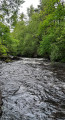
A short hike from Bugeat, along the Vézère river through the woods, very pleasant in summer as it is well shaded. You will discover the meanders of the Vézère along a narrow path right by the river. Not very practicable in winter as it is very wet.
The Vézère and the Bois de Chaleix
 5.28 mi
+404 ft
-417 ft
2h 45
Easy
Departure from Bugeat (Corrèze)
5.28 mi
+404 ft
-417 ft
2h 45
Easy
Departure from Bugeat (Corrèze)
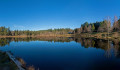
A walk taking you along the banks of the Vézère for around three kilometres. A pleasant stretch through the woodland. Also worth seeing is a ruined farmhouse with the date of construction, 1886, on its pediment. Best undertaken in dry weather, as some stream crossings can become muddy in wet weather and are impassable if the Vézère is in flood.
Nergout - Vassivière Dam
 11.57 mi
+666 ft
-735 ft
5h 55
11.57 mi
+666 ft
-735 ft
5h 55
 Difficult
Departure from Beaumont-du-Lac (Haute-Vienne)
Difficult
Departure from Beaumont-du-Lac (Haute-Vienne)
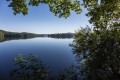
Nature and Land Art for this second stage, around the 5th largest artificial lake in France!
Tour of Lake Vaud-Gelade
 14.66 mi
+1,142 ft
-1,142 ft
7h 45
Difficult
Departure from Saint-Marc-à-Loubaud (Creuse)
14.66 mi
+1,142 ft
-1,142 ft
7h 45
Difficult
Departure from Saint-Marc-à-Loubaud (Creuse)
Located on the Millevaches plateau, Lac de la Vaud-Gelade is an artificial lake, created between 1940 and 1944, with a surface area of 300 hectares. It is fed by the Thaurion and several streams.
It is used for electricity production. Its earthen dam with a granulite foundation holds 21 million cubic metres of water, which feeds Lac de Vassivière, depending on its water needs, through a 4km-long underground tunnel.
The unmissable little Roman bridge at Senoueix
 10.73 mi
+512 ft
-515 ft
5h 25
Moderate
Departure from Saint-Marc-à-Loubaud (Creuse)
10.73 mi
+512 ft
-515 ft
5h 25
Moderate
Departure from Saint-Marc-à-Loubaud (Creuse)
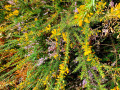
This tiny Roman bridge features on every postcard of the Creuse’s remarkable sites! The circular route therefore takes you there after a detour via Lake Lavaud Gelade, then back through meadows and young woodland. Although the walk begins with a short stretch of road (with little traffic), it then mainly follows paths and tracks lined with heather in bloom in autumn.
Circular route via the Puy de la Croix and Royère
8.17 mi
+663 ft
-653 ft
4h 20
Moderate
Departure from Royère-de-Vassivière (Creuse)
A walk starting from Lake Vassivière offering a variety of landscapes: the lake shore, heathland with heather or ferns, mixed woodland, pastures with Limousin cattle, peat bogs, and numerous ponds.
Le Puy de la Croix
1.39 mi
+194 ft
-194 ft
0h 50
Easy
Departure from Royère-de-Vassivière (Creuse)
A pleasant walk on the Puy de la Croix, which overlooks Lake Vassivière, along beautiful paths through heathland covered in heather and gorse (which flower in late summer), passing by the Puy de la Croix viewpoint and then along the lake’s shore.
The Chassagnas Peninsula on Lake Vassivière
 4.49 mi
+364 ft
-371 ft
2h 25
Easy
Departure from Royère-de-Vassivière (Creuse)
4.49 mi
+364 ft
-371 ft
2h 25
Easy
Departure from Royère-de-Vassivière (Creuse)
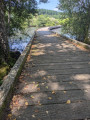
Chassagnas, of Latin origin, Cassania or Gallic Cassanus, refers to the oak tree. Chassagnas consists of a wooded slope down to the edge of Lake Vassivière and a partially cleared summit offering a 180° view of the lake.The Chassagnas peninsula, jutting out into the heart of Lake Vassivière, forms the boundary between Creuse and Haute-Vienne. Together with its twin, the Puy du Rocher, which overlooks Vauveix, it acts as a barrier between the lake's two main bays.
Masgrangeas Wood and Chassagnas Peninsula
7.97 mi
+761 ft
-781 ft
4h 20
Moderate
Departure from Royère-de-Vassivière (Creuse)
A walk on the Millevaches Plateau, mainly through woodland, passing through the pretty hamlet of Masgrangeas. After a circular route through the Bois de la Roche, the route continues with a circular route around the Chassagnas Peninsula, along Lake Vassivière, then a walk around the small Île de Vauveix.
Route des Tourbières - Vassivière
 8.83 mi
+837 ft
-843 ft
4h 45
Moderate
Departure from Royère-de-Vassivière (Creuse)
8.83 mi
+837 ft
-843 ft
4h 45
Moderate
Departure from Royère-de-Vassivière (Creuse)
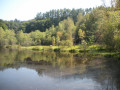
Peat bogs develop in granite basins called alveoli, where the acidic, poor soil provides favourable conditions for their growth. These fragile environments are home to a specific flora composed of very particular primitive plants: sphagnum mosses. The different stages are visible here: low marshes covered with quaking bogs, active raised bogs, and peat heaths bordered by willows and birches.
Route des 7 Peux
 7.98 mi
+538 ft
-538 ft
4h 10
Moderate
Departure from Royère-de-Vassivière (Creuse)
7.98 mi
+538 ft
-538 ft
4h 10
Moderate
Departure from Royère-de-Vassivière (Creuse)
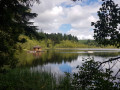
The village of Royère-de-Vassivière was established on a strategic pass on the Millevaches plateau, at the crossing point of a prehistoric ridge path. The ridge paths (or pouges) allowed people to travel long distances. They favoured the granite peaks of the rounded hills, called Puy or Peux, and avoided the damp, peaty valley bottoms that only cattle frequented.
The Thaurion Valley
 8.57 mi
+692 ft
-676 ft
4h 35
Moderate
Departure from Royère-de-Vassivière (Creuse)
8.57 mi
+692 ft
-676 ft
4h 35
Moderate
Departure from Royère-de-Vassivière (Creuse)
The Rigole du Diable is a picturesque site situated in the upper Thaurion valley. This site is a Natura 2000 site and is listed in the ZNIEFF inventory. The Rigole du Diable and its tributary are strewn with pebbles and boulders. Here you’ll find the unusual Rocher du Diable near the old Planchette mill. Legendary stones are common in Limousin. These strangely shaped boulders, formed by the erosion of exposed granite, have often captured the imagination of local people.