Country:

 City:
City:


When arriving in Saint-Merd-les-Oussines (a) from the west on the D164, park in the large car park on the right at the entrance to the village.
Please note! This hike is not marked as such.
(S/E) Return to the D164 and follow it to the right, towards the centre of the village. Ignore the street on the left that leads to the church. At the next intersection, turn right onto the road, following the red and yellow markings. Cross the Vézère river at the mill
(1) Ignore the road that branches off to the left and then, just after, at a cross, take the dirt track on the left, following the blue markings. Ignore the red and white marked path that branches off to the right and continue straight ahead on the path, which becomes grassy. You will come to a small road.
(2) Walk a few metres to the left to reach another road, the D109, at a cross. Follow this road to the right. It is intermittently lined with a beech hedge. Ignore the hamlet of La Tindelière on the right at a cross and continue.
(3) At a stream, turn left onto a road following the signs for "Corrèze à vélo route 5". The small road runs alongside meadows and moors and offers unobstructed views. You will come to an intersection with a path (the path on the left is marked by a sign for "Saint-Merd-les-Oussines par l'Étang du Diable"; the route takes this path on the way back).
(4) Follow the path to the right. Ignore a path to the left. Further on, another path joins from the left at a stone marker carved with heather and a red arrow: this is the Sentier des Bruyères trail, which you should follow unless otherwise indicated.
(5) Continue straight ahead on the path lined with beech trees to reach a road and follow it straight ahead to the Tourbière de Longeyroux visitor centre (b) and the trailhead (information boards).
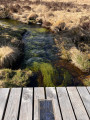
(6) Take the Sentier des Linaigrettes trail on the left, following the white signs (it is not possible to leave the boardwalk anyway). You will immediately come to an orientation table, then continue along the wooden walkway.
(6) At the end of the short circular loop of the Sentier des Linaigrettes, join the road and follow it to the left to continue on the Sentier des Bruyères, following the markings on the posts.
(7) Turn onto the first path on the left. At a fork, ignore the path on the right. The path leaves the forest and becomes grassy. Ignore a path on the left.
(8) Further on, at a marker, you will find a gate on the left. Go through it and follow the path to the Cent Pierres site, which gives the bog its nickname. Retrace your steps to rejoin the path at the gate.
(8) Continue to the left. Shortly afterwards, cross one of the many streams that form the source of the Vézère river. Ignore a path on the right. When you reach the end of the bog, turn left through a gate, then a second gate, and cross the "official" stream of the Vézère (c) on a footbridge. Further on, leave the path that goes straight up and turn left onto a trail that joins a small road further on.
(9) Follow it to the left, above the bog, until you reach the information panels about the heath islands and the Vézère (beautiful view of the bog).
(10) Leave the road and head back down the path on the left, following the signs for "Retour aire d'accueil" (Return to reception area). Further down, cross the Vézère again via a footbridge and continue along the grassy path until you reach the intersection with the path you took on the way there.
(5) Take the same route back, turning right.
(4) At the junction with the road, leave the outward route and head straight up towards Saint-Merd-les-Oussines via the Étang du Diable.
(11) Shortly after entering the pine forest, at theGR®® (red and white) and blue (which go straight ahead) markings, follow a narrow path to the left (and not the forest path that also goes to the left) for a return trip to the edge of the Étang du Diable.
(11) Back on the path, continue left, following theGR®® markings (follow these markings until you reach your destination). Further on, walk along a recently deforested area, with the path bordered on the right by a remarkable hedge of fir trees.
(12) Ignore a vague path straight ahead at a left-hand bend. The path leads to a road.
(13) Follow it to the left. Pass a cross dating from 1883, then walk alongside a property with a pond and thatched cottages. Ignore a road on the left and arrive shortly afterwards at the mill on the Vézère.
(1) Turn right to reach the village of Saint-Merd-les-Oussines. At the crossroads, go straight ahead, then turn left twice to reach the church (d) (outside tomb; inside, a knight's recumbent statue and swallows' nests!). Continue along the street and, just before you reach the D164, opposite the car park (S/E), turn right (towards the cemetery) for a short return trip to the Saint-Médard Fountain (a).

 Visorando Member
 Easy
Easy