


Refine your search for walks in La Fontenelle (Loir-et-Cher)
La Fontenelle (Loir-et-Cher) walks
 The Yerre Valley
 Tourism professional
 7.32 mi
 +33 ft
 -33 ft
 3h 25
3h 25
 Easy
Easy
 Departure from La Bazoche-Gouet (Eure-et-Loir)
A beautiful walk in the former fiefdom of the turbulent Gouet barons. Like Brou, La Bazoche continues a long tradition of fairs and markets. For over 100 years, the Percheron foal fair has been held on thefirst Saturday in November.
The Boisvinet Ponds
 Association / Club / Walk leader
 7.59 mi
+302 ft
-308 ft
3h 45
7.59 mi
+302 ft
-308 ft
3h 45
 Moderate
Departure from Le Plessis-Dorin (Loir-et-Cher)
Moderate
Departure from Le Plessis-Dorin (Loir-et-Cher)
This route takes you along quiet country lanes, paths through the bocage and forest trails, and will introduce you to the Étangs de Boisvinet. You will also pass the glassworks, which operated until 1952 and was the subject of a book by Daphne du Maurier, *The Glass Blowers*.
The châteaux around Lanneray
12.64 mi
+197 ft
-200 ft
6h 00
 Difficult
Departure from Lanneray (Eure-et-Loir)
Difficult
Departure from Lanneray (Eure-et-Loir)
Dating from different periods, the three châteaux of Lanneray mark your route through landscapes of woods, plains and valleys.
Walking trails in La Ville-aux-Clercs: Blue route
 Visorando Member
 6.00 mi
+69 ft
-69 ft
2h 50
Easy
Departure from La Ville-aux-Clercs (Loir-et-Cher)
6.00 mi
+69 ft
-69 ft
2h 50
Easy
Departure from La Ville-aux-Clercs (Loir-et-Cher)
Of the four walking routes on offer around La Ville-aux-Clercs, here is the Blue route.
Walking trails in La Ville-aux-Clercs: Red route
 6.49 mi
+164 ft
-141 ft
3h 05
Easy
Departure from La Ville-aux-Clercs (Loir-et-Cher)
6.49 mi
+164 ft
-141 ft
3h 05
Easy
Departure from La Ville-aux-Clercs (Loir-et-Cher)
La Ville-aux-Clercs offers four walking routes that are also suitable for mountain bikes: here is the Red route in the heart of the Perche Vendômois region.
La Ville-aux-Clercs walking trails: Yellow route
 9.65 mi
+135 ft
-151 ft
4h 35
Moderate
Departure from La Ville-aux-Clercs (Loir-et-Cher)
9.65 mi
+135 ft
-151 ft
4h 35
Moderate
Departure from La Ville-aux-Clercs (Loir-et-Cher)
La Ville-aux-Clercs offers four walking routes that are also suitable for mountain biking. This is the longest one, passing by the Étangs du Milieu and the Étangs du Souci. (Geocaching on this route).
Between Beauce and Perche from Cloyes-sur-le-Loir
 12.10 mi
+381 ft
-377 ft
5h 55
Difficult
Departure from Cloyes-sur-le-Loir (Eure-et-Loir)
12.10 mi
+381 ft
-377 ft
5h 55
Difficult
Departure from Cloyes-sur-le-Loir (Eure-et-Loir)
Located between Beauce and Perche, at the crossroads of the Loir Valley and the Route du Blé, Cloyes-sur-le-Loir is a sleeping beauty on the banks of the Loir. This pretty town combines modernity and heritage. The hike takes you through the countryside with its valleys, forests and rolling hills, which are sure to charm you.
The Yerre Valley
11.03 mi
+262 ft
-262 ft
5h 20
Moderate
Departure from Saint-Hilaire-sur-Yerre (Eure-et-Loir)
The Yerre river approaches, accompanied by scents and sounds that it seems to have carried from the depths of the forest, before flowing along the edge of the Perche region and joining the Loir river above Cloyes.
Montmirail Castle and its countryside
 6.17 mi
+295 ft
-312 ft
3h 05
Easy
Departure from Montmirail (Sarthe) (Sarthe)
6.17 mi
+295 ft
-312 ft
3h 05
Easy
Departure from Montmirail (Sarthe) (Sarthe)
This hike allows you to discover Montmirail, a "small town of character", and its green countryside through woods and sunken paths.
 Les Terres Douces
14.13 mi
+433 ft
-410 ft
3 hrs
Moderate
Departure from Authon-du-Perche (Eure-et-Loir)
The "Terres Douces" countryside reveals a heritage full of charm: the former Priory of Les Châtaigniers and the Manoir de la Guillerie.
The Woods of Roussigny
 11.28 mi
+758 ft
-751 ft
5h 50
Moderate
Departure from Saint-Ulphace (Sarthe)
11.28 mi
+758 ft
-751 ft
5h 50
Moderate
Departure from Saint-Ulphace (Sarthe)
Like the neighbouring village of Gréez, the medieval development of Saint-Ulphace is linked to the settlement, between the Braye and the Saint-Ulphace stream, of a hermit monk in the6th century. The Hermitage of Saint-Ulphace led to the clearing of the surrounding land and the settlement of Christianised populations, followed by the establishment of the parish, first mentioned in 802.
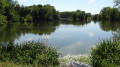
The Étang Saint-Lubin and the Loir Valley as seen from Saint-Hilaire-la-Gravelle
 8.57 mi
+381 ft
-361 ft
4h 15
Moderate
Departure from Saint-Hilaire-la-Gravelle (Loir-et-Cher)
8.57 mi
+381 ft
-361 ft
4h 15
Moderate
Departure from Saint-Hilaire-la-Gravelle (Loir-et-Cher)
In the Haut-Vendômois region, this route runs alongside the Loir valley, then winds its way through the shade of the banks of the Étang Saint-Lubin, takes a detour to the ruins of the feudal castle of Fréteval, before venturing through the fields, across a rolling landscape, to reach the pretty village of Saint-Hilaire-la-Gravelle.
Circular walk starting from Rahart
 6.94 mi
+108 ft
-128 ft
3h 15
Moderate
Departure from Rahart (Loir-et-Cher)
6.94 mi
+108 ft
-128 ft
3h 15
Moderate
Departure from Rahart (Loir-et-Cher)
A lovely walk with plenty of sections through the woods.
Hiking is all about having ‘fun’, and even if it’s ‘customary’ to pass through the ‘desert’, don’t worry – you’ll always make it to the church.
The Étang des Panses
 7.73 mi
+299 ft
-272 ft
3h 50
Moderate
Departure from Beaumont-les-Autels (Eure-et-Loir)
7.73 mi
+299 ft
-272 ft
3h 50
Moderate
Departure from Beaumont-les-Autels (Eure-et-Loir)
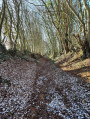
The Étang des Panses lake can be seen along a path where it is not uncommon to encounter forest animals. After the forest, you will discover Percheron fruit trees at the Miermaigne conservation orchard; in mid-November, you can take part in the Apple Festival.