Country:

 City:
City:


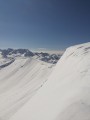
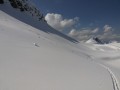
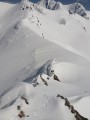
In winter, the start is from the small car park at Col de Tramassel (or Buraü), near the start of the ski lift. This is the car park immediately below the astronomical observatory car park.
In summer, it is better to take the short track leading to the Col du Moutala car park to start the hike straight away in the heart of the countryside.
(S/E) Col de Tramassel. Take the track to the Moutala car park.
(1) At the end of the Moutala car park, take the route skirting the Pic de Naüit (Naouit) to the south and stay on the contour line initially.
(2) At the fork, begin the ascent towards the Col du Clot du Serpent. Do not go down, otherwise you will end up at Lac de Layous or Lac d’Isaby. Up to this point, the climb is gentle and uneventful.
(3) Then follow a path roughly parallel to the ridge, keeping the ridge on your right, to reach a small, unnamed pass. This pass, which is sometimes incorrectly referred to as the Collet du Clot du Serpent, is the junction with the standard summer path (below it there is a drinking trough and a water source consisting of two old bathtubs).
(4) As you can no longer follow the ridge because it is rocky, continue the ascent slightly to its right. This is the trickiest section.
NB: The slope is quite steep and the angle is very unfavourable for snowshoes. Skiers fare better. (I even took off my snowshoes for the final third of the route to prevent my right snowshoe from slipping on the slope. It should be noted that I was the first snowshoer to pass, just behind three skiers. I saw snowshoers giving up on this climb.)''
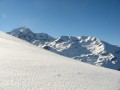
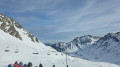
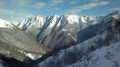
(5) We reach an unnamed small pass, just south of Pic de Barran. The view is already very impressive. You can make out all the routes to the lakes (Ourrec, Bassias, Bleu, Vert, etc.), the peaks between 2,400 and 2,600 metres, and the magnificent Grande Estiberre cirque.
A few dozen metres higher up, we reach the summit of Pic de Barran and its tall cairn, which can be seen from a great distance.
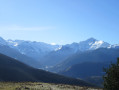
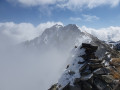
(6) From here on, the entire ascent continues along the ridge. To the right, a multitude of peaks stretch as far as the “Giant of Bigorre”, the Pic du Midi de Bigorre (2,876 m), and the start of the Lesponne valley. To the left, the northern ridges of the Hautacam, the Piémont, the Pibeste-Aühlet nature reserve massif, stretching as far as Lourdes and Tarbes. In sight is the Pic du Montaigu (2,339m), accessible by foot only in summer. Depending on the situation, we either climb or descend.
(7) We cross the 2,000m mark at the Pic du Mont, then descend to the Col de Barran at 1,934m.
(8) From this pass, the ascent is steady and gradual without being overly tiring.
We then reach an unnamed pass at 2,045m facing the Pènes de Barran and the Col des Rosques (2,018m).
(9) For me, the hike ends here, as to continue one must cross a 20-metre drop, which I consider too steep and therefore too dangerous in snowshoes and without a safety line.
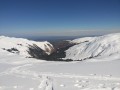
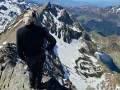
From here, the 360° view is already magnificent. The Montaigu still seems quite far away. The Pic du Midi de Bigorre watches over all this immaculate whiteness. It is in this peaceful solitude that I have a bite to eat, at the top of a small gap, sheltered from the wind, facing the inaccessible ridge...
NB: it is through this gap that the route continues in summer.
The return is via the same route to the Col de Barran.
(8) Afterwards, I don’t take the easy route, preferring instead to head for the Clot du Serpent, which I had overlooked on the way up.
(10) In winter, the descent continues down to the 1760m mark, done by eye and instinct, avoiding slopes that are too steep (due to the slope angle) and gaps in the terrain (due to the risk of faults or hidden torrents).
NB: If you follow my GPS track, you shouldn’t have too much trouble, as the summer trail markings are invisible and the route I deliberately abandon at 1,820m allows me to avoid sections I consider too dangerous on snowshoes.
In summer, it is best to follow the path, which is clearly marked on the map.
At the bottom of the Clot du Serpent, I cannot take the route that follows the path skirting the Pic de Naüit to the north. It is heavily snow-covered, and there are exposed rock outcrops and unsecured ridges.
I prefer to head back up near the Col du Clot du Serpent, more easily bypassing the unnamed pass at 1,707m and rejoining the fork passed on the way out.
(2) Then, follow the same route as on the way up to reach the car parks (1) or (S/E).


 Thanks, Marc

 Visorando Member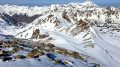
 Difficult
 Moderate