Pic de Pène Blanque via Lac and Col d'Oncet from Super-Barèges

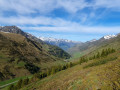
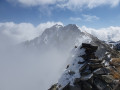
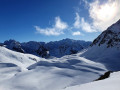
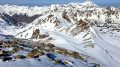
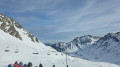
This little-visited peak is the last in a series of four along the ridge from Lac Bleu du Chiroulet to the Pic du Midi de Bigorre (2,876 m). Somewhat technical in winter conditions or at the end of the winter season, it offers a fairly easy and very enjoyable final ridge. From the summit, there is an exceptional 360° view stretching from the nearby Pic du Midi Observatory to the border range and the 3,000-metre peaks of Gavarnie. You can choose to stop at the Col d’Oncet if the ascent of Pène Blanque seems too difficult.

Details

33674435
Creation:
Last update:
Last review:
  • Snowshoeing
    Activity: Snowshoeing
  • ↔
    Distance: 5.39 mi
  • ◔
    Duration according to the author: 8 hrs 
  • ▲
    Difficulty: Difficult

  • ⚐
    Back to start: Yes
  • ↗
    Ascent: + 3,547 ft
  • ↘
    Descent: - 3,543 ft

  • ▲
    Highest point: 8,894 ft
  • ▼
    Lowest point: 5,348 ft

Photos

Description of the walk

Head towards the Bastan Valley via Luz-Saint-Sauveur. Pass through the village of Barèges and continue for 3 km on the D918. Reach the car park at the Tournaboup ski resort. If the D918 is open beyond this point, continue uphill towards the Col du Tourmalet. The road runs alongside a ski run called "Bastan".
Drive as high as possible to the 1,629 m mark (at the final S-bend before Super-Barèges).
Park at the side of the road if the area is snow-covered, or on a flat area to the left as you climb (start of the Cabane d'Ourdégon trail).

(S/E) Depending on where you park, if at the Tournaboup car park, take the Bastan track in the opposite direction, or if at the 1,629 m mark on the D918 (as on this route), join theGR®®10Cheading east, on the left-hand side of the road.

(1) At around 1,800 m, leave theGR®®10Cand head left (north-east) towards the Plat de Monhaillat and Montaquéou. Cross the Altisurface and continue climbing in a north-easterly direction. Cross theGR®®10Cat around 1,965 m and continue north to quickly rejoin theGR®®10C.

(2) Then take theGR®®10Cto the right. Head up the Vallon d’Oncet heading north-north-east.

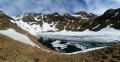
(3) Leave theGR®®10Cby veering left off the path. Cross the Ruisseau d'Oncet and pass a small lake on your left. Then turn left, leaving the Lac d'Oncet on your right. Climb the ridge heading west-north-west. Pass directly below the Pic d'Oncet and reach the pass of the same name.
NB: from this WP(3) to WP(6) you are in high mountain terrain with no path or markings.

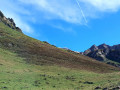
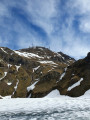
(4) Then climb north-northeast across the scree (potential snowfields in spring). This will take you to the ridge and then to the summit of Pène Blanque occidental.

(5) Descend to the Col d’Oncet via the same route as the ascent.

(4) Then head into a cirque on the right. Descend this towards the south-west and, as soon as possible, veer left (south) to reach Lac d’Aouda.

(6) Follow the Tourmalet path southwards to Lac Bleu du Chiroulet. Descend the Vallon d’Aoube.

(7) At around 2,040 m, when the path turns left, leave it and turn right towards the Cabanes d'Aoube, which are clearly visible with their enclosures (cuyalas).

(8) Leave the Cabanes d'Aoube on your right and take the path that winds down (south) in hairpin bends to the stream. Join theGR®®10Cand follow it to the right. After about 150 m, turn left onto the path that runs alongside the stream bed and you will soon reach the car park (S/E).


Waypoints

  1. S/E : mi 0 - alt. 5,348 ft
  2. 1 : mi 0.49 - alt. 5,892 ft - Abandonment of the GR°°®°°10C
  3. 2 : mi 1 - alt. 6,667 ft - GR10C junction
  4. 3 : mi 1.96 - alt. 7,329 ft - Laquet du déversoir d'Oncet - Lac d'Oncet (2254 m)
  5. 4 : mi 2.77 - alt. 8,428 ft - Col d'Oncet (2,544 m)
  6. 5 : mi 2.93 - alt. 8,894 ft - Pène Blanque (2,743m)
  7. 6 : mi 3.61 - alt. 7,287 ft - Lake Aouda
  8. 7 : mi 4.3 - alt. 6,686 ft - Junction
  9. 8 : mi 4.8 - alt. 6,070 ft - Aoube huts
  10. S/E : mi 5.39 - alt. 5,351 ft

Notes

This description covers a hike undertaken by two people in early May 2023, with very little snow (equivalent to late June).
After Lac d’Oncet (3), there are no tracks, no paths and no markings visible! Most of the route will follow the description accompanied by a GPS track, or even the tracks left by previous skiers or snowshoers.
In winter, only attempt this route if you are fully proficient in snowshoeing or ski touring, and in the use of crampons and an ice axe.

Parking at the start
There is no proper car park, but there are spaces along the D918 road; parking is fully tolerated by the police and local authorities.

Estimated time
I completed this route in 7 hours 45 minutes, including breaks and a picnic (3 hours), setting off from the car park at 8.45 am. This is an average time. Allow between 6 hours 30 minutes and 9 hours.

Difficulty
Classified as a Difficult hike, due to the significant elevation gain, the presence of very steep sections between (3) and (5), the lack of signposting, and high-mountain conditions. It is a challenging route, reserved for experienced mountaineers, but anyone can stop along the way.
In summer, the rating is Moderate (but there are no markings between (3) and (6)).
The IBP Index is 130 HKG (with or without snow), which corresponds to a Difficult route for a hiker with a high level of physical fitness.
The classification of the entire hike according to the Swiss Alpine Club’s guidelines is T6: Difficult alpine hike.
The mountaineering grade for the ridge is F: Easy (no harness or ropes required), although exposed.

Water sources
There are no drinking water sources along the route.
- In winter when there is snow, streams can be used as water sources without too much danger. However, allow for 1 litre of cold water per person and 1 litre of hot water in a thermos flask per person.
- In summer, springs, lakes, rivers or runoff water are not guaranteed to be safe to drink. Allow 1.5 litres per person.

Shelters
There are no huts or mountain refuges open along the route; the only shelters are at the start and finish.

Equipment
- In summer, bring standard high-mountain hiking gear: hiking boots, suitable clothing, rainwear, water, food, a survival blanket, a knife, a compass, a map and a whistle.
- In winter when there is snow, you must also bring snowshoes or touring skis, a pair of poles, gaiters, sun cream, lip balm, a GPS or the Visorando app on your smartphone, gloves, suitable warm clothing, a flask with a hot drink, a hat, and sunglasses suitable for glare on the snow. Some will also add an avalanche transceiver (AV), a shovel and a probe. Crampons and an ice axe are essential accessories on this route.

Visitor numbers
- In winter when there is snow, Lac d’Oncet is moderately busy, mainly with ski tourers rather than snowshoers. However, the ascent to Col d’Oncet is considered perilous in this direction and is very rarely used. The ascent to Pène Blanque is rarely undertaken.
- In summer, the route is fairly busy up to the pass, less so up to Pène Blanque.
Whatever the season, don’t forget to tell your friends and family your exact route and let them know of any changes by text or phone.

Snowshoes + poles or crampons + poles or crampons + ice axe
In the depths of winter in the morning, it may be easier to use crampons than snowshoes or skis. Indeed, walking in crampons is almost identical to walking in boots, with the added advantage of safely navigating small flat sections or icy slopes, and especially narrow, overhanging sections of hard or icy snow.
When putting on crampons on flat ground or gentle slopes, you keep your poles. As soon as the gradient exceeds 15 to 20%, the snowshoes and poles are stowed away and securely fastened to the rucksack, and you use the ice axe. Using an ice axe requires a good level of skill, particularly in the event of a fall or when descending.

Check the weather forecast, particularly the snow and avalanche report from Météo-France for the Haute-Bigorre massif in the Hautes-Pyrénées.

Avalanche risk areas
The area is not known for avalanches on this route, but the western and eastern slopes of the Col d’Oncet are more prone to them than others.

If you notice any errors in the route markings or place names on your route or on the map you are using, you can become a contributor and report them:
- marking errors, safety issues, conflicts of use, environment: click here.
- mapping errors, place names: click here.

Worth a visit

Place names
Source: La mule et l'intello blog. Many thanks to him!
Translations with the help of Pierre Salles, an excellent columnist on France-Bleu Béarn.
Barèges: Barètge The little (?) valley. Etymology (Latin) is rather disputed, but seems nevertheless unavoidable. The root comes from the Latin ‘vallem’ and the suffix most likely comes from the Latin ‘-eticam’,…perhaps a diminutive (?)
“Barège” (actually “Varètge”) is the name of the valley. The commune bearing this name only came into being in the 20th century: at the instigation of Urbain Cazaux, a member of the valley’s General Council and president of the French Ski Federation, the entire eastern section of the land previously belonging to the commune of Betpouey was separated from it to create the new commune.
The place had already been given this name due to the great renown of its thermal baths (cf. their imperial clientele): it was originally referred to as ‘the baths of (the valley of) Barège’, then (in Paris!) this was shortened to ‘Barèges’ to refer, in fact, solely to these thermal baths. This name has stuck.

Variants
At the Col d'Oncet, you can easily continue south towards the Pic d'Oncet (2,607 m, a gentle climb of just 63 m).

Always be cautious and plan ahead when you're outdoors. Visorando and the author of this route cannot be held responsible for any accidents occurring on this route.

The GR® and PR® markings are the intellectual property of the Fédération Française de Randonnée Pédestre.

Reviews and comments

1.3 / 5
Based on 1 review

Reliability of the description
1 / 5
Ease of following the route
1 / 5
Route interest
2 / 5
MCTOUL
MCTOUL

Hello Guy,
I’ve simply copied what you wrote:
"Date of the hike: Monday 18 September 2023"
"...path at the bottom of Lac Bleu..."
OK, it’s true there are plenty of rocks in the mountains.

My comments in my guidebook are sufficiently clear about the difficulty of the route.
Your comments and ratings add an air of extreme danger, which risks misleading hikers; I do not share your point of view.

Kind regards

Machine-translated

Guy.C
Guy.C
• Edited:

Hello Marc,
I did this route on Sunday 17 September, not the 18th as you assume.
I’ve been hiking in the mountains for 20 years, so I think I know a thing or two about them. What’s more, in September there’s no snow to follow the tracks, as you so aptly put it, because I’m not just a casual hiker – I do high-altitude mountaineering.
I didn’t go to the Blue Lake; I joined the Blue Lake trail at the bottom of the Col d’Oncet (see GPS track).
I simply wanted to point out how dangerous this route is. I do a lot of hiking with Visorando and have never had any problems; I’m very happy with your routes, but I’m very disappointed with this one – that’s all.
Kind regards:
GUY

Machine-translated

MCTOUL
MCTOUL
• Edited:

Hello Guy.C,
I am truly sorry that you did not enjoy the route...
But you did see in the description:
- "Difficult level"
- "The IBP index is 130 HKG (with or without snow), which corresponds to a Difficult route for a hiker with a high level of physical fitness.
The classification of the entire hike according to the Swiss Alpine Club’s guidelines is T6: Difficult alpine hike.
The mountaineering grade for the ridge is F: Easy (no harness or ropes required), although exposed."
- And "After Lac d'Oncet (3), no track, no path, and no markings are visible! Most of the route will follow the route description accompanied by a GPS track, or even the tracks of previous skiers or snowshoers."

It seemed to me that these warnings were enough to put off a casual walker and alert the senses of a seasoned mountaineer. So there are no surprises—we are well and truly in the high mountains!

Furthermore:
- the ascent is not “very dangerous on the scree”,
- the route does not lead to Lac Bleu as you suggest,
- if you didn’t meet anyone on Monday 18 September, that’s quite normal; it was a weekday and outside the school term; ultimately, one could say that, for a mountaineer, you were lucky to be alone in these magnificent landscapes!

Did you climb to the summit of Pène Blanque?

Kind regards

Machine-translated

Guy.C
Guy.C

Overall rating : 1.3 / 5

Date of your route : Sep 18, 2023
Reliability of the description : ★☆☆☆☆ Very disappointing
Ease of following the route : ★☆☆☆☆ Very disappointing
Route interest : ★★☆☆☆ Disappointing
Very busy route : No

Hello,
I’ve just completed the Pic de Péne Blanque hike via the lake and Col d’Oncet.
From the lake to the Col d’Oncet, there is no path and no signposting; the climb up through the scree is very dangerous and not recommended. The descent is the same, through the grass with no path – you’ll need to rely on GPS all the way to the path at the bottom of Lac Bleu.
I didn’t meet anyone, and I can see why. I would advise all hikers against this circular route for their own safety.

Machine-translated

Other walks in the area

For more walks, use our search engine .

The GPS track and description are the property of this route's author. Please do not copy them without permission.