Pic Crémat via the Col d'Aoube, a circular route from Super-Barèges

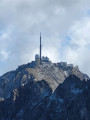
This little-visited peak is part of a series of four peaks along the stunning and challenging ridge stretching from Lac Bleu de Lesponne (2,021 m) to Pic du Midi de Bigorre (2,876 m). The pass is somewhat technical in winter conditions or at the end of the winter season, but it nevertheless provides fairly easy access to the peak itself. From the top, there is an exceptional 360° view, stretching from the nearby Pic du Midi Observatory to the border range and the 3,000-metre peaks of Gavarnie.
The circular route through the superb, secluded hanging valley of Aoube to Lac Bleu, via the Col Bédéra (2,404 m), adds a wild, untamed flavour to this ascent.

Details

41534310
Creation:
Last update:
Last review:
  • Snowshoeing
    Activity: Snowshoeing
  • ↔
    Distance: 8.57 km
  • ◔
    Duration according to the author: 8 hrs 
  • ▲
    Difficulty: Very difficult

  • ⚐
    Back to start: Yes
  • ↗
    Ascent: + 1,154 m
  • ↘
    Descent: - 1,148 m

  • ▲
    Highest point: 2,608 m
  • ▼
    Lowest point: 1,627 m

Photos

Description of the walk

Head towards the Bastan Valley via Luz-Saint-Sauveur. Pass the village of Barèges and continue for 3 km on the RD 918. Reach the car park at the Tournaboup winter sports resort. If the RD 918 is open beyond this point, continue uphill towards the Col du Tourmalet. The road runs alongside a ski run called "Bastan". Drive as far up as possible to the last hairpin bend before Super Barèges (Cabanes de Stouets).
Wherever the road is blocked (which varies depending on the season and snow conditions), park on the hard shoulder. Continue along the road and put on your snowshoes (or skis) as soon as possible.
On this route, the start is from the small car park at the final hairpin bend, at an altitude of 1,629 m.

(S/E) Depending on where you park: if at the Tournaboup car park, take the Bastan track in reverse; or if on the hard shoulder of the RD 918 (as on this route), take theGR®®10C which branches off to the left of the road, or follow the RD 918 (closed to traffic), or if parked at the final hairpin bend at 1,629 m, cut across the lower part of the Plat de Monhaillat and Montaquéou to join theGR®®10.

(1) Almost in the thalweg of the Ruisseau d'Aoube, climb the slope on the left bank (the right bank is also passable). Pass by the Cabanes d'Aoube, on the plateau of the same name. Climb due north at the bottom of the Vallon de l'Aouda, keeping the Bonida mountain well to your right

(2) Pass the western valley of the Col d'Oncet on your right and continue north-west towards the Col d'Aoube.
The ascent to the pass follows the northern side of the valley, via a series of tight hairpin bends. Reach the Col d'Aoube (2,369 m).

(3) Head north-west initially to avoid the first rocky outcrop below the pass, then climb in switchbacks towards the summit, clearly visible on the right. The final part of the ascent follows the ridge line between the pass and the summit.

(4) Leave the pass heading south-south-west, then follow the top of a rocky massif to head westwards.

(5) Once past the rocky outcrops, head south-west, then south, to reach the bottom of the valley and rejoin the Tourmalet-Lac Bleu summer path.

(6) Follow this path, hidden beneath the snow, westwards, until you reach the entrance to the Col de Bédéra valley, at an elevation of 2,236 m.

(7) Enter the valley, climbing up the right-hand bank. Join the summer path leading to the Col de la Bédéra.
Reach the Col de la Bédéra (2,404 m).

(8) The descent from the south-facing pass can be tricky depending on snow conditions. The cornice faces south. There are often ‘whale’s mouths’ beneath the cornice. The most obvious route is generally to the east of the pass. Head down towards Lac de la Lahude, hidden behind a small promontory, which you go round to the west via its spillway, partially or completely covered by snow. Head south-west into the Ruisseau de la Mousquère ravine, a narrow corridor of boulders and deep snow. Reach a flat area where you must leave the ravine (the rest of the ravine is very difficult to traverse).

(9) Head towards the Cabanes du Plateau d'Aoube to the south-east. Cross through the middle of the huts. Find a rounded ridge with a few shrubs, junipers and mountain pines, which leads down to the car park (S/E).


Waypoints

  1. S/E : km 0 - alt. 1,627 m - D918 road – Hairpin bend. Near the - Bastan (cours d'eau) - Affluent du Gave de Gavarnie
  2. 1 : km 0.5 - alt. 1,729 m - Crossing the GR10
  3. 2 : km 3.04 - alt. 2,225 m - Turn-off towards Col d'Oncet - Lac d'Aouda
  4. 3 : km 3.59 - alt. 2,364 m - Col d'Aoube (2369m)
  5. 4 : km 4.11 - alt. 2,608 m - Pic Crémat (2630m)
  6. 5 : km 4.38 - alt. 2,500 m - End of rocky outcrop
  7. 6 : km 4.78 - alt. 2,320 m - Junction with the Tourmalet-Lac Bleu summer trail
  8. 7 : km 5.11 - alt. 2,241 m - Entrance to the Col de Bédéra valley
  9. 8 : km 5.97 - alt. 2,367 m - Col de Bédéra (2404m)
  10. 9 : km 7.32 - alt. 1,944 m - Flat section
  11. S/E : km 8.57 - alt. 1,627 m - Road D918 - Hairpin bend

Notes

This description covers a hike undertaken by a group of three in mid-April 2023, with fairly light snow cover. The starting altitude was 2,200 m, in La Bonida.
However, from 1,900 m onwards, no path or markings are visible! Most of the route will follow the description accompanied by a GPS track, or even the tracks left by previous skiers or snowshoers.
In winter, only attempt this route if you are fully proficient in snowshoeing or ski touring.

Parking at the start
You can use the Lacet car park at 1,629 m, provided it is not covered in snow; otherwise, there is no proper car park, but there are spaces along the RD918 road; parking is fully tolerated by the police and the departmental roads department.

Estimated time
I completed this route in 8 hours, including breaks and a picnic, setting off from the car park at 8 am. This is an average time. Allow between 7 and 9 hours.

Difficulty

  • Hike classified as Very Difficult (Visorando rating), due to the significant elevation gain, the presence of very steep sections between (2) and (4) and before and after (8), the lack of signposting, and high-mountain conditions. This is a challenging route, reserved for experienced mountaineers, but it can be shortened (except after (7)). In summer, the rating is Difficult.
  • The IBP Index is 139 HKG (with or without snow), which corresponds to a route of Medium difficulty for a hiker with a high level of physical fitness (excluding snow conditions).
  • The classification of the entire hike according to the Swiss Alpine Club’s guidelines is T5: Demanding alpine hike.
  • The classification of the entire hike according to the CampToCamp guidelines is R4: Alpine snowshoe hike on steep slopes.

Water sources
There are no drinking water sources along the route.
- In winter when there is snow, streams can be used as water sources without too much risk. However, allow for 1 litre of cold water per person and 1 litre of hot water in a thermos flask per person.
- In summer, springs, lakes, rivers or runoff water are not guaranteed to be safe to drink. Allow 1.5 litres per person.

Shelter
There are no open huts or refuges along the route; the only shelters are at the start and finish.

Equipment
- In winter when there is snow, you must also bring snowshoes or touring skis, a pair of poles, gaiters, sun cream, lip balm, a GPS or the Visorando app on your smartphone, gloves, suitable warm clothing, a flask with a hot drink, a hat, and sunglasses suitable for glare on snow. Some may also wish to bring an avalanche transceiver (AV), a shovel and a probe.
- In summer, bring standard high-mountain hiking kit: hiking boots, suitable clothing, rainwear, water, food, a survival blanket, a knife, a compass, a map and a whistle.

Traffic
- In winter when there is snow, the entire route is little or very little used from Lac d’Aouda onwards, mainly by ski tourers rather than snowshoers. The ascent to Pène Blanque is rarely undertaken.
- In summer, the route is fairly busy up to the lake, less so up to the Col d’Aoube.

Whatever the season, don’t forget to tell your friends and family your exact route and let them know of any changes by text or phone.

Check the weather forecast, particularly the snow and avalanche report from Météo-France for the Haute-Bigorre massif in the Hautes-Pyrénées.

Avalanche risk areas__
This route is not known for avalanche risk.__

If, on your route or on the map you are using, you notice any errors in signposting or place names, you can become a contributor and report them:
- marking errors, safety issues, conflicts of use, environment: click here.
- mapping errors, place names: click here.

Worth a visit

(3) Col d'Aoube
There is usually a snow cornice on the pass.
As the pass runs east-west, the overhanging cornice is always on the eastern side of the pass.
You therefore arrive beneath the side sheltered from the wind by the cornice, which can be several metres thick.
A few dozen metres from the pass, visually select the best route of access, generally from the north where the rock allows you to avoid wind-blown slabs and ‘whale’s mouths’ beneath the cornice.
If access to the rock is impossible, you must visually assess whether the cornice is only slightly overhanging, whether there is little wind, and whether anyone is on the cornice.
But sometimes, if one or more hikers ahead have not already created a gap or a passageway through the cornice, you can get out your shovel and clear a safe passage yourself.

(3) to (4) Ascent to Pic Crémat from Col d'Aoube
Some guidebooks mention a direct north-facing ascent from the Col d'Aoube, or a north-westerly traverse from the Col d'Aoube, to find a south-west-facing gully and continue for a long way, practically up to the ridge. The latter option appears to require traversing a very steep slope (40°?). This route is a hybrid option, entirely dependent on the snow conditions on the day.

(4) At Pic Crémat
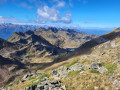
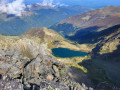
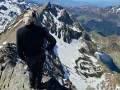
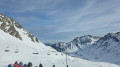
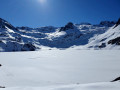
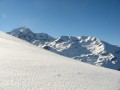
Magnificent views in all directions: the Pic du Midi Observatory to the east, the frozen Lac Bleu to the west, the peaks of the Néouvielle in the distance to the south, and the extraordinary view down to Lac de Peyralade to the north (700 metres below!) and the entire Bassin du Ruisseau du Brouilh.

Place names
Source: La mule et l'intello blog. Many thanks to him!
Translations with the help of Pierre Salles, an excellent commentator on France-Bleu Béarn.
Barèges: Barètge The small (?) valley. Etymology (Latin) is somewhat disputed, but seems nevertheless unavoidable. The root comes from the Latin ‘vallem’ and the suffix most likely from the Latin ‘-eticam’,…perhaps a diminutive (?)
‘Barège’ (actually ‘Varètge’) is the name of the valley. The commune bearing this name only came into being in the 20th century: under the impetus of Urbain Cazaux, general councillor for the valley and president of the French Ski Federation, the entire eastern section of the land previously belonging to the commune of Betpouey was separated from it to create the new commune.
The place had already been given this name due to the great renown of its thermal baths (cf. their imperial clientele): originally, people spoke of ‘the baths of (the valley of) Barège’, then (in Paris!) this was shortened to ‘Barèges’ to refer, in effect, solely to these thermal baths. This name has stuck.

Variants
Variant 1
You can take the Col des Pêcheurs instead of the Col de Bédéra, which is reputed to be gentler but longer. Allow an extra hour.

Variation 2
After Pic Crémat, you can return via the same route as on the way out.

Always be cautious and plan ahead when you're outdoors. Visorando and the author of this route cannot be held responsible for any accidents occurring on this route.

The GR® and PR® markings are the intellectual property of the Fédération Française de Randonnée Pédestre.

Reviews and comments

4.8 / 5
Based on 2 reviews

Reliability of the description
4.5 / 5
Ease of following the route
5 / 5
Route interest
5 / 5
MCTOUL
MCTOUL

Overall rating : 5 / 5

Date of your route : Sep 24, 2024
Reliability of the description : ★★★★★ Very good
Ease of following the route : ★★★★★ Very good
Route interest : ★★★★★ Very good
Very busy route : No

Starting from the bend below the Col du Tourmalet at 1,944m rather than the car park at 1,629m saves you 300m of elevation gain, especially on the way up.
We extended the route to include the ridge up to Pic de Merlheu, then Lacs Bleu and Vert.
Return via the suggested route and the stunning, wild Lac de la Lahude, which was almost dry.

Machine-translated

MICHEL.SOL
MICHEL.SOL

Overall rating : 4.7 / 5

Date of your route : Jun 24, 2024
Reliability of the description : ★★★★☆ Good
Ease of following the route : ★★★★★ Very good
Route interest : ★★★★★ Very good
Very busy route : No

It really is an interesting route for experienced hikers. In summer, it’s best to follow the sign for the Pic du Midi along the GR 10 to the Col d’Aoube – a fairly busy, easy-going route. Lac d’Aoube has dried up. After that, there’s no one around and the going gets tougher – brilliant! The return via Lac de Lahude was magnificently wild.

Machine-translated

Other walks in the area

For more walks, use our search engine .

The GPS track and description are the property of this route's author. Please do not copy them without permission.