


Refine your search for walks in Bouloire
Bouloire walks


 In the footsteps of Gohan in Bouloire
 Tourism professional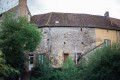
 10.05 mi
 +486 ft
 -509 ft
 5h 05
5h 05
 Moderate
 Departure from Bouloire (Sarthe)
Bouloire is nestled in the heart of a vast, hilly agricultural region crossed by the Dué and Tortue rivers. Human presence along the ancient road between Le Mans and Orléans is attested to by a coin dating back to the Merovingian period. Its name comes either from a Celtic place name meaning "fortification" or from an etymology meaning "between two coasts ". The town centre is rich in ancient architectural heritage. The Church of Saint-Georges, destroyed by a fire that ravaged the village in 1680, bears the coat of arms of Marshal Guillaume Testu de Balincourt, who enabled its reconstruction. The town's coat of arms is also linked to this figure.
On the Via Turniacensis in Maisoncelles
 5.48 mi
+82 ft
-82 ft
2h 35
5.48 mi
+82 ft
-82 ft
2h 35
 Easy
Departure from Maisoncelles (Sarthe) (Sarthe)
Easy
Departure from Maisoncelles (Sarthe) (Sarthe)
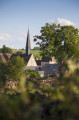
The village of Maisoncelles, described as a ‘street village’, has developed linearly along the road linking Bouloire to Tresson and Écorpain, running perpendicular to the Ruisseau de l’Étangsort. Although difficult to date precisely, the imposing Church of Notre-Dame, possibly dating back to the Romanesque period, is undoubtedly the oldest building in the village. You can, however, see typical rural features from theThird Republic, such as the public pump at the foot of the church. Heading towards the cemetery, you will see on the right the old communal washhouse, recently converted to welcome walkers, and further up, a former school recognisable by its two-storey structure and brick window frames.
The angel musicians of Les Loges
 7.26 mi
+295 ft
-282 ft
3h 35
Moderate
Departure from Coudrecieux (Sarthe)
7.26 mi
+295 ft
-282 ft
3h 35
Moderate
Departure from Coudrecieux (Sarthe)
The present-day commune of Coudrecieux consists of the former parish of the same name, which was merged with that of Les Loges in 1808. Their place names reflect the wooded environment of these villages, which are still 50% forest today. Coudrecieux refers to the hazel wood known locally as ‘coudre’, and Les Loges to the light dwellings, made of branches and heather, temporarily occupied by charcoal burners and other forest workers. The Coudrecieux route will allow you to discover the rich architectural and landscape heritage of this commune. This is evidenced by the Manoir de la Cour, the Château des Loges, and the church of Les Loges (with its renowned stone bell tower dating from the year 1000)… These features are highlighted by information panels.
The Pescheray Estate
 7.19 mi
+174 ft
-174 ft
3h 25
Moderate
Departure from Le Breil-sur-Mérize (Sarthe)
7.19 mi
+174 ft
-174 ft
3h 25
Moderate
Departure from Le Breil-sur-Mérize (Sarthe)
Le Breil and Nuillé are two villages of ancient origin. In the Middle Ages, Le Breil, or Breuil, was a seigneurial hunting ground. Nuillé, first mentioned in the9th century, still has a small Romanesque church.
The Sourice Valley
 6.31 mi
+203 ft
-190 ft
3h 05
Moderate
Departure from Surfonds (Sarthe)
6.31 mi
+203 ft
-190 ft
3h 05
Moderate
Departure from Surfonds (Sarthe)
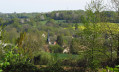
The parish underwent a re-demarcation in 1836: certain farms such as La Bardouillère and houses in the village were part of Volnay. Since then, the south-eastern boundary has been formed by the Ruisseau la Sourice. Under the Ancien Régime, the parish seigneury was annexed to the Château du Coudray, which you will see to the right of the hill as you head towards La Bardouillère. The village still has traditional houses near the church; it has gradually expanded towards the crossing point over the Sourice, where the roads from Surfonds to Bouloire and from Le Breil to Volnay used to meet, later transformed inthe 19th century into the main road from Tuffé to Le Grand-Lucé.
Les Sapins des Pauvres
 11.37 mi
+302 ft
-289 ft
5h 30
Moderate
Departure from Saint-Mars-de-Locquenay (Sarthe)
11.37 mi
+302 ft
-289 ft
5h 30
Moderate
Departure from Saint-Mars-de-Locquenay (Sarthe)
The name adopted at the time of the merger refers to the location of the two villages situated in the valley at the confluence of the Arche and Hune streams. The area has been inhabited since ancient times, as evidenced by the dolmen on the border with Tresson, dating from the Neolithic period, and the ancient road – the Via Turniacensis – linking Le Mans to Blois; passing through Volnay and Saint-Mars-de-Locquenay before heading towards the Loir Valley. This facilitated the development of large agricultural estates, explaining the presence of numerous fiefdoms in medieval times, of which few traces remain (Champion, Pois, Le Grand Yvay, Mèleve, Sargilet), with the exception of La Chesnaye, which incorporated most of them during the Modern Era (16th–18th centuries).
In the shade of the hedgerows towards Thorigny-sur-Dué
 7.30 mi
+203 ft
-213 ft
3h 30
Moderate
Departure from Thorigné-sur-Dué (Sarthe)
7.30 mi
+203 ft
-213 ft
3h 30
Moderate
Departure from Thorigné-sur-Dué (Sarthe)
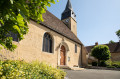
A few archaeological finds attest to human presence in Thorigné as far back as the Neolithic period. In Gallo-Roman times, a large agricultural estate (villa) is thought to have been the origin of a permanent settlement, which is better documented from the Middle Ages onwards. Despite the destruction of its medieval castle, which was replaced by a bourgeois house in the19th century, Thorigné stands out as a fairly large village offering a wide variety of civil architecture, spread out along the main axis linking the Dué valley to the church. Probably of Romanesque origin, the church was enlarged in the16th century and remodelled inthe 18th century . It houses interesting stained-glass windows and furnishings, such as the high altarpiece dating from 1669 and the18th-century side altarpieces.
Bird trail from Nuillé-le-Jalais
 4.43 mi
+151 ft
-174 ft
2h 10
Easy
Departure from Nuillé-le-Jalais (Sarthe)
4.43 mi
+151 ft
-174 ft
2h 10
Easy
Departure from Nuillé-le-Jalais (Sarthe)
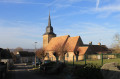
Nuillé-le-Jalais, first mentioned in the9th century , still has a small Romanesque church. Surprisingly, many of the local place-names refer to birds: La Pie qui Couette, La Grande Oiselerie and Le Chardonneret. The route’s signposting is a nod to this unique feature.
The Étangsort Valley towards Tresson
 8.68 mi
+348 ft
-351 ft
4h 20
Moderate
Departure from Tresson (Sarthe)
8.68 mi
+348 ft
-351 ft
4h 20
Moderate
Departure from Tresson (Sarthe)
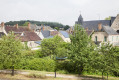
The origins of the settlement of Tresson are very ancient, as evidenced by a dolmen situated not far from Les Basses Poches. Furthermore, the territory of Tresson is crossed by the Via Turniacensis, near which a large agricultural estate is recorded in 572. This villa was donated by Bishop Domnole to Saint-Vincent Abbey, which established a priory in Tresson. This combination of factors led to the development of the present-day village in the Étangsort valley.
An unusual walk in Dollon
 14.36 mi
+715 ft
-689 ft
7h 15
14.36 mi
+715 ft
-689 ft
7h 15
 Difficult
Departure from Dollon (Sarthe)
Difficult
Departure from Dollon (Sarthe)
This route will allow you to discover the villages of Lavaré, Dollon and Semur-en-Vallon. These villages developed in the Middle Ages on land that was often sandy or stony, not particularly suitable for farming before modernisation. The villagers therefore found additional sources of income through textile crafts and the extraction of building materials. Situated away from major transport routes, these villages have retained their vitality despite the rural exodus that affected them following the decline of rural industries and traditional activities. Furthermore, these villages have managed to maintain a vibrant community life, fostering the development of unique events and venues such as the tourist train in Semur-en-Vallon and the Museum of Mechanical Music in Dollon.
On the edge of the woods from Volnay
 13.34 mi
+502 ft
-492 ft
6h 35
Difficult
Departure from Volnay (Sarthe) (Sarthe)
13.34 mi
+502 ft
-492 ft
6h 35
Difficult
Departure from Volnay (Sarthe) (Sarthe)
The name Val-de-la-Hune, adopted at the time of the merger, refers to the location of the two villages situated in the valley at the confluence of the Ruisseau de l’Arche and the Hune. The area has been inhabited since ancient times, as evidenced by the dolmen on the border with Tresson, dating from the Neolithic period, and the ancient road, the Via Turniacensis, linking Le Mans to Blois; passing through Volnay and Saint-Mars-de-Locquenay before heading towards the Loir Valley. This facilitated the development of large agricultural estates, explaining the presence of numerous fiefdoms in medieval times, of which few remains are left (Champion, Pois, Le Grand Yvay, Mélève, Sargilet), with the exception of La Chesnaye, which incorporated most of them during the Modern Era (16th–18th centuries).
Lutin route
 Visorando Member6.33 mi
+331 ft
-331 ft
3h 10
Moderate
Departure from Soulitré (Sarthe)
Visorando Member6.33 mi
+331 ft
-331 ft
3h 10
Moderate
Departure from Soulitré (Sarthe)
This route owes its name to the shape of its route, which evokes the silhouette of a leprechaun for dreamers. It offers a path between Jalais, a bocage plain on the Soulitré side, and the Huisne valley.
Along the banks of the Tusson towards Val-d'Etangson
 7.85 mi
+308 ft
-315 ft
3h 55
Moderate
Departure from Évaillé (Sarthe)
7.85 mi
+308 ft
-315 ft
3h 55
Moderate
Departure from Évaillé (Sarthe)
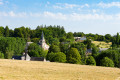
Val-d’Étangson is a new commune formed in 2019 from the merger of the communes of Évaillé and Sainte-Osmane. Possibly first mentioned as early as the9th century, the village on the banks of the Tusson consisted in 1829 of nothing more than the church, the18th-century presbytery with its courtyard and garden, and around fifteen houses. It expanded after 1840, no doubt linked to the opening of the road connecting the two sub-prefectures of La Flèche and Saint-Calais (now the D13).
Between Tuffeau and Grès Roussard
 7.53 mi
+289 ft
-279 ft
3h 45
Moderate
Departure from Sainte-Osmane (Sarthe)
7.53 mi
+289 ft
-279 ft
3h 45
Moderate
Departure from Sainte-Osmane (Sarthe)
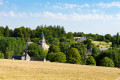
Val-d’Étangson is a new commune formed in 2019 from the merger of the communes of Évaillé and Sainte-Osmane. Dedicated to an Irish princess who became a hermit in Brittany in the7th century, the church, extensively remodelled around 1540, features a beautiful Renaissance porch with classical decorations. By undertaking the interior restoration of the building themselves, the residents have revived the tradition of the ‘fabrique’ – an assembly of parishioners responsible, under the Ancien Régime, for the building’s upkeep. In 1841, the local landscape was mainly characterised by small farmsteads, sometimes grouped into hamlets such as La Chauvière, and a few large estates, such as Rateau or a dairy farm.
The Maquis des Bois de la Croix in Connerré
 3.50 mi
+233 ft
-220 ft
1h 50
Easy
Departure from Connerré (Sarthe)
3.50 mi
+233 ft
-220 ft
1h 50
Easy
Departure from Connerré (Sarthe)
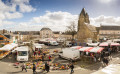
Situated in the Huisne valley, inhabited since prehistoric times, Connerré developed in the Middle Ages around a religious centre comprising the Church of Saint-Symphorien and a priory. The town, enclosed by a wall at the end of the 16th century, opened up at the end of the Ancien Régime thanks to the construction of bridges replacing fords and the expansion of transport links: the construction of the Paris–Nantes royal road around 1780, followed by the opening of a station on the Le Mans–Paris line in 1854. These developments fuelled the economic boom of the 19th century through fairs and markets and the growth of industry. The market town modernised and expanded gradually, then more rapidly from the 1970s onwards. Today, Connerré is an attractive small town, situated halfway between Le Mans and La Ferté-Bernard.
The Two Oaks of Luart Route
 4.15 mi
+69 ft
-69 ft
2h 00
Easy
Departure from Le Luart (Sarthe)
4.15 mi
+69 ft
-69 ft
2h 00
Easy
Departure from Le Luart (Sarthe)
This rural village had a population of just over 1,000 in themid-19th century before seeing its population gradually decline due to rural depopulation until 1962, when it fell to 643 inhabitants. The closure of many small farms gradually freed up the least productive agricultural land for building. Thanks to a proactive policy by the local council and the presence of a construction company in the village, Le Luart experienced considerable suburban development, leading to a spectacular rise in its population, which reached 1,445 inhabitants in 2012. Since then, the population has tended to stabilise.
Around Duneau
2.42 mi
+138 ft
-138 ft
1h 15
Easy
Departure from Duneau (Sarthe)
The village of Duneau is located in a dominant position on the left bank of the Huisne, on a route that has been highly sought-after since prehistoric times. The Pierre Fiche menhir and the Pierre Couverte dolmen, dating from the Neolithic period (around 4000 BC), bear witness to this. These are the only visible archaeological remains among many others covering the periods of Antiquity and the Middle Ages.