In the footsteps of Boulogne-Billancourt’s industrial past

For what will no doubt remain a long time to come, the names of Billancourt andÎleSeguin are associated with the Renault factories, which closed their doors in 1992. Boulogne-Billancourt’s industrial and working-class past is not limited to car manufacturing but also encompasses other sectors: laundries (to which we owe the fact that no railway line runs through the town), ice works, aeronautics, telecommunications equipment, cinema and the record industry… This urban walking tour, inspired by the brochure and information panels provided by the town’s Tourist Office, aims to retrace this working-class past. It also offers an opportunity to observe how the urban landscape of a town in the Petite Couronne of Paris has changed radically over the course of a few decades.

This walk is part of a multi-day hike: Over hill and dale in the Hauts-de-Seine

Details

101244044
Creation:
Last update:
Last review:
  • Walking
    Activity: Walking
  • ↔
    Distance: 5.38 mi
  • ◔
    Average duration: 2h 30 
  • ▲
    Difficulty: Easy

  • ⚐
    Back to start: No
  • ↗
    Ascent: + 30 ft
  • ↘
    Descent: - 10 ft

  • ▲
    Highest point: 125 ft
  • ▼
    Lowest point: 89 ft

Photos

Description of the walk

Starting point and access: Boulogne-Pont de Saint-Cloud metro station.
- Metro – Line 10 (terminus). Get off at the rear of the train and take Exit 2 onto Avenue Jean-Baptiste Clément.
- Bus – Lines 52, 72, 126, 160, 175, 260, 466, 5117, 6246.
- Tram – Line T2, Parc de Saint-Cloud stop. Take the bridge across the Seine, cross the quay and continue straight on along Avenue du Maréchal de Lattre de Tassigny until you reach the Rhin et Danube roundabout. Go round the roundabout on the left to reach Avenue Jean-Baptiste Clément.

Former industrial sites and information boards are indicated directly in the description. A lower-case letter in brackets refers to a short note in the ‘Places to see’ section, where the sites are listed in the order in which they appear on the route.

(S) As you exit the metro station, head straight onto Avenue Jean-Baptiste Clément. Walk along the right-hand side of the Studios de Boulogne (a), with their rust-coloured render. At the traffic lights, turn right onto Rue de Silly and continue alongside the studios. At the next set of traffic lights, cross Rue de Paris and follow it to the right, keeping the studios in view. Take the first left, into Rue de Bellevue, and go under an archway. At the traffic lights, cross Route de la Reine and follow it to the right until you reach the Rhin et Danube roundabout. Then turn left to cross Avenue André Morizet (monument in honour of Marshal de Lattre de Tassigny).

(1) If you wish, continue left along Avenue André Morizet. Carry on straight ahead until you reach No. 61, just past Rue de l’Ancienne Mairie, where an information board mentions the former Robat laundry (b). However, no trace of this business remains. To see a remnant of a laundry, continue along Avenue Morizet, past the town hall (on the left) and the post office (on the right), until you reach the foot of a tall old chimney just before Rue Georges Sorel.

(2) Retrace your steps back to the Rhin and Danube roundabout. N.B. This round trip of approximately 2 km can, of course, be considered optional.

(1) Cross Rue de Sèvres (to the left if you’re coming back from Avenue Morizet, to the right if you’ve skipped the round trip) and follow it to the left. Take the first right onto Rue Béranger. Opposite No. 21, at the foot of an EDF substation, a sign refers to Auto-Thermos (c) (no trace of the company remains). Continue straight on along the street. You’ll come out onto Quai Alphonse Le Gallo and follow it to the left. Walk past the imposing Matériel Téléphonique building (d) and look out for the information sign on the corner just before the entrance to No. 46. Continue along the quai, passing a riding centre.

(3) Turn left immediately onto Rue Gallieni. At the next junction, rejoin Rue de Sèvres and follow it to the right. At No. 62 were the Pathé-Marconi Studios (e). Immediately afterwards, turn left onto Avenue du Maréchal Juin (pedestrianised). At the next junction, turn right onto Rue de Bellevue. You will reach the junction with Rue Couchot.

(4) Continue straight on and, shortly afterwards, at No. 125, you’ll find the sign for the Ateliers Surcouf ( f) (no remains). Retrace your steps to the previous junction.

(4) Turn right into Rue Couchot and begin a route linked to the aviation industry. On the right-hand side, you will pass Rue Esnault Pelterie. Then cross Rue de Silly and continue straight ahead into Rue Louis Blériot. Cross Place des Ailes (featuring a fountain and a statue of Neptune) and continue along Rue Blériot. On your right, you’ll pass Rue Gabriel et Charles Voisin (which will be discussed later) and turn left onto Rue Louis Blériot. When this street bends to the right, enter the Jardin Farman, situated near the site of the factory of the same name (g). Turn immediately right and take a path running parallel to the street. At the end, go round a bend and leave the garden on the right.

(5) You will emerge onto Rue de Billancourt; follow it to the right, passing the Lycée Jacques Prévert on your left and a primary school on your right. Cross Avenue du Général Leclerc at the traffic lights and continue straight ahead into Rue de la Ferme. At No. 4, an information board tells the story of the Voisin brothers (h). Carry on straight ahead. Cross Rue du Vieux Pont de Sèvres, turn left to cross Place Bir-Hakeim and take Allée Émile Puget. Pass a hairpin bend and you’ll immediately reach the entrance to Parc des Glacières (i).

(6) Enter the park on the right, walk past a children’s playground on your left and, at the corner, turn right. At the Fork in the road shortly afterwards (toilets), turn left onto a tarmac path. Shortly afterwards, turn left along this path, walk slightly uphill and ignore the dirt tracks on either side. At a junction (chairs, bench), go straight on. At a fork in the road (bin), turn right and head back down. At the bottom (chairs), turn left. At a three-way junction, turn right and walk alongside a sports ground on your right. At the end, ignore a flight of steps leading down to the left. At a three-way junction, turn left, pass a chicane and leave the park. You’ll come out onto a street; follow it to the left until you reach Place Jules Guesde.

(7) If you wish, take the second left, Rue du Point du Jour. Then take the first left, Rue de Solférino. The Billancourt Studios (j) were located at No. 5.

(8) Retrace your steps back to Place Jules Guesde (k).

(7) The rest of the route is entirely devoted to the former Renault factories, whose siren stands proudly in the square and whose pediment was ‘recycled’ during the construction of the Lycée Simone Veil. Facing this pediment, go round the school on the right and turn into Traverse Jules Guesde. Carry straight on, passing through the area known as the ‘Trapèze’ (l), so named after the shape of the factory site at the time. At the end, turn right onto Avenue Pierre Lefaucheux, passing a brick building on your left which is none other thanthe former headquarters of Régie Renault. At the traffic lights, turn left, walk past the entrance archway of the former headquarters and head gently uphill towards the Pont Daydé (m), recognisable by its blue steelwork.

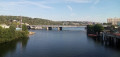
(9) Cross the bridge over a branch of the Seine to reachÎle Seguin (n). Walk on for a good fifty metres until you reach the first entrance to Parc Gauthier Mougin.

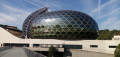
(10) Turn right and enter the park. Follow a hard-surfaced path that stays at a higher level and cross two footbridges in succession. Note several modern sculptures on either side. Leave the park and emerge onto the forecourt of La Seine Musicale.

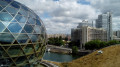
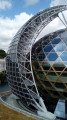
(11) Climb the large flight of steps opposite, which leads to the Jardin Bellini. At the top, at the Fork in the road by the corner of a small metal building, take the concrete path on the left overlooking the Seine. Shortly afterwards, climb the steps on the right to reach the top of the hill (panoramic view). Retrace your steps and, at the bottom of the staircase, continue to the right along the concrete path, passing as close as possible to the spherical structure and its solar panels. Once back at the Fork in the road, go down the large staircase you climbed on the way up, keeping to the left.

(11) With your back to the staircase, head left. At the foot of a giant thumb (by the sculptor César), turn left and walk alongside the Seine, which lies below on your right.

(12) At the end of the esplanade, take the footbridge on the right to cross the arm of the Seine once more. On the other side, continue along the foot of the tall buildings on the right. Soon turn left to cross an avenue at the traffic lights and arrive at the Pont de Sèvres metro and bus station (E).

To get back home:
- Metro – Line 9 (terminus).
- Bus – Lines 169, 171, 179, 426, 467.
- Tram – Line T2. Cross the Seine via the Pont de Sèvres, using the right-hand pavement. Just before the old railway station building, go down the stairs on the right which lead to the tram station.

Waypoints

  1. S : mi 0 - alt. 98 ft - Boulogne metro station - Pont de Saint-Cloud
  2. 1 : mi 0.36 - alt. 102 ft - Rond-point Rhin et Danube
  3. 2 : mi 1.01 - alt. 115 ft - Town Hall – Chimney of the former laundry
  4. 3 : mi 2.3 - alt. 95 ft - Quai Alphonse Le Gallo x Rue Gallieni
  5. 4 : mi 2.78 - alt. 108 ft - Rue de Bellevue x Rue Couchot
  6. 5 : mi 3.12 - alt. 112 ft - Rue Louis Blériot x Rue de Billancourt
  7. 6 : mi 3.44 - alt. 112 ft - Entrance to the - Parc des Glacières (Boulogne-Billancourt)
  8. 7 : mi 3.71 - alt. 105 ft - Place Jules Guesde (Boulogne-Billancourt)
  9. 8 : mi 3.8 - alt. 108 ft - Rue Solférino
  10. 9 : mi 4.21 - alt. 102 ft - Pont Daydé
  11. 10 : mi 4.4 - alt. 118 ft - Entrance to Gauthier Mougin Park - Ile Seguin
  12. 11 : mi 4.68 - alt. 115 ft - Forecourt of the Seine Musicale - Ile Seguin
  13. 12 : mi 5.11 - alt. 102 ft - Footbridge over the - Seine [la]
  14. E : mi 5.38 - alt. 118 ft - Metro station - Pont de sèvres

Notes

A good pair of trainers is sufficient for this urban route.

Drinking fountains and public toilets in the Parc des Glacières (6). Numerous bars, restaurants and shops all along the route.

Opening hours of public parks:
Jardin Farman: 07:00–21:00.
Parc des Glacières
- November to February: 07:30–21:00.
- March to October: 07:00–23:00.
Gauthier Mougin Departmental Park: 08:00–19:30.
Bellini Garden
Closed on Mondays and Tuesdays.
- Opens: 11.00.
- Closing time: 5.00 pm to 10.00 pm depending on the amount of sunlight.

A detailed map is useful (at the very least, the one accompanying this description).

Walk undertaken by the author on 12 July 2026.

Worth a visit

a - Boulogne Studios - Established in 1940, the Boulogne Studios cover an area of 25,000m². Of all the sites visited on this route, this is the only one still in operation today.
b – Robat Laundry – Thanks to abundant water resources, the laundry industry flourished in Boulogne-Billancourt: there were 450 businesses in 1913 and 769 in 1944. This high concentration of laundries from the late 19th century and into the early 20th century was the reason behind the refusal to allow a railway line to pass through the town, given the risk that the smoke from steam locomotives would soot the clothes spread out on the drying racks. Established in 1866, the Robat Laundry was one of the largest in the town. Its large chimney, which was clearly visible from Avenue André Morizet, was dismantled in 2023. The laundry industry began to decline from the 1960s onwards with the development and widespread adoption of domestic washing machines.
c – Auto-Thermos – It was in the late 1920s that the first pressure cooker, known as the Auto-Thermos, was introduced to the general public. However, the appliance was of a complicated design and was expensive, which hampered its commercial success. The company closed in 1968.
d - Le Matériel Téléphonique (LMT) - Built between 1925 and 1928, this factory reached its maximum production capacity as early as 1930. This imposing building, typical of the Art Deco style, now houses a centre of the OECD (Organisation for Economic Co-operation and Development).
e – Pathé-Marconi Studios – Founded in 1958, these studios served as a recording venue for famous rock bands in the 1960s. They were demolished in the late 1990s.
f - Surcouf Workshops - Founded in the early 20th century, the Surcouf workshops specialised in the design and construction of airships.
g - Farman Factory - Henri Farman (1874–1958) was first and foremost a great sportsman, a cycling champion and then a motor racing driver. He subsequently took up recreational aviation and, in 1908, became the first person to complete a full route flight covering a distance of one kilometre. He then turned his hand to building aeroplanes, hydrofoils and cars. The Boulogne-Billancourt factory was established in 1910. By 1917, it covered 90,000 and was the town’s second-largest employer after the Renault factories.
h – The Voisin Brothers – Gabriel and Charles Voisin were pioneers of aviation. They collaborated with famous pilots, briefly with Louis Blériot and for a longer period with Henri Farman: it was in a Voisin brothers’ aeroplane that Farman made the first one-kilometre flight (see above). The workshop on Rue de la Ferme was the first of those established by the Voisin brothers in the early 20th century. They left Boulogne-Billancourt in 1911, following the floods of 1910.
i – Icehouses – The Société des Nouvelles Glaciaires was established in Boulogne-Billancourt in 1899. Ice was harvested in winter, either locally or from more distant regions depending on the severity of the cold. It was stored in huge warehouses before being distributed in spring or summer to ensure food preservation. With the development of domestic refrigerators from the 1960s onwards, the ice houses specialised in a few functions: supplying the nearby ice rink and storing frozen meat. The ice houses ceased operations in 1975.
j - Billancourt Studios - Founded in 1923, the Billancourt Studios enjoyed a remarkable period of activity in the 1930s. They closed in 1994.
k – Place Jules Guesde – Formerly known as Place Nationale, it was renamed “Jules Guesde” in 1925. This square is emblematic of the former Renault factories, whose main entrance was located here. The pediment was “reused” during the construction of the Lycée Simone Veil.
l - Le Trapèze - In 1902, Louis Renault set up workshops along the quay oppositeÎleSeguin. During the First World War (1914–1918) and in the years that followed, the company experienced spectacular growth and its footprint continued to expand until it formed a trapezium covering an area of 76,000m². The head office was inaugurated in 1933. A rare remnant of the factories, it is now named after Pierre Dreyfus, who was CEO of Renault from 1955 to 1975.
m – Daydé Bridge – Built in 1928, this bridge was the only route connectingÎleSeguin (see below) and the ‘Trapèze’ (see above), serving workers, materials arriving on the island and cars leaving it.
n - ÎleSeguin - From 1929 to 1992,ÎleSeguin was home to one of Renault’s factories, which covered its entire area (11.5 ha). In the interwar period, this factory, which employed 30,000 workers, was the largest in France. The demolition of the factory and the decontamination of the site took a long time, as did the process leading to the island’s redevelopment. Today, a theatre and an auditorium (La Seine Musicale) are located at the downstream end, and a cinema complex is due to open in September 2026 at the upstream end. A sculpture garden opened in January 2026. Renault’s head office is due to be established on the island shortly.

Download the brochure on the industrial heritage trail published by the Boulogne-Billancourt Tourist Office, which inspired the author to map out this route and write the descriptions above.

Other walks in the area

For more walks, use our search engine .

The GPS track and description are the property of this route's author. Please do not copy them without permission.