The Tour of the Soubeyran Massif

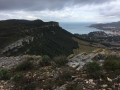
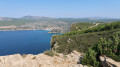
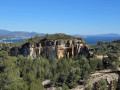
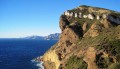
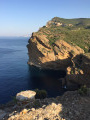
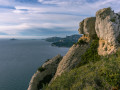
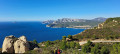
This long hike will take you around the Tour du Massif Soubeyran, bordered by the Mediterranean Sea and the D559 road linking Cassis to La Ciotat. For a good half of the route, you will follow the ridge line between Pas de Bellefille and La Ciotat. This balcony section offers breathtaking views of the Toulon-Marseille arc throughout the route. You will complete the route in a circular fashion with a tour of the valleys overlooking La Ciotat.

GPS is highly recommended!

Details

2707954
Creation:
Last update:
Last review:
  • Walking
    Activity: Walking
  • ↔
    Distance: 22.53 km
  • ◔
    Duration according to the author: 7 hrs 
  • ▲
    Difficulty: Very difficult

  • ⚐
    Back to start: Yes
  • ↗
    Ascent: + 998 m
  • ↘
    Descent: - 1,001 m

  • ▲
    Highest point: 394 m
  • ▼
    Lowest point: 82 m

Photos

Description of the walk

The hike is described from the Bucelle school, located at the top of Avenue Marcel Camuso, at the start of the ridge road (D141), to the right of the barrier when coming from La Ciotat. There are several parking options nearby, particularly on Avenue de la Fade below the school.

(S/E) Take Avenue de la Fade north to its end, where a path begins that runs alongside properties and joins Chemin de Fardeloup. Follow it as close as possible to the fences to reach the path climbing westwards 20 metres before the road.

Follow this path for about 100 metres until you reach a fork. Take the right-hand path, which runs parallel to the road leading to Fardeloup. After a short descent, you will reach the bottom of a small valley crossed by the path leading to the Fardeloup Cave.

Option - Visit to the Fardeloup Shelter

Turn left to walk up the dry stream bed at the bottom of the valley. After about 250 metres, you will arrive at the porch of the Abri de Fardeloup, which can be reached by a short, easy climb. Its 8-metre-high vault has two chimneys. After your visit, retrace your steps to the previous intersection.

Continue straight ahead (to the left coming from the shelter) along a steep path that climbs up the eastern side of the valley to reach the access track to the Fardeloup cistern (wide platform).

(1) Take the wide path leading west from the platform to the tarmac road leading to a shooting range. Follow the steep path continuing opposite to the top of a small ridge crossed by the path leading to the Dent du Chat. Continue opposite along a wide path descending gradually towards the north-east.

You will reach an old quarry that has been converted into a rock climbing site known as the Étoile Noire, then the tarmac track leading to the Loin quarry. Continue along the track on the right, descending. After about 100 metres (elevation 141), leave the track and take the path leading off to the left. You will reach the Chemin des Carrières, which you follow to the right, heading northeast, until you reach a DFCI track leading off to the left near the Pin de Galaban cistern.

(2) Take this track marked in yellowGRP® to climb up the Vallon des Brusquières to the north-east. Ignore an uphill track on your left and continue to a three-way junction. Leave the yellow trail and take the track on the right, which climbs up the side of the valley towards the south-west to join the Chemin de Saint-Loup at a crossroads (elevation 158) near a cistern.

(3) Take the wide track opposite, which winds northwards to a junction (elevation 144). Do not take the track on the left, but continue straight on along the railway line to join the track leading to the D559 at the Pont de la Bécasse cistern.

(4) Follow this track on the left (west) to go around Mont du Président until you reach a fork (elevation 134). Continue on the track on the right, which continues north. Shortly after the ruins of Jas du Président, you will reach a wide track (elevation 205). Continue on the track opposite, which continues uphill. Leave the path on the left at the top of the hill. After 100 metres, leave the track and take the path on the left. After about 200 metres, you will reach theGR®51at one of the ventilation shafts of the Janots railway tunnel.

(5) Follow theGR®51-GR®98(white and red markings) on the left (west) towards the summit of the Couronne de Charlemagne.

(6) Descend following theGR®, which runs along the edge of the cliff towards the south-east and then turns west, to reach the Pas de Julien (elevation 245) at the end of the circular track below. Continue following theGR® along the ridge towards the south-west. At a left-hand bend, take the path in line with the track to the Pas du Vicaire viewpoint. Return to the track and join the access road to Bau de la Saoupe. Turn right to the summit.

(7) Leave the summit. About 150m from the edge of the cliff, take a narrow path on the right that returns below the summit and continues downhill south towards the road below. Descend this steep, heavily eroded gravel path to reach the road, which you follow downhill to Pas de la Colle.

Alternative route:
This difficult passage can be avoided by following the access road to Bau de la Saoupe downhill.

(8) At Pas de la Colle, cut across the first bend in the D141 by taking a small steep path to the south.
Reach the second bend. Continue up the road for 100m and take theGRP® "Des Crêtes" trail on the right, marked in yellow.
After a fairly steep initial section, the slope gradually levels out. The path continues above a small valley, passing in front of the Grotte des Espagnols.

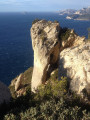
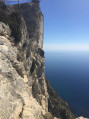
(9) About 50 metres before reaching the Belvédère des Calanques car park esplanade, take a path on the right to go directly to the viewpoint and enjoy the panorama and the breathtaking view of the vertical cliff at this point.

(10) Leave the viewpoint by taking the path along the cliff, following the yellowGRP® markings. After a short descent, join the road at a bend. Take the wide path climbing opposite, preferably following the yellow markings which offer a less steep climb on the right-hand side. This will take you to the summit of Cap Canaille. Enjoy the magnificent panorama of the Calanques Massif that unfolds before you.

(11) Continue along the path along the southern ridge until you reach a bend in the road after a descent. The rest of the route follows the ridge line, crossing two successive hills (elevations 344 and 356), each of which joins a bend in the road.

Option - Visit to the Grotte des Émigres

At the bottom of the descent, at the third bend, leave the yellow trail and follow the black trail, which leads to the edge of the embankment running alongside the road on the sea side. Descend the steep hairpin bends that skirt around the right-hand side of some very jagged rocks, one of which resembles an elephant's head. After about a hundred metres, the slope levels out and the path continues (south-east) along the cliff. After about a hundred metres, pass below a small cave known as the Grotte des Émigrés, which you can visit briefly. Retrace your steps to rejoin the yellow trail.

Take the ridge trail that continues opposite to cross another hill. On the descent, go around a large isolated mushroom-shaped rock on the left before reaching the road at the foot of the final ascent. After climbing up the rocky slabs, you will reach the Belvédère des Crêtes viewpoint, which is protected by a safety railing. On the ground, inscriptions on the rock identify the start of historic climbing routes such as the Voie du Belvédère, opened in 1968. Continue the climb, walking between the slabs to avoid dropping stones on vehicles or people below. After passing through a few small passages where your hands may be useful, you will reach the summit of the Grande Tête (394 metres), the highest point of the Soubeyran Massif.

(12) Follow the yellow markings on the descent. Pass two paths on your left that join the Route des Crêtes. At the bottom of the descent, the path continues along a ledge above one of the oldest climbing sites in La Ciotat (Site du Sémaphore). Join the access road to the Bec de l'Aigle semaphore (D148B) and follow it to the orientation table located on the embankment 50 metres to the right of the semaphore. The view from here is unique. Enjoy the panorama covering the Toulon-Marseille arc, from the summit of Notre-Dame du Mai and the Embiez archipelago in the east to the summit of Marseilleveyre and Île Maïre in the west, and closer to home, Cap de l'Aigle, La Ciotat, Île Verte and the Golfe d'Amour.

(13) Join the road below and retrace your steps (north). After about 150m, 30m from a barrier closing off a path rising slightly to the right, look for the barely visible start of the Chemin de la Vigie (blue markings) on the right, which descends like a balcony into the Cirque de la Vigie. Follow this path, which gradually turns north-east-east, descending along a beautiful dry stone wall. At the first houses, the path widens and a partially tarmac road leads to Chemin de Sainte-Croix near the ruins of the chapel of the same name.

(14) Cross the road and take the path opposite to the north in a heavily overgrown area. Please note that this path is not very well marked at the beginning. Follow the path gradually descending above the houses. After a few short technical sections, walk along the properties before reaching Avenue Marcel Camusso. The steep descent that follows leads to the D141 and from there to our starting point (S/E).

Waypoints

  1. S/E : km 0 - alt. 85 m - Avenue de La Fade (Bucelle)
  2. 1 : km 1.48 - alt. 143 m - Fardeloup cistern - Grotte de Fardeloup
  3. 2 : km 3.02 - alt. 99 m - Citerne du Pin de Galaban
  4. 3 : km 4.89 - alt. 157 m - Citerne du Chemin de Saint-Loup
  5. 4 : km 8.75 - alt. 116 m - Cistern at the Pont de la Bécasse
  6. 5 : km 11.05 - alt. 268 m - GR51 - Ventilation shaft
  7. 6 : km 11.41 - alt. 329 m - Crown of Charlemagne
  8. 7 : km 13.59 - alt. 337 m - Baou de la Saoupe
  9. 8 : km 14.21 - alt. 212 m - Pas de la Colle (213m)
  10. 9 : km 15.34 - alt. 311 m - Baume Noire ou Grotte des Espagnols
  11. 10 : km 15.66 - alt. 327 m - Bevédère des Calanques (328m)
  12. 11 : km 16.49 - alt. 346 m - Cap Canaille
  13. 12 : km 18.48 - alt. 394 m - La Grande Tête
  14. 13 : km 19.7 - alt. 321 m - Orientation table at - Sémaphore du Bec de l'Aigle
  15. 14 : km 21.59 - alt. 156 m - Chemin de Sainte Croix. Close to the - Chapelle de Sainte-Croix (La Ciotat)
  16. S/E : km 22.53 - alt. 85 m - Avenue de La Fade (Bucelle)

Notes

A little toponymy

The cliffs are called Soubeyranes, a word that comes from the Provençal "sobeiranas" meaning "sovereigns", itself derived from the Occitan word "soubeyran" which comes from the Latin "superanus" meaning "superior".
Soubeyran and its variants therefore refer to a place that is higher, at the top of, or above.

Starting point
This hike is described starting from the Route des Crêtes in La Ciotat. It is also possible to start from the Chemin de Roche Redonne picnic area located north of the Fardeloup district (43.189696°N/5.588041°E). This option may be interesting if you wish to split the hike in two.
For those coming from Cassis or the Marseille or Aubagne areas, it may be preferable to start from Pas de Bellefille or Pas de La Colle.

Planning the hike
Due to its length, it is best to do this hike when the days are long. Many sections are relatively shaded and there is usually a light breeze on the ridges, so this hike is feasible in summer.
There is no water on the route, so plan accordingly. A minimum of 2 litres per person is recommended in summer.
The time given by the app should be considered a minimum for a small group of moderately fit hikers, especially if visiting the Abri de Fardeloup and the Grotte des Emigrés.
This hike is not difficult, and it is possible to shorten it at any time by taking one of the many paths that run along the ridges and valleys leading down to La Ciotat.

For information, the FFRandonnée rating is E4/T3/E3 (IBP 93).

Worth a visit

(5)(6) Oppidum of the Couronne de Charlemagne:

Before reaching the summit of the Couronne de Charlemagne, the trail crosses a row of dry stones piled up to a height of about 50 metres long and 2 metres wide. These are the remains of the fortification wall of an oppidum built by the Celto-Ligures 500 to 600 years BC.
On the IGN map, you will notice that the name Baou Redon is associated with the Couronne de Charlemagne. The Baou or Bau in Provence is a rocky escarpment with a flat top, and redon is an adjective meaning round. In this region, the name is associated with the presence of oppida, as evidenced by the presence 2.5 km north, as the crow flies, in Roquefort-la-Bédoule, of a slightly higher peak (402 m) named "Baou Redon" and another "Oppidum du Baou Redon" in Auriol.

Fardeloup Cave
This cave is located on the right as you go up the valley, a few dozen metres from the shelter of the same name. Its entrance porch, located in the middle of the cliff, is accessible via a short, easy climb. Visiting the cave is not particularly difficult. It has two rooms with very few concretions, covering a distance of 85 m and with an average height of 1.50 m.

Grotte des Espagnols
This cave is now closed to the public and blocked off by a wall and bars, as it is a nesting site for colonies of bats, specifically Schreiber's bat. It owes its name to the fact that in the 17th century, under Louis XIII, this cave was used as a hideout by Catalan counterfeiters, who blew up part of it when they were discovered.

Cave of the Emigrants
Historically, the name comes from a wealthy family from La Ciotat who decided to flee the town during the revolutionary period of 1789. Our frightened Ciotadens went into hiding in this cave, which was well concealed by the wild nature of the area, and remained there for many weeks in very precarious conditions.
No revolutionary forces came to dislodge them from there. They punished themselves with this voluntary exile, and when the population found out, they named them "les Émigrés" (the Emigrants). Since then, this nickname has remained attached to this beautiful bivouac, whose layout has varied over time. A few years ago, it was still furnished. Today, due to the needs of the Calanques National Park, it has been completely emptied.

(14) Sainte-Croix Chapel
Little remains of the Sainte-Croix Chapel, only the ruins of the oldest chapel in La Ciotat. Built outside the town, its location made it one of the first lookout points before the construction of the first lookout point on the site of the current semaphore.
It was built around a plot of land planted with vines, fig trees and almond trees.
Owned by the White Penitents, it was home to a hermit who acted as a lookout and could send signals. Sold as national property in 1790, the chapel, which consisted of two rooms and a courtyard, was converted into a shed.
Traces of arches can be seen on its north façade, the terrace and the watchman's loggia, and part of the sacristy vault.
A few years later, the chapel was purchased and converted into a shed.
Fifty years ago, its altar and crucifix were still visible, but today only a section of wall remains. Along the path leading to the chapel, a dozen oratories marked the stops, as well as a Saint-Monas chapel, of which only the vaulted entrance remains.

Always be cautious and plan ahead when you're outdoors. Visorando and the author of this route cannot be held responsible for any accidents occurring on this route.

The GR® and PR® markings are the intellectual property of the Fédération Française de Randonnée Pédestre.

Reviews and comments

4.9 / 5
Based on 7 reviews

Reliability of the description
5 / 5
Ease of following the route
4.9 / 5
Route interest
4.9 / 5
User 27390299

Overall rating : 5 / 5

Date of your route : Dec 22, 2025
Reliability of the description : ★★★★★ Very good
Ease of following the route : ★★★★★ Very good
Route interest : ★★★★★ Very good
Very busy route : No

A superb hike, in my opinion without any technical difficulty, completed in 6 hours at a good pace. The first part is on a forest path and the second part is on the Cap Canaille customs officers' path with magnificent views. Many thanks for the route.

Machine-translated

Babu83
Babu83

Overall rating : 5 / 5

Date of your route : Apr 04, 2025
Reliability of the description : ★★★★★ Very good
Ease of following the route : ★★★★★ Very good
Route interest : ★★★★★ Very good
Very busy route : No

A magnificent hike in fine weather, with a light breeze in the morning and gusts of 50-60km/h in the early afternoon.

The rocky descent at (7) requires the utmost caution; it is the main technical difficulty of this route. Do not hesitate to take the tarmac road if you are not comfortable with this type of challenging descent.
The first part is very gentle, but the gradient increases at km 10-11 with the start of the ridge road.
The stream between 0 and 1 leading to the Fardeloup shelter was not dry at the beginning of April 2025. Do not make the round trip if you are not prepared to get your socks wet
It took me 5 hours at a brisk pace, including a short 15-minute lunch break and the time needed to take some nice photos.

Machine-translated

Pascalouhhh
Pascalouhhh
• Edited:

Overall rating : 5 / 5

Date of your route : Feb 09, 2025
Reliability of the description : ★★★★★ Very good
Ease of following the route : ★★★★★ Very good
Route interest : ★★★★★ Very good
Very busy route : No

I really enjoyed this circular walk. It wasn't that difficult in the end if you like walks of over 20 km with some elevation gain. The trails and firebreaks used are fairly easy. There are superb sea views along much of the route with beautiful spots for picnics. As the ridge road is closed to traffic, it was pure bliss to walk along these ridges on the trail between the TV relay station and the semaphore, as there were very few people and no engine noise.

Machine-translated

Sala13
Sala13

Overall rating : 5 / 5

Date of your route : Nov 04, 2024
Reliability of the description : ★★★★★ Very good
Ease of following the route : ★★★★★ Very good
Route interest : ★★★★★ Very good
Very busy route : No

A nice, varied route. I ran it and enjoyed both sections – the first was about ten kilometres long on a single track and firebreaks with a very slight continuous incline, and the second involved climbing up and down cliffs with breathtaking views of the sea and the towns of Cassis and La Ciotat. There were a few more people on the second part, but nothing crazy, although I did do the run in November.

Machine-translated

Cdric87
Cdric87
• Edited:

Overall rating : 5 / 5

Date of your route : Apr 22, 2024
Reliability of the description : ★★★★★ Very good
Ease of following the route : ★★★★★ Very good
Route interest : ★★★★★ Very good
Very busy route : No

A walk with superb views of the Cassis calanques

Machine-translated

amsa
amsa

This route has been considered but has not been selected at this time.

Machine-translated

Moug Salem
Moug Salem

Overall rating : 4.3 / 5

Date of your route : Feb 19, 2021
Reliability of the description : ★★★★★ Very good
Ease of following the route : ★★★★☆ Good
Route interest : ★★★★☆ Good
Very busy route : No

Well done to those who do this as a hike. I did it as a trail run. The first part is very fast-paced. It's fine when running, but when walking... It's a superb route. The second part is much more challenging and more interesting in terms of the views. Thank you for the route!

Machine-translated

Virage
Virage

That doesn't help me much, haha, but thank you for your reply.

Machine-translated

RickyH5
RickyH5

Personally, I've done it both ways and in my opinion, they're pretty much the same... Whichever way you choose, you'll see the calanques and Cassis Bay, and on the other side, the entire Var hinterland and, when you reach the heights of La Ciotat, the three secs.

Enjoy your hike.

Machine-translated

Virage
Virage

Hello, I plan to do only the western part of the route, i.e. the part near the cliffs. In which direction would you say the view is most interesting: from Cassis to La Ciotat or from La Ciotat to Cassis?

Machine-translated

RickyH5
RickyH5

Overall rating : 5 / 5

Date of your route : Jun 01, 2020
Reliability of the description : ★★★★★ Very good
Ease of following the route : ★★★★★ Very good
Route interest : ★★★★★ Very good
Very busy route : No

Hello,

Today's hike took place under beautiful sunshine but with a gale-force wind on the ridges.

Apart from the Fordeloup cave, which is always nice to visit, I would say that the ten kilometres or so after the start are not really interesting, except for racking up the mileage. The really interesting part starts when you begin the climb towards the Couronne de Charlemagne.
The rest is simply magnificent, but I knew that before I set off, as I'm fairly familiar with the area and did a small part of it two years ago.
There are breathtaking views over the entire Calanques area, not to mention the Var hinterland behind you.

I obviously went through the Espagnoles cave, which is a real shame that it's barricaded, but apparently it's good for the bats, so good for them...

So, I decided to do the ridge at the entrance instead... I climbed down a scree slope on the right (before the cave), and there's even a cairn on the left. When you reach the bottom of the small gully, you can take the path down to the right and climb back up via a blue trail that takes you back to the ridge opposite. Be careful not to take the ledge that the blue colour seems to follow, but head towards the ridge and join the path that follows this ridge higher up. It's quite tricky going downhill (I did it this way to see if it was passable), but going uphill it shouldn't be a problem.
I'm pretty sure you can get there from Pas de La Colle, which would avoid having to go back on the tarmac road... I'll go back and check this section.

After that, no problem, I went to see the Émigrées cave, which in my opinion is really worth a look. Follow the black trail as explained, the elephant's head is clearly marked there.

I recorded a higher mileage and elevation gain given what I did on the Baume Noire side, but that seems consistent to me.

A beautiful, athletic route overall. Thank you for this route and the guidebook.

Machine-translated

Other walks in the area

For more walks, use our search engine .

The GPS track and description are the property of this route's author. Please do not copy them without permission.