


 Country:
 City:
City:


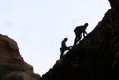
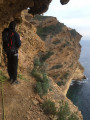
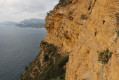
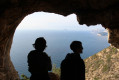
Park at the top of Chemin du Sémaphore near the ruins of Sainte-Frétouse, close to the Parc des Calanques sign. It is best to park along the walls of the properties, where the road is widest.
(S/E) Follow the yellow trail along the tarmac road leading up to Sainte-Croix. After a few dozen metres, the trail leaves the road and follows a wide path above the Carrière de la Vigie quarry. Follow this path, which winds its way up through old terraced fields, to the Bec de l'Aigle semaphore.
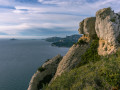
(1) Enjoy the view of the Golfe d'Amour and La Ciotat Bay (orientation table on the left) and continue along the road (north-northwest) for about 250 metres.
Leave the road and follow the yellow trail, which takes the wide path down to the left (west) towards Cassis. Pass over the rocky ridge of the Sémaphore climbing site. Leave the path leading to the Route des Crêtes on your right. Continue along the yellow trail, climbing to the left (north-west). At a bend, ignore the path opposite leading to the edge of the cliff at the Faille de la Goulette, located above the Pas de La Chèvre, which you will cross on the way back. Continue uphill to the right, following the yellow trail until you reach a wide path joining the Route des Crêtes on the right.
(2) Take the path on the left (north-west) to the summit of Grande Tête (394m - geodesic marker).
Continue along the path to the Selle des Ténibres, marking the end of the summit plateau. Follow the yellow trail, which takes a steep, very rugged path on the right, descending like a balcony above the Route des Crêtes. You will reach the only viewpoint protected by a guardrail on the Falaises Soubeyrannes.
Continue along the yellow trail, descending steeply sloping rock slabs to the Col des Chèvres (or Col Ouest). You will reach a bend in the road. Climb towards a large mushroom-shaped rock. Go around it on the right and follow the yellow trail to Col du Faucon (328 m), where the road makes another hairpin bend (Parking des Émigrés).
The outward journey is now complete. Leave the yellow trail and follow the black trail back, which leads to the left, on the sea side, to the edge of the embankment bordering the road.
Take the steep, winding descent that goes around the right side of some very jagged rocks, one of which resembles an elephant's head. After about a hundred metres, the slope levels out and the path continues (south-east) along the cliff. After about a hundred metres, you will pass below a small cave known as the Grotte des Émigrés.
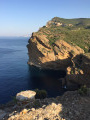
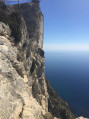
(3) Follow the black markings, which are more or less visible, along the path running alongside the cliff, which becomes increasingly vertical. Shortly after the Grotte du Grand Draïoun, located above and difficult to see from the path, after about 500 metres you will reach the edge of a large break where a large rock is marked with a black cross. This is the Pas de La Chèvre, which is the first difficult part of the route.
(4) Walk along the edge of the break for about fifteen metres, descending towards the sea to the edge of the cliff. The passage follows a series of narrow, sandy and very exposed ledges, which lead to the rest of the trail. Follow the stainless steel rings that mark the route, allowing you to secure yourself. Once you have crossed the 200-metre-long passage, continue (south-east) on the trail, which is narrower in places and whose black markings are partially faded.
Follow the black markings across the wide slopes of heath halfway up the cliff. After about 500m of winding terrain, you will reach the Cirque du 14 Juillet, characterised by a beautiful vertical wall of compact limestone, located below the Sémaphore climbing site seen on the way there.
The path gradually approaches the cliff until it runs alongside it. Leave the black trail, which climbs up through the rocks, to reach the bottom of one of the abseil lines connecting to the upper part of the black trail called "Passage à Philémon".
(5) Follow the path along the wall. After about thirty metres, pass at the foot of the Philémon chimney (sealed via ferrata-type bars), known as the first access route to the bottom of the cliff.
Continue along the cliff (south-east) on the path through the vegetation, passing under puddingstone overhangs, to reach the end of the path after about 200 metres. This is the start of a wide sandy ledge, where there is a rusty plate and bolt. This is where the Vire des Immortelles begins, the crossing of which is the main difficulty of the route.
(6) Climb up the sandy ledge for about 50 metres before it ends at a sealed ring. Climb 3 metres vertically to a ring equipped with a link (3b) to reach a narrow ledge, which you follow to the right across to some shrubs. The ledge gradually widens and becomes spacious.
Follow the ledge, interrupted by a vertical drop, equipped with a sealed ring.
Caution: Do not climb this ledge. It provides access to a more difficult and very challenging upper variant, joining the Yellow route from the Semaphore.
The route continues below. Descend a few metres to reach a fixed rope securing the rest of the route. Go around the ledge via a very narrow and exposed passage, but without any technical difficulty. Reach a wider balcony area and follow it. After crossing a temporary waterfall, climb a small ledge (3a) to reach the rest of the route, which follows a wide, sandy ledge downhill. Follow it to its end at a fixed ring. Climb the short puddingstone ledge on the left that closes off the ledge. Continue diagonally to the left (plate) to reach a sealed ring (3b) below a puddingstone overhang. Follow a short, rugged traverse (east) to reach a wide heath slope. Follow the path along the cliff for about ten metres until you reach a clear rocky area (a plate and a sealed ring) at the edge of a temporary waterfall.
Note: The original route continues above, climbing the puddingstone wall (plate visible) to a small cave, then diagonally to the right to a ridge bordering a dry canyon (4c). Climbing this ridge on foot, you can reach the top of the Black route and from there the Yellow route of the Sémaphore.
Descend a few metres to reach a path that you follow to the left (east), skirting the large puddingstone walls.
Reach a 3-4m high puddingstone ledge equipped with a short handrail leading to an abseil ring. Abseil down this ledge or climb down diagonally towards the edge of the cliff (3b). You will reach a large sandy terrace in the middle of a dry canyon (palm tree). Continue opposite, towards a steeply sloping ledge running along the cliff (east). Climb up this ledge, then the puddingstone slabs at the top, diagonally to reach a path which you follow to Villa Teychéné.
(7) Note: Do not take the track leading from the villa towards Sainte-Croix as it crosses private property closed off by a barrier.
Take the blue-marked trail starting east of the villa's terrace.
Follow this path to Villa Speany (ruins) and reach it to the north-east via a good path, the Chemin du Sémaphore, near the place where you started the hike. From there, return to the car park (S/E).




 Association / Club / Walk leader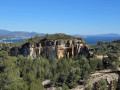
 Moderate
 Difficult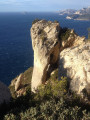
 Very difficult
  Visorando Member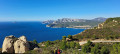
 Easy
Easy 
