Country:
 City:
City:


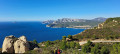
Passing through La Ciotat, take the Route des Crêtes as far as the no-entry sign on the road leading to the semaphore, 1 km from it. Parking spaces are located along the road on the right.
(S/E) Head south-east down the northern slope of the Grande Tête. You will reach a junction of five paths.
(1) Turn slightly left, keep right at the first three-way junction and then left at the next.
(2) Leave the wide path and take a path on the left which descends until it crosses the Route des Crêtes (D141). Take the path opposite, which continues from the first one, descending to a four-way junction.
(3) Turn left onto a small, barely visible path. Keep left at the next fork.
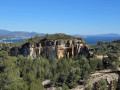
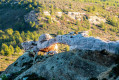
(4) Take a small path on the right that descends to the bottom of the valley: look out for caves and, at the bottom of the valley, a large rock painted red. Continue north along this path, which overlooks the caves, until you reach a group of pine trees on a small platform.
(5) You can leave your rucksacks here to explore the Grotte de Fardeloup on a round trip via a small path at the foot of the cliff. This is situated some 10 m below the path we have just followed and passes close to the rock painted red. Reach the cave.
(5) Back on the platform, cross the tarmac path and take the path directly opposite. Continue to the road leading to the shooting range.
(6) Cross the road and take the fairly steep climb opposite for 150 m. Turn left to climb the wide stony path, leaving the Dent du Chat on your right, and climb up to the Arche de Terrevaine.
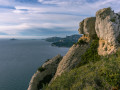
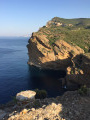
(7) Leave your rucksacks at the foot of the arch and climb the few metres to the base of the arch, taking care to keep as close as possible to the vertical rock face and using it for support if necessary: splendid views over La Ciotat Bay and the surrounding area. Back at your bags, follow the path to a cave offering photo opportunities through a stone porthole. Continue westwards then northwards, climbing gradually to a platform at Bau Rous.
(8) Follow the clearly visible path for about 10 metres at a constant level. From there, a small, barely visible path branches off to the right, winding around the valley first south-west then north-north-east, descending gradually. This path leaves the rocky ridge to the left all the way to Le Faucon.
(9) Turn left, due west, to take a wide path that follows the valley floor to a fork marked by the ruined Cabanon des Cardes.
(10) Take the wide path climbing up to the right, which narrows and becomes steeper until you rejoin the Route des Crêtes. Follow this road to the left for about 200 m , taking care of cars which sometimes drive fast.
(11) Follow the ridge path as it climbs to the right. Then descend until you reach the road again: an excellent spot for lunch after a 3½-hour walk. Continue along the path, which climbs and then descends to the car park. Follow the path for about 150 m to a viewing platform just before the Calanques viewpoint.
(12) From this platform, there is a splendid view of Cassis Bay (the coves of Grande Mer, Sainte-Magdeleine and Arène), the access points to the calanques of Port Miou, Port Pin and d’en Vau, the Grande Candelle and Mont Puget, and the islands off the calanques of Marseille: Île Maire, Île de Jarre, Île Plane, Île Riou, etc.
Turn back.
(11) Continue along the ridge path to reach a new viewpoint at a hairpin bend in the road.
(13) Continue to the highest point (altitude 394) and descend a few metres.
(14) Take a path on the right that descends steeply: an easier option is to continue straight on the path that leads directly to the Route des Crêtes. Reach a junction.
(15) Do not continue to the signal box, but turn left to return to the car park (S/E).



 Visorando Member
 Average
 Association / Club / Walk leader
 Extremely difficult
 Very difficult