The Coastal Path between La Garde and the Bec de l'Aigle Semaphore

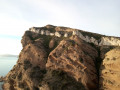
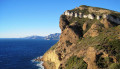
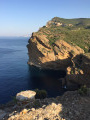
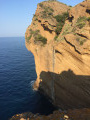
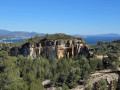
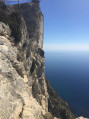
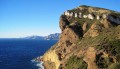
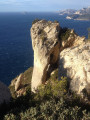
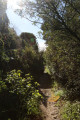
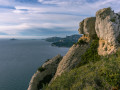
This challenging and technical route, which is exposed in places (please read the description carefully), starts from La Garde in La Ciotat and takes you close to part of the Soubeyranes Cliffs between Notre-Dame de la Garde and the Bec de l'Aigle semaphore. You will discover the unique characteristics of these cliffs, made of a mixture of sandstone, puddingstone and limestone. On the way back, you will cross ancient terraces and the ruins of forgotten farms before returning to your starting point via a small road.
See the chapter: practical information about the (4)

Details

1324413
Creation:
Last update:
Last review:
  • Walking
    Activity: Walking
  • ↔
    Distance: 7.29 km
  • ◔
    Average duration: 3h 20 
  • ▲
    Difficulty: Difficult

  • ⚐
    Back to start: Yes
  • ↗
    Ascent: + 445 m
  • ↘
    Descent: - 441 m

  • ▲
    Highest point: 321 m
  • ▼
    Lowest point: 15 m

Photos

Description of the walk

For road access, it is best to park along Chemin du Sémaphore near the La Garde stop on the Ciotabus line 30. Avoid parking in the Résidence de Notre-Dame de la Garde (private property) or in the Traverse de Notre-Dame de la Garde.

(S/E) Follow the signs for Chapelle Notre-Dame de la Garde. Walk up the path and the shaded steps alongside the residence. You will come out onto the chapel forecourt, where you can access the south terrace. Go around the chapel to the west to reach the north path on the left, which leads to Saint-Pilon. Follow this path as it winds its way up the puddingstone dome via a series of steps, some of which are built, to the summit (a beautiful viewpoint offering a stunning view of the 3 Secs and the Rocher du Capucin, also known as the Tête de Chien, above the Calanque de Figuerolle).

Alternative: Instead of going around the terrace, look for a large hole on the western ridge of Saint Pilon. Go to this hole (marked in blue) and climb through it (mind your head). Emerge on the south face and climb up a natural staircase from right to left to the summit. This alternative route is easy but impressive and very exposed, with a short section of grade II mountain climbing.

(1) Descend from the summit via the northern path. Pass north of the wall bordering the forecourt and take the path on the left that descends into the woods below (blue markings). Follow this narrow, winding and steep path, which can be slippery in wet weather. You will come out onto a path (green markings) that leads to the residence on the right.

Turn left (west) and follow the green markings along the path. After about 200 metres, at a clearing, leave this path, which continues to the Maison de Michel Simon. Take the path on the left (west), following the green markings, and continue to an intersection.

(2) Follow the path on the left (south) which gradually climbs towards the eastern foothills of Anse du Cannier. Just before reaching the summit (+86m), you will come to the Table de Brancusi, which offers a beautiful view of Anse du Cannier.

(3) Descend via the path you took on the way up until you reach the intersection.

(2) Continue straight ahead (leaving the path you took on the way up on your right) up a short climb (north) to an intersection and take the path on the left (west) marked with green and blue markings.

Caution: Numerous paths cross the route throughout this area, which can be misleading. Do not hesitate to retrace your steps if in doubt.

Follow this narrow path winding down to the bottom of the Michel Simon Canyon (green markings) near the 18-metre-high Saint-Jean de Capistan waterfall on your right (north).

(4) See practical information.
At the bottom of the descent, look for a path on the left carved into the puddingstone by former fishermen from La Ciotat. Leave the trail and follow this path, which descends across a puddingstone ledge (a few carved steps) to a flat area. Follow the path towards the sea (south) to the edge of the cliff.

Caution: Do not take the numerous paths that descend to the bottom of the valley.

The path leads to the top of a wide crevice equipped with a ladder allowing you to reach the sea at the bottom of Anse du Cannier. Retrace your steps to rejoin the path you took earlier.

(4) At the intersection, continue to the left (north-west) along the balcony. A short descent and an exposed traverse, secured by a handrail, lead to the bottom of a very shady valley. Climb out of the valley following the path that winds through the undergrowth before crossing a short puddingstone wall to an intersection.

Caution: The short descent and traverse are equipped with sealed bolts. A rope handrail, in varying states of repair, is usually present, but this cannot be guaranteed given the incivility of some people and the relative popularity of the route.

Take the path on the left towards the sea (south) to reach the top of the promontory overlooking Ferrand Cove to the east, which offers a breathtaking view of the grey trail of the 45-metre-high Pirates' Waterfall. A gap below allows you to reach a system of ledges used by former fishermen to reach the sea via a short descent.

Retrace your steps to rejoin the trail (green markings) at the intersection. Continue straight ahead (north) for about 50 metres until you reach another intersection. Turn left and follow the green trail (west) towards Domaine de Sainte Frétouse. Follow the path down to the bottom of a gully before climbing up a puddingstone outcrop on a ridge to an intersection.

Leave the path on your left that leads south to the promontory (+86m) overlooking the Trou de Jeannette.
Continue on the green trail towards the ruins of Villa Speany for about 100m. Before climbing up to the villa (north), leave the main trail and take the narrow trail on the left (blue markings) descending to the bottom of the Saint-Frétouse valley.

Caution: Follow the blue markers carefully, as there are many paths crossing the route in this area, which can be misleading. If in doubt, do not hesitate to retrace your steps.

Climb up the puddingstone wall following the blue dots. The path continues along the top of the Falaise des Grands Ducs cliff to Villa Teychéné (+135m) with its blocked openings.

(5) Enjoy the panoramic view from the terraces of this former property. Join the access track to the villa on the right, or take the path (west) to reach the wide embankment below. Leave the track, cross the embankment on the left and take the ascending path (west) to reach the Corniche des Grands Ducs. A short climb takes you to a horizontal balcony 100 metres away, where an old stone bench awaits you. Continue for a few metres to a small promontory of puddingstone offering an exceptional view of the Grand Cirque des Cascades, the Vires des Immortelles and the start of the Grande Face (only visible from the sea), bordered by the ridge connecting the Vigie du Sémaphore to the Pierres Tombées.

Retrace your steps, cross the balcony, and when the path climbs up to the left, leave the path you took on the way up and take the steep path (north) leading to the top of the ridge (+153m) towards the top of the Carrière de la Vigie. Continue along this path and after a few dozen metres you will come to a path (blue markings).

Continue in the same direction. The path climbs gently above the private properties of Saint-Frétouse to an old rusty skip (blue markings) where the path continues to the left. Follow the path to a small three-way junction near the end of the limestone ridge leading to the Sémaphore.

Take the path on the left towards the base of the cliff (blue markings) and follow this path along the cliff to a small dry cave with some unusual calcite formations.

Alternative route: From the cave, continue along the path (blue markings) climbing along the bottom of the cliff to a large sloping puddingstone slope. Cross it horizontally, following the blue markings (this passage may look daunting but is easy to cross). Continue along the cliff to a limestone terrace at the top of a rocky spur where you join the black markings of the Sentier Philémon trail. Climb up the rocky outcrop by ascending from right to left (III mountain). Climb up the rocky ridge, following the black markings as best you can, until you reach an intersection where you join the blue markings of the original route.

Retrace your steps to the three-way junction. Take the path (blue markings) on the left, climbing up the right side of the cliff to the edge of the Carrière de la Vigie (signpost: Vigie - La Ciotat). Follow the path that continues uphill to the left towards the Semaphore (blue "danger cliff" triangles) until you reach the intersection with the black trail. Continue along the path, following the double markings, until you reach the intersection with the yellow trail, which you follow to the Semaphore, which you go around to the east.

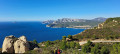
(6) Reach the viewpoint on the left above the road. Enjoy the panorama covering the Marseille-Toulon arc. To the west, you will see the Calanques Massif and the islands, to the east the Cap de l'Aigle that you have just climbed, and the Golfe d'Amour as far as Cap Sicié.

Reach the road below and follow it north for about 150 metres to 30 metres from a barrier closing off a path that climbs slightly to the right. On the right, look for the barely visible start of the Chemin de la Vigie (blue markings) descending like a balcony into Le Cirque de la Vigie. Follow this path, which gradually turns north/east-east, descending along a beautiful dry stone wall.

(7) 30 metres after a ruin on the left, at the bottom of a shallow valley forming a flat area, take a faint path on the right descending towards the Carrière de la Vigie. Follow this narrow path as best you can, following the edge of the terraces and leading to the ruins below on the right, from where you will join the Tracé Jaune du Sémaphore.

Follow this path on the left (south-east) towards La Ciotat until you reach the crossroads at the bottom of the tarmac descent. Continue along the road (Chemin du Sémaphore) for about 120 metres until you reach the bend below. Take the path downhill to the right (south), above a valley, and follow it to the ruins of Villa Speany.

(8) Walk along the villa to the old threshing floor, which forms a large terrace to the south. Climb a few steps to reach the east gable of the villa, where you will find a narrow path. Follow this slightly descending path along the edge of the terraces to the bottom of the valley you crossed earlier. Reach the road via a short winding climb. Follow the road towards La Ciotat (east) to the Résidence Notre-Dame de la Garde (S/E)

Waypoints

  1. S/E : km 0 - alt. 62 m - Notre-Dame de la Garde Residence
  2. 1 : km 0.57 - alt. 116 m - Le Saint Pilon - Chapelle Notre-Dame de la Garde
  3. 2 : km 1.03 - alt. 67 m - On the left
  4. 3 : km 1.17 - alt. 77 m - Brancusi Table
  5. 4 : km 1.47 - alt. 33 m - Access to Anse du Cannier
  6. 5 : km 2.71 - alt. 139 m - Villa Teychéné
  7. 6 : km 4.19 - alt. 321 m - Belvédère du Sémaphore du Bec de l'Aigle
  8. 7 : km 5.03 - alt. 228 m - Start of the descent path in the terraces
  9. 8 : km 6.17 - alt. 109 m - Villa Speany
  10. S/E : km 7.29 - alt. 62 m - Notre-Dame de la Garde Residence

Notes

at (4) At this location (43.16953, 5.58889) there is a National Park sign indicating:
"To continue in this area, you must have equipment suitable for vertical environments and master the techniques for progressing in such terrain. It is also strongly recommended that you be accompanied by a qualified professional."

Variants:
The description offers a few more difficult options or variations involving short climbing passages. People taking these variations must be aware of the risks they are taking given their level of experience (see "Difficulties" below).

Time:
The duration indicated on the information sheet can only be achieved by people who are comfortable in "alpine terrain". The actual duration will depend on the number of participants and their technical level, particularly if you choose to take the variations using belaying techniques on exposed sections.

Difficulties:
This hike combines walking and possibly some climbing. It has a significant elevation gain for the distance. Some passages are steep. In places, the route follows narrow paths lined with thorny bushes.

This route should be avoided in wet weather, as some sections can become very slippery.

The route is partially marked, but the markings are old and partially faded in places. The GPS track is approximate on the sections near the cliffs. Numerous paths cross the route described; avoid using them so that the vegetation can regenerate and reclaim its rights. If in doubt, follow the GPS track, which is reliable in open areas. Much of the route is not shown on IGN maps. You will therefore often need to switch to "route finding" mode, particularly in the terraces on the way back.

This route can be done without ropes for people who are comfortable in this type of terrain and have level III mountain climbing skills, noting that several passages are very exposed and a fall in these areas could be fatal (fall of several tens of metres).

The exit via the Black route is equipped with several fixed pitons to secure this passage using appropriate belaying techniques.

Equipment:
A small 25m rope and 3 or 4 carabiners if you wish to secure yourself in the final climbing passage of the Black route exit variant.

Be sure to take at least 1 litre of water per person.

Additional information:
The route follows much of the future "Sentier du Littoral" coastal path, which is partially marked in green and has been developed over many years by several outdoor associations in La Ciotat.

This part of the Soubeyran Massif is rich in canyons that can be explored by canyoning enthusiasts. This route allows you to approach some of them. These routes are described in the guidebook "Cascades et Canyons littoraux à La Ciotat" (Coastal Waterfalls and Canyons in La Ciotat) by Catherine and Carlos Fait (Éditions des Falaises), from which I have taken the names of the waterfalls and certain places mentioned in this description.

Worth a visit

(1) Notre-Dame de la Garde:
This chapel was built in 1613 by the Brotherhood of the Blue Penitents

(1) Le Saint-Pilon (116m):
The former "Rocca Rodona" became "la Gardi" at the end of the 16th century because a lookout post was built there.

Maison Michel Simon:
The artist bought this country house in 1946 and stayed there regularly until 1975.
In 1990, the town of La Ciotat bought the estate and transformed it into a writing residence for cinema and audiovisual arts.

(3) Brancusi's table:
Built at the request of Michel Simon for his friend, the sculptor Constantin Brancusi, who both loved to admire the Anse du Cannier from here.

Ferrand Cove:
This cove owes its name to the presence of a large puddingstone pebble, set above the sea, engraved with the name of a former fisherman, "Ferrand 1897", and the two intertwined sardines of the coat of arms of La Ciotat

(5) Villa Teychéné
This vandalised house bears the name of a doctor from Marseille who used it as his second home.

(8) Villa Speany
This ruined house bears the name of the Swiss sculptor Walter Speany (1892-1952), who lived there for 20 years.

Reviews and comments

4.3 / 5
Based on 27 reviews

Reliability of the description
4.2 / 5
Ease of following the route
3.9 / 5
Route interest
4.7 / 5
biloba
biloba

Overall rating : 4.7 / 5

Date of your route : Mar 02, 2026
Reliability of the description : ★★★★★ Very good
Ease of following the route : ★★★★☆ Good
Route interest : ★★★★★ Very good
Very busy route : No

A very beautiful route, a bit physically demanding.
The description is very well done.
It is advisable to have a GPS to follow the route, as the markings are very random.

Machine-translated

Mariogin
Mariogin
• Edited:

Overall rating : 4.7 / 5

Date of your route : Dec 29, 2025
Reliability of the description : ★★★★★ Very good
Ease of following the route : ★★★★☆ Good
Route interest : ★★★★★ Very good
Very busy route : No

A beautiful hike with superb views of La Ciotat Bay and the Calanques of Cassis.
I did it yesterday, Sunday, in beautiful sunshine and no wind (not to be done in strong winds, as it is a coastal path).
I didn't go down to Anse du Cannier, so I didn't find the hike very difficult, you just have to be careful on the puddingstone sections.
Thank you, Alain, for this wonderful day.

Machine-translated

DominiqueBonnet
DominiqueBonnet

Overall rating : 4.3 / 5

Date of your route : Oct 27, 2025
Reliability of the description : ★★★★★ Very good
Ease of following the route : ★★★☆☆ Average
Route interest : ★★★★★ Very good
Very busy route : No

Hello,
At point 4, we couldn't find the path in question. Otherwise, it was very good and not that difficult. I'm 67 years old...

Machine-translated

anou13
anou13

Overall rating : 4.3 / 5

Date of your route : May 06, 2025
Reliability of the description : ★★★★☆ Good
Ease of following the route : ★★★★☆ Good
Route interest : ★★★★★ Very good
Very busy route : No

superb hike with views of La Ciotat Bay at the start, then the puddingstone cliffs and a picnic at the Semaphore

Machine-translated

lemarcheur65
lemarcheur65 ★

I wasn't talking to you.

I first replied to: Pluc

Then at the bottom of my message to you: Alain C16.
And I asked you:

Is it possible for you to clearly indicate the route that does not require any equipment and is accessible to everyone?

you replied.

I will end this discussion here.

Thank you for taking part in this discussion.

Machine-translated

Alain C16.
Alain C16.

I am not questioning the PNC's warnings. These warnings concern climbing the cliffs, which may require the use of ropes for safety, and, as in this case where the ladder has been removed, a rope to descend to the sea. The route described does not require any special equipment if you are sure-footed, as is the case with many trails in this area.

Machine-translated

lemarcheur65
lemarcheur65 ★
• Edited:

Hello Alain C16 and Pluc
I'll take your comments into account.
I am reclassifying the hike as difficult.

To Pluc

The "very difficult" rating is not only unjustified, but also creates dangerous confusion with the difficulty of other routes that truly deserve this rating.

= > This is the only way to highlight the difficulties that will be encountered and which require an approach other than hiking without special equipment.

The difficulty from point (4) onwards is no greater than that encountered on many trails in the region, which include a few steep, aerial or exposed passages, sometimes equipped with handrails as here.

= > Precisely, we (Visorando) must warn about the risks inherent in the equipment and facilities that equip the paths.

But in any case, it seems that you are questioning the warnings put in place by the PNC!

To Alain C16. Is it possible for you to clearly indicate the route that does not require equipment or that is accessible to everyone?

Machine-translated

Pluc
Pluc

As I am familiar with this route, I would like to offer my opinion.
The difficulty from point (4) onwards is no greater than that encountered on many trails in the region, which include some steep, aerial or exposed passages, sometimes equipped with handrails as here.
The "very difficult" rating is not only unjustified, but also creates dangerous confusion with the difficulty of other routes that truly deserve this rating.

Machine-translated

Alain C16.
Alain C16.

Hello,
In point 4, the route described by the path leading to the edge of the cliff is an option (not written as such, I admit...) of the main route. It is not recommended to use the ladder to descend to the water's edge. Since this itinerary was published, the ladder has been removed at the initiative of the PNC because it was too dangerous, and a warning sign has also been posted.
This does not alter the overall difficulty of the original route in any way, with the exception of the options described above (see previous comments).
Kind regards
Alain

Machine-translated

lemarcheur65
lemarcheur65 ★

Hello Hubert THOMAS
Thank you for reporting this.
Annotated hike: warning.
I took the liberty of copying what you wrote regarding the PNR warning.
This hike has been classified as very difficult, which means a warning can be included in the guidebook.

Machine-translated

Hubert THOMAS
Hubert THOMAS

Overall rating : 3.3 / 5

Date of your route : Jan 31, 2025
Reliability of the description : ★★★☆☆ Average
Ease of following the route : ★★★☆☆ Average
Route interest : ★★★★☆ Good
Very busy route : No

See my question about the level of difficulty.
I only covered the route from the start to point (4), where I was forced to turn back.

Machine-translated

Hubert THOMAS
Hubert THOMAS

Hello,
Many thanks to the author of this hike and for the details provided, well done.

I have a question about the classification: "Activity: Hiking" and "Difficulty: Difficult".

When I reached point (4), I had to turn back due to the level of difficulty and the risk of falling, which could have had serious consequences.
At this exact location (43.16953, 5.58889), there was a National Park sign that read:

"To continue in this area, it is necessary to have equipment suitable for vertical environments and to have mastered the techniques for progressing in such terrain. It is also strongly recommended to be accompanied by a qualified professional."

Photos and GPX tracks are available to moderators.
Kind regards.

Machine-translated

Aix
Aix

Overall rating : 4 / 5

Date of your route : May 13, 2024
Reliability of the description : ★★★★☆ Good
Ease of following the route : ★★★☆☆ Average
Route interest : ★★★★★ Very good
Very busy route : No

A very beautiful loop but, as indicated, physically demanding with a few tricky sections, though not particularly exposed or dangerous.
Best done in good weather when it's not too windy.
Hike done on a Tuesday in early May, so not too crowded yet.

Machine-translated

Pluc
Pluc
• Edited:

Overall rating : 4.3 / 5

Date of your route : Apr 01, 2024
Reliability of the description : ★★★★☆ Good
Ease of following the route : ★★★★☆ Good
Route interest : ★★★★★ Very good
Very busy route : No

A superb route, which has the merit of getting off the beaten track.
A very pretty, easy aerial route to reach the small summit above Notre-Dame de la Garde.
We went to see the start of the second variant, up to the junction with the black Philémon trail. Then I went to check out part of the rocky outcrop above on my own and came back down, as I didn't have the safety equipment needed for less experienced people (I could have continued on my own, certainly without any problems).
Otherwise, the normal route does not present any significant technical difficulties for people who are used to hiking in moderately rugged terrain (I have already taken the rocky passage marked as the most difficult several times in the opposite direction, with a bicycle on my shoulder, without needing the handrail... the descent from the Semaphore to Notre-Dame de la Garde, via the yellow trail, Villa Speany, and then from there, is well known to some local mountain bikers).
The path after point 7 is difficult to see in places due to the undergrowth, but it is ultimately quite easy to follow once you realise that there is no better route.

Machine-translated

Courtiol
Courtiol
• Edited:

Overall rating : 4 / 5

Date of your route : Feb 21, 2024
Reliability of the description : ★★★★★ Very good
Ease of following the route : ★★★☆☆ Average
Route interest : ★★★★☆ Good
Very busy route : No

A beautiful hike that is not difficult at all, except in the puddingstone hollows where the trail is sometimes hard to follow. Once you reach the lookout point, you are rewarded with a magnificent view.
Michel Simon's old villa, currently undergoing renovation, is no longer visible for the time being.

Machine-translated

Other walks in the area

For more walks, use our search engine .

The GPS track and description are the property of this route's author. Please do not copy them without permission.