The Moulin de la Claie

Explore the natural landscape around Corbigny, which combines woodland, streams and meadows. Discover the town of Corbigny too, with its abbey, church, rich heritage and numerous events.

Details

101151776
Creation:
Last update:
Last review:
  • Walking
    Activity: Walking
  • ↔
    Distance: 6.66 mi
  • ◔
    Average duration: 3h 25 
  • ▲
    Difficulty: Moderate

  • ⚐
    Back to start: Yes
  • ↗
    Ascent: + 436 ft
  • ↘
    Descent: - 443 ft

  • ▲
    Highest point: 883 ft
  • ▼
    Lowest point: 600 ft

Photos

Description of the walk

Park at the Madeleine car park (47.2586584, 3.6838359).

(S/E) Turn right into Rue de l’Abbaye and pass the former gendarmerie. Continue towards Clamecy via the D 985 for approximately 300 metres. Turn right into Rue du Gros-Chêne.

(1) At the crossroads, carry straight on along the gravel track in front of you. At the fork in the track, turn left. At the end, turn right onto the road and follow it for 100 metres.

(2) Take the path on the left.

(3) Turn right onto the Route de Cropigny, which passes through the Bois d’Échereau.

(4) At the fork, take the road on the right and walk through Les Buissons.

(5) At the crossroads, take the path on the right. Then, at the edge of the woods, turn left (the ground may be slippery in wet weather) and take the path that follows the edge of the woods. Cross the bridge and pass the Moulin de la Claie.

(6) Take the path on the right; further on, follow the D 284 to the right and pass through the hamlet of Auxois. Cross the bridge and ignore the road on the right.

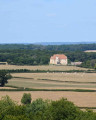
(7) At the bend, head up the path opposite. Halfway up, turn right (viewpoint over Villemoulin Castle) and eventually join the D958.

(8) Follow it to the right until you reach the bend (view of Corbigny), then turn left and walk through Rennebourg. Carry on straight ahead, past the farm, and head downhill (slippery in bad weather). Follow the D977 bis to the right to return to Corbigny.

(9) At the crossroads, carry on straight ahead along the Anguison. Pass the wash house (view of the Madeleine tower and the former marshes), turn left into Rue de la Madeleine and reach the end of the bridge (S/E).

Waypoints

  1. S/E : mi 0 - alt. 656 ft - Abbey - Anguison (rivière) à finaliser
  2. 1 : mi 0.31 - alt. 669 ft - Path
  3. 2 : mi 1.17 - alt. 873 ft - Path
  4. 3 : mi 1.74 - alt. 840 ft - Route de Cropigny
  5. 4 : mi 2.19 - alt. 764 ft - T-junction
  6. 5 : mi 2.56 - alt. 659 ft - Crossroads
  7. 6 : mi 3.16 - alt. 607 ft - Moulin de la Claie - Auxois (rivière) - Affluent de l'Yonne
  8. 7 : mi 4.29 - alt. 640 ft - Turn - Auxois (rivière) - Affluent de l'Yonne
  9. 8 : mi 5.08 - alt. 873 ft - Corbigny
  10. 9 : mi 6.48 - alt. 650 ft - Washing house - Anguison (rivière) à finaliser
  11. S/E : mi 6.66 - alt. 656 ft - Abbey - Anguison (rivière) à finaliser

Notes

Water point and public toilets in Corbigny. Plenty of shops and restaurants.

Worth a visit

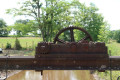
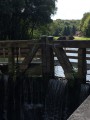
Le Moulin de la Claie: in the past, the village of Anthien had three mills used to grind the locals’ grain. It was the Moulin de la Claie that remained in operation for the longest time. In fact, in 1988, the local council referred to its ‘highly modern design’. It was powered mainly by water from the Auxois river and by steam during periods of drought.

Villemollin Castle: this castle is said to have been built on the site of a temple dedicated to Jupiter and a Gallo-Roman villa. It is a15th-century fortified residence, the majority of which was rebuilt inthe 17th century and then extensively remodelled inthe 19th century. The ‘De Certaines’ family have owned the property since 1538. Listed as a Historic Monument, the château also served as a filming location for Bruno Podalydès’s film *Le Mystère de la Chambre Jaune*. It is open to visitors in July and August. Contact: 06 73 19 78 22.

The Madeleine Tower: it evokes the days when the town was fortified with 14 towers, pierced by five gates and surrounded by moats. Most of the structures were destroyed. The Madeleine Tower and the Isle Tower still stand, both listed as Historic Monuments.

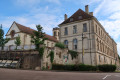
Corbigny Abbey: founded around 1107, the current building dates from 1754. Since 1789, the abbey has served various purposes: a state stud farm, a teacher-training college, a military hospital and a secondary school. Listed as a Historic Monument, it is now a centre for creative work and cultural outreach. Come and visit it to explore its exhibitions in July and August.

Other walks in the area

For more walks, use our search engine .

The GPS track and description are the property of this route's author. Please do not copy them without permission.