


Refine your search for walks in La Richardais
La Richardais walks


 Circular walk via Pointe de Cancaval from La Richardais
 Association / Club / Walk leader
 5.03 mi
 +157 ft
 -174 ft
 2h 25
2h 25
 Easy
Easy
 Departure from La Richardais (Ille-et-Vilaine)
The route takes you along the banks of the Rance between La Richardais and the hamlet of Créhen, via the Pointe de Gronget. The Pointe de Cancaval offers a beautiful view of the Rance, the dam of the same name and the town of Alet towards Saint-Malo.
Around La Richardais
 Visorando Member6.13 mi
+308 ft
-295 ft
3h 05
Easy
Departure from La Richardais (Ille-et-Vilaine)
Visorando Member6.13 mi
+308 ft
-295 ft
3h 05
Easy
Departure from La Richardais (Ille-et-Vilaine)
Walk around the village of La Richardais. You start on the banks of the Rance, on the foreshore at La Richardais harbour, near an old tide mill at Pointe de Cancaval. Return via the most inland route possible, following paths through the woodland.
Pointe de Cancaval and La Malouinière du Montmarin
 3.52 mi
+105 ft
-108 ft
1h 45
Easy
Departure from Pleurtuit (Ille-et-Vilaine)
3.52 mi
+105 ft
-108 ft
1h 45
Easy
Departure from Pleurtuit (Ille-et-Vilaine)
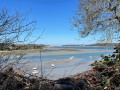
Jutting out into the Rance estuary, Pointe de Cancaval offers beautiful views of the right bank: from Saint-Servan to Saint-Malo, the dam and the moorings dotted along the coast.
During the walk, you will notice La Malouinière de Montmarin and its remarkable garden, which is one of the most beautiful private residences, and two tidal mill sites that bear witness to the industrial past linked to the tidal range.
The Rance estuary on the Dinard side, then Saint-Malo
 9.52 mi
+489 ft
-518 ft
4h 50
9.52 mi
+489 ft
-518 ft
4h 50
 Moderate
Departure from La Richardais (Ille-et-Vilaine)
Moderate
Departure from La Richardais (Ille-et-Vilaine)
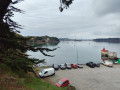
Walking along the Chemin de Ronde between the dam and the pier, you will enjoy various panoramic views of Saint-Servan-sur-Mer and then Saint-Malo. A short boat trip will take you to an outer basin of the port of Saint-Malo. Continue on to the Cité d'Aleth, the Solidor Tower and the Rosais to complete this tour by crossing the dam.
The mills of the Rance - Le Poudouvre
 10.34 mi
+705 ft
-696 ft
5h 20
Moderate
Departure from Pleurtuit (Ille-et-Vilaine)
10.34 mi
+705 ft
-696 ft
5h 20
Moderate
Departure from Pleurtuit (Ille-et-Vilaine)
The Rance once had many tide mills on its banks. Today, with the passage of time, erosion and lack of maintenance, little remains. This circuit allows you to discover the coastline, countryside, coastal path, remains of the Montmarin mills, the new mill and the dam that uses the movements of the tides for its tidal power plant.
Around Saint-Jouan-des-Guérets
 10.60 mi
+351 ft
-381 ft
5h 10
Moderate
Departure from Saint-Malo (Ille-et-Vilaine)
10.60 mi
+351 ft
-381 ft
5h 10
Moderate
Departure from Saint-Malo (Ille-et-Vilaine)
From Saint-Jouan-des-Guérets to La Rance via theGRP® long-distance hiking trail and the countryside around Saint-Malo.
Dinard between land and sea
 9.31 mi
+410 ft
-420 ft
4h 40
Moderate
Departure from Dinard (Ille-et-Vilaine)
9.31 mi
+410 ft
-420 ft
4h 40
Moderate
Departure from Dinard (Ille-et-Vilaine)
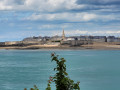
You will start by winding your way through the Dinard countryside to reach the sea. Take the customs officers' path, the Clair de Lune promenade, and discover the many islets of the Bay of Saint-Malo. You can also explore the Goule aux Fées cave, where the Lumière brothers took their first photographs in 1877.
Around Quelmer, starting from La Goëléterie
 5.92 mi
+387 ft
-358 ft
3h 05
Easy
Departure from Saint-Malo (Ille-et-Vilaine)
5.92 mi
+387 ft
-358 ft
3h 05
Easy
Departure from Saint-Malo (Ille-et-Vilaine)
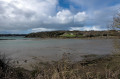
A circular trail of about 10 km around Quelmer, starting from La Goëléterie. Points of interest: the banks of the Rance, La Passagère, the boat graveyard at La Passagère, the Pointe de la Roche du Port with its superb views of the Rance, and splendid malouinières (traditional houses) along the way.
The first part of this route follows the coastal path. The second part follows another route called "Around Quelmer and La Passagère".
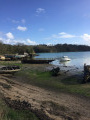
La Rance at Quelmer, La Passagère and the boat graveyard.
 4.14 mi
+154 ft
-141 ft
2h 00
Easy
Departure from Saint-Malo (Ille-et-Vilaine)
4.14 mi
+154 ft
-141 ft
2h 00
Easy
Departure from Saint-Malo (Ille-et-Vilaine)
The path runs along the right bank of the Rance, overlooking its rocky coves, which resemble Mediterranean calanques. Along the way, stop at La Passagère, where you can see the Maison du Passeur and the house of Commander Jean Charcot. In the cove, you will find the boat graveyard, the only place where old hulls from the Rance valley are beached.
From Dinard to Saint-Briac
15.76 mi
+535 ft
-535 ft
7h 45
 Difficult
Departure from Dinard (Ille-et-Vilaine)
Difficult
Departure from Dinard (Ille-et-Vilaine)
A fantastic walk overlooking a multitude of beaches and coves via theGR®34. Most of the route follows a coastal path with a few sections of moderate difficulty. Return via a very pleasant little country road.
Please note: at Pointe du Moulinet and Port-Blanc, the path may be inaccessible at high tide.
The Rance, parks and gardens from the Cité d’Aleth to La Briantais
 5.79 mi
+453 ft
-456 ft
3h 05
Easy
Departure from Saint-Malo (Ille-et-Vilaine)
5.79 mi
+453 ft
-456 ft
3h 05
Easy
Departure from Saint-Malo (Ille-et-Vilaine)
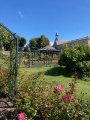
On the other side of the walls, the west coast of the Saint-Servan district unfolds before walkers like a green carpet stretching from the Cité d’Aleth to Parc du Briantais. From Cale Solidor, where the tower stands elegantly, this route, dotted with green spaces, passes through a multitude of exceptional landscapes alternating between coves, parks, inlets and beaches. The Parc des Corbières trail offers, right from the start, a unique view of the Rance estuary and the town of Dinard, and allows you to discover some rather secluded beaches. Further on, the magnificent Parc du Briantais invites you to enjoy a moment of discovery and relaxation before a more urban return through the parks and gardens. Next, the Port des Sablons and the ferry terminal bear witness to the town’s importance as a port. Finally, the Cité d’Aleth opens up to you; step back in time through its history, facing the English Channel where Vauban’s forts stand out against the horizon.
A balcony overlooking the Bay of Saint-Malo - La Cité d'Alet
 2.28 mi
+151 ft
-144 ft
1h 10
Easy
Departure from Saint-Malo (Ille-et-Vilaine)
2.28 mi
+151 ft
-144 ft
1h 10
Easy
Departure from Saint-Malo (Ille-et-Vilaine)
The Cité d'Alet is a family-friendly walk, with an exceptional promontory, offering 270° panorama of the Cité Corsaire, the fortified rocks of La Conchée, Petit Bé, Île Harbour, Grand Bé (Chateaubriand's burial place), the Rance estuary and its dam, and Dinard and its beaches.
It's also Saint-Malo birthplace, with the remains of the first human settlements.
Following Lawrence of Arabia to Dinard
4.23 mi
+207 ft
-220 ft
2h 10
Easy
Departure from Dinard (Ille-et-Vilaine)
The environment we are taking you to is no longer the one that Thomas Edward Lawrence, known as Lawrence of Arabia, explored by bicycle. But although urbanisation has developed considerably, the charm of the Emerald Coast remains. Let's head to the village of Saint-Énogat, the birthplace of the tourist town of Dinard, and take the coastal path around the two headlands that frame it: Pointe de la Malouine and Pointe du Moulinet.
In the footsteps of Vauban in Saint-Malo
5.74 mi
+341 ft
-315 ft
2h 55
Easy
Departure from Saint-Malo (Ille-et-Vilaine)
Vauban erected numerous military structures along the Breton coastline, and they are very often built on remarkable sites. Here are two notable examples: the Fort de la Cité d’Alet at the summit of the Saint-Servan peninsula, and the Fort National, which faces the Plage de l’Éventail in Saint-Malo.
The garden of Minihic-sur-Rance and its dry dock at La Landriais
 5.26 mi
+272 ft
-285 ft
2h 40
Easy
Departure from Le Minihic-sur-Rance (Ille-et-Vilaine)
5.26 mi
+272 ft
-285 ft
2h 40
Easy
Departure from Le Minihic-sur-Rance (Ille-et-Vilaine)
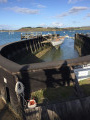
From the beautifully landscaped public garden, there is a remarkable view of the Rance and its right bank, from which the village of Saint-Suliac stands out. From the garden, you can easily reach Garel Beach and the Landriais shipyard with its specific equipment: the above-ground wooden dry dock, via the cliff-top path.
The wet Guérouse valley winds through the undergrowth that makes up the Domaine du Pièton.
A circular loop along the banks of the Rance, starting from Minihic
 11.75 mi
+594 ft
-607 ft
5h 55
Moderate
Departure from Le Minihic-sur-Rance (Ille-et-Vilaine)
11.75 mi
+594 ft
-607 ft
5h 55
Moderate
Departure from Le Minihic-sur-Rance (Ille-et-Vilaine)
This walk combines the routes suggested on Visorando around the Minihic, forming a double circular route around the Minihic and Langrolay further south. It is a pleasant walk along the banks of the Rance, with Mont Gareau, Saint-Suliac and the Pointe du Puits opposite. The path overlooks the Rance and offers numerous viewpoints. The route passes by the Landriais shipyards and dry dock, to the north of the Minihic. On the return journey, there are sunken paths via Langrolay and the Chapel of Sainte-Anne in Saint-Buc, dating from 1631. The walk is well shaded in summer and late spring.
The mills of the Rance - The foreshores
 9.53 mi
+594 ft
-610 ft
4h 55
Moderate
Departure from Le Minihic-sur-Rance (Ille-et-Vilaine)
9.53 mi
+594 ft
-610 ft
4h 55
Moderate
Departure from Le Minihic-sur-Rance (Ille-et-Vilaine)
The first tidal mill on the Rance was built in 1181 (Moulin du Lupin near Rothéneuf). These mills flourished between the 16th and 17th centuries. Today, few of these renewable energy sources remain. This route allows you to see the remains of two mills (Fosse Mort and La Herviais) and to stroll through this estuary, which is ideal for the construction of mills.
The balconies of Minihic-sur-Rance
 7.12 mi
+423 ft
-453 ft
3h 40
Moderate
Departure from Le Minihic-sur-Rance (Ille-et-Vilaine)
7.12 mi
+423 ft
-453 ft
3h 40
Moderate
Departure from Le Minihic-sur-Rance (Ille-et-Vilaine)
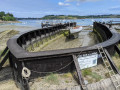
One of the classic walks in the Rance Basin. The path overlooks the Rance and offers numerous colourful views of the water, the riverbanks and river life. An opportunity to walk alongside the Minihic shipyards. A return via the sunken paths and the shaded valley of Saint-Buc takes us back to the Sainte-Anne Chapel, dating from 1631.
Very breezy and shaded in summer, very bright and open in early spring. High tide, low tide: you never see the same landscape.
The forts of Saint-Malo at low tide with a high tidal range
4.54 mi
+66 ft
-89 ft
2h 10
Easy
Departure from Saint-Malo (Ille-et-Vilaine)
We invite you to explore the three main fortified islets in the Bay of Saint-Malo: Fort du Petit Bé, Grand Bé—which houses Chateaubriand’s tomb—and Fort National. Access to these islets is only safe at low tide and when the tidal range is at least 80. Extend your exploration with a stroll along the foreshore and its wooden breakwaters, admiring the beautiful buildings and hotels lining the Sillon.Before setting off on the walk, check the day’s weather forecast.
Views of the islands of Saint-Jouan-des-Guérets
 5.88 mi
+276 ft
-266 ft
2h 55
Easy
Departure from Saint-Jouan-des-Guérets (Ille-et-Vilaine)
5.88 mi
+276 ft
-266 ft
2h 55
Easy
Departure from Saint-Jouan-des-Guérets (Ille-et-Vilaine)
A walk that allows you to explore the Rance estuary and a few islands. This is a shorter version of walk 88877, ‘Around Saint-Jouan-des-Guérets’.
The Pointe de la Varde from the ramparts of Saint-Malo
 7.74 mi
+171 ft
-141 ft
3h 40
Moderate
Departure from Saint-Malo (Ille-et-Vilaine)
7.74 mi
+171 ft
-141 ft
3h 40
Moderate
Departure from Saint-Malo (Ille-et-Vilaine)
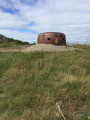
The autumn equinox tides (coefficient of 92) allow you to make a return trip from the ramparts of Saint-Malo to the Pointe de la Varde, across the foreshore and with dry feet. You walk alongside theGRP®® Tour du Pays Malouin at a distance.
Circular loop of Saint-Jouan and La Chapelle du Val ès Bouillis
 5.56 mi
+400 ft
-390 ft
2h 55
Easy
Departure from Saint-Jouan-des-Guérets (Ille-et-Vilaine)
5.56 mi
+400 ft
-390 ft
2h 55
Easy
Departure from Saint-Jouan-des-Guérets (Ille-et-Vilaine)
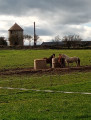
This is a gentle hike that forms a double circular route, one around the hamlet of Le Val ès Bouilli and the second around La Livaudais. Much of the route runs alongside the Rance. The rest is divided between sunken paths and small roads. Along the way, you can see the Pointe du Puits and the Pont Chateaubriand to the south.
Saint-Malo intramural city and Solidor Tower
 7.71 mi
+390 ft
-384 ft
3h 55
Moderate
Departure from Saint-Malo (Ille-et-Vilaine)
7.71 mi
+390 ft
-384 ft
3h 55
Moderate
Departure from Saint-Malo (Ille-et-Vilaine)
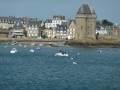
Discover the pirate town and the personalities who played a part in its history.
Route of Street Art in Saint-Malo
 5.23 mi
+69 ft
-69 ft
2h 30
Easy
Departure from Saint-Malo (Ille-et-Vilaine)
5.23 mi
+69 ft
-69 ft
2h 30
Easy
Departure from Saint-Malo (Ille-et-Vilaine)
Since 2013, the cities of Rennes and Saint-Malo have been joining forces every two years for a new street art event. On this occasion, works by urban artists adorn the city’s walls, transforming them into giant, colourful murals. Thus, this ephemeral art form emerges and disappears with each edition. The most recent event took place in 2022. This purely urban walking route, created in August 2024, winds its way through various neighbourhoods of the city and allows you to discover a number of works – often panoramic in nature – some of which have vanished from the landscape, hidden beneath a layer of insulation or following façade renovation, notably on Quai Duguay Trouin. Wander through this open-air gallery – the perfect opportunity to get some fresh air whilst drifting between dreams and imagination.
Saint-Suliac, North point
 3.97 mi
+151 ft
-167 ft
1h 55
Easy
Departure from Saint-Suliac (Ille-et-Vilaine)
3.97 mi
+151 ft
-167 ft
1h 55
Easy
Departure from Saint-Suliac (Ille-et-Vilaine)
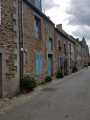
A lovely walk around the northern tip of Saint-Suliac. Do it whatever the weather!
Moderator's note as of 06/04/2021: Some modifications on the ground since the creation of this hike: see the comments at the bottom of this page.
Moderator's note a description of June 2022 in reverse order to this one is available here
Circular walk from Saint-Suliac via Pointe du Puits and Mont Gareau
 7.16 mi
+515 ft
-515 ft
3h 45
Moderate
Departure from Saint-Suliac (Ille-et-Vilaine)
7.16 mi
+515 ft
-515 ft
3h 45
Moderate
Departure from Saint-Suliac (Ille-et-Vilaine)
Just ten kilometres or so south of Saint-Malo, Saint-Suliac is a small village situated on the coast of the Rance estuary. It is a former fishing village. The route suggested here allows you to discover the rich variety of landscapes; it passes via Mont Garrot (or Gareau), which, at a height of 73 metres, offers a panoramic view of the Rance valley and the ‘Viking camp’. It runs alongside the river and passes through designated nature reserves. Along the route, you can admire two historic mills: a windmill overlooking the hill (which cannot be visited, as it stands on private land that is not accessible) and the old Boschet tide mill, built inthe 16th century and in operation until the 1940s. A local association has carried out its complete restoration.
Circular route to Saint-Suliac via Mont Gareau and Moulin du Tertre
 5.37 mi
+463 ft
-463 ft
2h 50
Easy
Departure from Saint-Suliac (Ille-et-Vilaine)
5.37 mi
+463 ft
-463 ft
2h 50
Easy
Departure from Saint-Suliac (Ille-et-Vilaine)
Shortly after setting off, you will come to the oratory, dedicated to the safety of sailors setting out to sea for the banks of Newfoundland. There is a magnificent view of the village, the Rance and the opposite bank as far as the Pont Chateaubriand bridge.
The walk continues along the banks of the Rance to the summit of Mont Gareau, where another viewpoint will surprise you.
Along the way, you can admire two old mills: a windmill overlooking the hill (not open to visitors, as it is on private land) and an old tide mill, built inthe 16th century, which was in operation until the 1940s. An association is working to restore it.
Circular via Pointe du Puits and Clos de la Croix in Saint-Suliac.
 4.79 mi
+256 ft
-272 ft
2h 25
Easy
Departure from Saint-Suliac (Ille-et-Vilaine)
4.79 mi
+256 ft
-272 ft
2h 25
Easy
Departure from Saint-Suliac (Ille-et-Vilaine)
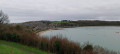
Saint-Suliac, a former fishing village, is located a stone's throw from Saint-Malo. The landscapes are varied, and this walk will allow you to discover the maritime side of Saint-Suliac and the narrow streets of the old part of the village. The steep side of the shore along the Rance is somewhat reminiscent of the GR®34 between Saint-Malo and Cancale, all things considered. There is a beautiful view of the Rance from the Pointe du Puits.
The hedgerows and ponds of the Frémur at the start of the Rues
 6.68 mi
+210 ft
-217 ft
3h 15
Moderate
Departure from Ploubalay (Côtes-d'Armor)
6.68 mi
+210 ft
-217 ft
3h 15
Moderate
Departure from Ploubalay (Côtes-d'Armor)
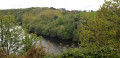
The Pleurtuit ponds, fed by the Frémur, are a delight for anglers and stretch out in deep meanders through peaceful countryside, just a few kilometres from the Dinard-Saint Malo conurbation.
They provide the drinking water supply for the entire urban area thanks to the Bois Joli dam, which was filled in 1992
The path marked in yellow circles the area; it can be accessed from various starting points, including the hamlet of Les Rues.
A viewpoint overlooking the Haut Frémur in Tréméreuc
 4.32 mi
+279 ft
-292 ft
2h 15
Easy
Departure from Tréméreuc (Côtes-d'Armor)
4.32 mi
+279 ft
-292 ft
2h 15
Easy
Departure from Tréméreuc (Côtes-d'Armor)
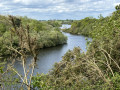
The upper reaches of the Frémur flow at the bottom of a lush green valley where, from a mere trickle, it transforms into a pretty river that feeds the Bois Joli dam, which serves as the water reservoir for the Dinard conurbation.The path descends to the valley floor, then climbs to form a balcony overlooking the valley, offering lovely views.The setting is peaceful, with its meadows, shaded paths and the golf course, just a few kilometres from Dinard.
More walks in La Richardais
Select a point of interest below: