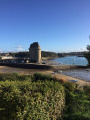
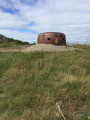
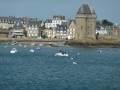
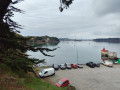
The forts of Saint-Malo at low tide with a high tidal range

We invite you to explore the three main fortified islets in the Bay of Saint-Malo: Fort du Petit Bé, Grand Bé—which houses Chateaubriand’s tomb—and Fort National. Access to these islets is only safe at low tide and when the tidal range is at least 80. Extend your exploration with a stroll along the foreshore and its wooden breakwaters, admiring the beautiful buildings and hotels lining the Sillon.
Before setting off on the walk, check the day’s weather forecast.

Details

94214573
Creation:
Last update:
Last review:
  • Walking
    Activity: Walking
  • ↔
    Distance: 7.31 km
  • ◔
    Average duration: 2h 10 
  • ▲
    Difficulty: Easy

  • ⚐
    Back to start: Yes
  • ↗
    Ascent: + 20 m
  • ↘
    Descent: - 27 m

  • ▲
    Highest point: 21 m
  • ▼
    Lowest point: -5 m
  • ⚐ Country: France
  • ⚐ District: Saint-Malo (35400)
  • ⚑
    Start/End: N 48.641086° / W 2.019858°
  • ❏
    IGN map(s): Ref. 1116ET
  • Hour-by-hour weather

Description of the walk

There are several car parks within the walled city of Saint-Malo, but they are all pay-and-display. We recommend parking at the Naye sports complex car park.

(S/E) Leave the car park and head towards the walled city. Walk along the Bassin Vauban, past the trawler quay, the lock and its drawbridge, then the large dry dock and the ferry terminal. Turn left onto the Quai de la Bourse.

(1) Before entering the old town through the Porte de Dinan, stop in front of this building, erected in the Coquillards industrial estate. Then walk up Rue de Dinan and turn left onto Rue d’Estrées. Continue to the end of the street.

(2) Head down onto the foreshore, then turn right to cross the rocks, then along the beach past the swimming pool to reach the Passage des Prés, and follow the submersible stone path. Head towards the islet of Le Petit Bé and its fort.

(3) Take the left-hand path to approach the fort.

(4) Return to the previous crossroads.

(3) Turn left and head towards Grand Bé. The path is a steep, stony track. It goes all the way round Grand Bé and passes Chateaubriand’s grave.

(5) Complete the circuit to return once more to the junction of the stony path.

(3) Head straight on to reach the ramparts at the steps of the Round Tower.

(6) Use these steps at the base of the tower to reach the foot of the wall. Walk around it along the path. Then descend onto a rocky area, which should be crossed with care. You will reach Plage du Sillon, then easily arrive at the foot of Fort National.

(7) Take the path on the right, turning almost 180°, to reach the beach and then the GR®34.

(8) Turn left onto it and follow the red and white markings to the junction with Rue Roger Vercel.

(9) Turn right onto it to reach Quai Dugay-Trouin.

(10) Turn right at a 90° angle onto this quay and walk along the Duguay and then Vauban basins before returning to the Naye car park (S/E).
You can extend your route with a stroll along the large Plage du Sillon, and return to the car park by following the quays (where the Route du Rhum boats are moored) of the Bassin Vauban.

Waypoints

  1. S/E : km 0 - alt. 8 m - Naye car park
  2. 1 : km 0.82 - alt. 4 m - Monument to the Terre-Neuvas
  3. 2 : km 1.12 - alt. 13 m - Poterne
  4. 3 : km 1.75 - alt. 3 m - Submersible cobbled path
  5. 4 : km 2.02 - alt. 0 m - Towards the Petit Bé
  6. 5 : km 2.58 - alt. 14 m - Grand Bé
  7. 6 : km 3.18 - alt. 10 m - Staircase of the Round Tower
  8. 7 : km 3.94 - alt. 3 m - Fort National
  9. 8 : km 4.37 - alt. 9 m - GR34
  10. 9 : km 5.09 - alt. 4 m - Rue Roger Vercel
  11. 10 : km 5.28 - alt. 7 m - Quai Dugay-Trouin
  12. S/E : km 7.31 - alt. 8 m - Naye car park

Notes

(1) The Coquillards’ shipyard: it commemorates the loss of 300 Newfoundland ships in 1750.

Why does Saint-Malo have the right to fly its own flag? In 1594, the rebellious bourgeoisie rallied to the French crown, which had recently reverted to Catholicism. Today, the Saint-Malo flag flies alone atop the Grand Donjon of Saint-Malo Castle, in homage to this ambitious maritime republic. And it is no coincidence that the city’s unofficial motto is ‘Neither French nor Breton, I am from Saint-Malo ’…

Worth a visit

The three forts form part of a line of defence erected under Louis XIV by the engineer Garangeau, based on Vauban’s plans, to protect the port of Saint-Malo from Anglo-Dutch attacks. They are complemented by Fort Harbour (opposite Dinard), the fort at Pointe de la Varde, and Fort de la Conchée.
During the Second World War, the Germans used the sites selected by Vauban to fortify them in turn. They have been demilitarised and are privately owned; some are open to visitors.

Shortly afterwards (4): Fort du Petit Bé has been restored by a private individual who organises tours and receptions. It is accessible only by sea.
(5) Le Grand Bé: only a few walls from the Vauban period remain, along with German fortifications. It is primarily Chateaubriand’s tomb that makes it an exception.
(7) Fort National: over the course of various political regimes, it has been known as Fort de l’Ilet, Fort Royal, and now Fort National. In August 1944, a few days before the liberation of Saint-Malo, the 380 able-bodied men of the Cité were imprisoned there; 18 were killed in a bombardment.
Important note: When Fort National is open to visitors, the French flag is hoisted on the flagpole.

Always be cautious and plan ahead when you're outdoors. Visorando and the author of this route cannot be held responsible for any accidents occurring on this route.

The GR® and PR® markings are the intellectual property of the Fédération Française de Randonnée Pédestre.

Other walks in the area

For more walks, use our search engine .

The GPS track and description are the property of this route's author. Please do not copy them without permission.