Following Lawrence of Arabia to Dinard

The environment we are taking you to is no longer the one that Thomas Edward Lawrence, known as Lawrence of Arabia, explored by bicycle. But although urbanisation has developed considerably, the charm of the Emerald Coast remains. Let's head to the village of Saint-Énogat, the birthplace of the tourist town of Dinard, and take the coastal path around the two headlands that frame it: Pointe de la Malouine and Pointe du Moulinet.

Details

28773300
Creation:
Last update:
Last review:
  • Walking
    Activity: Walking
  • ↔
    Distance: 6.81 km
  • ◔
    Average duration: 2h 10 
  • ▲
    Difficulty: Easy

  • ⚐
    Back to start: Yes
  • ↗
    Ascent: + 63 m
  • ↘
    Descent: - 67 m

  • ▲
    Highest point: 38 m
  • ▼
    Lowest point: -2 m
  • ⚐ Country: France
  • ⚐ District: Dinard (35800|35780)
  • ⚑
    Start/End: N 48.631507° / W 2.060532°
  • ❏
    IGN map(s): Ref. 1016ET, 1116ET
  • Hour-by-hour weather

Description of the walk

Park in the Veil car park at the corner of Rue Raphaël Veil and Rue de la Fontaine: free outside the tourist season.

(S/E) Leave the car park via the stairs next to the transformer on Rue Raphaël Veil, and take Rue Clos du Roy opposite. Cross Avenue Édouard VII at the pedestrian crossing and continue straight on along Rue du Paradou. At the crossroads, take a short detour to the right onto Passage du Trocadéro and see the oldest house in Dinard, La Centenaire, dating from 1797.

(1) Retrace your steps and take Rue du Paradou on the right to reach Rue de Saint-Énogat. Turn left and walk for about 200 metres.

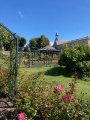
(2) On your left, an unnamed road leads to the Tourelles public garden, which was completely redesigned in 2025. Exit through the opening onto Boulevard Lhotelier next to the Temple. Turn right and continue straight ahead.

(3) Cross Boulevard Lacroix, noting the Regional Sports Centre located in a former disused hotel. Walk along Parc des Marettes, then Halle Binet, until you reach the junction with Boulevard de la Mer.

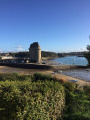
(4) Turn left and you will see the boundary wall and its decoration of an imposing residence on your right. The boulevard overlooks the park and Port Riou beach, where a monument has been erected in honour of sailors lost at sea.

(5) At the end of the boulevard, turn right onto Rue des Villas de la Mer. Turn right, walk alongside Saint-Énogat cemetery and go around it on the left via Rue de la Vistule. Continue along Rue Noroy, then along the cobbled path that extends it and leads to Rue des Bains. Turn right to reach the beach and follow the foreshore to the right.

(6) Find the concrete coastal path that follows the coastline at the foot of the cliffs overlooked by the oldest villas and most beautiful residences on the coast. Pass Pointe de la Malouin, the small beach of Port Salut and reach Pointe de Roche Pendante, at the top of which stands the Villa des Roches Brunes, the emblem of the town of Dinard.

(7) Continue along the coastal path which leads to Écluse beach, Dinard's main beach.

(8) Walk up Promenade Picasso, characterised by its beach huts, each bearing the name of an artist or film professional who has presided over the Dinard Film Festival. Then pass by the beach bars and restaurants, the statue of Alfred Hitchcock, the Casino, the heated indoor Olympic-size seawater swimming pool, and the adjacent Palais des Arts et des Festivals. Continue along the Promenade des Alliés to reach the open-air swimming pool.

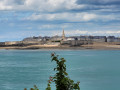
(9) Continue along the coastal path on the left to go around Dinard's second distinctive headland, the Pointe du Moulinet, from where you have an exceptional view of Saint-Malo, its port, ramparts and the islets in the bay. Reach the cove known as the Bec de la Vallée.

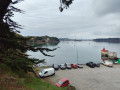
(10) Then switch to the part of the coast facing Saint-Malo and Saint-Servan, well sheltered from the prevailing winds, facing east-south-east. This is also the Rance estuary and the marina area with its hundreds of boats moored in neat rows. The coastal path then takes the name Promenade du Clair de Lune. It is embellished by Mediterranean-style vegetation thanks to its exposure. Throughout the promenade, stairways or access ramps provide access to the town centre.

(11) Take the ramp to leave the promenade, and via Rue Émile Baba, then Rue de la Gare, which extends it, reach Rue du Clos de la Fontaine. At the crossroads, take the street on the right to reach the car park (S/E).

Waypoints

  1. S/E : km 0 - alt. 16 m - Veil car park
  2. 1 : km 0.29 - alt. 18 m - La Centenaire House
  3. 2 : km 0.54 - alt. 26 m - Jardin public des Tourelles junction
  4. 3 : km 1 - alt. 35 m - Boulevard Lacroix
  5. 4 : km 1.29 - alt. 30 m - An exceptional residence
  6. 5 : km 1.75 - alt. 26 m - Turn right at the fork.
  7. 6 : km 2.25 - alt. 9 m - Coastal path
  8. 7 : km 3.21 - alt. 1 m - Pointe de Roche Pendante
  9. 8 : km 3.61 - alt. 15 m - Écluse Beach
  10. 9 : km 4.37 - alt. 17 m - Open-air swimming pool - Pointe du Moulinet (Dinard)
  11. 10 : km 5.19 - alt. 18 m - The Bec de la Vallée
  12. 11 : km 6.11 - alt. 7 m - Footbridge - Rance (fleuve)
  13. S/E : km 6.81 - alt. 16 m - Veil car park

Notes

Depending on the tides and weather conditions, the coastal path can be dangerous.

It is therefore recommended that you always check the sea and weather conditions, as well as any access restrictions issued by the authorities, before setting out.

(10) From Bec de la Vallée and the marina, two regular boat services take you to the ramparts of Saint-Malo at the Porte de Dinan.

Worth a visit

Thomas Édouard (1888/1935) lived in Dinard with his parents from 1891 to 1893, then made several visits between 1906 and 1910, during which time he criss-crossed Brittany by bicycle. We have found no concrete evidence of his visits.

Until the end of the 19th century, the Dinard-Saint-Enogat coastline was covered with moorland and pastures, and the main activities were livestock farming and coastal fishing. Seaweed harvesting provided additional income. Windmills dotted the coastline.

Around 1850, the first sea bathing establishments appeared, along with French and foreign investors. It was mainly the Lebanese Rachaîd Dahdah who structured the sector by subdividing vast tracts of land and building luxury villas, large hotels and casinos, and bringing in the train.

The English played an important role in urbanisation by bringing their methods to the construction of villas and manor houses: steeply pitched roofs, bow windows and large parks.

Dinard-Saint-Énogat welcomed a wealthy clientele, including royal families, artists and politicians, until 1929. After the war, the resort developed around mass tourism.

However, it was the construction of the hydroelectric dam on the Rance (1966) that brought economic development (it can be visited during the holidays upon registration).

Along the route, you will see many villas and manor houses, characteristic of this period. Some have been divided into flats.

You will also discover the islands of Saint-Malo Bay: Fort Harbour, the Grand Jardin lighthouse, Cézembre Island, Fort Petit Bé, Grand Bé (where Chateaubriand is buried), Fort National, and the Rance estuary, which is cut off by the dam.

Other walks in the area

For more walks, use our search engine .

The GPS track and description are the property of this route's author. Please do not copy them without permission.