A walk in the countryside near Lorigné

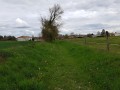
A short walk combining heritage discoveries with a chance to enjoy nature. It takes in several wells, a pond, bread ovens, remarkable trees and a beautiful viewpoint.

Details

745351
Creation:
Last update:
Last review:
  • Walking
    Activity: Walking
  • ↔
    Distance: 2.96 mi
  • ◔
    Average duration: 1h 30 
  • ▲
    Difficulty: Easy

  • ⚐
    Back to start: Yes
  • ↗
    Ascent: + 115 ft
  • ↘
    Descent: - 112 ft

  • ▲
    Highest point: 499 ft
  • ▼
    Lowest point: 430 ft
  • ⚐ Country: France
  • ⚐ City: Lorigné (79190)
  • ⚑
    Start/End: N 46.099172° / E 0.093009°
  • ❏
    IGN map(s): Ref. 1729SB, 1730SB
  • Hour-by-hour weather

Photos

Description of the walk

(S/E) The starting point is on Rue des Fayes in the hamlet of Le Sauvage. Take Rue de la Mare, which heads downhill (towards the west). After a right-hand bend, the narrow road reaches a crossroads: take the road on the left, making a very sharp hairpin bend (Rue du Carrefour du Puits). Ignore the dead-end road furthest to the right (which leads to a house) and the road opposite, which runs alongside a house.

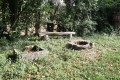
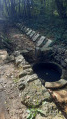
As you reach the bottom of the small valley, you’ll notice a small clearing on the left-hand side of the road with a stone well at ground level and a wooden bench. The road climbs, then takes a wide bend to the right, leading to the hamlet known as Chez Clion. Turn right onto Rue des Sabots de la Liberté, ignoring the road on the left and the dead-end road opposite. The narrow road winds its way out of the hamlet of Chez Clion. Further on, leave the descending road on your left – which joins the main road – and continue to the crossroads 100 metres ahead.

(1) At the centre of this three-way junction stands the Chez Clion well, complete with a swing beam for drawing water. Retrace your steps towards the hamlet of Chez Clion and, after about 100 metres, turn right onto the steeply ascending road leading up to the plateau.

Once on the plateau, the road runs alongside a small copse on your right. The road crosses a farm track: turn right onto the farm track. A little further on, pass a path on your right.

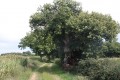
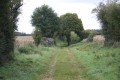
(2) The route reaches a ‘Y’-shaped junction of farm tracks; take one of the two branches, then turn sharply left to take the other branch of the ‘Y’. The farm track is lined with remarkable trees for a few hundred metres. Further on, it rejoins the road you took earlier to reach the plateau. Cross straight ahead and continue along the existing farm track.

A little further on, the forest track once again reaches a road; cross this straight ahead and continue along the forest track, which heads south-east towards the Bois des Fayes.
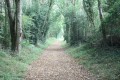
Shortly afterwards, the forest track enters the woodland and runs along the edge, turning into a lovely forest lane. Further on, leave a forest track on your right and continue along the forest lane, which is very shady and cool in summer.

(3) A little further on, at a junction of forest lanes, turn left onto the lane that leads deep into the Bois des Fayes.

(4) As you approach the clearings, turn left onto the forest lane at a T-junction and ignore the forest lane opposite, which leads to La Grange Neuve. A little further on, the forest lane becomes a forest track again at the edge of the woodland.

At the far end of the Bois des Fayes, pass a track on your left and continue straight ahead along the forest track, which climbs gently towards the first houses of the hamlet of Le Sauvage. Just before the hamlet of Le Sauvage, pass a forest track on your right. From there, the track gives way to a small tarmac road, the Rue des Fayes. It curves sharply to the left. Take this road and, shortly afterwards, you’ll see a charming communal bread oven on the right. The road bends to the right and you’ll soon reach the car park marking the end of the walk (S/E).

Waypoints

  1. S/E : mi 0 - alt. 472 ft - Rue des Fayes – Le Sauvage
  2. 1 : mi 0.58 - alt. 436 ft - Puits de Chez Clion
  3. 2 : mi 1.11 - alt. 489 ft - Y-junction
  4. 3 : mi 2.12 - alt. 466 ft - Junction of forest tracks
  5. 4 : mi 2.32 - alt. 440 ft - Junction of forest tracks
  6. S/E : mi 2.96 - alt. 472 ft - Rue des Fayes – Le Sauvage

Notes

The car park is situated at a crossroads in the hamlet of Le Sauvage in the municipality of Lorigné (near the ‘ruisseau perdu’ at 4 Rue des Fayes). Opposite is a small picnic area with a table and a drinking fountain (which may run dry in summer).

The route is signposted in yellow or blue (depending on the section).

This walk across varied terrain requires suitable footwear.

Worth a visit

Lorigné
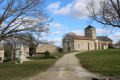
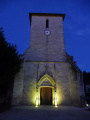
In the commune of Lorigné, there is an old bread oven and a remarkable church.

Sauzé-Vaussais
Over the centuries, the Sauzé-Vaussais region has been the scene of numerous battles:
the Battle of Voulon between the Franks and the Visigoths in the early 6th century, and the Battle of Poitiers in 732. Later, it was the Frankish invaders who ravaged the province. Undoubtedly, the inhabitants of Sauzé were not spared when Pepin the Short set fire to Mairé Abbey.
Of the two seigneuries of Sauzé, La Chaume was the smaller; that of Le Breuil, having belonged to the De Losne family, was owned by the Prévost Sansac family at the time of the Revolution.
The commandery of Sauzé, established as early as 1184, was subordinate to that of Civray. The chapel later became the property of the Hospitallers and served for a long time as a parish church; the commandery’s buildings were sold as national property during the Revolution.
Around 1884, some fifteen gold coins bearing the effigies of Philip VI, John the Good, Edward V and the Black Prince were discovered at Sauzé.

Vaussais:
Vaussais was for a long time the only parish in the commune; it formerly fell under the archpriesthood of Chaunay and the deanery of Poitiers.
The church at Vaussais, dedicated to Saint Junien, had been bequeathed to Saint-Étienne de Limoges in 1013 by a certain Doctrinus.
Severely damaged during the Wars of Religion, it was restored in 1681 thanks to the generosity of the lords of Puy d’Anché, who owned a chapel there and held a pew right in the chancel.
It has been listed as a historic monument since 1907 and has been undergoing extensive restoration work for several years, focusing in particular on the chancel and the transept. As a result, it is currently closed to both the public and for worship.

The legend of the Grosse Borne:
In Vaussais, the Saint-Junien well commemorates the patron saint of the labourers of Poitou. Legend has it that one day the local people attacked the hermit and stoned him. Junien placed a large stone on the ground and forbade his pursuers from going any further. Most obeyed, but a few brazen individuals pressed on. The very next day, these men were stricken with goitre, and their descendants, it is said, suffered from the same debilitating condition for several generations.

Sauzé-Vaussais in the 19th century:
At the beginning of the 19th century, Sauzé-Vaussais was home to two notaries, a tax collector for the Crown estates, a gendarmerie detachment and a post office. The land is fairly fertile and produces wheat, barley, rye, maize, oats and potatoes. Artificial pastures were also sown. There was a watermill, which was powered by the Péruze stream for only a third of the year. A small quantity of coarse cloth and fabric was produced for the farmers’ use. There was also a tile works and market halls. Sixteen annual fairs were held; markets took place every Thursday.

Places and monuments

Puy d’Anché Manor
Romanesque church of Vaussais
Vignaud Dovecote:
Owned by the Coulleau du Vigneau family in 1463, this dovecote formed part of the buildings of the Royal Post Office at Sauzé.
Featuring an original architectural design, the Royal Post Office’s dovecote consists of a square base with four semi-circular arches. The keystone is finely carved with the coat of arms of the Coulleau du Vigneau family.
The upper storey, containing 260 nesting boxes, is octagonal in shape and features an entrance door framed by four coats of arms that are indecipherable, having been hammered out during the Revolution. The pigeons entered via the two dormer windows, which were originally open to the south-west and north-west.
The ruins of the dovecote were donated to the local council in 1993. Clearing and dismantling work began in early November 1993 and was completed in late December 1996. It was transported and reassembled in 1999 on the RD 948 bypass. Part of its vault was deliberately left gaping open to reveal the terracotta nesting boxes and the chestnut timber frame.
The local council acquired and cleared a small adjoining woodland, and the site of the dovecote has been converted into a rest area.

Clock Tower, Town Hall Square.
The Clock Tower was built in 1840. It was the focal point of the Market Halls, which housed the town hall and magistrates’ court on the first floor.
It was around 1824 that the residents of Sauzé and the merchants called for the installation of a clock.
In 1839, the town council decided to build a square tower to house the famous municipal clock. However, the council eventually abandoned this plan in favour of constructing a town hall and magistrates’ court within the market halls, along with a bell tower (the present-day tower).
Later, at the start of the 20th century, the halls were demolished and only the tower was preserved

The Market Halls:
The old market halls, a timber-framed building with a tiled roof, were situated on the market square; these were demolished in the early 20th century.
In 1870, on the site of the current socio-cultural centre, the foundation stone was laid for the Halle aux blés, or grain market. Having suffered initial damage in February 1935 following a storm, it was completely destroyed in June 1944 during the war.
The new market halls, built in the early 1950s, were funded by the state following the war damage.
Several rooms were later fitted out on the upper floor, and the market halls were renamed the Socio-Cultural Centre.

Reviews and comments

4.7 / 5
Based on 3 reviews

Reliability of the description
5 / 5
Ease of following the route
5 / 5
Route interest
4 / 5
User 27843603

Overall rating : 4.7 / 5

Date of your route : Oct 13, 2025
Reliability of the description : ★★★★★ Very good
Ease of following the route : ★★★★★ Very good
Route interest : ★★★★☆ Good
Very busy route : No

A lovely walk, 80% of which is through woodland, taking 1½ hours. In mid-October, there are lots of chestnuts on the ground (avoid walking dogs). A wonderful experience. I recommend it

Machine-translated

User 24937301

Overall rating : 5 / 5

Date of your route : Sep 01, 2025
Reliability of the description : ★★★★★ Very good
Ease of following the route : ★★★★★ Very good
Route interest : ★★★★★ Very good
Very busy route : No

A charming little circuit alternating between farmland and woods. Magnificent solitary chestnut trees line the path. Charming hamlets.

Machine-translated

bischuss
bischuss

Overall rating : 4.3 / 5

Date of your route : Aug 07, 2023
Reliability of the description : ★★★★★ Very good
Ease of following the route : ★★★★★ Very good
Route interest : ★★★☆☆ Average
Very busy route : No

A walk through fields and woodland. Pleasant, but with no historical sites. A good way to explore nature

Machine-translated

Other walks in the area

For more walks, use our search engine .

The GPS track and description are the property of this route's author. Please do not copy them without permission.