Chef-Boutonne
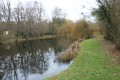
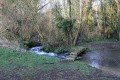
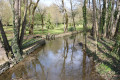
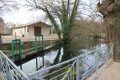
The village owes its name to the River Boutonne, which rises in the heart of the town, beneath the wash house on Rue de la Fontaine – hence the name ‘chef’, meaning the head of the Boutonne.
In the Poitevin dialect, its name is ‘Ch’ Boutoune’
Chef-Boutonne is a little-known cantonal town, save for the national fame of two figures: Chrétien Guillaume de Lamoignon de Malesherbes, the ill-fated defender of Louis XVI, and, closer to our own time, Jean-François Cail, who in the 19th century was the equivalent of what the industrialists Dassault or Bouygues represent today. The former lent his name to the square built on the ruins of the old feudal castle, at a place known as La Plaine, whilst the latter gave his name to the main square in the centre of the village.
Javarzay, whose name is of Gallo-Roman origin, was originally the main settlement; ancient remains have been found in its subsoil; however, the burial mounds at the Champ des Chirons (rue du Pont-Supérieur, excavated by Henri Beauchet-Filleau) indicate that Chef-Boutonne may have existed as early as that period.
As Chef-Boutonne, Javarzay and Lussay each formed a parish, they became separate municipalities in 1789. As early as 1790, the municipality of Javarzay was incorporated into Chef-Boutonne, and Lussay followed suit in 1829 or 1830.
In 1714, 12 fairs were held in the town. A pottery works, founded around 1778, operated at least until 1810. Textile manufacturing ceased in the 19th century. A spinning mill in Javarzay burnt down in 1859. In 1800, there were seven tanneries; all had ceased trading fifty years later.
The station, the building of which still stands, was served by two lines, both of which have since been closed:
- the standard-gauge Niort–Ruffec line operated by the Chemins de Fer de l’État (later the SNCF from 1937);
- the metre-gauge line from Saint-Saviol to Saint-Jean-d’Angély (1896–1951) operated by the Compagnie de chemins de fer départementaux (Charentes and Deux-Sèvres Network).
Boasting a rich and diverse range of community activities, the town has in recent years become renowned for an international table tennis tournament. Indeed, many players ranked in the world’s top 100 take part in it. The 9th edition of this tournament took place in 2011.
Places and monuments
- The Church of Saint-Chartier in Javarzay
Javarzay, formerly an independent castellany, is now a suburb of Chef-Boutonne. Its imposing church is dedicated to Saint Chartier, a saint from the Berry region who is said to have lived in the 6th century.
The nave with its side aisles and the transept were built around 1140, whilst the chancel was completely rebuilt in the early 16th century. The architectural structure, dating from the Romanesque period, is reminiscent of that of Saint-Pierre d’Aulnay in Charente-Maritime, a prestigious building and a jewel of Romanesque Poitou, listed as a UNESCO World Heritage Site as part of the Routes of Santiago de Compostela.
The expansive façade is punctuated vertically by four imposing buttresses and horizontally by a cornice that defines two levels. The central portal, with its four toric arches, is flanked on either side by a double blind arcade; the whole is crowned by a diamond-pointed string course. The capitals are decorated with masks and hollow leaves, whilst the abaci are adorned with foliage, stars and discs. The imposing cornice consists of carved modillions and metopes: in the centre, the Mystical Lamb, an image of the Saviour, flanked by an owl; and on either side, palmettes, rosettes, stars, birds and a figure walking with a staff over his shoulder. Above the portal, a window with small columns illuminates the nave.
Thirteen metres high and four bays long, the nave is vaulted with a broken barrel vault, as are the side aisles and the arms of the transept. Arches and transverse arches rest on fasciculated piers with eight small columns.
The transept crossing is covered by a dome supported by pendentives with large toric ribs. Note the highly decorative reticulated masonry of the pendentives. The band of wolf’s teeth that frames them is repeated at the base of the dome.
The capitals in the nave and side aisles are carved with water leaves from which emerge scrolls of foliage, fish, birds perched on lions pecking at their heads or hindquarters, quadrupeds including a hare and goat’s heads, and human heads rendered in a folk style.
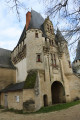
- Javarzay Castle (16th century), a listed historic monument, which houses the Coiffe Museum;
- The former Rue du Château, now the Avenue des Fils Fouquaud, which commemorates the fact that they were shot by the Germans in 1944
- Avenue Louis-Proust commemorates this young Resistance fighter who was shot at the age of sixteen and a half. This ‘avenue’ runs from the former Place du Marché, where market halls once stood before being demolished in 1787
- In Chef-Boutonne, official place names make no distinction between an ‘avenue’ and a ‘rue’. Thus, Avenue Louis-Proust is extended by a street – Rue de l’Hôtel-de-Ville et des Écoles – of equal importance, the same width and running in the same alignment, forming part of what is simply and more accurately known as Avenue de Javarzay, which was deliberately created in 1738
- La Croix Perrine: the name of this small square already existed in 1654 and undoubtedly derives from the almshouse that once stood there. It was a charitable institution that took in beggars and pilgrims during their journeys, equipped with a chapel for prayer and a cemetery, and which naturally would have had a cross. It was closed down under Louis XIV in 1696
- The Grand’Maison catches the eye with its architecture. In the triangular pediment above the door, a Latin inscription could be read within the medallion, stating that ‘the fear of the Lord is the beginning of wisdom’. It is dated 1567 and, as Protestants liked to engrave biblical quotations at the entrance to their homes, we can assume that the ‘Grand’Maison’ was built by a Protestant in 1567
- The Boutonne spring
- The Vestegaille Ecomuseum
Notable figures associated with the commune
- Jérôme Phélypeaux de Pontchartrain (1674–1747), statesman. In 1712, he acquired the barony of Chef-Boutonne, which was subsequently elevated to a marquisate for the benefit of Paul Jérôme, one of his sons.
- Jean-François Cail (1804–1871), industrial entrepreneur and mechanical engineer, born in Chef-Boutonne. The firm J.F. Cail & Cie was partly responsible for the founding of the Fives-Lille group.
- Jules Chabot de Bouin (1807–1857), writer, novelist and playwright, born in Chef-Boutonne.
- Laurent Cantet (1961), film director and screenwriter. He spent his childhood in Ardilleux in the canton of Chef-Boutonne.
Javarzay Castle
The site of Javarzay has been occupied since antiquity by a Gallo-Roman farm, the estate of GAVARCIUS, from which the name JAVARZAY derives.
It became a Merovingian royal farm in the 6th century. Clothaire I, son of Clovis and husband of Radegonde, stayed there in 559, and Saint Junien, the legendary hermit, was welcomed there.
Javarzay Castle is one of the earliest Renaissance castles in Poitou. It was built by François de Rochechouart (a comrade-in-arms of François I) around 1515 and at that time comprised 12 defensive towers.
Javarzay Castle was owned by notable figures, including the de la Rochefoucault family, the Count of Ponchartrain (a minister under Louis XIV) in the 17th century, and Chrétien Guillaume de Lamoisgnon de Malesherbes (a lawyer to Louis XVI) in the 18th century.
Having passed through the hands of various families since the Revolution, it was more or less left to fall into ruin. However, from 1982 onwards, the château began to be restored to its former glory following its purchase by the municipality of Chef-Boutonne.
Since 1983, the château has regained its former splendour, thanks in particular to the efforts of the association ‘Les Amis du Château de Javarzay’ and a major restoration project carried out by the Historic Monuments department in 1995.
The refurbishment of the rooms is the work of “Les Amis du Château”, joined in 2003 by “L’association C.A.I.L.”.
The Arboretum
All the trees surrounding the château are catalogued, and their information plaques state their scientific and common names. Among them are:
- A Ginkgo biloba, the ‘tree of 40 écus’. A true ‘living fossil’, the ‘tree of 40 écus’ is the sole survivor of the species that existed on Earth 250 million years ago. Before falling in autumn, the fan-shaped leaves of this conifer adorn it in a golden yellow hue.
- A sycamore maple (Acer pseudoplatanus), which belongs to the Aceraceae family.
Both trees are listed in the Deux-Sèvres Inventory of Remarkable Trees; this rather subjective term refers to a tree that is out of the ordinary due to its size, shape, age, appearance, originality, rarity, the legends surrounding it, or the historical events associated with it.
Sources: Wikipedia, the official website of the Château de Javarzay and the ‘Portail de l’Age Roman en Poitou-Charentes’ website



 Country:
 City:
City:




 Visorando Member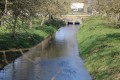

 Moderate