The church at Caunay
Although somewhat overlooked, this building is nevertheless highly interesting, featuring in particular around forty carved capitals in its eastern section.
Unresolved questions
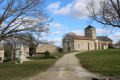
The small church of Saint-Pierre aux Liens in Caunay, which was probably built in the first half of the 12th century, belonged at that time to the Benedictine Abbey of Saint-Jean-d’Angély (an earlier building is mentioned in the second half of the 11th century). Its patron saint is linked to the legend of Peter’s deliverance by an angel on the eve of his execution, enabling him to escape unnoticed by the Roman soldiers guarding him.
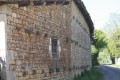
Like many others, the church suffered the effects of the various conflicts that ravaged the region, particularly the Wars of Religion between Protestant and Catholic communities. It was probably the western section that bore the brunt of the damage. Indeed, there is currently no entrance on the west façade; access is via a door in the south wall. It is reasonable to assume that a gateway existed on this side in the 12th century. The question that arises – and which is likely to remain unanswered – is whether it was as richly decorated as the chancel...
Whispers
There is certainly a great deal of whispering at the chevet of Caunay Church. Indeed, three capitals feature two human faces and an animal’s muzzle, each adorned with birds or snakes at ear level. Should we interpret the presence of the snakes as a symbol of temptation, with the animals in question instilling evil thoughts into the minds of those listening? Poor snake, which for over 2,000 years has had to bear this heavy burden that is not its own! This motif, consisting of faces surrounded by animals, appears regularly on the capitals of Mellois churches, with various variations depending on the building; the best-known example is found on the façade of the church of Saint-Génard.
The Sirens’ Song A small two-tailed mermaid is depicted on the capital facing the face surrounded by animals. This mermaid could be seen as the emblem of temptation, which would link her to the other capital. For some scholars, the two-tailed mermaid is also a symbol of human duality, torn between organic and spiritual life. Still others see in this figure the theme of fertility, the two raised tails being linked to the idea of gestation and birth. This
example, the full complexity of Romanesque symbolism. At Caunay, however, the stylised hair framing her face (similar to that at Vançais) and the boldly rendered breasts likely take us further
into the world of seduction and temptation.
Another very fine example of two-tailed mermaids can be seen on a capital in the nearby church of Sainte-Soline.
These two capitals mentioned above help to clearly illustrate what is known as the Limousin style. Indeed, there is no abacus to break the continuity between the toruses – the mouldings that surround the arches of the opening – and the capital’s basket. This style is found on other monuments in the Melle area, such as the Church of Saint-Pierre in Melle, for example, or Saint-Génard and Clussais-la-Pommeraie…
There were undoubtedly exchanges between Limousin and Poitou during the Romanesque period. In particular, we know that the Abbey of Celles-sur-Belle was originally a priory dependent on the Limousin Abbey of Lesterps.
Could there be a link between the Limousin-style windows seen here and there and this connection?
Inside
The chancel and its right-hand bay also feature ornate capitals (one must imagine that the right-hand bay was originally vaulted rather than timber-framed as it is today). A small lion, found on a capital in the north-facing bay of this section and carved in a rather crude manner, is in a highly original position. Indeed, its hindquarters extend beyond the base of the capital to rest on the wall. This position suggests a certain freedom taken by the sculptor of this piece in defiance of certain conventions governing Romanesque sculpture in general. Here too, one can see fine examples of Limousin-style windows, notably the central window of the apse.
For those who take their time, numerous interesting details will reveal themselves: gravestones, a holy water font shaped like an egg cup (a form found repeatedly in the region), stained-glass windows, the Stations of the Cross… And even though Caunay Church is not one of the so-called major buildings of the Mellois region, it still has
things to tell you, or perhaps even to whisper to you.
The Fontadam Fountain
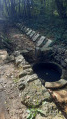
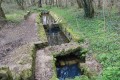
On the road leading from Clussais-La Pommeraie to Vanzay, on the left, in the middle of a wood, you’ll come across a fountain: the Fontadam Fountain. It is said that this fountain possesses miraculous properties; its water is said to cure many ailments, whether drunk or applied to the skin…
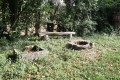
A fountain comprising two parts: a spring and a pool. It has a very beautiful round basin. A wayside cross was erected there in September 1925 in memory of this former settlement.
A letter published in *Les Affiches du Poitou* on 26 November 1785, p. 141, provides the following information on the state of Fontadam at that time:
“All that remains of the old buildings are a few stones that appear to have formed walls and are now overgrown with scrub, amongst which stand a few trees that time has almost destroyed.
In front of the house, to the south, was a courtyard of about one arpent; at the foot of the eastern walls springs a fountain known as Font-Adam, which is never seen to run dry, although it does not appear to flow abundantly...”
History
This monastery must have been founded between 1140 and 1163. The marshy location was not particularly conducive to such a settlement. Consequently, the community never grew large: there were just three monks in 1295. United with the priory of La Carte in 1317, it soon became little more than a farm. Bands of discharged soldiers, perhaps from the armies of the Duke of Berry, plundered it around 1380. Fontadam had become uninhabitable. This is confirmed by a petition sent to Pope Eugene IV on 1 July 1441, stating that the priory of Fontis Ade had been in a state of ruin for fifty years, that no one could live there, and that there was a lack of funds to carry out repairs
On 11 November 1462, a lease was concluded by Jean Joubert, Prior of La Carte and its dependencies, for a plot of woodland and fallow land belonging to Fontadam.
On 24 March 1563, the seneschalship of Poitiers ordered Rose Doyneau, widow of François Doyneau, Lord of Souline and Lieutenant-General of Poitou, to pay an annuity of one hundred sous.
On 7 August 1568, a lease was concluded between Prior Arnaud d’Estissac and Brother Pierre Baudouin, a monk at La Carte, covering the revenues of this priory and its dependencies, including Fontadam, for a term of five years.
The monastery of La Carte, to which Fontadam belonged, was donated to the Society of Jesus in Poitiers by General Rigaud de Lavaur in gratitude for services the Society had rendered to the Grandmontines. A royal charter dated 28 October 1605 completed this gift by transferring the prior’s estate to the Jesuits. They took possession of it on 30 April 1607, in return for the annual payment of a fee of 120 livres, which the priory of La Carte paid to the Superior General. This fee was paid to the Collège Mignon until 1769.
A legal dispute arose shortly afterwards between the tenant farmer of Fontadam and the new owners. The tenant claimed that he was liable only to the local lord, Sir Emery de Barbezières, Lord of La Roche Chemeraud and Count of Civray, who had acquired the estate of Fontadam, allegedly as its purchaser, through a sale of ecclesiastical property carried out with the permission of His Holiness and by order of His Majesty. Having been widowed, his wife Claude de l’Aubespine, the usufructuary of the estate, realising she had little interest in retaining the property, asked her tenant to cede the use of the estate to the Jesuits. She confirmed her withdrawal of her claims by deed on 3 February 1611.In a lease drawn up by the Jesuits in 1692, the Fontadam estate was described in these terms:
“The estate of Fontadam, belonging to the Priory of La Carte, consisting of coppice woodland, meadows, land, waters, fisheries, cens, rents, duties, tithes, terrages, annuities and honours, rights to collect tolls from the chail used for milling the grain that will be harvested from the said land, and generally everything pertaining to the said land”.
On 7 July 1791, the properties belonging to the former priory were sold at auction by the Melle district administration with the following description:
“Fifty boisselées of land comprising meadows and pastures, enclosed by hedges and dry stone walls, situated near the Fontadam spring; another plot of land of approximately 18 boisselées, partly coppice, partly pasture, known as the Grand Taillis; a third plot of approximately 20 boisselées on which the former monastery of Fontadam was built, and a fourth plot of approximately sixty boisselées, partly heathland and partly woodland, adjoining the preceding plots, all belonging to the former Jesuits and situated in the parish of Caulnay”.
The property was sold at auction for 14,100 livres.



 Country:
 City:
City:






 Visorando Member
 Moderate