Country:
 City:
City:


Starting point and access: Porte de Clichy.
- Metro – Lines 13 or 14. Take Exit 4 onto Avenue du Cimetière des Batignolles.
- Tram – Line T3b.
- RER – Line C, on the section between Paris and Pontoise.
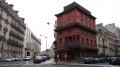
(S/E) Upon exiting the metro station, turn right twice to join Avenue de Clichy (note the tall silhouette of the Paris Court of Justice on the left). Take the first right onto Avenue du Cimetière des Batignolles and follow it to the entrance of the cemetery.
The route within the cemetery is a guide only and there are various alternative routes. In the description that follows, the names appearing on the graves may be highlighted for three different reasons:
1) Graves of notable figures; a lower-case letter in brackets refers to a short entry in the ‘Places to see’ section, where the names are listed in the order in which they appear on the route.
2) Particularly original monuments.
3) Useful landmarks on the ground.
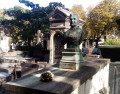
(1) Enter the cemetery, pass a sign with the cemetery map on your right and walk on for a few dozen metres. Take the first right, Avenue Circulaire, and follow it to the end. You will then see, on the left, the grave adorned with a bust of Victor Rose (a).
Retrace your steps and turn immediately right, leaving the Hamon Chapel on your left. Note, on the left, a grave adorned with two black globes and, on the right, the colourful gravestone of Joséphin Peladan (b). Immediately afterwards, turn left, leaving the Rosé Chapel on your right, and follow a grassy path interspersed with flagstones.
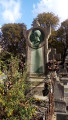
At a junction, go straight on and note, on the right-hand side, the bust of Lorenzo Pagans (c). Then turn right. You will come out onto a tarmac path (Avenue de l’Est) and follow it to the left. At the junction shortly afterwards, turn right and you’ll come to a roundabout. Go round it on the left, ignore the first exit and, at the edge of the roundabout, near a bench, you’ll find Paul Verlaine’s grave (d).
Then take the next exit, Avenue Principale, then the first right, Avenue du Nord. Note, on the right, the Ganola family’s tomb with its small columns.
Walk back very slightly and turn right, leaving the Bodier grave on your left. In front of the Streiff grave, turn right. Note, on the right, the bas-relief depicting an angel on the grave of a teenager. At the corner by the Marvillet grave, take a path on the left. Note, on the right-hand side, a grave adorned with a sculpture depicting two birds in flight (perhaps seagulls).
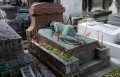
(2) You will come out onto a tarmac path; follow it to the right (Avenue Lacombe). At the junction shortly afterwards, continue straight ahead. Note the statue of a mourner on the left. At the end, turn left onto a wide grassy path.
At the corner by the Krug-Basse grave, turn left onto a grassy path, leaving the Dieulefils-Dagron grave on your right. In the third row on the left, note a colourful headstone depicting ears of wheat and butterflies.Still on the left is the grave of Jean-François Roux (e).
One row before you reach a tarmac path again, turn right onto a path at the corner of the Gauthier-Ninet grave. On the right-hand side, opposite the Texier grave, you will find the grave of Patrice Neumont (f), whose name is written in his signature style. Next, in the third row on the right, note the grave of Raymond Villechanoux (g), adorned with a biplane. Then turn left, join a tarmac path (Avenue Centrale), follow it to the right and you will immediately come to a junction.
(3) Then turn right onto Avenue des Plantations and walk past, on your left, an area dedicated to the storage of the ashes of those who have chosen to be cremated. Note on the right the grave of Paul Vidal (h), marked with his medallion. Then turn left onto a path that starts between the Charpentier grave, on the left, and the Scala grave, on the right. This leads onto a tarmac path (Avenue du Sud); follow it to the right. At the junction, continue straight ahead.
At the end, turn left onto a grassy path, then pass between the Thomas graves on the left and the Durand-Rancher grave on the right. Note on the left the grave of Pierre Salama (i). Cross a tarmac path and continue along the path opposite, leaving the Cartier-Varkan grave on your right. At the next junction, go straight on.
Two rows further on, turn left at the corner of the Lopez grave. Note a grave on the right adorned with a horse’s head. Just before a tarmac path, turn right onto a footpath at the corner of the Betlem grave. At the end, on the left-hand side, is the very simple grave of Ray Ventura (j).
(4) Facing the fountain, first turn left then right onto a paved path between the second and third rows, leaving the Solomon grave on your left. Note the grave of Benjamin Péret (k) on your right (spelled ‘Perret’ on the site). Continue straight on and, before the Boulevard Périphérique viaduct, turn left onto a gravel track, leaving the Legrand grave on your left.
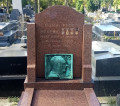
At the junction, look for André Breton’s grave (l) on the left-hand corner ( incorrectly marked on the map provided by Paris City Hall) and continue straight ahead along the hard-packed track. Further on, cross a tarmac path and continue along the path opposite. Shortly afterwards, turn right at the corner by the Favier grave. The third grave on the left is that of Gilbert-Médéric Védy (m).
At the end of the path, turn left and walk alongside a hedge on your right. At the end, first turn right then left to return to a junction you passed earlier.
(3) Then turn right onto Avenue des Plantations and walk alongside the Jardin du Souvenir on your left. At the next junction (war memorial on the right), carry straight on and pass under the Boulevard Périphérique. Soon after, turn left onto the lane and pass under the Périphérique again.
Immediately afterwards, turn right into a grassy path, leaving the Pilot-Debienne grave on your left. Then turn right at the corner by the Lambert grave. Note on your left the Delatour-Mumeret grave, whose three sons died during or as a result of the First World War. Then first turn left then right onto Avenue du Nord and pass under the Boulevard Périphérique once more.
Note a heart-shaped memorial on the left. Take the second left, the Chemin du Nord. Opposite the Gholam grave, follow a grassy path to the right. At the T-junction, turn left.
(5) Cross Avenue Transversale and continue straight ahead along Chemin du Sud. Between the third and fourth rows, turn left onto a path. Note, on the left-hand side, the grave of a child decorated with toys. At the corner of a chapel (with a statue of a weeping woman opposite), turn left. You will soon rejoin Avenue Transversale; follow it to the right and pass under the Boulevard Périphérique one last time.
At the junction on the other side, turn right onto Avenue Circulaire. Take the first left onto Chemin de l’Est. On the left-hand side are René Sergent’s tomb with its two small columns, followed by Charles Valois’s tomb with its medallion (o). Take the first grassy path on the right. At the corner by the Thomas tomb, turn left onto a footpath. Further on, note the bust of Madame Maillet on the left.
Just before a tarmac path, turn right at the corner by the Chavance grave. First turn left then right and follow Avenue Principale to leave the cemetery.
(1) Follow Avenue du Cimetière des Batignolles straight on. At the end, turn left. At the traffic lights, turn left and you will immediately find the Porte de Clichy metro station on your left (S/E).
 Visorando Member

 Moderate
 Association / Club / Walk leader