Green spaces in the west of Paris’s 17th arrondissement

The 17th arrondissement of Paris is distinguished by its great urban and social diversity. The western part of the arrondissement is more residential and middle-class than the east, with the Ternes and Monceau neighbourhoods. It is characterised by varied architecture ranging from Haussmann-style buildings to contemporary blocks. Well-served by public transport, it combines Parisian traditions with modernity. The western part of the arrondissement offers two long walks and around twenty green spaces, including picturesque gardens such as the Square Saint-Odile and the undulating Jardin Claire Motte.

Details

91311930
Creation:
Last update:
Last review:
  • Walking
    Activity: Walking
  • ↔
    Distance: 6.52 mi
  • ◔
    Average duration: 3h 05 
  • ▲
    Difficulty: Moderate

  • ⚐
    Back to start: No
  • ↗
    Ascent: + 49 ft
  • ↘
    Descent: - 36 ft

  • ▲
    Highest point: 151 ft
  • ▼
    Lowest point: 95 ft
  • ⚐ Country: France
  • ⚐ City: Paris (75000)
  • ⚑
    Start: N 48.888414° / E 2.315497°
  • ⚑
    End: N 48.883176° / E 2.309128°
  • ❏
    IGN map(s): Ref. 2314OT
  • Hour-by-hour weather

Photos

Description of the walk

Start from Pont Cardinet metro station – Line 14, Exit 1 “Rue Cardinet”. Also accessible via the Transilien Line L.

(S) On leaving the metro, turn right onto Rue Cardinet, cross the railway tracks, and turn right at the corner of the station to join Boulevard Pereire. Cross Rue Georges Picquart on the right.

(1) Cross Rue de Saussure, turn right to cross the old Petite Ceinture railway tracks, join Boulevard Pereire Nord and immediately take the metal staircase on the left to descend to the Promenade PC 17 Tranchée Pereire.

Take thefirst exit on the left and walk up Rue de Tocqueville. At the top of the stairs, turn right, cross Boulevard Pereire Sud, and continue along Rue de Tocqueville to no. 89.

(2) Go under a building, walk alongside a private garden on the right, go under another building and enter Square Alexis Clérel de Tocqueville. Walk around the square and return to Rue de Tocqueville.

(2) Turn left and rejoin Boulevard Pereire on the left. Pass Rue des Chasseurs on the left, cross Place de Wagram by going round it on the left, and then successively Boulevard Malesherbes and Avenue de Wagram. Continue left onto Boulevard Pereire. Turn left onto Rue Gustave Doré, then Rue Alphonse de Neuville. Note the beautiful two-tone façades on the left at nos. 89 to 95 (1883). Cross Rue Puvis de Chavannes on the left and note the contrast with the contemporary building at no. 97. When you reach Place du Maréchal Juin, turn left, cross Rue de Villiers at the pedestrian crossing, in front of the Wallace Fountain, and, in the middle of the street on the small traffic island, turn right to cross the square at the pedestrian crossing to reach Square Albert Besnard.

(3) Go straight ahead to cross the square, cross the square at the pedestrian crossing to reach a small traffic island in the centre of Rue de Villiers. Turn left, finish crossing Avenue de Villiers, then cross the northern slip road of Boulevard Pereire and turn right opposite onto Promenade Pereire. Continue along Promenade Pereire (1st section: Promenade Gilberte Brossolette under the pergolas), cross Rue Rennequin, and continue along the promenade (2nd section, Promenade Rosemonde Pujol, alongside flowerbeds).

(4) When you reach Rue Laugier, cross the street, turn left to cross Boulevard Pereire Sud and cross Rue Faraday on the right. Turn right into Rue Saint-Sénoch, left into Rue du Sergent Hoff, and right into Rue Pierre Demours. Turn right into Square Pierre Demours.

(5) Cross the square and exit at the far end on the left. Turn right onto Rue Bayen, go under the building and continue straight ahead. Cross Boulevard Pereire and continue straight on Rue Bayen to enter Square Olave et Robert Baden-Powell on the left.

(6) Cross the square, staying on the central path, and exit via a long, narrow path. Cross the northern section of Boulevard Pereire and turn right onto Promenade Pereire. Cross Rue Guersant and continue along Boulevard Pereire, passing a community garden on the left on the central reservation.

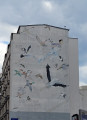
(7) When you reach Avenue des Ternes, turn right. Note a mural depicting birds taking flight opposite No. 96. Cross Boulevard Gouvion Saint Cyr and the tram tracks (passing the ‘Anny Flore’ stop for the T3b tram and bus 43 on your right). Cross Place du Général Koenig keeping to the right, then Boulevard Pershing, and turn right onto Boulevard d’Aurelle de Paladines. After a few dozen metres, opposite the small church of Notre-Dame de Compassion, turn right into Jardin Marguerite Long.

(8) Cross the garden; on exiting, turn left onto Avenue de Salonique, then rejoin Boulevard d’Aurelle de Paladines on the right. Go over the ring road, cross an exit slip road, then turn left onto Boulevard d’Aurelle de Paladines. Turn right into Square du Caporal Petit de Julleville.

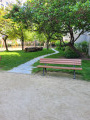
Cross the square and take the exit on the right. Turn left, walk past the tennis courts on your left, then cross the boulevard to the right at the traffic lights. First turn right then left, going round a small triangular grassy area lined with benches on the right, and head straight on into Rue Cinco del Duca. Turn immediately right, opposite No. 32, into a lane that continues to the left, and turn right into the Jardin Lucien Fontanarosa.

(9) Cross the garden and, to exit, either go through the small tunnel opposite or take the ramp uphill to get a view of the whole garden and go down the steps on the right. In both cases, turn left to continue along Promenade Bernard Lafay. Go through a small gate, walk past the sports centre on the right and, a little further on, turn left into Square Jacques Audiberti.

(10) Cross the square and exit at the far end. Cross Avenue de la Porte de Villiers to the right at the pedestrian crossing and continue to the right. Then turn left onto Rue Charles Tournemine, a winding little pedestrian street with colourful paving. When you reach Avenue de la Porte de Champerret, turn right, cross the avenue to the left in three stages at the traffic lights and continue opposite, slightly to the right, along Rue Oestreicher.

(11) Opposite the Espace Champerret, turn left into the Jardin Lili Laskine. Walk round the playground on the right, pass a table tennis table on the left, then leave an exit under a small pointed roof on your left. Turn right along the path and take the exit opposite, just after a twisted tree on the left.
As you leave the square, turn left and, facing a low brick wall, turn right. When you reach Rue du Caporal Peugeot, turn right, cross Rue Oestreicher and immediately turn right into the small, winding red-paved lane between two low walls. This is Square Auguste Dalagny.

When you reach a circular open space, leave the entrance to Espace Champerret on your right and turn left. Cross Boulevard de la Somme at the pedestrian crossing and enter Square de l’Amérique Latine opposite.

Cross the square, exit onto Place de la Porte de Champerret and go straight on to cross the square. Cross Avenue Stéphane Mallarmé and the tram tracks. You will arrive at a central reservation, leaving the “Porte de Champerret” metro station and the bus stops on your right. Cross one last time at the pedestrian crossing opposite and enter Square Jérôme Bellat.

(12) Walk along the right-hand side of the multi-sports ground, go round the garden and back to the multi-sports ground, then take the exit on the right. Turn right onto Boulevard Berthier, signposted further on, then turn left onto Rue Albert Samain. At the end of the street, cross Avenue Stéphane Mallarmé and the tram tracks in two stages and turn left, passing in front of the Church of Sainte-Odile on your right.

Take thesecond right onto Rue Catulle Mendès. When you reach Boulevard de la Somme, turn left and cross the boulevard at the pedestrian crossing, then cross the ring road slip road, and turn right into Square du Caporal Peugeot and cross it.

On exiting, turn right, cross the ring road exit ramp and turn right into Promenade Bernard Lafay. At the Fork in the road, take either the right or left path; both lead to the same place.

(13) When you reach Rue de Courcelles, turn right, go over the ring road, cross Boulevard de la Somme and turn right into Square Sainte Odile, cross it and exit at the foot of Sainte-Odile Church.
Turn left onto Rue Stéphane Mallarmé. Cross Rue de Courcelles and continue straight on along Boulevard de Reims.

Opposite nos. 38–40, cross Boulevard de Reims to the right at the pedestrian crossing and continue along the central reservation. Cross a cobbled path and turn left onto a second central reservation with fitness equipment. Walk past a boules court on the right and, on the other side of the street to the left, the Marjorie Gestring Swimming Pool, followed by the sports centre, and enter the André Ulmann Garden in the centre of the reservation. Leave the park at the far end on the right.

(14) Turn left onto Rue Brunetière, cross the small Rue du Marquis d’Arlendes, then walk along the left-hand side of the Just Fontaine sports centre. Cross Avenue de la Porte d’Asnières in two stages, using the pedestrian crossing on the right. Continue straight ahead along Passage de la Hutte aux Gardes, a cobbled pedestrian lane (signposted further on), pass a chicane, cross Rue Margarite Long, turn left and, immediately afterwards, cross a small cobbled courtyard with trees on the right to enter the Claire Motte Garden.

(15) Pass a kiosk on the right and a playground on the left, from where you can see the Tower-Flower in the background. Go down a few steps, pass between two lawns bordered by flowerbeds, continue straight ahead over a wooden footbridge and take the exit on the right.
Turn left and, at the end of the street, turn right onto Boulevard Berthier. Continue to the traffic lights and cross, to the left, the boulevard and the tram tracks. Turn left, cross Rue de Saussure and take a first turn right then left to enter a lane called Résidence Jaques Balmat, lined with flower beds and benches. After a straight stretch, follow this small winding street to the right towards "Notre-Dame de la Confiance". Pass a mural on the right, depicting a mountain range, and continue following the coloured posts. Leave a small tree-lined square on your left and follow the arrow on the right pointing to “Maison des Possibles”. At the end of the alley, opposite a handmade book box, turn left into a cobbled lane, and enter Square Paul Paray on the right.

(16) Cross the square, passing a greenhouse and then a large playground on your left. Follow a shaded, paved path, passing a boules court on your left, and exit the square to the right.
Once you reach Rue de Saussure, turn left, cross Rue Christine de Pisan on your left and then Rue Georges Picquart. Stay on the left-hand pavement, pass the Petite Ceinture railway tracks, and cross the northern branch of Boulevard Pereire at the pedestrian crossing on the right.

(1) Continue straight ahead along Rue de Saussure. Pass Rue de la Félicité and Rue des Fermiers on your right, cross Rue Jouffroy d’Abbans and turn right onto Rue Cardinet.
Cross Rue de Levis on your left, cross Rue de Tocqueville, cross Rue d’Aubigny on your right and continue straight ahead. After the beautiful two-tone building at no. 80, then the imposing stone building, the École Nationale de Musique de Paris, turn left onto Boulevard Malesherbes.

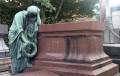
Pass the Centre Universitaire Malesherbes of the Université Paris Sorbonne on your left, stay on the left-hand pavement and, opposite No. 24 Place du Général Catroux, cross via a small pedestrian crossing to reach a central reservation. Turn left onto the traffic island, walking alongside a triangular lawn enclosed on the right. This is the Jardin Solitude, where a bronze statue named Solitude stands. Pass a small path on your right and continue along the Jardin Solitude, walking alongside a second triangular lawn which houses the monument entitled "Fers". Note the sumptuous stone-fronted mansions on the left, including the Hôtel Fournier at No. 14, which once housed the Lithuanian Embassy, and No. 12, the current headquarters of the Liberian Embassy.
At the end of the traffic island, turn right, cross Avenue de Villiers at the pedestrian crossing and continue straight ahead to see, on the right, the statue of Alexandre Dumas fils, in the centre of an enclosed triangular lawn. Cross Boulevard Malesherbes at the pedestrian crossing opposite.

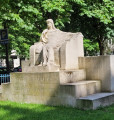
You will arrive at another small traffic island, opposite the majestic Hôtel Gaillard,which was for many years a branch of the Banque de France. (It now houses the Cité de l’Économie, an educational museum dedicated to economics and currency). Turnright to walk along a small enclosed triangular lawn on your right. Note a statue of Sarah Bernhardt, facing a bust of Edmond Rostand. After a short path on the right, a magnificent chestnut tree marks the start of a final enclosed area featuring dense vegetation followed by a small flower-filled lawn. This is the Jardin de la Lituanie.

At the end of the central reservation, turn right to cross Avenue de Villiers at the pedestrian crossing; on your right, you will see a sculpted group on a pedestal depicting Alexandre Dumas. At the end of this final central reservation, cross at the pedestrian crossing on the left to reach the Malesherbes metro station – Line 3 (E).

Waypoints

  1. S : mi 0 - alt. 131 ft - Pont Cardinet metro station
  2. 1 : mi 0.24 - alt. 131 ft - Rue de Saussure
  3. 2 : mi 0.47 - alt. 131 ft - 89 Rue de Tocqueville
  4. 3 : mi 1.19 - alt. 118 ft - Square Albert Besnard - Place du Maréchal Juin
  5. 4 : mi 1.48 - alt. 118 ft - Rue Laugier
  6. 5 : mi 1.68 - alt. 112 ft - Rue Pierre Demours x Rue Bayen
  7. 6 : mi 1.87 - alt. 112 ft - Square Olave and Robert Baden-Powell
  8. 7 : mi 2.14 - alt. 125 ft - Boulevard Pereire x Avenue des Ternes
  9. 8 : mi 2.38 - alt. 118 ft - Jardin Marguerite Long - Chapelle Notre-Dame de la Compassion (Paris)
  10. 9 : mi 2.66 - alt. 112 ft - Lucien Fontanarosa Garden
  11. 10 : mi 2.86 - alt. 118 ft - Square Jacques Audiberti
  12. 11 : mi 3.19 - alt. 118 ft - Lili Laskine Garden
  13. 12 : mi 3.61 - alt. 112 ft - Square Jérôme Bellat - Porte de Champerret
  14. 13 : mi 4.36 - alt. 121 ft - Rue de Courcelles
  15. 14 : mi 4.87 - alt. 112 ft - Rue Brunetière
  16. 15 : mi 5.14 - alt. 118 ft - Claire Motte Garden
  17. 16 : mi 5.49 - alt. 118 ft - Square Paul Paray - Chapelle Notre-Dame de la Confiance (Paris)
  18. E : mi 6.52 - alt. 144 ft - Malesherbes Metro

Notes

At (12), Place de la Porte de Champerret, you’ll find the “Porte de Champerret” metro station (line 3), the “Porte de Champerret” T3b tram stop, as well as bus routes 92, 93, 163 and 164, which allow you to split this rather long Parisian walk into two roughly equal stages.

Worth a visit

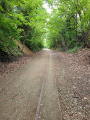
Walk PC 17 Tranchée Pereire – 109 Rue de Saussure, Rue Alphonse de Neuville (700m) The Petite Ceinture, a 32-km railway line opened in sections between 1852 and 1869, closed to passengers in 1934. Left to fall into disrepair, the infrastructure became overgrown. Since 2006, however, several short sections have been redeveloped and opened to the public. The Pereire section stretches from Rue Alphonse de Neuville to Rue de Saussure. It offers a 0.7 km walkway running alongside the existing tracks. The sunken layout of this walkway gives the impression of being outside the city, amidst nature that has taken root spontaneously across the embankments.

Square Alexis Clérel de Tocqueville – 89 Rue de Tocqueville – Created in 1969 (2,041 m²) Playground, drinking fountains, book box. A garden surrounded on all sides by high building walls. It consists of an enclosed playground and a small square courtyard surrounded by benches and hedges. It pays tribute to Charles-Alexis Clérel de Tocqueville (1805–1859), a French historian and politician. He campaigned for freedom of the press and the independence of the judiciary.

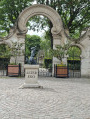
(3) Square Albert Besnard - 9 Place Du Marechal Juin - Created in 1930 (4,780 m²) An open space forming the centre of Place du Maréchal Juin, a roundabout and junction where several major roads in the 17th arrondissement meet. It features two open lawns and two enclosed flowerbeds, surrounded by a few benches. Named in memory of Albert Besnard (1849–1934), a French painter, decorator and draughtsman who lived in the neighbourhood. A statue of the painter, created by his son in 1967, pays tribute to him.

Promenade Pereire - Place du Maréchal Juin - Created in 1989 (approx. 1 km) Play areas, table tennis tables, fitness equipment, drinking fountains, book box. - The promenade, which conceals the underground RER C line, was built in 1989 on the cover of the trench of the former Auteuil line. It runs from Place du Maréchal Juin to Porte Maillot, punctuated by seven spaces that are sometimes enclosed, sometimes open, in a harmonious landscaped style. There is also a series of bronze sculptures, each depicting familiar landscapes: vineyards, fields, the river, trees and the sea. The promenade pays tribute to the Pereire brothers: Jacob Émile (1800–1875) and Isaac Pereire (1806–1880). Both bankers and members of parliament, they founded Crédit Mobilier in 1852, a bank specialising in long-term loans to industrialists.

(5) Square Pierre Demours- Opposite No. 20 Rue Pierre Demours - Open to the public in August 2025 (400 m²) A small green space surrounded by chairs fixed to the ground. This garden recalls the vast estate that once surrounded the Château des Ternes, also known as the Hôtel de Saint-Senoch, built in the 18th century. Part of it still remains, with an original opening right in the middle of the building, creating a passageway to Rue Bayen.

(6) Olave and Robert Baden-Powell Square – 57 Rue Bayen, Boulevard Pereire – Created in 1979 (4,130 m²) Play area, drinking fountains, book box. The square, almost entirely surrounded by buildings, consists of two rectangular areas. It features two playgrounds that are very popular with children from neighbouring schools. It is named in honour of Robert Baden-Powell (1857–1951), founder of the Scout Movement, and his wife Olave (1889–1977), who was World Chief Guide.

(8) Jardin Marguerite Long – 2 Allée du Général Koenig – Created in 1992 (1208) A small circular garden situated at the foot of a block of flats. Stone planters adorn the centre of the garden, which is surrounded by benches. Set slightly back from the ring road, between Porte Maillot and Porte d’Asnières, traffic noise is nevertheless very noticeable. It is named in memory of the world-renowned French pianist Marguerite Long (1874–1966), who lived and taught in the 17th arrondissement for many years.

Square Du Cardinal Petit de Julleville - 2 Rue Gustave Charpentier - Created in 1984 (3,426 m²), refurbished in 2025. Playground. A quiet and relaxing garden despite its proximity to Porte Maillot. Although not very busy, it is always very well maintained and artistically landscaped. It is named after Cardinal Petit de Julleville (1876–1947), who served at the nearby Collège Sainte-Croix from 1910 to 1927.

(9) Jardin Lucien Fontanarosa - 29 Rue Cino Del Duca - Created in 1978 (4,000 m²) Play area, drinking fountains. A quiet, shaded spot located at the entrance to the Promenade Bernard Lafay. This is a undulating space featuring conifers and evergreen trees in a woodland-like setting. The garden is named in memory of Lucien Fontanarosa (1912–1975), a French painter and lithographer whose studio was located on Cité des Fleurs, a private road in the 17th arrondissement.

(10) Jacques Audiberti Garden - 9 Rue Cino Del Duca - Created in 1986 (2,650 m²) Playground, boules court, table tennis tables, chess tables. A vast, airy, elongated space. Lawns stretch along a central path. There is a playground at each end of the garden, as well as a small, quiet area with deckchairs. The garden is named in honour of the French writer Jacques Audiberti (1899–1965), who often wrote about Paris in his poems. He lived there for many years, notably in the 17th arrondissement.

(11) Lily Laskine Garden - 5 Rue Du Caporal Peugeot - (Created in 1991 (5,243 m²) Playground, table tennis tables. A terraced garden following an octagonal layout, consisting of a circular path around an elevated playground. Blue railings and benches stand out, in contrast to the typical Parisian green. It pays tribute to Lili Laskine, the stage name of Aimée Émilie Laskine (1893–1988), a French harpist who joined the Opera at the age of 16 and was the first woman to be admitted to the orchestra.

Square Auguste Balagny - 1 Rue Jean Oestreicher - Created in 1987 (2,295 m²) An open space comprising a central square flanked on either side by lawns set between winding paths with red paving. The square honours Auguste Balagny (1805–1896), the first mayor of Paris’s 17th arrondissement, who served from 1860 to 1870. Nicknamed ‘the Baron Haussmann of the Batignolles’, he was the driving force behind a wide-ranging urban and cultural policy.

Square de l’Amérique Latine – 8 Place de la Porte de Champerret – Created in 1931 (1,825 m²) Play area, drinking fountain. A small, elongated square with a circular space at its centre paying tribute to nine figures who have played a significant role in the history of Latin America. In the centre stands a large bronze statue of Francisco Miranda (1750–1816), a Venezuelan patriot, with smaller statues on either side. Opposite stands a statue of Jiménez Deredia, “Mythical Poem”, depicting a reclining woman. It was gifted by Costa Rica to the City of Paris in 1992. The square features blue railings and benches, in contrast to the usual Parisian green.

(12) Square Jérôme Bellat – 2 Place Stuart Merrill – Created in 1926 (1,925 m²) Playground, multi-sports ground, drinking fountains. A small, long, narrow playground, with a play area at each end. It consists of a central path lined with hedges and benches. It is named after the architect Jérôme Bellat, who built the blocks of flats around Place de la Porte-de-Champerret near the square

Square Du Caporal Peugeot - 2 Rue Du Caporal Peugeot - Created in 1978 (1,411 m²) - Situated above the ring road, this small square, consisting of a single path, brings a touch of greenery to the hustle and bustle of traffic. Like the street on which it is located, it is named after Corporal Jules André Peugeot (1893–1914), the first French casualty of the First World War.

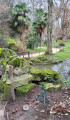
Square Sainte-Odile - 1 Boulevard De La Somme - Created in 1976 (11,344 m²) Play area, drinking fountains, table tennis tables. A vast, undulating garden full of flowers, featuring a lovely play area in front of a pond with a water feature. The space is thoughtfully divided into small areas where lawns and deckchairs invite visitors to relax. There is also a memorial in honour of the harpist Lily Laskine (1893–1988). The square takes its name from the Sainte-Odile church which overlooks it. Built in 1945 in the Neo-Byzantine style using pink brick, its 72-metre-high bell tower is the tallest in Paris.

Promenade Bernard Lafay - 8 Boulevard De Reims - Created in 1990 (2 km) Fitness equipment, playground, boules court, drinking fountains, table tennis tables. Opened in 1990, the Promenade Bernard Lafay, named after the President of the Paris Council from 1975 to 1977, stretches for approximately 2 km in the west of Paris’s 17th arrondissement. It links several separate green spaces located near the ring road, between Porte Maillot and Porte d’Asnières.

Jardin André Ulmann - 18 Avenue Brunetière - Created in 1947 (5,900 m²) Play area, drinking fountains, table tennis tables. Two tree-lined paths frame a play area and a small lawn with deckchairs. An ecological maze has recently been installed there. The garden is named in memory of André Ulmann (1912–1970), an economic journalist who established an internal resistance network during the Second World War.

(15) Claire Motte Garden - 6 Place Paul Tortelier - Created in 2005 (6,100 m²) Play area, drinking fountains, book box, toilets. A undulating garden created on the site of the former railway line between Paris and Saint-Germain-en-Laye. It offers a view of the Tower-Flower, so named for its balconies lined with potted trees on all sides up to its 10th and top floor: 380 pots thus surround the building. Furthermore, the garden’s layout highlights the remains of the old Thiers fortifications. This garden pays tribute to the Paris Opera’s prima ballerina Claire Motte (1937–1986).

(16) Square Paul Paray - 24 Rue Christine De Pisan, 164 Rue de Saussure - Created in 1967 (3,845 m²) Play area, drinking fountains, boules court. A pretty little garden crossed by a footpath. It features a paved path and a greenhouse at the foot of a nativity scene. It is named after the conductor and composer Paul Paray (1886–1979).

Place du Général Catroux

The Jardin Solitude is named after Solitude (c. 1772–1802), a Guadeloupean slave who rebelled against the re-establishment of slavery in 1802 by Napoleon Bonaparte and was sentenced to death. She is depicted here pregnant, brandishing a text in her right hand. Solitude was hanged the day after the birth of her child. Further into the garden stands the “Fers” monument, depicting broken slave shackles over five metres high.

The Hôtel Gaillard, a beautiful Renaissance-style building of brick and stone, built in the 19th century, formerly a branch of the Banque de France, is now the “Cité de l’Économie”, a French museum open to the public.

Monument to Alexandre Dumas fils, who lived on Rue de Villiers and was one of the first writers to reside in the Plaine Monceau, a hub for painters, actors and musicians.

Stone statue of Sarah Bernhardt, who had a mansion on the square, depicting the actress in the role of Phèdre by Racine.

Monument to Edmond Rostand, who lived nearby on Rue Fortuny, where he wrote *Cyrano de Bergerac*.

A sculpted group of Alexandre Dumas (1802–1870) stands on a pedestal; on the front of the base, a bronze group depicts readers leafing through a book, and on the rear of the monument stands d’Artagnan, one of his fictional heroes.

Other walks in the area

For more walks, use our search engine .

The GPS track and description are the property of this route's author. Please do not copy them without permission.